Scolds, Killjoys & Blackmailers: When “Good Christians” Become Annoyances

Standard

Something was wrong with Jimmy Swaggart.

Watching his TV show back in the 70s and ’80s, I noticed the gradual change: Swaggart went from preaching the Gospel to letting everyone know just who was in error, who was doing it wrong, and who was screwing up.

We all know who was ultimately screwing up, don’t we?

I learned the lesson of watching a “good Christian” go from a blessing to a scold by watching Swaggart. In his earlier years, he used to show people what they should be for. The later years were instead filled with screaming about who and what people should be against.

I believe that sometimes people with a pulpit run out of good things to say. Even bloggers. I don’t write as much as I once did because I noticed the tendency to go negative in my own writings the more I felt compelled to write something, anything.

John Piper fell into that trap last week when he warned that buying a lottery ticket in the Mega Millions frenzy was “suicidal.”

Really, John? Suicidal?

So I spend a buck and buy a lottery ticket once every five years when the jackpot gets to be some stupidly large amount. Is this truly the pathway to personal destruction?

Actually, I didn’t buy a lottery ticket last week. But with the weather heating up, I will buy an ice cream cone now and then. By Piper’s standard, that cone purchase makes me a bad steward of God’s money on loan to me. Or as he puts it, an “embezzler.” Because which of us American Christians truly needs to further strain against the borders of obesity by shoving more crap down our gullets? I mean, have you seen the size of the Christian T-shirts on the nearly spherical visitors to Main Street in Gatlinburg, Tenn.? Just how many Xs come before that L?

Fact is, if Piper’s judgment is meted out rightly, every Christian in North America is an embezzler of God’s funds, because heaven knows we’re not watching every dime of outflow to ensure its sanctified usage. Do I need a cell phone? XM Radio? Private schooling for my kids? A two-story home?

And sometimes, it’s not what I do that’s bad, but what I threaten not to do.

Case in point: From what is yelled at me from the ChristianMilitaryIndustrialEntertainment Complex, I MUST attend Christian movies when they hit the cineplex or else I am not a good Christian. Entertainment blackmailWorse, if I don’t attend, the ChristianMilitaryIndustrialEntertainment Complex Powers That Be will no longer make exceptional ChristianMilitaryIndustrialEntertainment Complex films for my mandatory consumption, which will result in the gates of hell prevailing (despite what the Bible says).
Here’s the thing: Where is grace in any of this?

It’s sad that Christians, the ones charged with being dispensers of grace, actually seem to experience so little of it in our own lives. In addition, some Christians—and often those who talk the most about grace—don’t seem to extend much grace to others.

The effect is that we become those pinch-faced killjoys on matters of life that really aren’t sin for most people. Instead, our dire warnings boomerang. Our every denouncement becomes ripe for media mockery, and we come off as off-kilter Don Quixotes tilting at really tiny windmills.

I’ve written before that one of the most overlooked traits we Christians need to exhibit far more of is winsomeness. Aren’t Christians the people best suited to be attractive to others because of how zestfully we live life? Shouldn’t we be laughing the loudest when it’s appropriate and mourning the most when necessary? Shouldn’t we bring the best wine to the party? Shouldn’t we tell the funniest jokes? Shouldn’t we be the ones with the most joyful outlook on life? How then is it that we’re so constricted and restricted by other Christians with bully pulpits telling us that buying a lottery ticket on a lark (and with no pretenses toward being crushed if we don’t win) will send us to hell?

We talk, talk, talk about freedom in Christ—and then we lay millstones around people’s necks.

The Bible says this:

Behold, what I have seen to be good and fitting is to eat and drink and find enjoyment in all the toil with which one toils under the sun the few days of his life that God has given him, for this is his lot. Everyone also to whom God has given wealth and possessions and power to enjoy them, and to accept his lot and rejoice in his toil–this is the gift of God.
— Ecclesiastes 5:18-19

So, why do we reject that gift, folks? Why be scolds, killjoys, blackmailers, and generally unpleasant people to be around?

In other words, for God’s sake, lighten up!

The Real Reason Why Young People Are Leaving the Church

Standard

A few weeks back, I touched on the issue of the increasing loss of people under 30 years of age in our churches (“The Church’s Lost Tribe“). The post was less about my thoughts and more about reader explanations for why this well-documented loss is occurring.

I’ll offer my thoughts today, but first, one more commentator.

Skye Jethani, one of the ascending names in post-Evangelicalism, attempts to pin the reason on the Internet’s favorite whipping boy: right-wing politics. Or more specifically, the Religious Right / Moral Majority interpretation of right-wing politics. For more, read his “Christianism Leads to Atheism” post.

Jethani cites an article “God and Caesar in America: Why Mixing Religion and Politics is Bad for Both” and attempts to data mine it. But like a bad doctor who automatically equates all headaches with brain tumors, Jethani assigns blame to the symptom rather than to the underlying disease.

In Jethani’s post, he states young people today are more politically liberal than older people. But if recent figures in the GOP primary are an indication, this is more a media sacred cow than reality. The most conservative candidate running is Ron Paul, and the hidden story is that Paul is crushing all the other GOP hopefuls in the 18-30 age demographic, winning (at last count) that group in every state that has held a primary. (If the 18-30 demographic, which has never been consistently enthusiastic about primaries, actually got to the polls in higher numbers, this might be a different race.) Even more compelling is that Paul is drawing young people who voted for Barack Obama in 2008 and are disillusioned with that president’s broken promises.

What young people find compelling in Ron Paul is he’s not ringmastering a dog and pony show. There are no smoke and mirrors. With Paul, they see a man who is not a political reptile but an authentic conservative from before the neo-cons grabbed control. They see a man with a real plan and genuine vision to fix problems and not just talk, talk, talk. To young people, authenticity matters more than just about any other trait. As they see it, Ron Paul lives what he believes, and what he believes rings true to them.

Can you see where this is going?

Oddly, the title of Jethani’s piece is more accurate than what follows in his post. Christianism does lead to atheism because Christianism (which is to Christianity as truthiness is to truth) isn’t genuine Christianity. It’s a twisted clone, inauthentic to the core.

It’s not that young people don’t like the politics of churches today. What they can’t stand is the dog and pony show that our churches have become. Dog and pony showWhat throws Jethani and others is that Christian political maneuvering is nothing more than a natural outgrowth of churches gone bad. It rushes into the vacuum left behind when genuine Christianity is gutted. The political mess and the culture wars are symptoms, but they are not the root of the disease.

Young people aren’t stupid. They can read the Book of Acts too. And the Church they find there is radically unlike the American Church of 2012.

If you want to blame a demographic for stupidity, look at the 35-65 group. We’re the ones that created these bogus churches that are all fluff and no substance. We’re the ones who are not feeding the poor, not evangelizing the world, not living in community, not building up each other’s gifts, not looking out for the needy in our own ranks, and generally disregarding every characteristic of the Church in Acts that made it vital, living, and desperately necessary to the lives of those early disciples. Young people today are not interested in boarding a train that has derailed. That many of us with some “maturity” are is a sign of our own ignorance.

Here’s the kicker: More and more of us who have been Christians for decades are fed up with pointless churches. We’re sick of the show too. With so many churches not living up to the standard we read in Acts, my peers and I will be the next group to go missing.

Christian commentators are wringing their hands over young people who when asked what their religion is say “none.” Honestly, I say good for those young people. Because the last thing the Church needs is more religion. What we need is Jesus Christ as Lord of our lives and for the Church to stop with the sideshows and to start looking less like a carnival and more like the authentic faith it was almost 2,000 years ago.

If that happens, I wouldn’t be surprised to hear the 18-30 year olds say, “What took you so long?”

When Christian Celebrities Crash and Burn

Standard

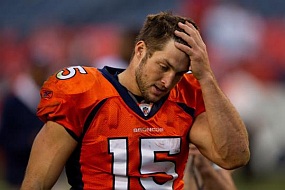
Tim TebowWith a recent long losing streak and a new coaching philosophy in New York, Linsanity is dead.

As of yesterday, Tim Tebow is riding the bench again and likely will be traded.

Two evangelical sports stars are now no longer lighting up the heavens. And that’s OK.

Well, it’s OK with me. Some other people may be taking Tebow’s and Lin’s descents hard. Seems we have a way of doing that when it comes to Christian celebrities. Christian sports stars are particularly ripe sources of adoration, but as the old axiom goes, the bigger they are, the harder they fall.

There is something desperate in evangelical Christian circles to be both taken seriously and liked enormously. Whenever a Christian “comes out” in Hollywood, it gets trumpeted in every Christian media outlet that follows popular culture. Somehow, it becomes news by the sheer force of will of people who are struggling to hold onto the idea that Christians are just as cool as everyone else—and possibly cooler. Like moths to a flame, Christian media outlets stampede to dub some Christian sports, music, political, or film sensation the next Great Christian Hope and the model for us all to emulate. That many of these celebs have a Q Score in single digits and often show up in a higher number of direct-to-DVD film productions seems not to trouble the true believers.

And then there are the celebrity pastors/preachers and their all-too-visible ministries.

Aside from the B-list nature of most Christian celebrities in the entertainment industry, once in a while we get some notable Christians in sports, with Jeremy Lin of the NBA Knicks and Tim Tebow of the NFL Broncos being the latest headline grabbers. Tebow has endured a level of scrutiny I wouldn’t wish on a presidential candidate, while Lin suddenly had all of Asian sports hopes dropped on his Ivy League shoulders. We Christians only made the hype worse, finding ourselves compelled to comment and to wish the very best for these golden representatives of Our Side®.

Then comes the inevitable fall. In the case of Christian celebs, that fall comes in the form of either some sin that becomes public or a rapid descent into averageness or irrelevancy.

This troubles the true believers to their cores because, honestly, their true believerdom is much shallower than they care to admit. It is as if the success of a Christian celebrity somehow is essential to proving true our Christian beliefs. Sadly, the triumph of a Christian in the public eye is too often seen as validation not only of the existence of God, but also that He favors us Christians above all other people.

I’ve been around a while, and I can say with all assurance that more often than not, our dependence on Christian celebrities to confirm our beliefs fails. And often fails spectacularly. We may no longer trust in chariots (Psalm 20:7), but we still trust in humans to meet our need for validation. Yet there is no more fragile receptacle for faith than fame. That it gets in the way of the Gospel far more often than it boosts it should be obvious to most Christians. Yet when the latest celeb comes around, we’re hopping on the bandwagon in droves. If experience should have taught us anything, it is that such bandwagons have an affinity for cliffs.

We won’t know who the real superstars in the Faith are until we get to other other side. Curiously, the overwhelming majority will be folks we never heard of. I suspect that’s the way the Kingdom works best. God doesn’t need celebs to advance the Gospel. He needs dedicated, mostly average, anonymous people who aren’t impressed by worldly accolades. In America 2012, those folks are rare indeed.

So please, can we stop with the hero worship? Clay feet are part and parcel of this world, and too many of the modern Christian heroes of our own creation come equipped with deluxe models. No one should be surprised, yet we always are, which only makes us look silly when a Christian celebrity we hyped to the max crashes and burns.

We don’t need celebrities to prove our beliefs true. Jesus more than validated Himself. Of course, God added the “This is my beloved Son, with whom I am well pleased. Listen to Him!” If we can’t trust God, then what’s the point?

Jesus had no need for a Q Score, and neither should we.