 This is the second in a series of posts covering the hidden messages that sneak into American churches’ proclamation of the Gospel. For more background, please refer to this post.
Fourteen years ago I sat among the throngs at Willow Creek Community Church and heard Bill Hybels talk about Christian excellence. Taking time to note that all their musicians were professionals, Hybels went on about the fact that unchurched Harry and Mary couldn’t tolerate a church service that wasn’t excellent and just as slick as anything you’d find on TV.
To a student of Christian Education looking to make church programming better, those words were true and right. Too often we church people had put up with off-key singers, monotone Scripture readers, and SAG-card-lacking actors in our church dramatic productions. It was all kind of tacky. Of course non-Christians would flee our little exercises in indulging the talentless.
But then a thought got the better of me.
As a pimply-faced teenager, I’d more than once walked out on stage in my old Lutheran Church and offered up my less than accomplished skills to the people of that church and to the Lord. I wasn’t Buddy Rich back then (or now), but I was encouraged to use my meager drumming ability for the youth productions we put on during Easter and Christmas. I’m almost positive I played way too loud. When I picked up a guitar later, the organist/youth minister encouraged me to play that instrument, too, and to even solo, playing songs I’d written.
Here at Willow Creek, though, they probably had armed guards with M-16s barring the stage from the likes of me. I’d certainly play or sing to the best of my ability, but it would never be good enough for “Christian excellence.”
I can’t really point to a time when Christianity turned professional. Researching older books has not turned up the first occurrence of this idea of excellence. Yet I have to believe that we lose something when we insist that only the remarkably gifted be allowed to share their talents with the family of God.
I also suspect that on any given Sunday, the truly remarkable people are in short supply in most churches. Sure, Willow Creek has a mid-size city’s worth of people from which to draw upon reserves of excellence (or they pay outsiders to come in and do what they do so excellently), but your average church does not. Still, that message that everything has to be perfect continues to trickle down from the brightest and best churches to those that are jealous to mimic churches of excellence.
How many churches today are more stringent in just who gets to do what on a Sunday? Growing up, I had the luxury of people who understood that encouraging youth to perform with the burgeoning talents they possessed was essential to a healthy church. I fear that today more and more churches are loathe to ratchet down their insistence on excellence to allow that.
The doppelganger of excellence is success. Success means reducing failure, and nothing spells excellence more than eliminating mistakes. The inroads that business practices made into our churches through the Church Growth Movement have enshrined success as the be all and end all. The only problem is that now there is no room for true grace for the fallen. Just as a company can’t go to shareholders and confess they had a bad quarter without paying the penalty, so our churches are becoming places where failure isn’t tolerated for very long. (We’ve all heard the aphorism that the Church in America is the only place where we bury our wounded, right?) If recent bestselling “Christian” book Your Best Life Now by Joel Osteen is any indication, success is the new goal of the Christian faith. So much for all those martyrs. Horrible failures all.
One of the most moving stories I have ever read is Oscar Wilde’s “The Happy Prince.” Despite his being jailed for debauchery by order of Queen Victoria, Wilde at least understood that the Gospel isn’t pretty. It’s not about success or excellence, but about the bloodied remains of the Messiah nailed to rough lumber. If you are not familiar with Wilde’s lovely story, I would heartily encourage everyone to read “The Happy Prince” at this link (pops) before going on.
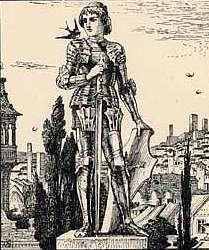
The story tells of a gilded statue dubbed “The Happy Prince” erected in honor of a long-dead prince who was known for his lightheartedness. As winter approaches, the bejeweled statue befriends a stray swallow on his way to the warmth of Africa. The swallow is concerned at the statue’s sadness over the plight of the downtrodden in the city, so at the statue’s request, the bird begins stripping all the gems and gold leaf off the Happy Prince and giving them away to the needy. In time, there is nothing precious left of the statue, and the dedicated swallow who once told exotic tales of Egypt to the statue, is chilled and exhausted.
Wilde concludes the story:
The poor little Swallow grew colder and colder, but he would not leave the Prince, he loved him too well. He picked up crumbs outside the baker’s door when the baker was not looking and tried to keep himself warm by flapping his wings.
But at last he knew that he was going to die. He had just strength to fly up to the Prince’s shoulder once more. “Good-bye, dear Prince!” he murmured, “will you let me kiss your hand?”
“I am glad that you are going to Egypt at last, little Swallow,” said the Prince, “you have stayed too long here; but you must kiss me on the lips, for I love you.”
“It is not to Egypt that I am going,” said the Swallow. “I am going to the House of Death. Death is the brother of Sleep, is he not?”
And he kissed the Happy Prince on the lips, and fell down dead at his feet.
At that moment a curious crack sounded inside the statue, as if something had broken. The fact is that the leaden heart had snapped right in two. It certainly was a dreadfully hard frost.
Early the next morning the Mayor was walking in the square below in company with the Town Councillors. As they passed the column he looked up at the statue: “Dear me! how shabby the Happy Prince looks!” he said.
“How shabby indeed!” cried the Town Councillors, who always agreed with the Mayor; and they went up to look at it.
“The ruby has fallen out of his sword, his eyes are gone, and he is golden no longer,” said the Mayor in fact, “he is little better than a beggar!”
“Little better than a beggar,” said the Town Councillors.
“And here is actually a dead bird at his feet!” continued the Mayor. “We must really issue a proclamation that birds are not to be allowed to die here.” And the Town Clerk made a note of the suggestion.
So they pulled down the statue of the Happy Prince. “As he is no longer beautiful he is no longer useful,” said the Art Professor at the University.
Then they melted the statue in a furnace, and the Mayor held a meeting of the Corporation to decide what was to be done with the metal. “We must have another statue, of course,” he said, “and it shall be a statue of myself.”
“Of myself,” said each of the Town Councillors, and they quarrelled. When I last heard of them they were quarrelling still.
“What a strange thing!” said the overseer of the workmen at the foundry. “This broken lead heart will not melt in the furnace. We must throw it away.” So they threw it on a dust-heap where the dead Swallow was also lying.
“Bring me the two most precious things in the city,” said God to one of His Angels; and the Angel brought Him the leaden heart and the dead bird.
“You have rightly chosen,” said God, “for in my garden of Paradise this little bird shall sing for evermore, and in my city of gold the Happy Prince shall praise me.”
When we are in the grips of the message of excellence and success we become like the Mayor and Town Councillors in the story. Our ability to see true beauty in the less than perfect is stymied and along with it the beauty of the Gospel.

 The very people of a God who is characterized by His Fatherly Love talk a good game about love, but the message we send out rarely starts with love. And when we end with it, that love's usually in the form of "Sorry about ripping your still-beating heart from your chest, but I did it in love."