
What the American Church Is Doing Right, Part 2

Standard

Yesterday, I began a two-part series looking at six things the American Church is doing right. In the day since I posted the first part, I’ve added one more positive I feel needs to be listed, so the total now comes to seven.

So without further delay, four more things the American Church is doing right:

4. Addressing major American social ills positively

Much has been made of the culture wars, and there are good people on both sides of the engagement/disengagement battle. Yet no matter how much we shy away from discussing whether Christians should be engaging in those skirmishes, the reality is that some of our American social ills would be far worse if Christians weren’t out on the front lines.

Roe vs. Wade decriminalized murder in America. Christians were asleep at their posts in the early Seventies when this horror was enacted, but if not for Christians working hard against abortion since then, millions more human beings never would have been. Thumbs Up!Crisis Pregnancy Centers operated by churches and other Christian organizations have saved countless babies. Many mothers who were considering abortion ultimately found Christ through the ministrations of dedicated Christian workers. No matter where we stand on fighting culture wars, fighting against the abortion mills has reaped rewards. Just ask someone saved from being aborted how important it was that Christians got involved.

Other areas have seen Christians move in and bring life-altering aid. In a culture that lives to shop, millions of Americans have dug themselves a financial hole. God honors hilarious giving, but not ridiculous consumption. Many have been rescued from financial ruin by churches and individual Christians who stepped in as financial mentors and worked alongside the nearly bankrupt to pay off their debt in a responsible manner. That may not seem like much, but to a person buried under a mountain of credit card debt, having that free help might be the only thing that keeps some folks from homelessness.

At a time when nearly everyone in America has heard the Gospel, but fewer have seen it in action, Christians working to be salt and light in a dying culture have affected countless people. That’s impossible to write off.

5. Developing new evangelistic methodologies

As I just wrote, I’m of the firm belief that everyone in this country has heard the name of Jesus and had some minor education (whether wrong or right) in the Faith. This makes our situation today totally unlike that of Paul’s day, when no one outside of Jerusalem had heard the name of Jesus.

I believe this saturation has put us into a mopping-up mode when it comes to evangelism. People have heard some parts of the Gospel, but what they’re not seeing is us Christians truly live it out.

My former pastor, Steve Sjogren, has pioneered many servant evangelism strategies for helping Christians put their walk where their talk is. While these methodologies cannot substitute for the Spirit of God bringing conviction into a sinner’s life, they create enough cognitive dissonance to blast through the walls people have erected against hearing the true Gospel. People can rail against talk, but seeing Christians actually living out their faith by serving others can’t be argued against. Christian scholars have definitively shown that one of the reasons the early Church grew exponentially in Rome was because Christians tended the sick when no one else in Roman society dared even touch them. People saw that and took notice.

No, I am not for many of the evangelistic ideas that many are championing that make concessions to worldliness, gutting the Gospel message and substituting nonsense. But serving others in a way that lives what we believe isn’t nonsense. It’s what we need to be doing—and fortunately, many are.

6. Rediscovering experiential faith

I know I’ll be branded a postmodern acolyte for writing this, but I’ve honestly thought that the Church in this country has been too rational and cerebral. I run across so many Christians who treat Jesus Christ as a theoretical rather than someone to be known as a real person. The Bible is the document of experiential faith, yet so many Christians are living out a set of beliefs rather than a real relationship with the Lord of the Universe.

This has been slowly changing in the last twenty years, a good thing, if you ask me. More and more Christians have a hunger for God, not being satisfied with being told about Him, but actually encountering Him themselves. In a way, this is a repeat of what happened during the Reformation. It’s what’s been happening in non-Western countries for a while now. I believe it’s one of the many reasons that non-Western Christians are so vital.

Now it’s coming to America.

And yes, it can be a bad thing if we jettison all common sense in search of experiences. Truthfully, some of the experiential bent needs to be reined in or tempered with the intellect. I’d be a fool to claim otherwise. The pendulum has moved the other way, and has, of course, overshot the blessed middle tension between experience and intellect.

Still, I’m hopeful that it won’t perpetually stay at either extreme.

7. Understanding that the Spirit of God is moving

Though I thoroughly endorse the charismata and will be seen by many to be a charismatic, I don’t jump on “fresh move of the Spirit” bandwagons. Folks in charismatic and Pentecostal realms have been claiming a fresh wind of the Spirit is just around the corner since…well, since Azusa Street. Needless to say, that’s been a hundred years now.

But I’m seeing real signs that the Spirit of God is moving, and sources not usually given over those proclamations are, too. People are tiring of the Joel Osteen flavor of “Christianity”; they aren’t satisfied with feel-good pseudo-Christianity anymore. They want meat. And God will give them meat if they repent and cleave to Him.

Many of the pseudo-Christian fads foisted off on unsuspecting Christians have been weighed in the scale and found wanting. People who got burned once aren’t willing to rush into the next fad quite so easily. They’re looking for honesty before God. And God will honor that kind of desire in people who truly seek Him transparently.

Aslan is on the move, as it was once said. I think that’s happening right now. We need to be prepared when God moves.

Those are my seven things the American Church is doing right.

What are yours?

A Delightful Inheritance

Standard

In 1981, at the Baccalaureate presentation a few days before graduation, a packed house of about 2,000 filled my high school auditorium. Superlative students received scholarships and kudos, offered up prayers of thanks, gave speeches, and filled the evening with hope. Only one award remained—the one honoring the student most involved in school activities.

My folks and I sat together, and as the award recipient's list of clubs and groups grew, I sat on the edge of my seat.

"National Honor Society, Science Club, Math Club, Photography Club, Chess Club, French Club, French National Honor Society…"

I knew most of the folks in those groups and started narrowing down the list of contenders. More clubs and groups rattled by. I said to my mom, "The person getting this is never home." She nodded.

When the Student Body President started in on the astonishing number of band-related functions—Orchestra, Pep Band, Concert Band, Marching Band, Chorale, Stage Band, Theater Orchestra—I had to admit I had no idea who this nut could be who was so massively involved in the school.

Then she read my name.

I fell out of my chair and somehow landed on my feet, rubbery legs guiding me from my spot way in the back of the auditorium to the stage. People were standing and cheering. Shock and disbelief on my part. Harrington Mann's "Angel Plucking Tulips"I'll probably never again get that feeling of being a celebrity.
And not once during the reciting of that list had I realized I was that highly involved person.

Last Monday, I attended the memorial service of a friend who spent the best years of his life giving his time and talents to others. When we pulled into the massive church, the parking lot bulged with cars. A human line streamed down the stairs into the church's auditorium. I suspect more than 1,300 people came to remember one man.

Upon witnessing the crowd, I failed to hold back the tears. Our friend was so well loved. During the service, a mic was handed around and people shared their stories of how our friend had touched others with his faith in Christ and his overt generosity, always giving away, always meeting a need. I think everyone there could have shared a special moment in which they'd been the recipient of this man's large heart. His past and present students spoke and when asked to rise, it seemed like the room was filled with people standing.

What a good, godly man. A man who never took the spotlight, but who gave and gave until it was time to go home. When a soloist sang Ray Boltz's classic "Thank You", there in that crowd I considered that never before had that song been so fitting a tribute.

One day, out on the boat from which he taught kids to water ski, he shared with me a Scripture he said was his life verse. A new believer at that time, his excitement at finding this verse was electric and his joy palpable: 

The boundary lines have fallen for me in pleasant places; surely I have a delightful inheritance.
—Psalms 16:6 NIV

When the discouragements of life press down on you, know this: you have a delightful inheritance. One day, you'll be standing among the saints in the presence of God and one of his angels will read through a list of godly acts rendered to others over the course of a full and blessed lifetime.

And then he'll call your name.

Was that you who helped the old lady get to her car without slipping on the ice? Or who taught the third grade Sunday School class? Did you sit and weep with a neighbor whose child died far too young? Did you prepare the communion elements alone in the church kitchen? Or pray through the church directory every day?

Thank you. Bless you for giving to the Lord. Surely you have a delightful inheritance.

And when you turn around to face that multitude in glory, we'll all be cheering.

{Image: Harrington Mann's Angel Plucking Tulips 1894}

The Superspiritual

Standard

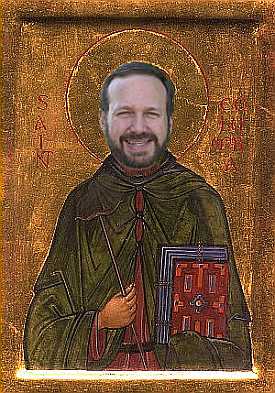
Saint Dan of PhotoshopolisA number of people I know have had recent encounters with strange persons who appear to be on the increase in the ranks of Christians in America. There’s no known genus and species name for these unusual creatures, so most people are forced to refer to them by their collective name, The Superspiritual.

I’m sure at least a few folks out there have crossed paths with this particular beast. For those unacquainted with The Superspiritual, a few of their traits stand out:

  1. They have a tendency to get up before the sun and have incredibly long quiet times that rival those of the great saints of old. In fact, the saints of old were pansies compared to these folks.
  2. They’ve memorized large swaths of the Bible—and in multiple translations. Ask them to quote a specific passage—they’re dying to share it with you.
  3. They have an answer to every possible theological question anyone might have. The best of them will offer multiple perspectives given by a chosen set of favorite authors. Always a very narrow selection of authors. Come to think of it, those authors always agree with each other on everything, so there isn’t much variation of perspective when you get right down to it.
  4. Their library of Christian books, if sold on eBay, could feed a hundred AIDS orphans in Africa for a decade, though it is doubtful they’d ever part with those books. Go ahead, try to snatch one out of their hands. (Fast reflexes, eh?)
  5. If they own a business, that business will be founded on, run by, and ever beholden to “Christian principles.” Those principles appear to include making as much money as possible by any means available.
  6. If you’re a heathen—meaning you’re not as spiritual as they are—you’re held at arm’s length until you ARE as spiritual as they are.  (Good luck! Typically it’s taken decades for them to reach their own peculiar nirvana.)
  7. “Christian practice” is defined as going to church on Sunday mornings, Sunday nights, Wednesdays nights, and at least a small group or two on a free night. Oh, and there’s a number of church boards to sit on, too. Christian practice is critical for enhancing one’s standing in order to maximize #5 above.
  8. They talk, talk, talk about family values, and you can’t help but think they’ve got the insular family thing down to a T, seeing that no one else associates with them. Just don’t bring up their middle child in conversation.
  9. They do an outstanding job of  telling you what the Bible says we should be against, but stumble a bit when pressed on what the Bible says we should be for.
  10. They have a way of making anyone who stands near them feel oddly guilty.

Sound familiar now? Certainly you’ve met one of these folks.

As to #2 above, their memorization skills are indeed impressive, but The Superspiritual seem to have mentally misplaced a few verses. Consider the following verses that routinely get overlooked:

And as you wish that others would do to you, do so to them.
—Luke 6:31 ESV

For judgment is without mercy to one who has shown no mercy. Mercy triumphs over judgment.
—James 2:13 ESV

And he said to him, “You shall love the Lord your God with all your heart and with all your soul and with all your mind. This is the great and first commandment. And a second is like it: You shall love your neighbor as yourself. On these two commandments depend all the Law and the Prophets.”
—Matthew 22:37-40 ESV

If anyone says, “I love God,” and hates his brother, he is a liar; for he who does not love his brother whom he has seen cannot love God whom he has not seen. And this commandment we have from him: whoever loves God must also love his brother.
—1 John 4:20-21 ESV

My brothers, show no partiality as you hold the faith in our Lord Jesus Christ, the Lord of glory. For if a man wearing a gold ring and fine clothing comes into your assembly, and a poor man in shabby clothing also comes in, and if you pay attention to the one who wears the fine clothing and say, “You sit here in a good place,” while you say to the poor man, “You stand over there,” or, “Sit down at my feet,” have you not then made distinctions among yourselves and become judges with evil thoughts?”
—James 2:1-4 ESV

What good is it, my brothers, if someone says he has faith but does not have works? Can that faith save him? If a brother or sister is poorly clothed and lacking in daily food, and one of you says to them, “Go in peace, be warmed and filled,” without giving them the things needed for the body, what good is that? So also faith by itself, if it does not have works, is dead. But someone will say, “You have faith and I have works.” Show me your faith apart from your works, and I will show you my faith by my works. You believe that God is one; you do well. Even the demons believe—and shudder!
—James 2:14-19 ESV

All joking aside, I’m growing tired of hearing stories about people afflicted with the disease of Superspirituality. And it  truly is a disease because it infects impressionable people who come under the tutelage of those already diseased.

  • What explains the Christian businessman who fires employees to cut costs rather than examine the careless way in which he doles out company money to ministries in order to get on their privileged donor list?
  • Or an upper-middle-class church that splits over outreach to a Hispanic neighborhood because the people they sought to evangelize in that neighborhood had the nerve to actually start showing up in the church on Sunday?
  • Or a radio ministry that promises a helpful book that can aid those who are struggling with long-term unemployment and its resulting financial ruin, but when calling in it’s a mandatory $30 “love gift” for the book—which Amazon sells for $8.99?
  • Or the Christian company that requests a prospective employee twice fly out for a job interview, only to later fail to reimburse the prospect for the plane flights or even bother to give her a follow-up phone call about the job?
  • Or the Christian organization that exists solely to help people with one specific kind of problem, but who gets a client in further trouble by failing to file critical paperwork because they were too busy preparing for a big evangelistic outreach they sponsor?

Don’t those just rip your heart out? What should be done with folks who have every appearance of being paragons of Christian virtue, yet they purposefully ignore the most basic aspects of the faith?

What would happen to us as a Church in this country if we spent the next year doing nothing that even vaguely resembled Superspirituality, instead simply doing unto others as we would have them do unto us? How hard is it to ask ourselves whether or not we like to be treated as badly by other Christians as we sometimes treat others?

I don’t think The Superspiritual ever ask themselves that kind of question.

A number of years ago, a friend, noting the sheer number of trivial things I know about highly useless topics, congratulated me on having filled my mind with so many facts. My response to him? I’d trade it all to be able to know the Bible inside and out.

Today, I realize that this response was Superspiritual. In reflecting about this issue of Superspirituality, it occurs to me that the less Superspiritual answer—and the one closer to the heart of Jesus—is this: that I be able to put into practice the amount of Bible I already know, rather than simply marinating my brain with it.

I mentioned this in a post last week, but what is the point in correctly learning and handling the Scriptures?

All Scripture is breathed out by God and profitable for teaching, for reproof, for correction, and for training in righteousness, that the man of God may be competent, equipped for every good work.
—2 Timothy 3:16-17 ESV

The end goal is good works. Good works are always others-centric. If we’re not putting into practice the things we already know, investing ourselves in the lives of our brothers and sisters in Christ, in the lives of the poor and needy, and in the lives of the lost, then all that Bible knowledge we’ve crammed into our craniums has no outlet. It puffs up our heads and leaves no room for our hearts.

The lost around us will argue our facts and figures, but they find it hard to argue when they’ve had a serious illness strike their household and we show up on their front porch with a homemade dinner. They used to refer to such selfless benevolence as “the milk of human kindness.” Trust me, folks; that’s “meat,” not “milk.”

James says this:

Religion that is pure and undefiled before God, the Father, is this: to visit orphans and widows in their affliction, and to keep oneself unstained from the world.
—James 1:27 ESV

And we already know that all the prophets were reiterating the same message of God: God desires that men love Him and love their neighbor as themselves.

Superspirituality is all too easy to catch, but there’s a way to avoid its disease. If we surrender ourselves lovingly to God and give of ourselves to our neighbors, there’s not a lot of us left over for that awful virus to infect.

Have a blessed week! And please show the love of Christ to someone this day who might not otherwise experience it.

{Image: Major apologies to the artist who crafted the icon of Saint Columba}