
 She dutifully drags her mop across the tile floor of the Taco Bell, head down, absorbed in her work. Once finished, she locates a clean towelette and wipes down each table, taking care to avoid spilling anything on the pristine floor.
While my son and I eat, I study her. She’s working every time we stop in, infrequent though our visits may be. I think she’s about thirty, but I may be wrong. Folks with Down Syndrome don’t always look their age.
In the county seat near us, at a McDonalds, she has a counterpart in a young man, also with Down, who also mops the floors of that restaurant and tends the tables. Both the Taco Bell and McDonalds maintain a level of cleanliness unmatched in other fast food restaurants thanks to two hard workers who will never be like the people they serve.
Each time I have the opportunity, I make certain I thank them for keeping the restaurants so neat and clean. I hope next time to remember to ask them their names. Something in me always forgets to ask. Something ingrained. Something that hates to be exposed.
In my observations, the one thing that grips me each time I encounter these two isn’t so much about them, but the people around them. The restaurant patrons don’t look their way, don’t greet them, don’t interact with them in any way. I don’t see the other restaurant employees talking with them, either. For all intents, the two Down Syndrome cleaners don’t exist.
But someone cares for them, I know. The woman carries a cell phone, to my surprise, and she once talked with someone while taking her break. Parents? Guardian? I know the fear of every parent of a Down child, that one day death will come too soon (as many parents of Down children gave birth to them in their older years), then who will look after their special child?
I don’t know the spiritual state of people born without all the faculties we possess. I confess I don’t know how to witness to someone who might not grasp the finer points of sin and redemption. I worked with Down kids in my years in camping ministry, but always felt helpless when it came to knowing how to address their spiritual needs. In the end, I decided that love might be the best I can give them. So in the case of the cleaners, that’s what I try to offer—a smile and a word of thanks.
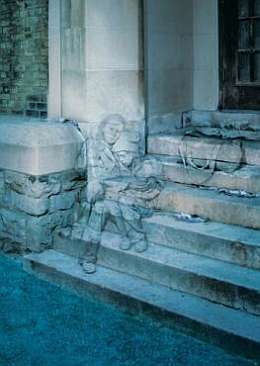
People don’t have to be afflicted with a genetic disorder to become invisible to us. American society is such that when someone yells, “Hey! Look at me!” we look. In many cases, we can’t tear our eyes off the attention junkies. In our staring at those enjoying their fifteen minutes of fame, we miss those who blend into the background, living, breathing people Christ died to save.
Ann sold high-tech electronics. Her bright smile and smart attention to fashion gave her a twinkle I didn’t find in the other reps who came into our store. When she talked with customers and other sales staff, you could tell she genuinely cared. Her job wasn’t just to sell gizmoes, but meet the needs of others. Her “ministry” consisted of helping other people take charge of their lives.
Little things set Ann apart. On Halloween, she came into the store in an elaborate costume I could tell she’d made herself. Perfect makeup, including prosthetics, and a wig that blended seamlessly completed the look. Dressing up like that meant something to her, the attention to detail telling others how much she enjoyed her work.
In her thirties and divorced, Ann hung around some days longer than her job entailed. I suspect she didn’t have much to go home to, just an apartment or small house filled with echoes. That never sat well with me. She had a lot to offer, but she was still invisible.
When the cuts came at her company, I knew I wouldn’t be seeing her again, and I never did. People like her don’t get noticed. They work hard. They care more than most. But the world doesn’t exalt people like her. And it never will.
We live in an era of the invisible. Despite all the boasting of empowerment, despite laws forged to ensure equality, I can’t help but feel we’re minting more invisible people than ever before.
The illegal immigrant. The single dad. The shy kid in class. The homeless. The old lady in the nursing home whose only crime is she got too slow for the rest of the world. The guy who put in ten good years in the office only to one day clean out his desk against his will and vanish into the ether.
We take people made in the Imago Dei and stick them in front of a computer in a vast array of cubicles and this becomes their life for half a day. And when The Big Cheese phones in from his yacht the day after the stock tanks, someone like Ann finds herself looking for another job at yet another company that could care less that she sewed her own costume for Halloween just to give a thrill to the kids who came in with dad to some podunk electronics store.
In the not-so-distant past, companies used to have Personnel departments. Now they have Human Resource departments. From Person to Resource. I don’t know about you, but I prefer to be a person rather than a resource. When I hear a term like “human resource,” I can’t help but think Soylent Green.
Former GE honcho Jack Welch, who seemed to make a career out of being as visible as possible, did a great Darwinian disservice to employees everywhere by reducing even the impersonal human resource into human capital, like so many $20 bills (used to light his cigars after a fine day of downsizing what used to be known as people, I guess). Folks like Jack render people invisible with a snap of their fingers and a drag on their Cuban.
But corporate bigwigs aren’t the only ones who can’t see. Ordinary Joes like us do it, too. You won’t confuse Taco Bell or McDonalds with Le Bernardin or The French Laundry, but even in a fast food joint, we all too easily look right through someone with an 80 IQ and no means.
Jesus said this:
“The kingdom of heaven may be compared to a king who gave a wedding feast for his son, and sent his servants to call those who were invited to the wedding feast, but they would not come. Again he sent other servants, saying, ‘Tell those who are invited, See, I have prepared my dinner, my oxen and my fat calves have been slaughtered, and everything is ready. Come to the wedding feast.’ But they paid no attention and went off, one to his farm, another to his business, while the rest seized his servants, treated them shamefully, and killed them. The king was angry, and he sent his troops and destroyed those murderers and burned their city. Then he said to his servants, ‘The wedding feast is ready, but those invited were not worthy. Go therefore to the main roads and invite to the wedding feast as many as you find.’ And those servants went out into the roads and gathered all whom they found, both bad and good. So the wedding hall was filled with guests.”
—Matthew 22:2-10
We’re surrounded by invisible people, but God calls us to go out into the highways and byways, to look hard for them, to find them wherever they might be found.
You see, as Christians, you and I are invisible, too. We’re invisible because we died at the cross, so we no longer live, but the very visible Christ lives in us (if we’re living for Him). So we’re uniquely geared to understand the invisible of the world. And the Lord would have us perpetually seek them out.
The invisible might be the Down Syndrome mop-wielder or she might be the salesperson who caught a couple bad breaks. The Holy Spirit will let us know just who’s invisible if we depend on Him to show us. He wants to show us. We just need to be listening to Him.
Because in His eyes, no one is invisible.
{Image: Detail from an ad campaign poster for the Salvation Army. Other posters can be seen here.}
 About specific issues I posted on, general needs—whatever.
 conferences to hear celebrity preachers preach, learn from massively credentialed Christian teachers, and enjoy fellowship with likeminded believers.