
That Saved a “Wreck” Like Me

Standard

My post last week on “Two Halves of the Whole Gospel” has generated some interesting conversations. I was originally intending to do a week of posts about my work, the reason this blog exists, and some tidbits about me. However, I feel the Lord tapping me on the shoulder about expanding the “Two Halves” post.

One of my concerns for the American Church is that we’re carving the Gospel up into disparate chunks, then loving our favorite chunk to the exclusion of the rest. I believe that terrible misunderstandings and errors grow like pernicious weeds because we do this. We end up missing the Lord’s best for us.

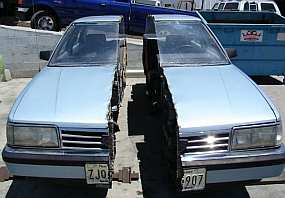
I want to begin my point here by having you all imagine a giant junkyard filled with one wrecked/junked vehicle after another for as far as the eye can see. Rusting heaps, useless, and destined for destruction.

One day, a master mechanic pulls into the junkyard behind the wheel of his rescue vehicle.Totaled for all eternity? He hauls some vehicles away to his garage, works on their engines, then fills them with his special fuel. A couple pumps of the accelerator and that once dead engine sputters to life.

In time, the master mechanic details each vehicle. Any portion of that vehicle that doesn’t work, he repairs. He removes all the rust, patches the holes, and primes, paints and buffs the results. The vehicles begin to look as they should. In fact, they begin to look a lot like the mechanic’s own rescue vehicle.

But the master mechanic is even more wise. He knows that each one of his vehicles exists for a reason. So he equips each with specialized parts that run off his unique fuel. To some, he gives wings to fly so they can journey to distant parts of the junkyard as his representatives. To others, he gives crane arms to lift other vehicles out of ditches should they run off the road. Each vehicle receives what it needs to serve. He makes each vehicle into exactly what he desires of it for his good purpose. Some are fast, some durable, some multi-functioned, some exceptionally good at a specific task, and many even help the master mechanic retrieve more wrecks from the junkyard. In the end, those once worthless vehicles become what the master mechanic intended for them to be in the first place. They fly, roll, and sail in tune because of the master mechanic, his rescue vehicle, and his special fuel.

Perhaps it’s too simple an illustration on some levels, but I believe that’s a decent explanation of the Gospel at work.

Sadly, too many of us live as if the Gospel stops once the master mechanic retrieves a few vehicles from the junkyard, tunes them up, and fills them with his fuel. If they do they little else than sit around the master mechanic’s lot, that’s fine.

But that’s a terrible error.

Those vehicles have a purpose and that purpose is as much a part of the Gospel as anything. If we fail to understand the truth that those vehicles have a destiny as tools for the use of the master craftsman, then we’ve missed Gospel truth. The equipping for service is part of the Gospel, too, for what was once useless now lives up to the reason for which it was made! That’s the Good News as much as not resting forever in a junkyard is.

What’s frightening is what happens when the vehicles on the master mechanic’s lot do nothing but hang around the lot all day. In time, the lot begins to resemble the junkyard: plenty of parked vehicles failing to do what they were created for. Eventually, those retrieved vehicles begin to sputter for they would rather hang out in the lot then go to the garage where the master mechanic can fuel and equip them for the purpose for which they exist.

It’s not enough to no longer be a wreck. If that’s what we think, then we don’t understand the whole Gospel.
Two Halves of the Whole Gospel

Standard

Goin' nowhere fastDo you sometimes feel like we’re not hearing the whole Gospel? Hang around the Godblogosphere long enough and you get the eerie feeling that no one truly knows what the whole Gospel entails.
And it’s not just the Godblogosphere. I suspect that many of our churches can’t articulate the entirety of the Gospel.

As I see it, we’ve made this mistake of viewing the whole Gospel as two halves. The mistake—one of typical human nature— is to wrap the entirety of our brains around the one half that resonates with us the most, then act as if the other half doesn’t exist.

If we must delineate the error of the two halves, it’s best to look at the one passage of Scripture that defines those halves. We find both in Ephesians 2:8-10.

Half A:

For by grace you have been saved through faith. And this is not your own doing; it is the gift of God, not a result of works, so that no one may boast.
—Ephesians 2:8-9

Half B:

For we are his workmanship, created in Christ Jesus for good works, which God prepared beforehand, that we should walk in them.
—Ephesians 2:10

Those who cling to Half A are the folks I’ll call the Elect. They obsess about doctrine, detest even a whiff of works righteousness, and are enormously concerned with getting people saved. They got their marching orders at the Reformation and consider it the high point in modern history. And heaven help anyone who’s not in total agreement with them.

Those who adhere to Half B are the folks I’ll call the Fieldworkers. They obsess about  helping those in need, detest the hypocrisy of not walking the talk, and are enormously concerned with bettering the lives of everyone around them. They can’t point to any one point in time for their marching orders,  but earnestly believe that we need a new Reformation. And heaven help anyone who’s not in total agreement with them.

The problem with the Elect and the Fieldworkers is that they are so focused on their half of the whole Gospel, they simply can’t bring themselves to understand the other half. The blinders are on so tight that neither group  can even acknowledge the other side’s main propositions are just as Scriptural as theirs.

The Elect easily trash the loose theology of the Fieldworkers. The Fieldworkers quickly note the clean, uncalloused hands of the Elect. To the Elect, the Fieldworkers are false teachers and heretics. To the Fieldworkers, the Elect are uncaring, self-absorbed Pharisees. Both sides point to the other and claim, “You’re not living the Gospel. I doubt you’re truly saved!”

And you know what? On that claim, both sides may actually be right!

Worrying about how you come to Christ is great, but Elect, what are you supposed to do with the sixty or so years of discipleship you have staring you in the face afterwards? Worrying about the needy is great, but Fieldworkers, how do you receive the heart of God to do so if you can’t articulate how to know God at all?

The whole Gospel contains both the power to raise the dead in spirit to spiritual life in the name of Jesus AND the power to tenderize the human heart toward the service of others in the name of Jesus.

What baffles me is why this is so hard to understand.

Why do we slice the Gospel in half then whine about the half we don’t like? Why the venom between the Elect and the Fieldworkers? Why?

The whole Gospel is the whole Gospel. If we’re not concerned with seeing people saved through hearing the message of salvation, maintaining the integrity of our doctrine, and preaching that we can’t earn our way to heaven, then we’re blowing it. If we’re not concerned about taking care of those in need, living out the love of Christ in practical ways, and fighting for the betterment of everyone we meet, then we’re blowing it.

Please Church, it’s time to believe and live the whole Gospel!

On Doing Our Best

Standard

I’m a real stickler for doing a job right. It’s not that I possess this overactive sense of correctness, more that I’m a bit fed up with the lax attitude afflicting so many people today concerning their work. There’s something about having to call a business six and seven times in order to get a job done at all, much less done right the first time.

For the first time in the history of my freelance writing business, I missed a deadline. Now yes, I did call the client a few days before the deadline to ask for an extension (which was granted graciously), and yes, I did get the work in the day after my original deadline. But still, in three years I’d never missed a deadline.

Now sure, anyone who works has to rely on others for help or information to meet the demands of his job, and this is often where the breakdown occurs. But an excuse is an excuse, and I sure hear a lot of excuses nowadays.

What really galls me is when a company hides its sloppy work (and lackadaisical attitude toward completing that work) behind a big ol’ ichthus symbol. They’ll slap that fish on their Yellow Pages ad, paint it on their trucks, and scream to the world, Awake, O Sleeper...“I’m your brother in Christ, y’all can trust me.” Or when something goes wrong and doesn’t get righted, “Grace, man, grace!”

I’m a small business owner who just happens to be a Christian, so I try really hard to give my business to fellow Christian businesspeople. Hey, I can commiserate. But because I uphold an extremely high standard for my own work, I expect the same from the folks I hire to help me.

I wish I could say I’ve never been disappointed in the Christians I’ve hired. Truth be told, my experience has been so bad that I’m delighted when someone actually does the work right!

Isn’t that a terrible thing to say?

Whatever you do, work heartily, as for the Lord and not for men, knowing that from the Lord you will receive the inheritance as your reward. You are serving the Lord Christ.
—Colossians 3:23-24

The depressing truth about that passage is a lot of Christian business owners excise it from the Scriptures. If not by taking an X-acto knife to their personal Bibles, then by failing to heed it in practice.

My church hired a Christian business to do the church’s pictorial directory and it took months of cajoling for that company to finally turn in their effort. I kept asking our church secretary whether she would like me to mention the company by name in a post like this one, publicly excoriating the company for not giving two hoots about delivering on their promises. She told me to hold off. Nine months after the fact, we finally got our directories.

I wonder how Christ was honored by that company’s actions.

What we are outside of church on Sunday mornings matters. If we’re not publicly exemplifying the Christian walk, then what are we doing? Shouldn’t we be doing our best at all times and in all places because of the Lord we serve?