
Jesus Christ, Lord of Empathy

Standard

Rejoice with those who rejoice, weep with those who weep.
—Romans 12:15 ESV

I buried my parents four months apart. Losing any parent hits too close to home, but losing them so close together only amplifies the grief.

Recently, I heard that someone we know, a person much younger than me, lost parents close together. Sitting here now, that kind of grief rises up again. I know exactly how that person feels. You’re cut loose. The world seems emptier and disconnected. I know that feeling because I’ve been there.

As I mature in the Lord, I realize that no one gets a pass. You can’t walk around this planet long before you experience death, illness, betrayal, loss, and a host of other pains. Like ticks, painful realities cling to us and sap our vital energies. A sheep so afflicted can’t remove the tick on its own.

And Jesus went throughout all the cities and villages, teaching in their synagogues and proclaiming the gospel of the kingdom and healing every disease and every affliction. When he saw the crowds, he had compassion for them, because they were harassed and helpless, like sheep without a shepherd. Then he said to his disciples, “The harvest is plentiful, but the laborers are few; therefore pray earnestly to the Lord of the harvest to send out laborers into his harvest.”
—Matthew 9:35-38 ESV

We Evangelicals can’t cede the humanity of Jesus Christ to the mainline churches. We do a fine job of making Jesus the Christ, the Lord of All, but we tend to forget Jesus gave up His place beside the Father to take on flesh and the subsequent misery of the helpless sheep He came to save.

Since therefore the children share in flesh and blood, [Jesus] himself likewise partook of the same things, that through death he might destroy the one who has the power of death, that is, the devil, and deliver all those who through fear of death were subject to lifelong slavery. For surely it is not angels that he helps, but he helps the offspring of Abraham. Therefore he had to be made like his brothers in every respect, so that he might become a merciful and faithful high priest in the service of God, to make propitiation for the sins of the people. For because he himself has suffered when tempted, he is able to help those who are being tempted.
—Hebrews 2:14-18 ESV

We don’t hear too much about Jesus our Brother in Evangelical circles, an incalculable loss. Jesus’ humanity drew people. They knew they could approach Him. He wasn’t distant and removed, but walked among us, giving His life away, serving others.

He did this because at the core of who He was beat a heart of empathy. The very act of incarnation forever linked the Son of God with the people He created. Incarnation embodies empathy for others. And Jesus not only displayed that empathy by taking on flesh, but by fully becoming one of us, emotions and all:

Now when Mary came to where Jesus was and saw him, she fell at his feet, saying to him, “Lord, if you had been here, my brother would not have died.” When Jesus saw her weeping, and the Jews who had come with her also weeping, he was deeply moved in his spirit and greatly troubled. And he said, “Where have you laid him?” They said to him, “Lord, come and see.” Jesus wept. So the Jews said, “See how he loved him!”
—John 11:32-36 ESV

For those of us who bear the image of Christ, empathy for our fellow men—be they believers or not—should permeate the core of who we are. Jesus felt Mary and Martha’s loss. The loss of a friend drove Him to tears. Even though He fully understood He could raise Lazarus from the dead, Jesus still showed empathy. His lesson? No one, not even the Christ, should ever walk away from another’s pain.

People who call themselves Christians, but who so readily tear into another person, display little of Christ’s empathy. Our lives should always be lived with one eye on what it means to be someone else. Ultimately, Jesus, the Lord of the Universe, did the same by becoming a man.

His empathy compels us to treat a man as if you or I were in his shoes. That empathy drives The Golden Rule: Do unto others as you would have them do unto you (Luke 6:31 rephrasing). Only then can we humbly dispense grace to those who so desperately need it.

Lastly, the empathetic nature of God shows in one final verse:

We love because he first loved us. If anyone says, “I love God,” and hates his brother, he is a liar; for he who does not love his brother whom he has seen cannot love God whom he has not seen. And this commandment we have from him: whoever loves God must also love his brother.
—1 John 4:19-21 ESV
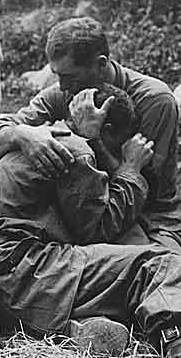
Empathy

Empathy for others proves itself when we say we love God, and vice versa. The relationship between our love of God and our love for others cannot be severed, for empathy drives it.

As we roll into Thanksgiving and Christmas, step into someone else’s life. This isn’t a call to overlook sin and how it leads to the shattered lives of people around us, only that we show empathy first. You and I have no idea what kind of living hell a person’s been through. Better that we empathize with him or her first because we ourselves went through our own hell. Without Christ we’d all still be living that hell right now. Lead with that empathetic love. Feel someone else’s pain and truly mean it.

Christ felt ours all the way to the cross.

An Island Never Cries

Standard

Our pastor and his wife called in the afternoon and wanted to know what we were doing tonight. The elders meeting was canceled (soybean harvest is running late), so they had a free night. They brought a couple pizzas, and we hung out and laughed.

Earlier in the day, I read this sobering report posted at Christianity Today Online:

As of 2004, the average American had just two close friends, compared with three in 1985. Those reporting no confidants at all jumped from 10 percent to 25 percent. Even the share of Americans reporting a healthy circle of four or five friends had plunged from 33 percent to just over 15 percent.

Increasingly, those whom we consider close friends—if we have any—are household members, not people who "bind us to community and neighborhood." Our wider social connections seem to be shriveling like a turkey left too long in the oven.

"You usually don't expect major features of social life to change very much from year to year or even decade to decade," Smith-Lovin, a sociologist at Duke University, told the news media.

Some may contend that the trend is no big deal, because the population is growing older and more racially diverse, and these demographic groups usually have smaller networks where friendships form. However, the nation's increasing level of education, the study says, should more than offset those factors (because, it argues, education often brings more social contacts). Yet our isolation has increased, leaving us at higher risk for a host of physical, social, and psychological ailments.

The article concludes by asking us Christians to make an effort to befriend the unchurched.

Amen.

But just as friendless people exist among the unchurched, the pews of our churches fill up on Sunday with the lonely. Some duck in and slink out without talking with anyone. Perhaps they don't want to talk, or perhaps they do and we just don't notice them. Either way, it's a tragedy.

We've been talking about community in the last couple weeks, and the topic won't let go of my heart. How sad that so many people don't feel a part of a healthy community. Like the CT article pointed out, our social networks have unraveled. And as I've said in recent posts, that only furthers an island mentality in people that eventually shuts everyone out and thinks the better for it.

And a rock feels no pain;

And an island never cries. *

In your church and mine, sheep have wandered away from the fold. Jesus beseeched us to go get them. AloneI used to think that had something to do with blatant sin in the missing sheep's life, but now I understand how easy it is to drift away for no other reason than people simply forget that sheep was ever there.

It's going to cost us something if we reach out the lonely and isolated. We may not get to do what we want each night of the week. We may have a little less private time. We might have to pick up the restaurant check. But the Kingdom of God pays dividends, so that whatever's spent returns ten, fifty, and hundredfold. We get back more than what we give, especially when we pour grace into the lives of lonely people. What a powerful revelation to hear someone say, "In the midst of my loneliness, when I thought no one cared, you were there for me." Do you think a person like that would be more open to hearing the truth of Jesus' Gospel? Or to desire to grow in true discipleship?

If in a given year, each Christian in this country befriended one overlooked person in his/her church and one person outside the church, how incredible would the return be? Not only for us, but for those lonely people?

Our isolation dampens what Christ can do through us. He came to serve others. His example of reaching out to the prostitute, the tax collector, and the other lonely people should stir us. The party is bigger than we are.

Can't we do this? Just two people a year?

I'm more than ready to. 

Politics, Economics, and the American Church

Standard

Empty pocketHere at Cerulean Sanctum, we talk little about politics and much about economic justice issues. Today, we'll see how those two items intersected in the election last week and how we American Christians must wake up to a brutal reality.

Pundits galore propounded the reason that Republicans got tossed off Capitol Hill, but they missed the real voter zeitgeist. Given the glowing economic news trumpeted in the usual Republican-sympathetic media sources, the talking heads looked only to non-economic federal issues to explain stunning Republican losses.

But to update a famous phrase, "It's still the economy, stupid."

While voters may talk about the Iraq War, terrorism, and a number of other global issues Republicans bungled, they'll vote based on local issues. Only people satisfied with their local outlook will vote global and national issues. If the local outlook is grim, forget about anyone looking beyond his own backyard. Local economic health, in particular, drives voting.

Here in (formerly, as of 11/7/06) Republican-dominated Ohio, the state with the worst job prospects in the country, a poll showed that 83% of Ohioans viewed economic issues as "very important" or "extremely important" in determining their Senate pick (Source: The Wall Street Journal, 11/8/06). But Republicans, thinking the economy was superb for everyone, continued to campaign on any issue but improving the economy. They expected folks to suck down the hoopla over the "great economy" despite seeing bare cupboards. As a result, Ohio incumbent Republican senator Mike DeWine got slaughtered by his Democratic challenger, Sherrod Brown, who took a more aggressive stance regarding Ohio's economic health. We talk about Virginia tipping the balance of power in the Senate, but DeWine's loss was potentially a greater news story, since it highlighted voter unease with the supposedly terrific economy. Plenty of people took one look at their bank accounts and the collective sigh sounded a lot like "*&^%!"

Ohio can't be the sole state with hurting workers. As we'll see, national figures could scare the heck out of anyone, regardless of state. So I suspect that many of the Republican losses reflect middle-class voters facing economic pressures, voting with their empty pockets.

As we know, money talks.

Consider the following realities:

  • The American savings rate hovers in negative numbers. (Source)
  • While salaries in the United States rose substantially in the United in the period 2000-2004, that wealth was almost entirely concentrated in the top one percent of wage-earners (household incomes of $300,000+/yr). That one percent saw a 19.8 percent increase in their income over the period. The other 99 percent? A 3 percent increase—not even close to keeping pace with 3 percent year-over-year inflation. (Plus, recent analysis of 2005-2006 shows a continued widening of the salary discrepancy.) (Source)
  • Consumer debt continues to rise. As of August 2006, Americans have never carried greater debt. (Interestingly,  those numbers backtracked a bit in September. I suspect people smelled trouble on the horizon. Perhaps that further proves Election Day results, especially since Republicans polled better against their Democratic opponents before September.) (Source)
  • For the first time since records began, highly educated Americans saw their earnings potential decrease in 2005, demolishing the accepted wisdom that more education translates into higher salaries. (Source)

While some debate that the negative savings rate ignores overall wealth, the information becomes even more dire when factoring in leverage and who holds investment wealth.

Many Americans leverage their home equity. With housing prices falling in almost every state, that leverage only eats away wealth and consumes retirement savings, compounding the problem. In addition, overall wealth incorporates investments, and again, that top one percent controls 93 percent of all investment wealth. (Just wait until those rich Baby Boomers start retiring, too, and begin pulling their money out of stocks.)

Given the rich are getting richer, what does the economic news tell us of the average family? For starters, the typical worker watched upper management prosper, while his or her real world dollars lost buying power. I know many people in their peak earning years whose companies reported record income, yet watched helplessly as their employers eliminated bonuses, cut back on insurance compensation, and froze or reduced cost-of-living increases.

I can't speak for you, but in our area in the last year alone, the cost of consumer goods skyrocketed. The box of cereal I bought last year for $2.29 is $2.99 now—a 31 percent increase. Broccoli cost $1.59 last November, but $1.99 a year later—25 percent more. Our electric company raised area rates 30 percent. And don't get me going on gasoline. I paid $1.59/gal. in the summer of 2005 and almost a dollar more now.

One doesn't need a PhD in mathematics to note that no one out there's received a 35 percent cost of living increase in the last year! Increasingly, middle class folks like us watch helplessly as our incomes buy less and less.

Five years ago, I knew several families where dad worked and mom didn't. I can't think of a single one like that now. While the unemployment figures look strong, do they merely reflect more families forced to put both parents to work to keep pace? If more women enter the job market (primarily in low-wage retail or service industry jobs) just to make ends meet at home, that puts a damper on much of that ecstatic job info, doesn't it?

My mother-in-law told me a new Wendy's opened in her small town. To her shock, most of the employees are over forty. Is working at a fast food restaurant the goal of people in their peak earning years? If so, we're in deep trouble.

In March 2006, I asked readers about their financial stability. More than sixty replied, about half via personal e-mail, the others through comments. Almost universally, people under 35 were better off at the end of 2005 than in previous years. That's to be expected, since many of them are young marrieds with both spouses working and few (or no) children. But the real shocker—and almost all these replies came through personal e-mails—concerned the state of people over forty. Many were far worse off than just five years before, having lost jobs (often multiple times) or  relegated to underemployment, compromised financially in what many consider peak earning years. Those tales broke my heart. I understand that kind of pain and what happens when the Church has no response—and none on the horizon, either.

And in the end, that's what this post is all about. I just completed a series on community , and I believe that our churches must start working toward some kind of money pool to help fellow congregants who fall on hard times. With so many families' money highly leveraged, and the reality that the middle class is fighting a losing battle against rising costs, something needs to be done on a macro level to fix some of the financial injustices people face today.

But the pulpit is silent. Sure, you'll hear about Ron Blue or Crown Financial stuff from time to time, but they only address individual issues. Who in the Church in America speaks out against the real problem, our broken system? 

Sure, we Americans spend too much of our incomes. But if the middle class continues to erode, it won't be a matter of spending too much on a consumeristic lifestyle. The real problem will be how to cope when curtailing excess spending simply won't halt the slide. You can shave expenses down to the bone, but when the bone's gone missing…

All it takes is a minor recession, I think. Or Ford or GM collapsing. With so many precariously perched families with no savings, high credit card debt, loans taken against homes of decreasing value—it won't take much.

Church, are we ready? Truly?

Time to wake up and start preparing for that day. It's coming faster than we think. 

UPDATE: I only got to see this last Saturday's Wall Street Journal late Monday evening. A front page story shows that Democrats running on anti-free-trade, anti-offshoring, and anti-outsourcing platforms crushed their Republican opponents in North Carolina, Indiana, and Pennsylvania. This further proves my theory that middle class voters smarting from job losses and inequities in the economy voted with their wallets, not with an eye toward Iraq, terrorism, or any other topic.

UPDATE II: Some who have read this post knee-jerked and assumed I was a Democrat or some other kind of liberal. Nothing could be further from the truth. In reality, I consider myself a pure conservative in that I believe in conserving what God values. I hold to many of the ideas espoused in Rod Dreher's book, Crunchy Cons. Also, I have a dim view of most political parties, Republican or Democrat. Both have sold out to special interests and forgotten the average American. Lastly, I firmly believe that politics is not the answer; the Kingdom of God is. The sooner American Christians realize this and start living it, the sooner we'll see many things come to pass that we're now foolishly hoping politics will give us.