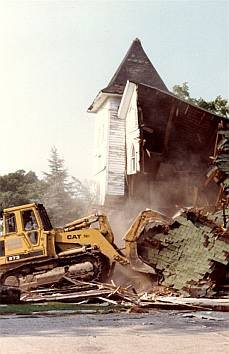
 Yes, Cerulean Sanctum has jumped the shark. I used the title of an Ashton Kutcher movie for a post. This also marks the second time in eight days that Kutcher's been mentioned on this blog.
Shame on me.
Shame, too, on the Supreme Court for the land grab they hatched in last year's Kelo Decision (see this past post, "R.I.P. America, June 23, 2005").
According to this Washington Times article, in just one year under Kelo, eminent domain rulings resulted in 5,783 property seizures. Compare that one year total with the five year total encompassing 1998-2002 in which 10,281 properties were seized.
Before Kelo came to light, I focused on this issue in my post "Taking Away Your Church Building". It troubles me that we Christians are failing to consider how easy it is for our church buildings to be seized by local, state, and federal governments for any and all purposes.
There's a difference between conspiracy theories and preparedness. Land grabs against churches are increasing yearly (see this post for a few instances). To ensure the maximum possible tax revenue, towns are also blocking the building of new churches in areas of prime development. A quick Google search will turn up plenty of instances for these kinds of strong-arm tactics.
So why aren't we Christians as a whole doing anything about it? Are our church leaders making plans in case we have to go underground? It hasn't come to that yet, but it's better for us to be thinking now about how we do church in a hostile social environment rather than later.
Rome is burning, folks. So why do our church leaders keep on fiddling?

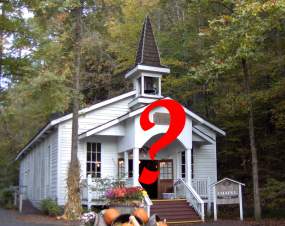 A church located on one of the major highways that we routinely travel has a huge sign out front that reads
 Last week at the Boar's Head Tavern, Josh Strodtbeck noted how easily we refer to any ideology as "liberal" or "conservative," and how those ideologies, even when theological, mirror those of the Democrats and Republicans.