Ravenhill Returns

Standard

One of the most perplexing parts of the Bible occurs whenever we have people wondering whether a deceased prophet has "returned" in the spirit of a new prophet. Consider this passage:

And Jesus went on with his disciples to the villages of Caesarea Philippi. And on the way he asked his disciples, "Who do people say that I am?" And they told him, "John the Baptist; and others say, Elijah; and others, one of the prophets."
—Mark 8:27-28 ESV

Today, some highly confused people use this to endorse reincarnation, but the reality of what is said above is reflected in another passage:

And he [John the Baptist] will turn many of the children of Israel to the Lord their God, and he will go before him in the spirit and power of Elijah, to turn the hearts of the fathers to the children, and the disobedient to the wisdom of the just, to make ready for the Lord a people prepared."
—Luke 1:16-17 ESV

John wasn't Elijah, but he preached by the same powerful Spirit that compelled Elijah. 

Leonard Ravenhill was one of my favorite preachers, but he passed on to glory a few years back. I haven't encountered anyone who can preach in the spirit of Ravenhill—that is until recently.

If you haven't heard the blistering message delivered by Paul Washer at an SBC youth rally, then you haven't heard one of the most pyrotechnic sermons since Ravenhill departed this sphere. Washer even mentions Ravenhill mid-sermon, so you know he's done his homework listening to that great saint. 

I heartily encourage you to listen to Washer's sermon by any of the means possible at the SermonAudio.com site. Several bloggers have linked to Washer's message, and I thank them all. I think every Christian in America needs to hear this one, myself included. It's an hour spent you won't regret.

No, Leonard Ravenhill hasn't come back. But it's good to see that men who minister in the same spirit and power as he did still exist. 

The Antiwitness

Standard

Wolf in Sheep's ClothingI once heard about an outreach that a popular campus ministry used to do during Spring Break. They'd go down to beaches and evangelize the collegians reveling in that yearly bacchanal. For a week, it was God's work for those young people sharing their faith in Christ. They'd hand out tracts, pray with folks, and for those few who did make a commitment to Christ, try to point them in the right direction for the few days the ministry ran.

We've all heard of (or participated in) short-term mission trips like this, whether in-country or out. Usually, it's a spiritual high for the participants that may just last a lifetime, or result in the kind of life-altering event that leads someone to go on to long-term missions work.

But then you start hearing the horror stories and you start to wonder.

I knew someone who used to do that Spring Break ministry, but who encountered something he never thought would be the fruit of that labor.

After several years of participation, he ran across a past convert from an earlier Spring Break outreach (I'll call that convert "Stu".) My friend encountered Stu back on the beach and asked him how his walk with the Lord was going since Stu's conversion the previous spring. Stu shared the following:

    1. He was glad to be a Christian now because his guilt was gone.

    2. He'd hung out a church for a little bit, but it didn't take, so he stopped going.

    3. The drinking had stopped for a little while, but now he didn't feel so bad about getting hammered all the time because he was forgiven.

    4. Same for the promiscuity. Stopped for a while, but a party's a party, right?

    5. He still had the Bible he'd received, but he never really read it.

    6. When asked what he believed, he heartily told everyone he was a Christian and proud of it.

Whatever we think about Stu's "conversion," one truth remains: he's doing more damage now than if he'd never encountered those eager Christian collegians on the shores of Spring Break.

Stu's become something worse than unregenerate; he's now an antiwitness.

Antiwitnesses are those poor souls who taste the goodness of Christ, but are never encouraged to grow deeper in Christ. They tend to comprehend just enough of the Gospel to be able to enunciate a few Christian truths, but they've ultimately been inoculated against any deeper life. They live exactly like the world—or worse—but continue to cling to some idea that they are real Christians.

The true devastation wrought by antiwitnesses comes through their ability to witness to their supposed conversion while acting out every conceivable witness against that reality. Theirs is the unique dysfunction of being the lone "Christian" many people know, but they project a halo so tarnished that most people are forever put off Christianity after encountering them. 

Male antiwitnesses soon learn they can use their newfound spirituality as leverage to bed even more impressionable young things than before. Said young things wind up with the impression that all Christians are hyprocrites in the wake of a tryst that lasts for a week before the antiwitness moves on to another conquest. I've heard so many of these accounts over the years I've lost track.

What creates an antiwitness?

While many will say that we Christians aren't nearly as zealous for evangelism as we once were, we must look beyond the shallowness of numbers. Too many times we think about the "spiritual brownie points" we get from being "soulwinners," but we fail to take into account the consequences of our discipleship deficiencies.

At its core, Christianity is a relational, community faith. But as self-actualized Americans who have lived under the shadow of rugged individualism and bootstrapping, we tend to forget that discipleship is not handing someone a Bible and pointing them to a church with a hearty "Go get 'em, Tiger!" pat on the back. Many religions are like that, but Christ did not come to establish a loose affiliation of believing loners.

Over at Paradoxology, a blog I recommend for the tough questions Chris Monroe asks, he wonders about the validity of door-to-door evangelism. Sadly, I have to question that evangelistic method in light of our tendency toward spawning antiwitnesses. Not because it doesn't reap rewards, but because we too often forget that we have a relational responsibility to people we evangelize. Selling ourselves as friendly people who care about someone's eternal state is only effective if that's what we truly believe.

We should ever go into every evangelistic situation with the understanding that we're personally responsible to pour our own lives into the lives of whatever converts we make by the grace of God. What message are we inadvertently sending to a new convert if we bail the second they say, "I believe"? We tend to want to make converts, but the actual interpersonal discipling that happens afterward becomes some other church's, pastor's, or discipler's responsibility.

I've seen or heard of too many people left to their own devices after a supposed conversion and more often than not those abandoned folks turn into antiwitnesses. We may think they're in God's care and protection, but the truth is that we left them to be sifted by Satan. God gave them to us and we tossed them aside to get torn apart by the Enemy.

Satan loves it when we go for numbers and not for depth of discipleship. He'll gladly take those folks and syncretize whatever primitive Christian belief system they received with the best he has to offer them. Sadly, one of his protegés, like Stu, has a half-baked experience that vaccinates everyone he meets against the real Gospel. We can work for years to make five disciples, but a guy like Stu can make a thousand naysayers in his travels.

I fully realize that we can't ensure genuine discipleship in people. But our "instant discipleship" ideas heightened by the general impatience we have with true relationship and real spiritual growth only make our evangelistic efforts fruitless, no matter how many notches we may claim to have in our soulwinner belt.

Having visited a self-described "soulwinning church" that baptized enormous numbers of people it picked up off the street, I was left with a curious question. Why was it that those being baptized were primarily black and Hispanic, but the church itself was whiter than a warehouse of marshmallows? What happened to all those people the church picked up off the streets and evangelized, resulting in the stream of baptizees I witnessed? I suspect they were never heard from again. That well-known church was probably making five antiwitnesses to every one real disciple.

Honestly, I don't think any of us should be sharing the Gospel with anyone unless we're also willing to be the ones doing the follow-up. Our problem is that this asks for a great deal of time and effort. I also suspect it's the main reason that the American Church isn't growing. We do lip service to evangelism, and either avoid it altogether because we know the cost to us is great, or we do the kind of "just add water" evangelism that makes nothing but antiwitnesses.

But it's not just the underdeveloped converts that can become antiwitnesses. Sometimes, the "overdeveloped" disciples that are impressed with their own righteous, the Superspiritual as I've called them, can be antiwitnesses.

Catez Stevens of Allthings2all tells of her pre-Christian days an her encounter with this second kind of antiwitness. Her cautionary true tale of The Merciful Stripper shows that  we can be antiwitnesses when we overspiritualize things and miss the true heart of Christ's Gospel. Please read her story; I promise you that, sadly, it's not unique.

Laziness on our part only makes for an antiwitness. In the end, if we are to make real disciples, we need to love people—and not just mouth loving platitudes, either. We've got to look at every person not as a notch in our soulwinning belt but as someone for whom Christ died and whom He calls us to partner with so they grow deeply and radically in love with Him. That requires time.

More than that, it requires that we die to self so that someone else might live.

Suffer Little Children…

Standard

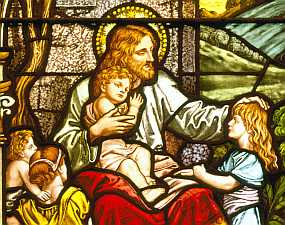
Then were there brought unto him little children, that he should put his hands on them, and pray: and the disciples rebuked them. But Jesus said, "Suffer little children, and forbid them not, to come unto me: for of such is the kingdom of heaven."
—Matthew 19:13-14 KJV

Earlier this week I posted a More Cowbell Award , handing out "The Award No One Wants to Win" to children's Christian education programs (including Sunday School, Vacation Bible School, and Christian summer camps). That Stained Glass of Jesus Blessing Childrenparticular post generated more comments than any other More Cowbell Award I've given out. When it comes to educating the next generation of Christians, plenty of opinions exist.

I suspect even more opinions exist about the nature of children and salvation.

My son is nearing six years old. He's quite intelligent, loves God, enjoys church, spontaneously prays for others and for his own needs, and has a decent knowledge of the general truths of the Bible for his age. He continually surprises me with his questions about God, and surprises me even more with some of his answers. He'll always answer positively when asked if he believes in Jesus.

But is he saved?

For most of my adult life, I've leaned toward credobaptism. I was baptized as an infant in the Lutheran Church, but grew convinced of the need as an adult to show my own faithfulness toward God by being baptized as a confessing adult. (I kept this secret for many years from my parents. My brother felt the same as I did, got baptized, and told my folks, bringing lots of grief down on him and them.)

Later on, I worked in ministry to children and grew increasingly distressed about the issue of whether or not a child under ten understood the Gospel well enough to be justified. Probing kids for any information that might shed light on their eternal status yielded few results. Kids are such natural mimics that it's hard to discern whether they truly believe or are just mimicking what they know adults like to hear.

Kids don't make it any easier when it comes to the fruit of genuine Christian belief. Kids whose parents adamantly claim are rock-solid, baptized kiddie believers can be as rotten as those kids whose parents make no such claims. If a kid shares his milk and cookies with his friends and can rattle off a few memorized Bible verses are those actions proof of a genuine conversion?

For adults, the issue isn't always clear, but it's still far easier to discern. The dope fiend in gothic drag who comes to Christ and then goes on the mission field—that's an easy one. But truthfully, as long as I've worked with kids under ten, I'm not sure what an honest-to-goodness conversion looks like in a young child.  And I don't think I'm the only one.

This whole sticky wicket poses enormous theological problems. A quick scan of the great Christians poised in every possible corner on this issue makes a less diligent believer like me feel extraordinarily uneasy.

Our inability to come to any unified answer on the topic of the justification of children clearly shows in our split on credobaptism (baptizing confessing believers) and paedobaptism (baptizing children, though without a profession of their own personal faith in Christ.) While I don't believe in regenerative baptism—and most Protestant's don't if they truly hold to the truth that justification is by faith alone in Christ—it's still clear that Jesus put an extremely high mandate on baptism:

Jesus answered, "Truly, truly, I say to you, unless one is born of water and the Spirit, he cannot enter the kingdom of God."
—John 3:5 ESV 

Obviously, one can go too far with this, though. I once had a friend whose boyfriend got mixed up in the Boston Church of Christ movement. That group believed in regenerative baptism. After he'd made a profession of faith, there was a delay in getting him baptized, and he basically locked himself up in his room until that day, afraid he'd be killed accidentally before he got baptized.

We read that and shake our heads, but if we extend the baptism beliefs of many Christians out to their logical ends, some relatively normal denominations pretty much believe the same thing—or else have to do a lot of intellectual shimmying to make their beliefs fit. I wrote a piece last year that talked about this issue after Steve Camp wrote a blistering predestination piece that pretty much came right out and said that the infant who dies in childbirth is predestined to hell. I don't know about you, but as a parent it's pretty hard to take to think that any child of mine that might have died in childbirth went straight to hell because God predestined him/her to die in childbirth. That seems a rather strict limit on God's mercy and any covenants He makes with believing parents.

Whether you're a credobaptist or paedobaptist, the questions remain:

  • What constitutes a genuine conversion in a child? And isn't it only by being converted that we are saved?
  • How do we know a child truly believes and isn't just repeating what he or she heard in Sunday School (or is mouthing what receives the most attention and adoration from Mommy and Daddy)?
  • Is there a covenantal aspect in the faith of believing Christian parents that ensures God's mercy and grace upon their children, whether baptized or not, believing or not?
  • For paedobaptists: If we're truly saved by faith alone, what good is baptizing an unbelieving child? And doesn't your baptizing of that child before a profession of faith only later lead to a false confidence in that child for his/her salvation? And what about the murky area of being "rebaptized" after a full confession of faith?
  • For credobaptists: How confident are you in credobaptism that you would risk letting your children die unbaptized?

It doesn't give me much comfort that so many good Christian sources are split on this. I noted earlier this week that Monergism.com highlighted the split, with solid theologians occupying both sides of the baptism argument. Ironically, most Arminians are credobaptists, so you would think the Calvinist monergists would be 100% in opposition, falling completely into the paedobaptist position. But even Jonathan Edwards was conflicted on this issue, baptizing infants but giving that baptism no efficacy for salvation. (What's the point then, Jonathan?)

Apart from the issue of baptism, Jonathan Edwards presents another unusual case that takes us back to our original question of the salvation of children: he states he was converted at four (or was it his wife—I can never remember). I talked to a member of my wife's family who told me last week that his kids were converted at that age. Honestly, I don't know how anyone can tell that for certain in a child that young, and if one can't (and happens to be a credobaptist), I'm not sure that baptizing them is a wise move.

In the end, this issue troubles me greatly. I'm sure I'm not the only one who's bothered by it, though.

You can't go to the great Christians on this issue because so many diverge on their opinions on baptism. Others fail to give any standards for judging if a child is saved or not. And like I said in my post from two days ago, what do we do when the pantheon of Christian greats can't answer the question?  I certainly don't want to trust the opinion of a man on this one, either, if salvation is truly on the line.

If we go to the Bible, we can find plenty of verses that go either way on baptism, so I dunno. And as to telling when a child is saved or not, well, the age of accountability doesn't exist in the pages of the Word, nor is there a truly solid "age-related" guide for discerning whether a child is genuinely espousing the faith or just trying to win "mommy points."

Other ideas have problems, too. If we are to receive the Kingdom as a child does, is this implying that children are already in and they can only fall out? So much for original sin. And if Jesus readily healed children in the course of His ministry, why would He do so if those kids would only grow up to either forget Him or reject Him? What's the point of healing people who are only destined for hell? And what of the perseverance of the saints if a child comes to Christ innocently in their young childhood, then completely rejects Him in adulthood? How many people can each of us name who did exactly that?

I get (wrongly) accused of being a blogging Christian know-it-all, but I'll be honest: this issue has me stumped. If there was ever a topic that I wish the Bible was more explicit on, it's this one.