For this is the covenant that I will make with the house of Israel after those days, declares the Lord: I will put my laws into their minds, and write them on their hearts, and I will be their God, and they shall be my people. And they shall not teach, each one his neighbor and each one his brother, saying, ‘Know the Lord,’ for they shall all know me, from the least of them to the greatest. For I will be merciful toward their iniquities, and I will remember their sins no more.” In speaking of a new covenant, he makes the first one obsolete. And what is becoming obsolete and growing old is ready to vanish away.
—Hebrews 8:10-13
I don’t normally jump all over someone else’s posts. Nor do I encourage rancor in the Godblogosphere since it (100 percent of the time) accomplishes nothing good for the Kingdom. But I saw something this weekend that just made my jaw drop.
Over at the Council of Reforming Churches, Tony Carter wrote an innocuous-looking post entitled “Reasons for Reading.” As an avid reader, I fully support reading. If I can look back on one good thing I did for my son, it’s that I got him reading at a young age—and enjoying it immensely. He goes over to another kid’s house and scopes out the books before the toys. If nothing else I do for him educationally, at least I know he’ll have a love for books.
No, what troubled me more than anything was Carter’s reasoning for why all Christians should be avid readers:
[Reading] is the primary means through which God has chosen to communicate to his people.
In short, no. Not even close.
Now before I get a hundred Scripture verses tossed my way, let me make a very simple (and historically) accurate statement: The reason that reading CANNOT be the primary means through which God has chosen to communicate to His people is that for most of human history, very few people could read. Illiteracy is the primary state of most humans throughout civilization, and only the cultural and governmental elite possessed a literacy rate worth mentioning.
I shouldn’t have to draw out this conclusion, but if most people in human history are/were illiterate, than that goes for most of the people labeled “Christian.”
This poses a horrid problem then, for if what Carter says is true in his statement, then most Christians were fundamentally cut off from communicating with God.
Let’s go even further and understand that even for those Christians who could read, very few of them had a Bible. Even during the days of the early Church, only a few households had any written Scriptures at all to select from. The situation gets worse when we consider the plight of the Gentiles, who had little access to what were then considered Jewish writings.
Further historical analysis shows that Christianity swept through the Roman Empire largely through the poor, who rarely had the kind of education that would allow them to read or write. The common people who embraced Christ so readily had almost no reading material of any kind, much less anything considered Biblical.
More to the point, it would be a millennia and half before the printing press even made owning a copy of the Bible possible, and still possessing copies of the Scriptures lay beyond the reach of the large majority of Christians.
So simply from a historical and sociological standpoint, it’s impossible to claim that reading is the primary means by which God communicates with His people.
But if not reading, what?
Well, for one, we know that oral communication made up much of what the people heard of God. Those few who could read may have been able to use that skill as a stepping stone to teaching others the Gospel. Again, history shows that the leaders of the Church possessed some level of literacy, or at least the ability to pass on what they heard orally. This explains the need for solid preaching—many people had no access to the Scriptures except from the preaching they heard.
But even this poses problems, for the second you remove the leaders from the life of the Christian, the common people end up deaf to God.
No, what is needed is the ability to always come before God, to hear Him, and to communicate with Him in such a way that even the most powerless, poverty-stricken disciple can talk with Him. That ability must not discriminate. It can’t be reserved for one special group or another. It must be available to all.
So what is God’s primary means of communicating with His people?
The Holy Spirit.
Not a believer exists who exists without the Spirit. Access to Scriptures may come and go. One may be able to read the KJV with total comprehension or one may be unable to even read or write one’s name. But no matter what, God gave us a means of communicating with Him and with each other through the Holy Spirit.
Need more proof?
When did the Church come into existence? At Pentecost. And what was the sign of Pentecost? 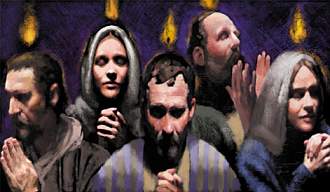 The Holy Spirit coming to indwell Man. And what was the sign of proof for that indwelling? A communication gift—tongues.
Even better, what distinguished the Church from the old Temple-based system in Israel comes down to access. The Temple system demanded literacy and was restricted to a priestly class of elites. The glory of Christ’s sacrifice to gather to Himself a a Bride is the rending of the Temple veil and a Holy God making his home in even the lowliest person. By the Holy Spirit alone are we made equals. Literacy or illiteracy, the Holy Spirit is the equalizer, transcending man-made barriers.
The Bible itself states that there are limitations to the written word:
Now there are also many other things that Jesus did. Were every one of them to be written, I suppose that the world itself could not contain the books that would be written.
—John 21:25
Truthfully, those books have not been written in pen and ink. If we consider carefully, those “books” are you and me, in that what Christ has done in us by His Spirit fills those unwritten books. Not by any means that can be read in print, but in transformed lives that “speak” and attest to the power of God by the very fact that you and I testify to Christ.
But it all comes by the Holy Spirit.
Because the depths of the wondrous workings of Jesus in our lives hasn’t been codified in its entirety (as is evidenced by the concluding statement of the Gospel of John above) , no limit exists to what we can know of the Godhead or His wonders. And who reveals the depths of the Lord to us?
But we impart a secret and hidden wisdom of God, which God decreed before the ages for our glory. None of the rulers of this age understood this, for if they had, they would not have crucified the Lord of glory. But, as it is written, “What no eye has seen, nor ear heard, nor the heart of man imagined, what God has prepared for those who love him”– these things God has revealed to us through the Spirit. For the Spirit searches everything, even the depths of God. For who knows a person’s thoughts except the spirit of that person, which is in him? So also no one comprehends the thoughts of God except the Spirit of God. Now we have received not the spirit of the world, but the Spirit who is from God, that we might understand the things freely given us by God. And we impart this in words not taught by human wisdom but taught by the Spirit, interpreting spiritual truths to those who are spiritual. The natural person does not accept the things of the Spirit of God, for they are folly to him, and he is not able to understand them because they are spiritually discerned. The spiritual person judges all things, but is himself to be judged by no one. “For who has understood the mind of the Lord so as to instruct him?” But we have the mind of Christ.
—1 Corinthians 2:7-16
I wrote a few weeks ago that we in the American Church continue to give short shrift to the Holy Spirit. Instead, let’s cherish the Holy Spirit and give Him the rightful place as the primary means by which God communicates with His people.

 The Scriptures describe three distinctives of this soldier:
 This week we’ve looked at insights I received last weekend concerning American Christianity’s bifurcation into two streams of thinking and operation, Externally Motivated (EM) Christianity and Internally Motivated (IM) Christianity. To go back to the sources, please read “