
Christmas…Resurrection

Standard

We may all have heard the statistics:

  • More heart attacks occur in December than any other month
  • More people are treated for depression in December than any other month

What is it about this time of year that people are so stressed, so sad?

I’ll admit that Christmastime has not been the same for me since my parents died. My father died at Christmastime five years ago, and Mom was clearly terminal, living with us, but in many ways already gone. Charlie Brown's ChristmasThe following Christmas in 2001 drove home the fact , now that they were both gone, that they had borne a far greater role in the joy of the season for me than I had understood. You are always a child at Christmastime as long as you’ve got a surviving parent, but take that away and now it’s up to you to be the one who maintains the Christmas spirit. Now it’s for your children more than for you. It’s a role we never think about accepting until it is thrust upon us and there is no one else to turn to.
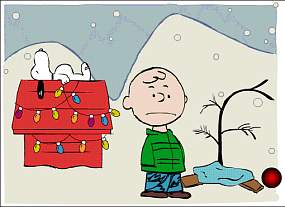
Big families make up for some of that loss, but Christmas is a bit sad for me now because I see that my own little family is probably going to stay little. The dynamic of having brothers and sisters at Christmastime will be lost on my son, something I never thought would be the case when my wife and I got married, but that is how things are, quite apart from our best intentions. Just the three of us creates a certain vulnerability at Christmastime that is hard to explain. I had my brothers around growing up, but my son will probably just have us.

Today, I was going to bake cookies, but my son may have chickenpox and my wife is very sick. Illness at Christmastime is the worst time for being under the weather. I remembered a couple Christmases growing up when one of my family was sick, but that was rare. However, in the last few years someone has always been sick at Christmas, usually me. When we were excited about hosting my wife’s family for Christmas a couple years ago, the real flu hit just about everyone and the whole enterprise shriveled up because no one was in the mood to do anything. The whole house should have been quarantined. Lots of planning and effort, but not much realization.

Whatever planning I had this year didn’t materialize. We can’t go see my brother across town for Christmas because he and his wife are expecting a child any day now and chickenpox and ready-to-birth moms are an absolute no-no. I had great plans for my wife and I to wrap presents together this year and relax, but she is in bed sick, and with my meager present-wrapping skills, I labored for six hours over what amounted to a little more than a dozen presents. Doing things alone at Christmas is not how it should be.

That meager stack of presents isn’t how it should be, either. I grew up with a Christmas tradition that said that Dec. 25th was the day that you got everything you were going to get for the year. All the toys came then. Most of the clothes came then. As a result, Christmases were huge at our house. Despite having a large family room, between the genuine tree and the tsunami of gifts pouring out from under it, there was hardly room to walk. I loved to shop for people, too, being one of those people who got more excited by what he gave then by what he received. I always tried to think of marvelous gifts to give, and more often than not, those gifts were spectacular and exactly the right thing to for each person.

Today, though, financial considerations have cut back our Christmases to the point that whatever boost I got from giving has been dampened by the realization that few of the things I’d like to give are within our reach anymore. If there’s a tree, it swallows whatever may be under it. And every year we are asked to cut back even more. Two out of the last five Christmases found us without an income, vulnerable at the one time of the year when plenty is assumed. Those were hard. I’m not sure I ever really got over them, either. You wonder what the next Christmas holds, a bit more fearful than the Christmas before.

None of this is how it should be. It’s not how I remember Christmas.

For four hundred years, the world lay waiting. There was no word from the Lord. The pagans swept in, and with them came darkness. Medes, Persians, Babylonians, Romans—one horde after another asserted control over the people of God.

Then came the light, the promise, the hope.

Christmas is a sad time for many who remember that it was good once, but doesn’t seem that way anymore. They are the ones who cry out, “Maranatha!” Christmas reminds us of all that should be right with the world, but the world isn’t always right. And as time goes on, it seems a little less right every year. It is our groaning, awaiting something better, the second Advent.

Nostalgia can bring paralysis. When I see people paralyzed by Christmastime, I know how they got that way. If you had a great childhood and things aren’t so great now, Christmas is missing that spark of life. An emptiness resides where the expectation once lived, nagging and frustrating.

But it’s not about Christmas, is it? It’s about an empty tomb. Christians were never the Christmas people, those concentrated on the First Advent. No, we are the resurrection people, born to die, then to live again. And at this point in time, as we move farther away from our own birth and closer to the time of our own death, we live in that stasis between the two, caught between opposing worlds, to die to the one and be raised into the other.

No one said it would be easy walking out that dying. When I look at Christmas 2005, I see a lot of little deaths. In the midst of that sadness, though, is the hope of the world to come.

If you’re sad this Christmas, let someone else know. It’s not something you struggle with alone—millions of others have a heavy heart as the shortest days of the year roll around. Don’t bear that by yourself.

…but we ourselves, who have the firstfruits of the Spirit, groan inwardly as we wait eagerly for adoption as sons, the redemption of our bodies. For in this hope we were saved. Now hope that is seen is not hope. For who hopes for what he sees? But if we hope for what we do not see, we wait for it with patience.
—Romans 8:23b-25 ESV
If We Should Have to Die

Standard

Although prepared for martyrdom, I prefer that it be postponed. —Winston Churchill

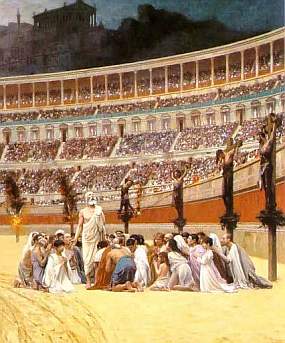
The end of October brought us three Indonesian girls beheaded for no other reason than their faith in Christ. Just last week, two Christian girls were shot in the head, one of them having since died. President Bush goes to China even as three Chinese Christians are imprisoned The Christian Martyrs' Last Prayerfor the crime of printing Bibles for the Chinese people to read.
All I ask is one question: Are you prepared to be martyred for the Lord Jesus Christ?

I suspect that Churchill's witticism is closer to the hearts of most Christians in America than the image of five dead American missionaries lying half submerged in an Ecuadoran river bed. Shouldn't the idea of martyrdom make it at least a fraction more difficult to get excited about loading our new iPod Nano with a thousand CCM offerings? Shouldn't the increased persecution of Christians in Eritrea, Sri Lanka, Bangladesh, Pakistan, Indonesia, China, Vietnam, and a plethora of other countries cause us to stop for a second during the orgy of shopping that passes for Christmas today?

Although this last Sunday was designated International Day of Prayer for the Persecuted Church, this issue of martyrdom has been on my mind since the day I first confessed Christ as Lord. Yet I don't meet too many Christians who actually think about it at all. I rarely hear about martyrdom from the pulpits in most churches in this country. It's something that happens elsewhere, but not here. We console ourselves with the fact that some anti-Christian punk might take a key to our Volvo, but that's as far as it goes.

It went a lot farther for four Indonesian girls who paid the ultimate price for their profession, didn't it? Did their churches teach that one day they might have to die because the world hated them?

The world doesn't really hate us here in America. We've camouflaged ourselves so readily with worldliness that no self-labeled persecutor of the Church would even be able to find us, much less martyr us for the Faith. We've got an appointment tomorrow with our Crown Financial consultant to go over our 401k distribution, don't we?

Not only have we not counted the cost all that well, but we've ignored it all together. Death is such a sticky thing and the less we bring up the subject, the more likely it is that we can postpone it altogether, especially if it involves winding up on the wrong end of a spear in a jungle. No jungles around here, right?

That jungle just may be coming to us, though. Even then, the sad truth for a lot of us, including myself, is that our lights may be so dim that the real haters of Christ may not feel that we're worth a spear. Why snuff a smoldering wick when there are still a few floodlights to deal with—emphasis on few.

I suspect that too many of us are working overtime to ensure that everyone loves us rather than living for Christ in such a way that everyone hates us. I know I don't feel especially hated. I must be doing something wrong. Yes, I've heard the conspiracies about the warehouses in upstate New York (or California or Wyoming or wherever) filled with guillotines so that the U.N. can more easily dispatch American Christians when the time comes. That scenario is not nearly as scary as the one where U.N. operatives under control of the antichrist can just let the guillotine blades rust because there's no one left in North America who still believes in Christ enough to warrant losing a head.

Let's face facts—we're not ready. The American Church is about as prepared to be martyred as it is to be fêted by the homosexual lobby. Can't remember the last time any noted Christian conference speaker (in front of a crowd that paid $300 each to hear him) delivered a message on how to be a martyr for Jesus Christ. Better to save that money for the latest iPod!

Voice of the Martyrs

Prisoner Alert

The Barnabas Fund

Open Doors Ministries

{Image: detail from The Christian Martyrs' Last Prayer by Jean-Léon Gérôme, 1883}

Creating a Theology from Unbelief

Standard

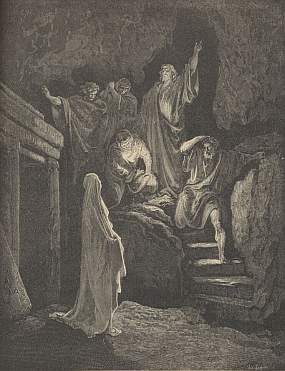
Christ raising LazarusThis is one of the most difficult posts I’ve ever written on Cerulean Sanctum. I have no doubt that there will be people who delist me from their blogroll or who will never visit this blog again simply because of this post.

But what I write here is something that has to be said. I hope you will read it to the end.

A couple weeks ago, Christianity Today online posted an article entitled “Can I Really Expect God to Protect Me?” (I would encourage everyone to read the entire article.) The author of the post goes on to relate the tragic story of her daughter who was born with a rare metabolic disorder and later died. This was indeed a heartrending event. However, I believe the author proceeds to deconstruct Psalm 91 and come up with a new theology that attempts to shoehorn her personal tragedy into the Scriptures and pull out something that does not exist.

Psalm 91 says:

He who dwells in the shelter of the Most High will abide in the shadow of the Almighty. I will say to the LORD, “My refuge and my fortress, my God, in whom I trust.” For he will deliver you from the snare of the fowler and from the deadly pestilence. He will cover you with his pinions, and under his wings you will find refuge; his faithfulness is a shield and buckler. You will not fear the terror of the night, nor the arrow that flies by day, nor the pestilence that stalks in darkness, nor the destruction that wastes at noonday. A thousand may fall at your side, ten thousand at your right hand, but it will not come near you. You will only look with your eyes and see the recompense of the wicked. Because you have made the LORD your dwelling place— the Most High, who is my refuge— no evil shall be allowed to befall you, no plague come near your tent. For he will command his angels concerning you to guard you in all your ways. On their hands they will bear you up, lest you strike your foot against a stone. You will tread on the lion and the adder; the young lion and the serpent you will trample underfoot. “Because he holds fast to me in love, I will deliver him; I will protect him, because he knows my name. When he calls to me, I will answer him; I will be with him in trouble; I will rescue him and honor him. With long life I will satisfy him and show him my salvation.
—Psalms 91:1-16 ESV

The disturbing issue for me is that the author takes the promises of Psalm 91 and spiritualizes them in such a way that they no longer refer to earthly protection, but instead have been translated into a form of gauzy spiritual protection by bringing in Matt 10:28a (“And do not fear those who kill the body but cannot kill the soul….”) and using it as a means of tempering the starkly-framed promises of Psalm 91. The end result of her exposition of Psalm 91 is that God doesn’t truly mean He’ll protect our physical selves, only our spiritual selves. The pestilence may very well kill the body, but it cannot kill the soul—we should be satisfied with that.

But is that what Psalm 91 really says? Or has the article’s author tried to bend the Scriptures to account for her experience?

The more I stand back and look at the state of Christian belief in this new millennium, the more I see that our theologies, while good on the surface, are rife with our own unbelief. We insist that the Bible is God’s inerrant word (and this I wholeheartedly believe), the very truth that frames our salvation and belief, but why then do we spend so much time trying to construct theologies that negate the truths we supposedly endorse?

Nothing makes me grind my teeth more than attending a funeral of a person who died from an illness, especially a protracted one, only to hear a half dozen people offer the same platitude: “Well, he’s finally healed.” What I have to ask is if Jesus or one of the apostles would have been satisfied with that assessment? Can you imagine that coming out of the mouth of Paul? Or who here, no matter how much of the Bible is believed to be inerrant, has the nerve to go up to James and say, “In this case, you really messed up in your chapter 5, verses 14 and 15!”

Am I the only one that thinks that the sort of attitude displayed by those half dozen at the funeral is nothing more than a theology of unbelief? A theology that says, “Plan A didn’t work, so we now have to settle for Plan B, shoehorn it into our experience, and explain it to our kids.” Despite the fact that we say the Bible is true, I suspect that many Christians today—even seasoned apologists—simply don’t believe it is, so they dance around the things they don’t believe and try to come up with verses and high-sounding enlightened spirituality to explain away the stuff that doesn’t seem to work.

Since we’re on the topic of healing, here’s a well-known passage to illustrate:

Of David. Bless the LORD, O my soul, and all that is within me, bless his holy name! Bless the LORD, O my soul, and forget not all his benefits, who forgives all your iniquity, who heals all your diseases, who redeems your life from the pit, who crowns you with steadfast love and mercy, who satisfies you with good so that your youth is renewed like the eagle’s.
—Psalms 103:1-5 ESV

Okay, so here’s the checklist of what God does here:

Forgives sins—check
Redeems our lives—check
Crowns us with perpetual love and mercy—check
Satisfies us with good—check
Renews our strength—check
Heals all our…hey, wait a second!

Wait a second, indeed. We seem to have no problem believing all the things we just checked off above. I would dare say there’s not a person reading this now who doesn’t assent to the truth that God makes those checked items happen. But do we believe God heals all our diseases? He said the pestilence wouldn’t touch our tent in Psalm 91, didn’t He? He ended that passage by saying something about blessing the righteous with long life. Well?

A few months ago I blogged on the least-believed verse in the Bible, Mark 11:23:

Truly, I say to you, whoever says to this mountain, ‘Be taken up and thrown into the sea,’ and does not doubt in his heart, but believes that what he says will come to pass, it will be done for him. (ESV)

Suffice it to say, Jesus drops a nuke here. When that ICBM explodes in our lives, I think too many of us erect a theological shack over the resulting crater and say to others and ourselves, “Move along! Nothing to see here.” Still, the crater and its fallout persist. Our choosing to ignore their existence is not a measure of God’s truth, but the tortured theology we’ve created to explain away the fact that whatever the mountain was that we needed moved, it dauntingly stayed right were it was.

Call me immature in my walk, if you wish to. Trot out all the great theologians over the centuries to lambaste what I’m saying. All I know is that I can’t escape the fact that far too many of the Bible’s promises, especially the most outlandish ones that don’t always fit with our experiences, are glossed over by Western Christians, explained away by complex manipulations of the Scriptures to suit whatever our personal blind spot is.

Why can’t we just come out and tell the truth here? The problem is not the Bible; it’s us. It’s our lack of faith. It’s our doubt. We can’t help but doubt because we live in a world where divine healing or exorcisms or mountains being cast into the sea are ruled out scientifically. Though Peter can’t be considered the be all and end all of scientific knowledge, he knew that a man can’t walk on water. Yet for a brief moment he was able to—until he let his earthly knowledge overrule heavenly faith.

Sadly, our willingness to believe only our eyes, our microscopes, our newspapers, or what our grandma says has led us to question the veracity of the Bible. In the end, every last one of us has traded at least some part of the truth of God for a lie. We’ve constructed a portion of our personal theology on smoke because some verse or passage in the Bible, from our point of view, just can’t be saying what we think it’s saying.

So when we doubt and use our manufactured theology to prop up that doubt, we create a self-fulfilling prophecy that ensures that none of those promises of God that we have a hard time swallowing will ever come to pass. We can believe 98% of what the Bible says is the truth about the world we live in and the world we cannot see, but what about that other 2%? How easy it is to find a religious-sounding means of explaining it away!

I am by no means a saint. If I listed all the sin in my life that routinely holds me back, you’d never visit this blog again. I’m sure if you posted your sins, there’d be a collective “Ooh!” from a lot of people, too. All have sinned and fall short of the glory of God. My heart truly goes out to the author of the Christianity Today article. This post is not meant to burden people, but to ask if we are as bold in our faith as we think we are. It’s a gut check for us to examine ourselves and see how we fail in regard to truly believing the promises of God.

I confess my own theology is not 100% faith-based. I’ll come right out and say that there are Scriptures that I mentally assent to, but deep in my heart I don’t fully believe them. One that always trips me is from the most beloved Psalm in all the Bible:

Surely goodness and mercy shall follow me all the days of my life….
—Psalm 23:6a

I don’t always believe that goodness and mercy will follow me all the days of my life. Too often I think that surely calamity and injustice will follow me all the days of my life instead. However, what I can’t escape is that somewhere in my inner man, in that place where the Spirit of God dwells, I know that if I truly did not doubt what Psalm 23 said, my life would be radically transformed.

That kind of unflinching, unwavering faith is the call of God, not only for me, but also for you. To fully believe all the Bible at face value is what God asks of us all. He doesn’t want us constructing negations of His truth from other parts of His truth. He wants us to believe and not doubt.

Are the dead still raised? Or are we going to try to spiritualize the raising of the dead by saying that God doesn’t really raise anyone physically from the dead anymore, but just spiritually, while piling on a heap of other Scriptures that speak tangentially to the issue we would rather not confront at face value? What other tough sayings or issues in the Bible cause us to trot out our finely-honed theological excuses? Are we ready to abandon them at the foot of the cross and take on a faith that believes the mountain can be cast into the sea?

Say it with me now: “I believe, Jesus! Help my unbelief!”