

The Practice of the Practical Gospel

Standard

Weeping angel sculptureTim Challies had a convicting analysis earlier this week concerning the shallowness of Evangelicalism. I think that more and more of us are fed up with the state of the American Church in general, and Tim puts a fine point on our flailing around:

The shallowness of evangelicalism leaves it largely inequipped to deal with the difficult issues. If we are to be a people that brings hope to the hopeless, purpose to the purposeless and joy to those who know only sorrow, we must be prepared to give answers that are biblically-based and Scripturally-satisfying. To do this we must wrestle with the difficult doctrines of sin, love, sorrow and suffering. We must be prepared not only to give an answer for the hope that lives within us, but for the suffering that causes us to draw upon that hope and to take our refuge in Christ Jesus, the One whose death gives us hope for now and for eternity.

Amen to that.

Yet I think that for the Church in America to really live out the Gospel it has to go one step further. While I agree that the Church must do a better job with our answers, I believe even more strongly that we must radically improve our praxis, the very practical living out of the faith that lies behind those answers.

While I may get dinged by some for suggesting this, if it were merely an issue of biblical answers, I could type up an appropriate set of Bible verses, add in a dash of exposition by a famous Christian of yesteryear, and simply hand out the right pages that would address the specific problem of this person or that. In this way, no one could ever claim that they didn't get answers to their pain.

However, if you'd just had your world ripped apart, is a package of answers wrapped neatly in a bow going to assuage your anguish or make you feel loved? Not likely.

If Christianity were just about answers, then it's reached its pinnacle because you can Google for answers and get a gazillion and a half Web sites—including this one—ready to dispense Christian truth at a moment's notice.

But we're not the Blog of Christ. We're the Body. That Body wasn't created to go into the hellholes of Earth and hand out a tract, but to be the very arms of Jesus around a broken person who needs a shoulder to cry on more than she needs someone armed with a relentless set of answers.

This isn't to say that Tim's wrong. No, he's absolutely right. The problem arises in that answers must be accompanied by someone who cares enough to go the second mile. Postmodern people expect that everyone will claim to have answers, but they're more willing to listen to those bearers of truth who demonstrate compassion first and answers second—and for good reason: the rightness of what we believe was never intended by God to exist in a vacuum barren of human interaction. We're the Body of Christ (and not merely the Answers of Christ) by His wisdom, and we gut the Gospel if we think we can casually drop an answer bomb on hurting people and walk away. Yet how many thousands of times a day, especially on Sunday, does that happen in our churches, workplaces, and homes?

No one supports apologetics more than I do. The Bible clearly states that each one of us should know that of which we speak. Still, the fact remains: one of the primary reasons the Western world doesn't take the Church seriously (and even the Western Church doesn't take itself seriously) is we thought we could trade godly, compassionate relationships for easily dispensed solutions.

Any regular reader of Cerulean Sanctum must get tired of me preaching this, but the whole truth is that the Gospel transforms fully only in vital community. Ignore community long enough and the power of the Gospel to change lives is diminished. Not because the Gospel failed, but because our practical expression of it in community failed. This is wholly our problem and not anything that's wrong with the Gospel.

How so? If we're not willing to sit for hours on end with the grieving congregant who just buried his fiancée days before their wedding, what then should we expect of him when it is our turn to mourn? Our lesson to him is that it is easier to quote a few appropriate passages of Scripture than it is to give the one thing we value more than anything else today: ourselves. Over time, people learn that only short, well-rehearsed scripts can be expected and not a knock on a door that reveals an empathetic face ready to listen rather than dispense answers. Pass enough of this anti-Christian interpersonal neglect around within a worshiping community and I can guarantee we can make Sunday (and the rest of the week for that matter) as empty of God's compassion as the darkest portions of hell.

Answers matter. But in the end those answers have a proscribed destination: people. Why then are we so willing to ignore people or give them only a minute of our time on our way to whatever we deem in the moment to be more important than they are?

We will never have a greater mission than to be Christ to the people we encounter daily. If we can't make room for them, then no matter how much of the Bible we memorize, nor how many answers we're equipped to provide, our ministry will bear no fruit.

Love Sin / Hate Sin

Standard

My church held their annual picnic this last weekend. One of the church-wide contests was a chili cook-off. I told my wife I was going to enter and win the whole thing. This blogger can cook a scrumptious bowl of chili. I whipped up a batch, entered it, and indeed won the whole thing.

Upon winning that coveted blue ribbon, I let out a huge whoop, raised the hands high, and let everyone there know that I was triumphant. And later I felt bad about doing so.

Was it too much? The more time passed, the more I felt that I’d been a tad over the top in my moment of chili glory. While the other contestants trash talked before the judging, I was relatively quiet—I let the chili do the talking. But afterwards I really wanted to rub their noses in it, at least a little.

It’s been a tough last few weeks. The tenor in the household is “muddle through” stage. That stage has been common around here far more than it should, and I’ve grown to hate it. You feel that things will never get better.

So is a little rejoicing for a silly contest too much? Can a little hollering be good for the soul here? Or am I just exulting at someone else’s expense?

Sin is perpetually crouching at the door. The smell of it lingers in the air. And though we are told to flee it, despise it, and rail against it, there are times that I must confess—to my own dishonor—that I love it.

During my tenure in the Lutheran Church, I never got a handle on Martin Luther’s famous aphorism on sin that he penned to his buddy Philip Melanchthon 484 years ago:

If you are a preacher of grace, then preach a true and not a fictitious grace; if grace is true, you must bear a true and not a fictitious sin. God does not save people who are only fictitious sinners. Be a sinner and sin boldly, but believe and rejoice in Christ even more boldly, for he is victorious over sin, death, and the world. As long as we are here [in this world] we have to sin. This life is not the dwelling place of righteousness, but, as Peter says, we look for new heavens and a new earth in which righteousness dwells. It is enough that by the riches of God’s glory we have come to know the Lamb that takes away the sin of the world. No sin will separate us from the Lamb, even though we commit fornication and murder a thousand times a day. Do you think that the purchase price that was paid for the redemption of our sins by so great a Lamb is too small? Pray boldly—you too are a mighty sinner.

Now that I am older, though, it makes more sense to me. As much as I am commended to loathe sin, there are still parts of me that love it just a little more than I should.

  • I love/hate reveling in accolades bestowed upon me.
  • I love/hate watching foes—real or imagined—get their comeuppance.
  • I love/hate convincing myself that I’m smarter than most people.
  • I love/hate gazing just a breath too long at the pretty young thing in line ahead of me at the grocery store.
  • I love/hate cutting down an opponent with a witticism worthy of Oscar Wilde or Will Rogers.
  • I love/hate knowing that the terrorist who just blew himself up and took out a dozen other people is going to burn in hell for eternity.
  • I love/hate watching haughty people taken down a peg or two.
  • I love/hate the dark fantasies I entertain.
  • I love/hate my own pride.

As a younger Christian, I would deceive myself into thinking that I wasn’t like this. But faux innocence is just that—a denial of the reality that in this world there will be sin. No one is immune no matter how perfect the persona we project to others.

I think the Christian blogosphere perpetuates this. Cruise around enough blogs on a daily basis and it’s fairly easy to see the hate portion of the love sin / hate sin equation. Yet there’s not quite as much of the love sin portion displayed. MasksToo much confession may alienate the more righteous readers. Too much confession may cast doubt on how well ANY of us Christians are doing in walking the walk as well as we talk the talk.
Far more of us are dying for confession than almost anything else, I suspect. Whitewashing takes exorbitant amounts of work, and legions of Christians are propping up an image of a fictitious sinner, the error Luther warns of, to their own detriment.

I crave grace, don’t you? What a marvelous gift, sublime, healing, and transforming all in one. Because of my love for grace, I can never be a fictitious sinner. My errors will always be bold. I can only ask that my prayer of repentance be yet bolder still.

Are you laboring to maintain the façade of a rosy righteous glow when darkness has become your friend instead? Christian, stop fighting and let someone else know!

…for all have sinned and fall short of the glory of God….
—Romans 3:23 ESV

There is peace in confessing your sins not only to God, but to someone else:

Therefore, confess your sins to one another and pray for one another, that you may be healed. The prayer of a righteous person has great power as it is working.
—James 5:16 ESV

Don’t be a fictitious sinner. It will steal your joy away. If you love a particular sin, acknowledge that before someone else and allow someone to draw up alongside you in the name of the Lord:

…a three-fold cord is not quickly broken.
—Ecclesiastes 4:12

Most of all, rest in the peace that the Lord Jesus bought with his own blood, the very blood that takes away the sins of the world. He said:

Peace I leave with you; my peace I give to you. Not as the world gives do I give to you. Let not your hearts be troubled, neither let them be afraid.
—John 14:27 ESV

Beloved, now is the day to come into the light of Christ’s grace.

What the Church Is Not Learning

Standard

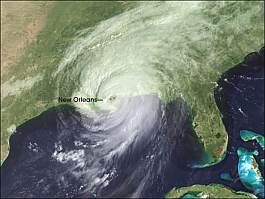
Carnage is the best word to describe what is happening in New Orleans. I pray the Church in this country is watching. What we are seeing may very well be the future, although on a scale restricted to one city in this country. Should more cities than one be involved in a more catastrophic event many days from now, it won't be pretty.

This is not a happy post. People may never want to come back here again after reading this, but I feel compelled to write.

I don't consider Jerry Falwell a spokesman for American Christianity. I want to say that up front. But on 9/11 he commented that perhaps what happened in New York that day was the judgment of God against America's sin. After being shouted down by a protest spearheaded by other Christians, Falwell was forced to retract that statement.

After hearing Falwell's comment, rather than immediately taking sides on it, I thought about it for a long time. Though I never did come to a firm position on what he said, Hurricane Katrinawhat shocked me was that so few people were even willing to consider for a brief moment that what Falwell said might be true.

Now we have a monstrous hurricane decimating a city known for it profligacy and overt sensuality. We have the gambling centers of Mississippi washed out into the Gulf. A couple folks have proffered the same reasoning as Falwell for the wreckage of New Orleans and Biloxi, but once again no one is listening.

Again, I don't have the perfect answer here. Judgment of God or not? I'm still pondering that. What troubles me is that so few Christians are willing to entertain for a second the possibility that Katrina is Wake-up Call #2.

Why does this trouble us so thoroughly that we relegate this possibility to the dumpster so quickly? Can we take a day to ponder this before we say that this is not the judgment of God against this nation? If it's not, then we move on. But what if it is?

The Church here has something to learn through all this. If we cannot discern the judgment of God, a judgment His righteous people easily saw in our Scriptural examples, what does that say about the American Church today?

The images and stories coming out of the Gulf are shocking. They so clearly show the utter depravity of Man that I can't see how we can be the same country after this. All the bravery that we hailed in New York almost four years ago has been swept away. The courageous stories of Katrina are buried in the rubble of vice and sin we see paraded on our TV screens.

What unnerves me about this is that the Church here does not understand that what we are seeing and hearing in New Orleans is far closer to the truth about Man than some are willing to admit. Worst of all, the events in Louisiana only prove that we as a Church are not prepared.

How are we unprepared? Look at the ripples this Gulf event is creating through all the strata that make up this experiment called America. The glaring weaknesses in our government, our energy reserves, our food and water supplies, and most of all, our souls, are on display for all to see. I read today that the area that makes up the most afflicted parts of the Gulf contributes a little less than two percent to the American economy. What if five or ten percent had been affected? Would total chaos reign nationwide?

It saddens me that the Church is largely unprepared to meet a major meltdown in America. We are not planning for a day when times get brutal. In truth, we act as if bad days will never come, the veritable grasshopper to the ant. Only in this story, there appear to be no ants.

He answered them, "When it is evening, you say, 'It will be fair weather, for the sky is red.' And in the morning, 'It will be stormy today, for the sky is red and threatening.' You know how to interpret the appearance of the sky, but you cannot interpret the signs of the times.
—Matthew 16:2-3 ESV

Church, should we not be the ones who interpret the signs of the times? Have we filled our lamps with oil or have the reserves gone out?

Did we learn anything from 9/11?
Did we learn anything from the prolonged recession from 2000-2004?
Are we going to learn anything from the aftermath of Katrina?

From what I can see, we ignorantly go on, blithely brushing it all aside. What else can explain the fact that we have not changed our course?

Just the other day I read that the underground Church in China is praying that persecution will come to America so revival will break out here. While I don't exactly side with that way of thinking, are we prepared if God answers the prayers of the persecuted Church in China?

I don't want the Church here to learn the hard way, but it looks as if we need a more catastrophic event to wake us from our slumber. God help us all should that catastrophe come and we are unprepared.