
The Christian & the Business World #6: The Industrial Church Revolution, Part 3

Standard

World War I stuck a dagger in the heart of Christian triumphalism and capped the rise of postmillennialism. The war over, America was ready to party for any and all reasons, yet it was the intellect that took the fore.

Freud, Marx, Nietzsche, Sanger, Huxley, Russell and Darwin were in vogue. It was all the rage to talk “high and mighty,” and name-dropping of this theorist or that philosopher was commonplace. By now, German higher criticism of the Bible was catching on in the “enlightened” theology departments at the oldest Christian colleges in the nation—Harvard, Yale, and others founded before 1800—and was crushing the life out of true biblical thought there. (Today, it’s hard to believe that schools such as these were founded to produce godly pastors. We’ve learned the lesson of our lack of vigilance the hard way.) Science and philosophy provided every answer and there wasn’t a major city that didn’t feature some form of “World of Tomorrow” exhibit for the residents to explore. Old ideas died or foundered and new ones took their place. It was an age of rationalism in the midst of dance marathons.

Again, the Church had a response to the rationalism, but it was not the measured response of earlier days founded on solid biblical principles. The post-WWI Church found itself in the grip of a Jesus never before considered.

By the 1920s, it was possible to carry a business card and have it say nothing more than “Businessman” and no one would think twice about such a title. Investing in the stock market was a rich man’s habit and a lesser man’s gamble. More than a hundred years of the Industrial Revolution and the rise of corporate America had so benumbed the Church that when President Calvin Coolidge remarked, “The man who builds a factory, builds a temple. Jesus, CEOThe man who works there, worships there,” it wasn’t given much fuss.
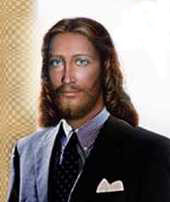
Part of the reason for this lack of condemnation from the Church (apart from the fact that most conservative theologians were busy fighting the battle against higher criticism) was the runaway success of a peculiar little book written by one of the age’s most noted advertising experts, Bruce Barton. His 1925 title The Man Nobody Knows: A Biography of Jesus portrayed the Lord as the “founder of modern business.” And if Jesus Himself had been co-opted, neither would the apostles escape the grasp of the syncretism of business and Christianity, for Barton called them “the greatest sales force in history.”

Looking at Jesus more as CEO than Lord reflected an age when the front pages of newspapers were dedicated to the lifestyles of families such as the Rockefellers, Mellons, Carnegies, and Gettys. Heirs and heiresses to these fortunes commanded center stage. The captains of industry were the role models for the little man. After all, the history of America was the history of pioneers and men who pulled themselves up by their own bootstraps. Each of those wealthy families was headed by a self-made man who had cornered a market by going against the flow. They had a destiny to fulfill, power to grasp, and a dominant will that could take them anywhere. Some of them even went to church on Sundays, and churches were often the beneficiaries of their trusts and philanthropy. In many ways, they were portrayed as the saviors of their times.

Barton’s book was a phenomenon. The fourth bestselling book of 1925, it climbed to number one the following year. Ultimately, The Man Nobody Knows spent more than two years in the top ten. So popular was it that it’s still available for sale today—a rare feat for a non-fiction title from the 1920s. In the end, millions of men and women were intrigued by the “Business Jesus.” Their fears that Corporate America might just be rolling over them were allayed by the fact that Jesus Himself was a businessman. And so the faithful partnership the modern Church in America extended to business was set in stone, a permanence we still feel today.

1925 was a watershed year for another reason, except this one took place far from the reaches of the big city. John Scopes, a high school biology teacher in Dayton, Tennessee, violated the Volunteer state’s constitutional ban against teaching Darwinism in public schools. His trial garnered massive media attention when William Jennings Bryan, failed three-time Democratic candidate for President, signed on as the prosecutor in the case. Bryan became the champion of Christian fundamentalism when pitted against the defendant’s legal counsel, the avowed atheist Clarence Darrow. The trial was broadcast live and radio audiences ate up every second of legal chicanery and posing wrought by both sides.

We all know how the trial ended, but the battle had been lost years before. Darwinism had come to flower in Britain more than fifty years previous, so America was just another step in the long parade. In fact, Social Darwinism, the idea that evolutionary theory explains sociological constructs, had found its perch long ago in business practices. Some people had and some didn’t; prosperity was a function of superior breeding, intellect, and other less classifiable “genetic predispositions.” Natural selection supposedly explained this fact. The witness of the newspapers and their constant trailing after the Rockefellers, Mellons, Carnegies, and Gettys cemented this in the minds of average Americans.

There were other depths reached by Social Darwinism during this time. The growing eugenics movement championed by noted psychologist Havelock Ellis, Margaret Sanger (the founder of what became Planned Parenthood), and a large swath of Catholic and Protestant leaders (either frustrated postmillennialists or those who had succumbed to the liberal theology that had formed from higher criticism), openly worked to separate the genetically pure from the corrupted. The “corrupted” in this case were the usual suspects: immigrants, blacks, and the “lower classes,” in general. Those lower classes were usually determined by one thing: their business status. The vile classism that Social Darwinism fostered had started all the way back in the factories of Britain and had now come to signify the vile racism behind a “Master Race.”

It would be hard to imagine that eugenics and the Social Darwinism that had cultivated it would have been possible without the drastic changes wrought by the Industrial Revolution. If the United States had remained a home-based economy (and free of slavery uniformly), proponents of Social Darwinism would have found it harder to draw the distinctions they promoted simply because any imagined underclass would not have existed.

Instead, the disconnect between what the Bible said about God’s view of Man and what Social Darwinism proclaimed began to tear at the fringes of the Church. A typical churchgoer would mouth the words of hymns, recite Bible verses, and read the Scriptures, but when Monday rolled around it was off to work and the Darwinian dynamic that had subsumed most business practices took over. Some climbed the corporate ladder and some didn’t—to those with a conflicted worldview, the supremacy of Darwin over Christ seemed clear. Better to be a wealthy Darwinian than a poor Christian.

Even today, the fallout of this mentality reigns in Corporate America. People work eight or more hours a day in an environment controlled by a worldview that is, quite simply, anti-Christian, yet few understand the pernicious nature of the worldview governing most of our work. Most of today’s business buzzwords have a distinctly Darwinian source when examined closely. In Christian circles, particularly in men’s groups, the business mantra is to be a “leader.” However, more often than not, “leader” does not mean “servant,” but rather “the one who made it to the top of the food chain.” Jesus is looking for disciples and it is the nature of disciples to be followers. But the average Christian bookstore would quickly fold if it sold Christian business books that claimed to teach people (men especially) how to be good followers.

And so we come to 2005. The troika of the Industrial Revolution, Social Darwinism, and a Church crippled by biblical higher criticism, rationalism, and a dulled reaction time to the sociological changes occurring around it, have spawned the business environment we work in every day. Most folks are oblivious to the insidious nature of Darwinism at work and its stranglehold on most company cultures and practices. That stranglehold extends to the Church, too, as “Jesus, CEO” continues to be the predominant thinking among Christian business leaders and authors who write business books for the Christian market, their failure being the inability to question if the foundation upon which today’s work world exists is actually the wrong foundation. Worse still, if they’ve supported the wrong foundation for business, why are they co-opting that foundation for the Church itself?

In the next installment of The Christian & the Business World, we’ll examine modern business assumptions and what they mean for all of us who work. Look for Binding the Business Strongman in the next day or so.

Previous post in the series: The Christian & the Business World #5: The Industrial Church Revolution, Part 2

Next post in the series: The Christian & the Business World #7: Binding the Business Strongman

The Christian & the Business World #5: The Industrial Church Revolution, Part 2

Standard

Children in the MillsJuvenile delinquency and young women falling prey to the vice of the city—both were created due to massive shifts in the work lives of Americans during the Industrial Revolution. Both saw the Church in this country rise to meet the challenge.
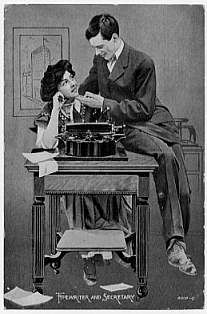
In the case of the young women, in 1877 a relatively new organization, the Young Women’s Christian Association (YWCA), stepped in to address the need. Seeing that many unmarried women were fleeing the farms in search of a better life in the city (or were part of the immigration stampede into the country), the YWCA decided to proactively deal with the problem of unskilled women moving into the city. Foresight proved them correct. The newly invented typewriter was a huge draw for women looking for decent work, and the YMCA started offering classes in the use of the device. These classes were remarkably popular and the pool of trained secretaries in the major cities was largely due to the YWCA. That organization also saw to the spiritual needs of the women, as well as to housing, medical provisions, and keeping oneself pure in a business environment that was so new that the rules were still being written even as the YWCA was teaching them.

The alternative for single women flooding into the city was often prostitution and the YWCA understood this. By meeting a great need, they were able to help keep women on a straight moral path and provide for food, shelter, and spiritual growth. This is the Church making the best of what could have been an awful situation.

This flight also contributed to the problem of delinquency. Once an important cog in the home economy, teenagers were left with nothing to do once farms were abandoned and factory reforms prevented the younger ones from working. Restless, farm-flight and immigrant children proved that idle hands were the devil’s play things. Crime rocketed up in the cities. The Church’s answer was a new idea: What if a ministry was founded that focused solely on the needs of youth?

Despite many years of research, I have not been able to pin down the exact date that a genuine youth-only ministry within a specific church first hit the spotlight. The first parachurch youth ministry of consequence was, interestingly enough, the Young Men’s Christian Association (YMCA) in Britain in the 1840’s, created by George Williams specifically to address the vagrancy of young men who, in this case, did have jobs in the factories, but were without family or away from home and were missing a fulfilled life. The YMCA grew rapidly and spread to America, only to be depleted by the Civil War as young men marched into battle. After the war, one of the major proponents of the YMCA, which was by all accounts not beholden to any one church, was evangelist Dwight Moody. His fame helped spread the YMCA vision of “The improvement of the spiritual, mental, social and physical condition of young men.”

From the parachurch YMCA, the focus began to drift back to churches in smaller locales that couldn’t afford a YMCA; some started their own ministries to youth. This helped further propel the whole concept that youth were a new ministry demographic. All this came about through the societal changes brought about by the Industrial Revolution. By the time Youth for Christ was popular in the 1940s, the idea that youth ministry was essential to the Church was a given.

But there are larger issues at work here.

Training women to have meaningful work in order to avoid a dissolute life is the Church meeting a practical business need while fending off corrupt social forces. On the other hand, youth ministry had its start in changes in the social fabric in Britain and America, then extended those to the spiritual. There is a very subtle distinction here.

Youth ministry’s long-term effect has been to take a family already fractured by societal changes caused by business practices coined during the Industrial Revolution and fracture it even further. While there is no doubt that on a granular level youth ministry has been effective in the lives of individuals (I include myself here), studies by researchers like George Barna have shown that, on the whole, the net effect of youth ministry today has been negligible on the spiritual and emotional welfare of youth. Christian youth are so much like their peers who don’t aspire to any Christian leanings as to be virtually indistinguishable. This is further proven by the horrendous attrition rate among Christian young people once they hit college. The majority come out of college completely stripped of whatever Christian faith and practice they possessed going in. Obviously, one must ask why this is if youth ministry were truly equipping youth to withstand the barrages of our cultural death-throes. We must consider whether the youth ministry model that was initially developed more than a hundred and sixty years ago is still valid.

The problems of youth ministry are compounded by the fact that it eventually sought to distance itself from conventional, whole-family ministry. In its infancy, youth ministry attempted to make the best of a bad situation in the lives of youth living far from home, but this is no longer the case. Most youth ministries in churches today appear to pride themselves on the fact they offer teens a chance to get away from their families and hang out with other teens. The net effect here has been that the typical youth minister has become the substitute parent for many teens. Since youth ministry tends to have its own separate teaching component, the incidental effect has been that parents have abdicated the Christian teaching role for their teens. This further alienates family members and leads to a loss of parental authority and respect.

The Industrial Revolution was responsible for the initial splits within family. The home economy that kept both parents at home working, supported by their children, was disrupted by changes in work emphasis and the rise of big business. Dads started working distantly and were gone for most of the day. This put added stress on moms to hold the family together. As work shifted to the cities, young people heard the siren call and left their traditional responsibilities behind. For farm families, this shattered the procession of farm life from one generation to another and hastened the move to cities. Youth moving to the cities encountered vice and the Church responded.

The larger question here that is left unanswered is whether the response of the Church was correct.

On the surface, the YWCA’s training of young women for secretarial work in light of the rise of business in the cities is admirable. They certainly addressed the need and were smart in doing so. But that larger question looms, particularly in the light of more than a hundred years of wisdom asks whether the Church missed the big picture for the details.

Even today, the Church is not asking whether the Industrial Revolution broke something, not only in society, but in the Church. In many ways, the Industrial Revolution was already in its maturity before the Church responded to it. Worse, still—and even today—no one in the Church in America is asking if the Industrial Revolution has a fundementally evil component that the Church swallowed without thinking. The Church certainly responded to the most obvious societal ills created by the Industrial Revolution as we have seen in part here, and while that was admirable, the results have been mixed.

In the next installment, The Industrial Church Revolution, Part 3, we’ll examine the “Jesus as CEO” concept that gained popularity in the 1920s and 30s along with Social Darwinism’s pernicious effects on the Church and business.

And thanks for reading this series!

Previous post in the series: The Christian & the Business World #4: The Industrial Church Revolution, Part 1

Next post in the series: The Christian & the Business World #6: The Industrial Church Revolution, Part 3

The Christian & the Business World #4: The Industrial Church Revolution, Part 1

Standard

{Two interlopers are chilling out at Cerulean Sanctum…}

I’m bored. Let’s play a game.

How about “Guess the Era!”

Dunno. How’s it played?

I’m thinking of an era in American History. I’ll throw out a fact and you try to tell me when that fact would’ve been true.

Sounds dull, but I’ll go along because I am like soooooo bored.

Dad works.

Yawn.

Mom homeschools the kids.

Official Focus on the Family Nuclear Family of the 2000s, right?

Wrong.

Mom also works.

Ooh, James Dobson’s ticker starts palpitating

Mom works from home.

Collective sigh of partial relief at Focus. Hmm, this is a toughie, though.

Dad homeschools the kids, too.

Really?

Dad also works from home.

Is this the family of the future, circa 2020, all gussied up with Terabit Internet access via which their home import/export biz of rare Chinese herbs for medicinal purposes competes in the global marketplace?

Aah, that would be “no.”

Even close?

Not on your life. Actually it’s the United States circa 1776. Revolutionary War days.

Wow, I would have never guessed. You’d think with all those smarmy Deists running around the country then that dogs and cats would’ve been living together in sin and the whole economy would’ve collapsed faster than the wooden tea stirrer market after the Boston Tea Party.

Well, I wouldn’t go that far.

Say, that kind of lifestyle sounds kind of appealing. Work from home. Do the log cabin thing. Grow your own…. You know, I’ve been to Colonial Williamsburg. Lots of real colonial cuties if you know what I—

Okay, you two, take a hike. This is my blog and I want control back.

You always want control, Dan. You’ve got issues. I know a great Christian therapist I can recommend. He’s a bit Jungian, but all the same, he’s—

HIT THE ROAD!

Okay, we get the picture.

Man, he’s goin’ all Cotton Mather on us!

OUT!

{Sounds of stumbling and mumbling, then a door slam.}

Sorry about that folks. Serious topics sometimes need levity. And this one is serious. It’s about the Industrial Church Revolution. You may never have heard of it, but like many things that go awry, it begins with a lot of hot air. Steam actually.

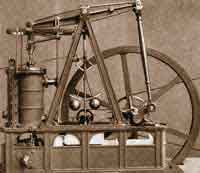
A couple decades before the idyllic days of mom and dad working together in a home-based economy in America at the dawn of independence, two English Thomases, Savery and Newcomen, invented a mechanical engine that ran on steam. Steam engineAnd though it worked, it wasn’t until James Watt radically improved the design in 1769 that the first rumblings of pressure surfaced that would seal the fate of that storybook lifestyle of Mom and Pop Free America.
The English were the first to fall to what would later be called the Industrial Revolution. Steam power made possible a new strength in work. Some discovered that stationary steam engines could have wheels attached and be made to run on tracks. They weren’t fast, but they could haul heavy loads. Those tracks were made with massive presses, molds, and machines that cut and bent—all powered by steam.

But steam engines were expensive regardless of whether they became trains or not. And even though they allowed for the very power to build and create even more powerful machines, the labor to do the work simply could not be done from home any longer since few had the cash to have their own home steam engine built for private use. So Britain built centralized factories where people could come to work via the new modes of transportation that were developing, mechanizing much of the labor that had been done in homes by hand (particularly textiles— one of Britain’s major exports.)

Americans, still wanting to show the former homeland a thing or two, decided they could do it, too. Mass production of guns in factories started in the United States around the same time as the British burned down the White House. Mass production meant good money, but also mass workers. And masses of workers responded by venturing out of the home and into distant factories.

Meanwhile, factories chugged away in Britain even as “malcontents” like the Luddites protested, busting up mechanized knitting machines and other signs of the young Industrial Revolution until they themselves were busted up by the British army. Some were exiled to America. But the real problem of factory life did not emerge until a young scientist named Charles Darwin came along in 1843 with a challenging new biological theory he called “transmutation.”

By this time, economies in both Britain and America were beginning to undergo a steady change as more people left the hard life of farming the cursed ground for the hard life of factory work. Over in England, intellectuals started listening to Darwin’s ideas and saw natural correlations between it and the growing class distinctions in that country. Of course, it made sense to them that an underclass of workers existed in the factories to make products that the intelligentsia could use. Those miners mining coal to power the engines of the Industrial Revolution were a form of unevolved man. This was natural selection at work. Some were meant to prosper due to their superior breeding and intellect, while some were relegated to mines and factories filled with sweat. Only later was a name attached to this idea: Social Darwinism.

So far, this story hasn’t had much Church in it. The fact was that the Church was ignorant of the gathering storm or, in the case of many churches in England, were actually championing Darwin’s ideas and the work ethic of the factories. Certainly some clerics protested the grim realities of how men, women, and children were treated in the mills and mines, (favorite author Charles Dickens chronicled this in Hard Times, exposing the harsh realities of poor factory workers to the middle and upper classes of Britain), but despite some reforms in 1833, the factories chugged on, grinding up the poor with them.

It is here that we see the first effects not of the Church on the Industrial Revolution, but the Industrial Revolution on the Church. Postmillennialism came to full bloom in both Britain and America after the Civil War, and this was largely due to the idea that science and technology were advancing so quickly that a new day was upon the Church that enabled Her to reach the world using the latest tech advances of the day. It was “Onward Christian Soldiers”—a hymn that reflects that thinking better than any other—and The Salvation Army ushering in the Age of Christ and His Church Triumphant.

Cities boomed as agricultural workers bought into the propaganda that life was better in the cities. Immigration in America further added workers to the expanding factories. The traditionally respected home economy languished in the face of the new: steel, oil, and the railroads. Secretary, Typewriter, & RogueAnd a little book called “On the Origin of Species by Means of Natural Selection” hit the shores of America.

Now as fin de siecle America flowed into the glories of the dawning 20th century, the Church finally realized that something had changed in the country—and not for the better. As youth left the farm for the city and immigrant children were left with little to do (once factories were deemed off limits to children due to various reforms), juvenile delinquency erupted in the crowded cities. Not only this, but wholesome young farm women learned of greater opportunities in the city serving as a secretary. So en masse they signed up to learn how to use the newly invented typewriter and headed to Metropolis.

But the evils of the city preyed hard on the virtue of these naifs and churches finally understood that something had to be done about them and the growing ranks of juvenile delinquents.

In the next installment of this series, The Christian & the Business World: The Industrial Church Revolution, Part 2, we’ll take a look at the radical new ideas the Church developed to finally address the massive social upheavals it had ignored for far too long, and how those ideas have drastically altered the look and mission of the Church in America.

Previous post in the series: The Christian & the Business World #3: Subduing the Earth

Next post in the series: The Christian & the Business World #5: The Industrial Church Revolution, Part 2