If We Should Have to Die

Standard

Although prepared for martyrdom, I prefer that it be postponed. —Winston Churchill

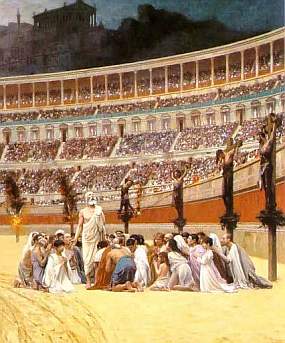
The end of October brought us three Indonesian girls beheaded for no other reason than their faith in Christ. Just last week, two Christian girls were shot in the head, one of them having since died. President Bush goes to China even as three Chinese Christians are imprisoned The Christian Martyrs' Last Prayerfor the crime of printing Bibles for the Chinese people to read.
All I ask is one question: Are you prepared to be martyred for the Lord Jesus Christ?

I suspect that Churchill's witticism is closer to the hearts of most Christians in America than the image of five dead American missionaries lying half submerged in an Ecuadoran river bed. Shouldn't the idea of martyrdom make it at least a fraction more difficult to get excited about loading our new iPod Nano with a thousand CCM offerings? Shouldn't the increased persecution of Christians in Eritrea, Sri Lanka, Bangladesh, Pakistan, Indonesia, China, Vietnam, and a plethora of other countries cause us to stop for a second during the orgy of shopping that passes for Christmas today?

Although this last Sunday was designated International Day of Prayer for the Persecuted Church, this issue of martyrdom has been on my mind since the day I first confessed Christ as Lord. Yet I don't meet too many Christians who actually think about it at all. I rarely hear about martyrdom from the pulpits in most churches in this country. It's something that happens elsewhere, but not here. We console ourselves with the fact that some anti-Christian punk might take a key to our Volvo, but that's as far as it goes.

It went a lot farther for four Indonesian girls who paid the ultimate price for their profession, didn't it? Did their churches teach that one day they might have to die because the world hated them?

The world doesn't really hate us here in America. We've camouflaged ourselves so readily with worldliness that no self-labeled persecutor of the Church would even be able to find us, much less martyr us for the Faith. We've got an appointment tomorrow with our Crown Financial consultant to go over our 401k distribution, don't we?

Not only have we not counted the cost all that well, but we've ignored it all together. Death is such a sticky thing and the less we bring up the subject, the more likely it is that we can postpone it altogether, especially if it involves winding up on the wrong end of a spear in a jungle. No jungles around here, right?

That jungle just may be coming to us, though. Even then, the sad truth for a lot of us, including myself, is that our lights may be so dim that the real haters of Christ may not feel that we're worth a spear. Why snuff a smoldering wick when there are still a few floodlights to deal with—emphasis on few.

I suspect that too many of us are working overtime to ensure that everyone loves us rather than living for Christ in such a way that everyone hates us. I know I don't feel especially hated. I must be doing something wrong. Yes, I've heard the conspiracies about the warehouses in upstate New York (or California or Wyoming or wherever) filled with guillotines so that the U.N. can more easily dispatch American Christians when the time comes. That scenario is not nearly as scary as the one where U.N. operatives under control of the antichrist can just let the guillotine blades rust because there's no one left in North America who still believes in Christ enough to warrant losing a head.

Let's face facts—we're not ready. The American Church is about as prepared to be martyred as it is to be fêted by the homosexual lobby. Can't remember the last time any noted Christian conference speaker (in front of a crowd that paid $300 each to hear him) delivered a message on how to be a martyr for Jesus Christ. Better to save that money for the latest iPod!

Voice of the Martyrs

Prisoner Alert

The Barnabas Fund

Open Doors Ministries

{Image: detail from The Christian Martyrs' Last Prayer by Jean-Léon Gérôme, 1883}
Grieving Answers to Prayer

Standard

Then [Job's] wife said to him, "Do you still hold fast your integrity? Curse God and die." But he said to her, "You speak as one of the foolish women would speak. Shall we receive good from God, and shall we not receive evil?" In all this Job did not sin with his lips.
—Job 2:9-10 ESV

I came back from the men's retreat I was on this weekend, but I did not return as I had hoped. Instead, I came back home weeping on the inside.
Grief
This is not the fault of the good men I grew closer to this weekend, but it has everything to do with the knowledge that even in the midst of good company, people truly do grieve alone. And I'd be lying if I claimed I was not grieving.

How long I've been grieving is a more difficult assessment. Or even what I'm grieving. Grief doesn't always announce itself or its intentions, we just know it's there, brooding. However, having the opportunity to get away and think a little may have jarred loose a few answers to both questions of "How long?" and "What?"

I'm grieving answers to prayer.

I'll say right away that you won't find a doctrine on this anywhere in the Scriptures. If you're the kind of person who detests what you might perceive as extrabiblical conjecture, then reading on will only anger you, so better stop right here and skip to another post. For anyone else, all I ask of you is to listen with the Spirit.

Anyone would think another a fool for grieving those answers to prayer that led to sustained blessings, and he'd be right. What's hard is dealing with answers to prayer that resulted in a firm No. Harder still is the answer that led to blessings that were later taken away before they bore fruit.

The accident that renders the promising athlete a quadriplegic. The new husband who loses his bride to an aneurysm only a month after their wedding. The career dream that was reached, only to be snatched away. The ministry that failed. The stillborn child.

We grieve them, don't we? Olympic glory. A love built for the future. The dream we put our sweat into all these years. The heeded call of God put into action. The child of hope. Once they seemed so beautiful in our thoughts and prayers, but what now? There is only grief.

It's popular in many Christian circles to counsel people that it's perfectly fine to get mad at God. But what of Job's response? He called such advice foolish and did not sin with his lips by giving in to such hellish temptation. Grief, though, was permitted, and so he grieved in the sackcloth of his acquired poverty and the ashes of his dreams.

Job's question is a penetrating one: Shall we receive good from God, and shall we not receive evil? As for me, I believe Job is right, but I must also believe that grief is allowed when the prayers of the righteous result in something other than their intentions.

I was once told the story of a teen who was one of those extraordinary few who God revealed the purposes of her life. He gave her an enormous burden for the African people, so much so that her whole heart was given to missions at a young age. Upon graduating from high school, she worked hard to raise support and was richly blessed by the many people who loved her and caught her vision. When she was selected to join a team going to the African interior, the joy was palpable. She boarded the plane, set foot in Africa, and promptly died from a fever within days.

As far as anyone knows, she never got to share the message of Christ with anyone there. Thousands had prayed for her, hoped for her, and supported her. But what of all those prayers?

I used to think there was always a lesson in happenings like this, but I'm not certain I do any longer. Some things just are and perhaps all we can do is grieve those answers to prayer that we do not understand. I know people who have driven their faith into the ground looking for a lesson from some horrid injustice that pierced them, but what if there is no lesson other than the way of suffering? What if grief is its own lesson?

Some things make no sense. I know that I reflexively must understand why something is the way it is. None of us says, "Thy will be done!" easily, particularly when that will seemed to lead to ruin. Why did that bright girl with a heart as big as the world start and end her journey the same week? My only response is grief for a prayer answered in a way I cannot comprehend.

We in our household appear to be receiving an extra portion of these questions whose only answer is grief. The way of the cross? I would like to think so. Maybe this is the ultimate meaning and source for that manner of grief, but like a fog it rolls in and obscure everything else before burning off in a shimmering morning that paints diamonds on the grass.

Let us accept good and endure evil. And may our faces be turned to the Son.

Tougher People

Standard

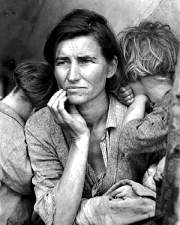
Migrant Mother by Dorothea LangeI don't usually blog about my emotional well-being, but it's been a rough week. Monday I got bad news about a serious dental problem I have that can only be resolved by drastic, painful surgery to the tune of a year's tuition (or more) at Harvard. With both of us deflated by this news, my wife asked me what people with my condition did before this kind of surgery was available. The only answer? They lived with it.

So I've been thinking since then about folks who lived long before any of the amenities we take for granted today. Amy Carmichael, missionary to India, never took a COX-2 inhibitor in her life, bedridden with constant pain for twenty years before she met her Maker. Yet her poetry and wisdom live on long after she succumbed to the affliction of living on this planet. Millions of women somehow got through childbirth without an epidural. And after suffering through the mind-numbing agony of a kidney stone late last year, I don't understand how anyone could have existed without opiates to dull the shrieking nerves.

Dentistry back in the old days consisted of a pair of pliers and a bottle of rotgut. There were no bionic limbs two hundred years ago for the soldier maimed in war; a hook or crutch would have to do. Infection took its toll on many body parts and no plastic surgery plied his trade in making torn bodies whole again. Deformity was life and you went on living it no matter how much you wanted the mirror to lie, if only for a moment.

Couples buried their children by the dozen. Mothers often accompanied their mis-born children to the grave. Life was often brutish, nasty, and short. Ask Hudson Taylor, the great Asian missionary, who returned to England—his own health shattered—after leaving his wife and several children in the cold Chinese soil. Many could tell you that living seemed much more about avoiding being in the wrong place at the wrong time. A simple handshake with the wrong person could leave a deposit of microbes for which there was no known cure, diseases like diptheria or pertussis that are rarely spoken of today.

You can't dismiss that people were tougher then. No one thought himself a victim of fate, either. One simply pressed on and that was it. There weren't scores of therapists to hear Abraham Lincoln talk about his sadness over the deaths of his children and the increasing mental instability of his wife at a time when the nation he presided over was torn in two, brother set against brother. More pressing needs begged for his allegiance, so he soldiered on.

I can't see myself crowded around Jesus, trying to clutch at His robe saying, "If only…." Instead, I would be marveling at the truly shattered people who flung themselves at him, people so broken that some of them weren't recognized as human any longer, except by the Lord Himself. I think I would have to give up whatever place I had in line if I'd seen someone like that. Those were hard days and it's a miracle to this child of the 1960s that anyone could live at all.

There aren't too many tough people in the West anymore. Perhaps this is why we are so willing to forget about the Lord; we have other answers for our problems, even the tiniest ones. A balm exists for whatever ails us as long as the price is right. And even when it isn't, the lengths we'll go to in making it right shows how easily we are bought, sold, and traded on the open market.

It's sobering to know I would've been one of those casualties a hundred years ago. I was hospitalized for two weeks at two years of age for pneumonia, a dreaded killer in the time of my great-grandfather, but not for someone born in the Camelot of Kennedy's era. Should my recovery have been only partial (and partial was what many hoped for in the fin de siecle), I would've been known as a "sickly child," a terminology we don't toss around today simply because we don't see it too often.

Jesus wants tough people who rely on Him for everything, particularly when everything is not provided without fail. If that's my prayer for myself right now, then it's my prayer for you, too. We can't live on "what if?" or "if only…." Faith demands more and asks for tougher people. On that Day, the Bride of Christ will be radiant in her beauty, but She will have gotten there bloodied and beaten—yet not defeated.

Be tougher.

{Image: Dorothea Lange's "Migrant Mother" (1936)}