
On Consigning Enemies of Christ to Hell

Standard

It's one of those blast furnace kind of days here today, 95 degrees with 95% humidity. To the amusement of little boys everywhere, the sun is so hot right now that ants burst into flame on the sidewalk without need for a magnifying glass. As I type, my son is sipping hot peppermint tea—of all things—somehow oblivious to the heat pump outside laboring to rid our house of thermal build-up. InfernoThe dryer is working with the weather to scorch our clothes dry, and just to add insult to injury, I need to take a flamethrower to some weeds outside tonight.

Why not talk about hell, then?

The Christian blogosphere talks about hell far more than you'll hear from any pulpit. I've read just about every take on hell you can imagine in just the last few weeks. But every one of those theological treatises has ignored one kind of hell, the hell that most people experience: hell on earth.

It doesn't take much for us Christians to castigate anyone we deem to be unworthy sinners. You don't have to look very far to find such horrid heathens. The Christian blogosphere is brimming over with posts that name names and point fingers. The names of the enemies change, but the general collection of them remains the same. You're likely to find homosexuals, evolutionists, atheists, and the ACLU in that category. Karl Rove seems to occupy that spot for Sojourners types, while the hardcore conservatives still get mileage out of Bill Clinton. And then there's whatever preacher or teacher we love to hate. Benny Hinn, Rick Warren, Joyce Meyer, Ken Copeland—maybe even your own pastor will show up on that list, who knows. The important thing here is that hell needs to be invoked whenever we think about them.

More and more I believe that we truly want to see some people burn in hell. It used to be the Hitlers, Pol Pots, and Stalins of the world, but increasingly it's the people we disagree with—you know, The Enemies of Christ. And from the dialog I see occurring on an increasing number of Christian Web sites, I believe that there are a few too many Christians who would get no more glee than to have a front row seat in Abraham's bosom so they can stare out over the chasm that separates heaven from hell and lob a few jeers at the prisoners of hell. Because we all know that nothing hurts worse than to be in hell and have to suffer the receiving end of cat-calls from The People Who Got It Right.

But waiting for the eventual demise of the Enemies of Christ is not enough for some of the most vocal critics out there. They'd love nothing more than to see people in hell right now, here on earth. Such an idea almost warms the cockles of their hearts (that is if stone can have cockles.)

Now it would seem a hard thing to make hell on earth for people, but I now know how it comes about easily.

You see, most people on earth are already in hell because they have no prayer covering. Most of those destined for fire have never once had anyone pray for them. At no time has a Christian stood up in public or stolen away to his or her prayer closet to pray for these souls just waiting for damnation. Not once. More often than not there hasn't been a real Christian within ten feet of those Enemies at any time in all their years on earth. No one to pick them up when they fall. No one to hear their hurts. No one to take their confession. At least no one who we would consider Spirit-filled.

It is a far easier thing to call someone an Enemy of Christ than it is to pray for them. It takes no effort on our part to just keep doing what we already do when confronted with people with whom we disagree. How simple it is to label someone "godless" or "heretical" or "deceived" than it is to get down on our knees and say to God Our Father, "And so I once was. May your truth be made known to them through me, Lord Jesus, by any means possible."

Because you see, someone may have been praying for you long before you surrendered up your Enemy of Christ label and became a Child of God. Someone loved you and me enough to have labored in prayer over our souls for years and yet we can't spare those we consider Enemies of Christ one second of our day to cover them in prayer for what may be the first time in their lives. No, it's easier to blog about their sin, to throw up our hands in disgust, and to leap to our feet in protest than it is to fold those hands and bow those knees.

So this is what I ask of anyone who comes to Cerulean Sanctum. Before you blog about this Enemy of Christ or that heretic, spend one month in prayer for them. Pray every single day. Pray that God would put Spirit-filled Christians into their lives who will speak life and truth into them, sharing the Gospel not only in words but also deeds. If you are close enough to actually be that supportive person, then consider taking the job because obviously no one else has. If after the end of that month of prayer (and service) your righteous indignation still burns hot, then do as you are lead of the Spirit.

Some people are already in hell, folks. Not having a prayer covering is the very definition of being in hell on earth. Not having the fellowship of committed Christians willing to draw up alongside you and help you through your hell on earth only makes it worse. Perhaps we need to remember how fortunate we are to have had that covering and that presence of devout believers in our own lives. And perhaps we need to stand in the gap for all we perceive to be Enemies of Christ before we get online and bitch and moan about them.

Nyah, Nyah, Nyah, We’re Not Listening!

Standard

Fingers in earsAll over the Christian Blogosphere the talk seems to gather sooner or later around one topic: the “Emerging Church” or “Emergent” (although there have been some comments that they are not strictly the same thing, for my purposes here I will consider them one and just call it the “EC” from here on.) While the EC considers itself Evangelical, hardcore orthodox Evangelicals have criticized the EC and buried it under a list of grievances, primarily dealing with aberrant theology and doctrine. Not a day goes by that my Bloglines list of Christian blogs does not feature some blogger shellacking the EC.
I’ve talked about the EC in several posts on Cerulean Sanctum, but I want to come out and take a firm stand publicly. I do not support the EC as it exists. I agree that it is making concessions with the world in order to make immutable doctrines more appealing to itching ears. Too many of the leaders in the EC are not-so-closeted Universalists and I personally think that guts the Gospel and cheapens the deaths of martyrs. The cross also takes on a bizarre appearance within EC doctrine. Open Theism runs rampant in the movement. I also find it arrogant that the EC has put the Bible on the table in order to analyze the veracity of this truth or that; there are things of God we should never deconstruct. We too easily forget that sin entered the world after these words were spoken: “Did God really say…?”

But I want to proclaim this to all the orthodox believers out there, particularly those who label themselves Evangelicals, and especially if you enjoy throwing stones at the EC. The EC exists for one reason and one reason only: because Evangelicals blew it. The EC exists as a reaction to the fact that Evangelicals have largely failed to address several key aspects of Christian life and practice. The EC exists because some people got sick of the concessions to materialism and worldliness that have defined many Evangelicals in America. The EC exists because far too many Evangelicals in the United States and Canada have lost their first love.

The issue as I see it is that Evangelicals are only compounding the very problems they are accused of by the EC by their constant tirade against it. It is possible to reject the doctrinal aberrations in the EC and still thoughtfully listen to its criticism of today’s strain of Evangelicalism. I find that criticism to be highly astute in several areas:

1. Many Evangelicals have lost the mystery and awesomeness of God. They have reduced God to a buddy they carry around in a shirt pocket and pull out whenever they need him.

2. Too many Evangelicals have little or no concern for people who do not possess what they have. I’ve even sat in on small groups of Evangelicals who spent part of their time griping about the poor around them, but without any sign that they would lift a finger to do anything to help them.

3. Evangelicals look too much like the world and have lost the aroma of God that pervades the saints.

4. Evangelicals are too often enshrouded in a cocoon of doctrine and never come out to put any of it to practical use.

5. Evangelicalism has lost the focus on Jesus and has become self-centered.

Personally, I believe that every one of those skewerings of Evangelicalism by the EC is sadly accurate. The problem is that Evangelicalism is simply unwilling to listen to criticism. Whenever the EC answers criticism from Evangelicals and offers their own criticism of Evangelicalism, the Evangelicals turn into five-year olds with their fingers in their ears chanting, “Nyah, nyah, nyah, we’re not listening!”

Now before I get lumped into the EC crowd just because I’m pointing out this truth, I want to appeal to someone well-respected within Evangelical circles who has made every single point I listed above—points that the dreaded EC is making, too. That would be Francis Schaeffer. Schaeffer prophesied (and I believe his voice is prophetic) each of the five points I mentioned above, points that are considered EC today. Despite the near sainthood status that many Evangelicals give to Schaeffer, it appears that too few are willing to listen to the criticisms he leveled at Evangelicalism in North America in books like The Great Evangelical Disaster.

And so I end with this: Take the fingers out of your ears, Evangelicals. Be more willing to admit that you’ve made mistakes and fumbled the Gospel in several places. No one will hate you for it; in truth, some might be more willing to listen to what you have to say. Keep the Lord’s doctrine pure, certainly, but be more human with it at the same time.

Arrogance, Ignorance, and “I Don’t Know.”

Standard

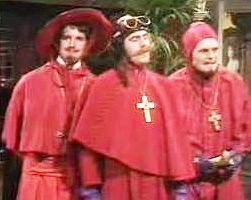
Nobody expects the Spanish Inquisition!Slice of Laodicea notes an Al Mohler article that brings up good talking points about the state of today’s Church in light of the proliferation of cults. Mohler’s basic comment is that poor doctrinal defense and an inability to nip error in the bud have resulted in Christianity being dogged by a plethora of pseudo-Christian cults all clamoring for legitimacy. Given that Eerdmans, long a stalwart in Evangelical publishing, just published a defense of Mormonism, fueling the growing desire of Mormons to be considered mainstream Christians (rather than gladhanders in bleached white Oxfords trying to dig up the remnants of a civilization as non-existent as Plato’s Atlanteans), Mohler may have a point.

But then again, nah.

Mohler’s piece is written as if no Church existed before 1800. Witness this assertion:

Writing early in the last century, J. K. Van Baalen argued that “the cults are the unpaid bills of the church.” Van Baalen’s influential work, The Chaos of the Cults, represented one of the very first comprehensive efforts to evaluate the various cults of the day from the vantage point of orthodox Christianity. Van Baalen’s survey considered movements and groups such as Spiritism, Theosophy, Christian Science, Rosicrucianism, Swedenborgianism, Mormonism, and the Jehovah’s Witnesses, among others.In Van Baalen’s analysis, orthodox Christianity had opened the door for the cults to emerge and to proliferate throughout the culture. Sidelined by pragmatism, distracted by divisions, and committed to a “smallest common-denominator faith,” the orthodox churches had left the larger culture, and even some of their own members, unprepared to meet the challenge of the cults.

If anything, the problem is more acute in our own day. The seductions of postmodernism and the complexities of a pluralistic culture compound the difficulty involved in engaging, understanding, and confronting the cults.

Is the problem more acute in our day? Well, if the Scriptures are to be believed, the first NT writings were not even dry on the page before the Church was confronting cults. We know that the Apostle John wrote to counter the nascent Gnostic heresies and that the Lord Himself called out the Nicolaitans in Revelation. In fact, as long as there has been Christianity there have been cults of Christianity. Paul was constantly squashing one heretical belief after another and even came into conflict with Peter over the Judaizers, a group that Mohler would be forced to tag as a cult if it existed today.

The list of heretical leaders and the groups that formed around them in the early days of Christianity’s spread could take up a leather-bound tome in itself. Mohler’s amnesia here is startling: Marcion, Pelagius, Apollinarius, Montanus, Arius, Nestorianus and on and on. Yes, the Church did put them down, but even today groups of pseudo-Christians cling to the remnant teachings of these heretics. Still, their ideas did not die; even a casual glance around proves Pelagianism is alive and well in the 21st century.

The issue of what constitutes a cult in the history of the Church is also difficult to ignore. To the orthodox Church (and Mohler makes much of what is “orthodox”), Martin Luther and his band of German ne’er-do-wells were a cult. Same goes for that Calvin guy and that fellow Knox. To those early Lutherans and Presbyterians, the Roman Catholic Church was a cult and plenty of Christians today still maintain that view.

In fact, you can trace every modern denomination in Christianity to a blistering reaction by that denomination’s adherents to an “apostate orthodox church.” Methodism, the Restoration Movement, the Quakers, the Puritans, all had a start as folks who came out of a church that was backslidden and given to cultic practices—at least as they saw it. How Mohler fails to consider this is beyond me.

Worse still, Mohler attributes the problem of cult proliferation in the last one hundred-fifty years solely to the Church’s inability to promote correct doctrine. To be honest, I don’t believe that this is the whole story, especially since Mohler lumps seeker-sensitive and Emerging churches in here. Again, an honest assessment shows that these two came not out of bad doctrine, but a reaction against an orthodox Church in America that simply wasn’t doing its job. A lot of denominations started out that way, but when they left their parent churches, the angry ones left behind were bellowing, “Heretics!” even as they smarted over the possible truth behind the breakaway group’s leaving. It was easier to blame them for bad doctrine than it was for being right about the status quo’s calcification and deadness.

Every doctrine of the Church is not nailed down. If we were honest with ourselves we would have to admit this. Get one hundred Christians of all “orthodox” persuasions in a room, and you’ll have at least twenty distinct eschatologies. And while some may say that eschatology makes no difference, many of the cults that arose in the mid-Nineteenth century did so because of eschatological beliefs. Nor does one’s eschatological view exist in a vacuum. The very way we live our lives every day is a reflection of how we think the world will end. If you don’t think that’s true, then compare and contrast Booth’s Salvation Army with today’s Christian survivalists.

I’m going out on a limb here and will certainly get angry comments, but even Paul didn’t have his theology crystal clear on all points—at least as many orthodox Christians might see it today. We know that Paul publicly confronted Peter over his falling in with the Judaizers, but Paul was not so sure of the issue of circumcision early on in his ministry (Acts 15), but then after it was decided that circumcision was not necessary, Paul went ahead in the very next chapter and circumcised Timothy in order to get a better opportunity to preach to the Jews who would have disqualified his testimony because of his uncircumcised co-worker in the Faith. Later on, we have Paul abiding Nazarite vows and ritual cleansings in Acts 21, acts that would drive batty those orthodox believers who eschew anything that looks like a ritual or smacks of legalism.

So just who is wrong here? And better yet, who’s willing to admit it?

It’s that latter sentence that may explain some of the reason why we have cults: dogmatism. Cults— and Christian denominations—exist in large part due to inflexibility of beliefs. They are all backlashes against a rock-solid dogma that chafed. Sometimes (and yes, I know, not always) we Christians must acknowledge some negotiables. Paul did so when he circumcised Timothy. Who here is willing to toss him out for that act? Was it a sin? Was he violating doctrine? Or was the Holy Spirit leading him outside the newly established boundaries just this once in order that some might be saved? That Paul also consented to a similar act (the vows) later on in order to win some to the Lord should give us pause.

Frankly, if Mohler were honest, he’d just skip to the punchline and say, “I’m a Baptist. From my perspective, anyone who baptizes infants is a heretic and their church is a cult.” The problem is, he can’t bring himself to say that because he mentally assents to some doctrinal “wiggle room” himself.

I’m not positive on a lot of points of established “orthodox” doctrine. I believe that because Man is made in the image of God, he’s a tripartite being, just as God is. Wayne Grudem, whose Systematic Theology is a work I deeply respect, does not share that belief. That makes one of us wrong. Applying the standard that Mohler asks, one of us is therefore a heretic.

The Holy Spirit will guide us into all Truth, as the Scriptures say, and yet we see through a glass darkly. I believe both those statements. I believe that the Holy Spirit will progressively make me more like the Lord and I will take on more of His Truth in doing so, but I also believe that I will not have all the answers in my lifetime. As Paul’s “man caught up into the third heaven” can attest, there are answers to questions we may never ask this side of eternity. And if we’ve never asked them, how then can we be perfect in our doctrine?

Arrogance led to erecting a gospel of stone, a weight that not only were the cultists not ready to accept, neither were the leaders of Christian denominations who broke off from the accepted teaching of the day and went down another path. On the other hand, there is no purity in ignorance. Certainly ignorance accounts for the cults and some of those same Christian denominations—ignorance of the Word and of sound doctrine.

Perhaps the reality we face this side of heaven is that on some issues the believer must be more humble, even to the point of saying, “I don’t know.” While I don’t ascribe to the belief that everything is a mystery, neither do I believe that everything is set in granite. I don’t believe that Jesus came to establish a set of dogmas used to crush ordinary people with, and yet He never tolerated erroneous teaching, either.

No matter what the case, we all need a bigger dose of humility when it comes to this issue of who is right and who is wrong. We use the word “heretic” far too often today. The Christian blogosphere is choking on the brutal arguing going on over who’s perfect and who isn’t. I don’t want any part of that anymore. It’s possible to call others to holiness without strangling them to death with a noose of righteousness. That’s the way I’m going to try to take, because in the end, I’m not perfect.

Now where’s my comfy chair?