
Cyrene Surpasses Berean

Standard

If you’ve noticed the lack of posts here recently, kudos for being a consistent reader! I must admit to some burnout. It’s not that I don’t have many topics I’d like to write about, it’s just that the Internet is such a poor place from which to minister to others that I’m having something of a crisis of conscience adding my voice to the cacophony and lack of action.

One of the things that has set me off lately concerns several posts and comments I’ve read from folks under the age of 40. I have no axe to grind against younger Christians, but when such folks start talking about how someone else isn’t carrying his or her cross correctly, I get furious.

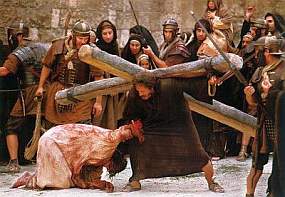
The problem of judging someone else’s ability to carry the cross is a huge one on the Internet. Simon the Cyrene bearing the cross for JesusThe amount of presumption on the part of these judges is staggering, particularly when that judger has lived a golden, carefree life in which “my cross” consists of mistakenly receiving a mocha latte instead of the ordered cappuccino from the barrista at Starbucks (or whichever coffee dispensary is trendiest among the self-righteous).
The wisdom to discern anything about another person’s life can only be gained through time and the Holy Spirit. Bury a parent or two. Have a child wind upon the wrong side of the law. Suffer a divorce. Care for a chronically ill or terminally sick family member. Adopt a special needs child. Suffer repeated job losses.

There’s a reason why the eldest were the first to drop their stones in John’s chapter 8 telling of the woman caught in the midst of adultery. The eldest were the first to understand what Jesus was saying. Age buys people rights, but that’s largely because they’ve experienced enough vicissitudes of life to know that sometimes they need to withdraw their dog from the hunt.

A prime example of how the young often get it wrong is the pile-on concerning stupid things Pat Robertson said to a man wondering if his pursuit of personal happiness trumped taking care of his wife, who had Alzheimer’s. Was it okay to divorce her and marry someone else?

No, it’s not okay. And the youngsters quoted Scriptures and got riled up and foamed at the mouth and all the other things they tend to do to make sure EVERYONE knew it was not okay. To let everyone know how right and just and perfect they were by letting their righteousness shine before all on the Internet.

But the funny thing about holding onto the rock when the elders have already dropped theirs is that the rock cries out against the holder. And it does so because the holder lacks the wisdom of empathy and basic compassion. To the fool, the path is always clear and obvious. Needless to say, the fool often winds up on the wide path that leads to destruction.

The ugliness that is self-righteousness starts from frame of reference. In the case of judgmental people, they rarely wander outside themselves to ask what it is like to be the person on trial. They don’t have enough rotten experiences in life to have any kind of empathy. They lack that perspective of Jesus, who saw lost people as more than just another face in the “bound for hell” crowd. He saw people as being more than their disease. More than anything else, He saw how He could be there for others.

The great unanswered question in the Robertson fiasco was not about the rightness or wrongness of the reply to the man asking the question about his wife, but why that man asked it in the first place. People who lack widsom and empathy never ask those kinds of deeper questions when confronted with a problem situation. They instead rush to the obvious question with the most broad, simplistic answer. The problem with that mentality is that life is found in the narrow, more difficult way.

While self-righteousness and judgmentalism rush to the approved mob answer, empathy and wisdom draw people to ask how difficult it must be for others to carry the cross.

Anyone who has spent a couple decades watching a spouse slowly lose his/her mind endures a cross unimaginable by most. Not everyone can afford the kind of professional, third-party care that allows the remaining spouse to put some distance between the horror of that cross and the rest of life. We know the simplistic answers, but it’s the daily living in the shadow of that cross that should have us clapping a hand over our mouths before we presume to speak and to reveal our ignorance.

No one wanted to help Jesus carry His cross. Someone had to be compelled to do it.

We can talk all we want about right and wrong. We can point fingers at weasels, liars, and cheats. We can let the world know just how right the Law might be. But for most of us, we are far, far away from anyone bearing a difficult cross.

All the Scripture study in the world cannot trump helping another bear the cross. I don’t care how right you are or how well you divide the Scriptures. It all comes to naught if you are too preoccupied to shoulder for a time someone else’s crushing cross.

Young people, here’s my word for you: One day it will be you. No one gets out unscathed. Be careful what you speak to others bearing up under the weight of the cross. Because you might very well have a massive one dropped on you, and when you cry out for help, you better pray that some kind soul shows you more compassion and aid than what you offered to others.


Fear: The Ruination of the American Church

Standard

fearIf someone were to ask me what emotion best characterizes the American Church in 2011, I’d have to say fear. Everywhere I look, some self-styled church leader is playing the fear card. Christian bloggers blog about issues that instill fear. Average Christians in the pews lament the continued American downslide and point trembling fingers willy-nilly at whomever/whatever they believe the cause to be. Christian survivalists are building their stashes to weather the coming apocalypse. I can’t tell you how many believers lately have told me they are considering, for the first time, buying a gun.

Talk to any of these folks and they’ll all tell you they are simply proving themselves ready. This is a commonly cited parable:

“Then the kingdom of heaven will be like ten virgins who took their lamps and went to meet the bridegroom. Five of them were foolish, and five were wise. For when the foolish took their lamps, they took no oil with them, but the wise took flasks of oil with their lamps. As the bridegroom was delayed, they all became drowsy and slept. But at midnight there was a cry, ‘Here is the bridegroom! Come out to meet him.’ Then all those virgins rose and trimmed their lamps. And the foolish said to the wise, ‘Give us some of your oil, for our lamps are going out.’ But the wise answered, saying, ‘Since there will not be enough for us and for you, go rather to the dealers and buy for yourselves.’ And while they were going to buy, the bridegroom came, and those who were ready went in with him to the marriage feast, and the door was shut. Afterward the other virgins came also, saying, ‘Lord, lord, open to us.’ But he answered, ‘Truly, I say to you, I do not know you.’ Watch therefore, for you know neither the day nor the hour.'”
—Matthew 25:1-13

The wise ones in the above parable are wise because they are ready for the bridegroom. But what does that readiness look like?

Therefore you also must be ready, for the Son of Man is coming at an hour you do not expect. “Who then is the faithful and wise servant, whom his master has set over his household, to give them their food at the proper time? Blessed is that servant whom his master will find so doing when he comes.”
—Matthew 24:44-46

Remind them to be submissive to rulers and authorities, to be obedient, to be ready for every good work, to speak evil of no one, to avoid quarreling, to be gentle, and to show perfect courtesy toward all people.
—Titus 3:1-2

And he called the twelve together and gave them power and authority over all demons and to cure diseases, and he sent them out to proclaim the kingdom of God and to heal. And he said to them, “Take nothing for your journey, no staff, nor bag, nor bread, nor money; and do not have two tunics. And whatever house you enter, stay there, and from there depart. And wherever they do not receive you, when you leave that town shake off the dust from your feet as a testimony against them.” And they departed and went through the villages, preaching the gospel and healing everywhere.
—Luke 9:1-6

“You have heard that it was said, ‘An eye for an eye and a tooth for a tooth.’ But I say to you, Do not resist the one who is evil. But if anyone slaps you on the right cheek, turn to him the other also. And if anyone would sue you and take your tunic, let him have your cloak as well. And if anyone forces you to go one mile, go with him two miles. Give to the one who begs from you, and do not refuse the one who would borrow from you. “You have heard that it was said, ‘You shall love your neighbor and hate your enemy.’ But I say to you, Love your enemies and pray for those who persecute you, so that you may be sons of your Father who is in heaven. For he makes his sun rise on the evil and on the good, and sends rain on the just and on the unjust. For if you love those who love you, what reward do you have? Do not even the tax collectors do the same? And if you greet only your brothers, what more are you doing than others? Do not even the Gentiles do the same? You therefore must be perfect, as your heavenly Father is perfect. ”
—Matthew 5:38-48

Does being ready consist of stuffing a basement full of freeze-dried food to ride out Armageddon? Buying guns to protect that food and oneself? Can anyone find that in the Bible? I sure can’t.

Or does being ready mean fulfilling the Great Commission, doing the work Christ called us to, and living at peace with all men? When the Bridegroom returns, which servant will hear the “Well done,” the one tending to the homeless or the one tending to his Mossberg to protect his home?

Here’s a question we must all ask ourselves:

So we can confidently say, “The Lord is my helper; I will not fear; what can man do to me?”
—Hebrews 13:6

It seems that for many of us, the answer to the question is “Mess with my lifestyle and take away my stuff.”

This explains the fear:

There is no fear in love, but perfect love casts out fear. For fear has to do with punishment, and whoever fears has not been perfected in love.
—1 John 4:18

Fear has to do with punishment. Fearful Christians, sadly, reflect the idea that they are being punished when their stuff is taken away or messed with. None of that fearful thinking reflects a born again experience of Christ, though.

Here’s the truth:

You are not your own, for you were bought with a price.
—1 Corinthians 6:19b-20a

I have been crucified with Christ. It is no longer I who live, but Christ who lives in me. And the life I now live in the flesh I live by faith in the Son of God, who loved me and gave himself for me.
—Galatians 2:20

But far be it from me to boast except in the cross of our Lord Jesus Christ, by which the world has been crucified to me, and I to the world.
—Galatians 6:14

If then you have been raised with Christ, seek the things that are above, where Christ is, seated at the right hand of God. Set your minds on things that are above, not on things that are on earth. For you have died, and your life is hidden with Christ in God.
—Colossians 3:1-3

The fact is, if you have been truly born again, you died. Dead people, by all legal terms, own nothing. In Christ, you don’t even own yourself. Everything that you were and are now is Christ’s.

You can’t harm a dead person. A dead person doesn’t care about earth-bound people messing with his lifestyle. A dead person doesn’t care if you take away his stuff. A dead person doesn’t care about dying; he’s already dead.

Fearful Christians are that way because they haven’t died to self. They have no sense of the world to come, which is why they want to hold onto THIS world so badly.

Fearful Christians think that by their own efforts they will stave off whatever is to come. The Bible says differently:

If anyone is to be taken captive, to captivity he goes; if anyone is to be slain with the sword, with the sword must he be slain. Here is a call for the endurance and faith of the saints.
—Revelation 13:10

Do we understand this? I don’t think we do. Instead, we bunker down and kick against the goads, desperate to save ourselves.

Christian, learn to die. In place of embracing fear, learn to love God. There is no fear in love, because perfect love casts out all fear.

Love casts out the fear of THOSE PEOPLE and their GODLESS AGENDA.

Love casts out the fear that THEY WILL TAKE AWAY OUR STUFF.

Love casts out the fear that THEY MAY EVEN KILL US.

Love of God takes away that desperate voice that so clings to what is passing and replaces it with love, which endures through all eternity.

Christian, your life is to run counter to the lives of those who hope in this world alone. Your is not to horde but to give freely. Yours is not to worry but to remain steadfast. Yours is not to plan your own means of escape, but to give direction for escaping the wrath to come to those who do not know the Way. Those who seek to save their own lives will lose them. Do not be deceived and fall into that enormous trap, as so many others will.

A life of fear can never reveal the life of Christ.

Now who is there to harm you if you are zealous for what is good? But even if you should suffer for righteousness’ sake, you will be blessed. Have no fear of them, nor be troubled, but in your hearts honor Christ the Lord as holy, always being prepared to make a defense to anyone who asks you for a reason for the hope that is in you; yet do it with gentleness and respect, having a good conscience, so that, when you are slandered, those who revile your good behavior in Christ may be put to shame.
—1 Peter 3:13-16

Your Church’s Budget–And Why It May Grieve the Lord

Standard

Jesus or Money?I was thinking about how churches spend their money. Given all the verses in the Bible on finances and the sheer number of Christians who ascribe to Dave Ramsay’s philosophies, one would think we Christians in America would have this money thing down pat.

One would think.

But what would happen if we were to scrap the way we think about church budgets and adopt something more aligned to what the Bible says?

I could list a thousand verses on money in this post, but you already know them, right? We all know them. We just don’t adhere to them very well.

Here is what I’m thinking:

First, let’s take church staff salaries off the table for now. This is a baby-step process I’m advocating, and it’s no use angering anyone by suggesting we reevaluate staff costs now. Maybe when we’re more mature in the Lord. 😉

Take the church budget and set salaries aside. Now take all the money leftover and split it into two equal piles: Inreach and Outreach.

The Bible states that we must take care of the needs of the brethren. That’s our Inreach. In truth, staff salaries should be part of Inreach, but we’ve got them excluded for now. Inreach covers the church physical plant, programs, and benevolences given to church members who need financial assistance.

The Bible states that we then take care of those outside the church. That’s our Outreach. Missions, connecting with lost people, and benevolences for the needy outside the church community comprise Outreach.

And that’s your basic church budget. I think that’s a Kingdom-minded approach, don’t you?

Now how many churches out there work that way?

I would suggest that Inreach and staff salaries dominate most church budgets. But there is a HUGE “however”: Inreach as allocated in too many churches leaves almost no money for benevolences given to church members. In fact, benevolences monies, whether for Inreach or Outreach, are often the smallest pool of cash in the church budget.

So much for “Give and it shall be given to you.”

As much as we talk about being others-centric in the American Church, our church budgets don’t reflect this. We really are too self-centered. For many churches, the Great Commission is thwarted by building and physical plant maintenance costs. When a church allocates little money for outsiders, it grows into itself and withers.

If you are a church leader, consider a different way of budgeting that better reflects the Kingdom of God. If it means not erecting a $10 million building so you can use those funds to finance the education of single moms in your community instead, then cancel the groundbreaking ceremony. If it means a Sunday School teacher who has been out of work gets to keep his house because you set aside monies for this kind of help, then go for it.

We live in disconcerting times. If we don’t adjust the way the Church spends money, we won’t be the first choice when lost people come looking for answers. The Church will look like any other worldly, tightfisted corporate entity, and no one is running to Megabiz Inc. for salvation.