

The Christian & the Business World #13: Radical Christian Workers Unite!

Standard

Radical Christian Workers Unite!The baker’s dozen: You buy 12 and he throws in one for free.

I hope in this final installment of this “epic” series on The Christian & the Business World I can wrap up this baker’s dozen postings with thoughts that will stay with people (like the smell of fresh-out-of-the-oven onion bagels. Yum!) At least I want this final post to jar something in everyone who reads it, for everything I post here is about as heartfelt as heartfelt can be. You may disagree with what I say—and feel free to—but I think that we Christians have to come to grips with the truth that something is wrong with the way we are living and our work lives are at the heart of the problem.

As we have seen, much of modern business operates from a worldview that is antithetical to Christianity. It cannot be reformed from without, but only from within, and only then if replaced with a Christian worldview. As much As I would like to see that occur, I am not confident it will. This requires us to have a Plan B.

Christians don’t think too often about Plan B, and this is one of the mysteries of the Church in America that I have never fathomed. We don’t handle failure very well when Plan A does not play out like we imagine. But we need a Plan B, folks—badly.

I’ve been thinking about Plan B for Christians in their work lives for a long time. In only nine years of marriage, my wife and I have been through five corporate downsizings between the two of us. The cumulative time spent searching for work after those downsizings has been over two years total.

I’ve received plenty of comments and private e-mails from folks who can identify. This is one reason why we have to find alternatives. The common knowledge for trained professionals today is that we will forever be going back to school to enhance our educations in order to keep up. I am not convinced, though, that a Christian can perpetually be in college trying to stay ahead of their career track and actually have a sustainable walk with the Lord if he or she has a family. Something in the equation has to give; something must be lost in that process. It’s either a marriage, vital intimacy with God, real relationship with one’s children, or connection to authentic community, but something is lost. In far too many cases, everything is sacrificed just to stay ahead. Trying to keep up with the ideal nuclear family so many of us Christians have held out before us is taking an inhuman toll.

We must consider alternatives and reinforce traditional ideas we’ve abandoned. Many of the long-time readers of this blog will have encountered some of these proposed solutions before, but I feel it is important to revisit these ideas. Here are seven of those ideas:

1. We need to consider living in alternative communities – We duplicate too many of our goods. People are forced to work harder for higher paying jobs in order to duplicate the possessions of our neighbors. Yet there is no reason for all of us to have a $350 lawn mower that is only used once a week. In that same reasoning, there is no reason for us to duplicate many of our common activities, like each family driving to the grocery store to shop for food, or each homeschooling family homeschooling just their own kids.I believe that mature Christians should reconsider the idea of small, planned communities in which a half dozen families could buy a plot of land, put a house up for each family, and have one communal building for meeting and worshipping together. Some families could work in town, while some could work at home, and at least one work the land. This community could be sustainable from food grown off the land purchased.Such a community would allow for less duplication of both effort and items for living. Less need for money that would have gone for duplicated items for living would free up folks to take lesser paying jobs that could allow them more time at home and before God.If we are serious about our faith, we have to do something to allow for more time serving the Lord. So far, I have seen no Christian leader proposing any practical way to do this.

2. We need to think green – I know this is a contentious subject, but we Christians really have forgotten that the call to work in the Garden was also a call to proper stewardship of the Earth. Again, if Christians can learn to get off the grid, rely less on expensive, entertaining gadgets that do nothing to promote community or are so costly we just have to work harder to buy them, I believe we will be substantially better off. We need to be the ones pushing for alternative energy sources and should be early adopters of those sources. Again, the point here is that we should consider if it is possible to find home-based methods for working while also reducing our need for jobs that are too expensive to maintain (in time or money.) Utility prices are only going to get higher. As Christians, we should be the ones pushing for unconventional thinking with regard to everything we consume.

3. We need to start saying NO to the world’s systems – The first step here is to understand what those systems are and whether they ultimately glorify God or not. Most don’t. Not only do we need to re-evaluate how we work in the light of Christ, we need to rethink just about everything else. I’ve mentioned Darwinism, but it goes beyond rooting out Darwinian business practices.

As I mentioned earlier in this series, the United States was once a home-based economy that had both parents at home, working together and raising the children. And those children were needed for the survival of the family, too. (Today’s kids have no purpose.) If that system worked, is it possible to restore it? What would it look like?

Let’s be frank here: the resulting outcome of the Industrial Revolution has been a plethora of shattered families and a society that has numbed itself to this through endless entertainment and escape. Some futurists contend that the only path for America as a post-industrial, post-technological society is as the entertainment center of the world. Is this the best we can hope for?

We in the Church have to start asking if there is a better way, and if so, what will it take to get us there.

4. We need to stand behind the brethren – In every way, we must start thinking about others in our churches and not just look out for number one.

First, whenever a person in a church is unemployed, we need to do everything possible to help that person find work ASAP. There is no sense for me to be buying $4000 plasma TVs when another family in my congregation is burning through their life’s savings while trying to find work. The average job search (even now in what some consider and “up” market) is ten months. That’s more than four months past when unemployment compensation runs out. No one should have to look that long while the Church stands idly by.

In the same way, we need to stand behind Christians who take tough stands in their businesses and jobs, especially if they pay the penalty for doing so. Taking on the Darwinian heart of business will spawn casualties. If our best and brightest business people go down for the cause, we better not let them twist in the wind as a result.

This goes for American Church leaders who try to step into the business world void in order to speak truth to the corporate world. We must support those folks 110%, particularly if we have gone to great lengths to raise them up to speak! And we so desperately need people to stand in the gap between the Church world and the business world that we can’t afford to let them suffer for the cause without our support, no matter what the outcome is.

5. We need to lay down our lives – One of the trends that just baffles me when I think about it is that supposed Christians are objecting on privacy grounds to having their personal information printed in church directories.

Listen, when we become Christians, all pretenses toward privacy that we might have had before is gone. We are part of a new Body now and that means we have to lay our privacy down and suffer the inconveniences that come from being a body part.

There is no reason why our church directory doesn’t list where we work, what our skills are, and how we can help other folks within the congregation in their specific needs, especially if they are work-related. That’s basic, folks. It is essential to our community that we be able to bear each other’s burdens, but the only way we can do that is if we give everything we are to the Lord and His Church.

6. We need to start planning to compensate for lost support systems, particularly government and business-related ones – I mentioned before that the church needs to consider sustainability in our living arrangements. That’s a start. But medical insurance, Social Security, and other support systems we have been repeatedly told will be there probably won’t be. Too many of our “American benefits” are linked to standard corporate operating expectations. If Christians consider alternatives to the business world and explore a traditional home-based economy, we must find ways to pick up the slack for families that have grown reliant on these government and business perks. With the ridiculous cost of medical care in this country, if the Church is serious about exploring other work arrangements, then we need to also consider how to provide medical support to families who drop out of today’s corporate environment. We also need to step up our help for the elderly and those who will probably face the specter of having all their Social Security savings consumed by the time they are old enough to ask for the share they put in.

7. We need to stay committed to each other in community, especially to our extended families – There is a Christian witness in every country on the planet. The Gospel has gone out. I know this is controversial, but I believe we are in a time when all of us who are Christians need to consider our harvest field to be the very neighborhood we live in right now. Our focus needs to become more local. This does not exclude a call to overseas work when God does call, but I think that He is moving to keep more and more of us right where we are now.

I believe that one of the problems we have gained from the Industrial Revolution is that extended families are fractured by our perpetual moving to be where the jobs are. If my wife and I are any indication, we could have considered moving six times in the course of our nine years of marriage in order to follow jobs to the next city with a hot job market. Is that feasible? With so many of our social constructs unable to handle such a move (even though Americans on average are now moving once every seven years—and pushing toward six), the toll this takes on relationships within families and church congregations is devastating. Community, the human connection factor we all need, simply cannot function.

How can we stay put for any length of time to grow with a church body or to see our extended families connect for more than a generation? Unless we find alternatives to current work realities, this is an impossible dream.

This has been a lot to digest. For those who are new to Cerulean Sanctum, I have several past posts that delve into some of these ideas further:

To Tim Challies, I say, Thanks for putting me up to this series. And oddly enough, I never did fully address the Pyromarketing post you put up, but I think this series has run its course. I know that I have put several projects on hold in writing it—projects that actually pay!

I’m trying to find a way to make what I have written about here work in my own family. I don’t know how successful it will be, but I feel it has to start here with us. I can only hope that more of us Christians will rally together to make a difference in attacking work issues head on. Many of these issues are entrenched and resemble nothing less than Pandora’s Box. But something must be done, and with Christ’s strength and Spirit, I know we will triumph if we let Him work through us.

Blessings, and thanks for making through all 13 posts of The Christian & the Business World!

Previous post in this series: The Christian & the Business World #12: The Redemption of Corporate America, Part 5

Series beginning:  The Christian & the Business World #1: My Qualifications for the Series
The Christian & the Business World #3: Subduing the Earth

Standard

So God created man in his own image, in the image of God he created him; male and female he created them. And God blessed them. And God said to them, “Be fruitful and multiply and fill the earth and subdue it and have dominion over the fish of the sea and over the birds of the heavens and over every living thing that moves on the earth.”
—Genesis 1:27-28 ESV

And so God created work and gave Man the right of dominion (or the very imprimatur to work and be satisfied in it without apology.) Read to the end of that chapter and note how God saw that this was a good thing.

One of the first pieces of business God set for Adam was to name the animals.

So out of the ground the LORD God formed every beast of the field and every bird of the heavens and brought them to the man to see what he would call them. And whatever the man called every living creature, that was its name. The man gave names to all livestock and to the birds of the heavens and to every beast of the field. But for Adam there was not found a helper fit for him.
—Genesis 2:19-20 ESV

Clearly, God was pleased and perhaps even amused by what Adam named the creatures God placed before him. We take the same pleasure from our children when they ascribe names and meaning to the things in this world that they encounter daily.

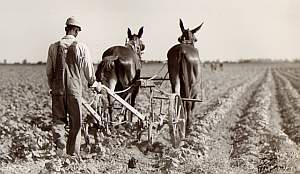
It has always startled me that so early on God let go of the reins, so to speak, to let His man assert a name for the very creatures God Himself created. I get a kick out of the fact that whatever Adam named the animal, God agreed that Adam’s choice of name was what that creature was. Tenant farmer plowing the fieldsIn this way, God viewed His Man as a partner for achieving His will.

We don’t tend to think of work as worship, but it is. In this simple act of naming the animals, Man is worshipping the Lord by utilizing the gifts of intellect and creativity God instilled in him. That same worship goes on every day when we work.

Some have confused the later curse God places on Adam with a cursing of work, but what does it actually say?

And to Adam he said, “Because you have listened to the voice of your wife and have eaten of the tree of which I commanded you, ‘You shall not eat of it,’ cursed is the ground because of you; in pain you shall eat of it all the days of your life; thorns and thistles it shall bring forth for you; and you shall eat the plants of the field. By the sweat of your face you shall eat bread, till you return to the ground, for out of it you were taken; for you are dust, and to dust you shall return.”
—Genesis 3:17-19 ESV

God did not curse work, but the ground. The call to subdue the earth and God’s handing dominion of the earth over to man proves that God thinks work is a valid and good thing still. I firmly believe that God takes pleasure in our work, even if we don’t. By working, we are continuing the call placed on us in the Garden, worshipping God in our work though we don’t realize it.

I’ve worked in a number of industries and for plenty of supervisors over the years. Today, I work at home and own my own business. As a freelance writer, I can attest that there’s not a whole lot of “the sweat of my brow” in what I do. In fact, the tendency is for my backside to broaden rather than to have it firmed up by toiling under the hot sun on a piece of ground that reluctantly gives up its fruits. That said, my wife and I have the beginnings of a farm on our land, having planted a fruit orchard and with plans to put in an acre or two of wine grapes later on. Whether I like it not, that will be the kind of work that suffers from the cursed ground in Genesis 3. But as for my writing career, the pleasure is only dampened by tough customers—and there’s no way that will get better until the Lord returns. Then who knows just what I will be doing for work?

In the course of time I’ve endured some backbreaking and downright noxious work. Possibly the worst thing I ever did in my life was when I was eighteen working for college money. I worked at the same pharmaceutical company my father worked for. Being sans skills, I was in maintenance at the plant. At one point I donned a Haz-Mat suit for two weeks and crawled through blistering hot ventilation shafts suspended seventy feet above the floor, scraping off built-up crusts of various drug residues. At 6′ 4″ tall and 190 pounds at the time, it was a narrow fit for me and a simply hideous task for anyone. Add in the undersized respirator they gave me and it was hell to just breathe—though removing it could’ve proven fatal. I also had to wear a “pinger” so they knew here I was in the shafts should some misfortune beset me and they had to cut me out—dead or alive. Of course, the older guys didn’t want to do that job, even if they had more elbow room up there. They’d all probably done it once in their time there.

Yet still, God was pleased with that work, although I felt like death at the end of the day.

God does not give us a pass to slack, no matter how tough work might be. He commanded us to work and work we must or else the apostle Paul will have something to say about it:

Now we command you, brothers, in the name of our Lord Jesus Christ, that you keep away from any brother who is walking in idleness and not in accord with the tradition that you received from us. For you yourselves know how you ought to imitate us, because we were not idle when we were with you, nor did we eat anyone’s bread without paying for it, but with toil and labor we worked night and day, that we might not be a burden to any of you. It was not because we do not have that right, but to give you in ourselves an example to imitate. For even when we were with you, we would give you this command: If anyone is not willing to work, let him not eat. For we hear that some among you walk in idleness, not busy at work, but busybodies. Now such persons we command and encourage in the Lord Jesus Christ to do their work quietly and to earn their own living.
—2 Thessalonians 3:6-12 ESV

…aspire to live quietly, and to mind your own affairs, and to work with your hands, as we instructed you, so that you may live properly before outsiders and be dependent on no one.
—1 Thessalonians 4:11-12 ESV

I think it is important here to point out that Paul is not recommending that we live as islands unto ourselves when he says, “Be dependent on no one.” It is quite clear that the early Christians saw that no one wanted for anything; certainly there were people who had needs that needed to be met and were thus dependent on benevolence to some extent. Rather Paul means that we not sponge off people while living a life of idleness. He affirms work.

Yet it wasn’t until the Reformation that work took on a new splendor. Martin Luther’s theology held work in high esteem, proving it to be a reflection of the work that God Himself performed. Luther’s strong work ethic, later reinforced by John Calvin, was instrumental in the ascendancy of existing German trade guilds that set new standards for entrepreneurship. It would be no stretch to say that the Reformation was the death knell for feudalism. This “power to the people” movement, however, did not result in communism or socialism, but pure capitalism.

But no matter the system, not all work is created equal. We all know people who work jobs that we would shrivel us to nothing in a week. And despite the tech revolution we are in, some jobs are still physically exhausting (Alaskan crab fisherman anyone?) or mentally draining. Many of us have come home from work and all we think about his work, even when are trying to sleep to get up the next day to work some more. Ecclesiastes nails it:

What has a man from all the toil and striving of heart with which he toils beneath the sun? For all his days are full of sorrow, and his work is a vexation. Even in the night his heart does not rest. This also is vanity. There is nothing better for a person than that he should eat and drink and find enjoyment in his toil. This also, I saw, is from the hand of God, for apart from him who can eat or who can have enjoyment? For to the one who pleases him God has given wisdom and knowledge and joy, but to the sinner he has given the business of gathering and collecting, only to give to one who pleases God. This also is vanity and a striving after wind.
—Ecclesiastes 2:22-26 ESV

But in the end, work still brings meaning and purpose. It also brings mystery. Again, from Ecclesiastes:

What gain has the worker from his toil? I have seen the business that God has given to the children of man to be busy with. He has made everything beautiful in its time. Also, he has put eternity into man’s heart, yet so that he cannot find out what God has done from the beginning to the end. I perceived that there is nothing better for them than to be joyful and to do good as long as they live; also that everyone should eat and drink and take pleasure in all his toil—this is God’s gift to man.
—Ecclesiastes 3:9-13 ESV

Now with these three brief intros, I think we’ve set the stage for looking at some of the tough issues we Christians face with work. In the days ahead, I’ll be exploring the nature of modern work, the American Church’s response to today’s business environment, and how we can pursue a radically different work ethic as Christians, an ethic I think can change the world.

Thanks for stopping by. Hope you have been blessed so far.

Previous post in the series: The Christian & the Business World #2: Economic Systems

Next post in the series: The Christian & the Business World #4: The Industrial Church Revolution, Part 1

Creation in the Heart of the Christian

Standard

View from Mt. Lassen, Callifornia

When I was a child, my favorite hymn was, by far, “This Is My Father’s World.” There was something inherently organic, yet otherworldly, in the simple words that begin this hymn:

This is my Father’s world,
and to my listening ears
all nature sings, and round me rings
the music of the spheres.
This is my Father’s world:
I rest me in the thought
of rocks and trees, of skies and seas;
His hand the wonders wrought.

This is my Father’s world,
the birds their carols raise,
the morning light, the lily white,
declare their maker’s praise.
This is my Father’s world:
He shines in all that’s fair;
in the rustling grass I hear Him pass;
He speaks to me everywhere.

The planets (the “spheres” as so elegantly put in the hymn) sing the praises of God. Contrary to the small-minded who believe God stopped speaking the second the canon of Scripture was closed, God continues to speak to us through His creation. The beauty of an unfolding lily attests to the artistry of God and His profound love for us that we may delight in what He delights in.

I know that God takes pleasure in what His words have wrought. I also know that I take pleasure in those things. So far this April it has averaged about 70 degrees and sunny here in SW Ohio. I cannot remember an April so auspicious in its loveliness. This kind of weather lifts everyone’s spirit.

Yesterday was the first cutting of the grass. Our property is a bit over thirteen acres, with much of it grass at this point. But as I sit up on my tractor and mow, I cannot help but feel something warm within me. The senses God gave me collect a host of data that all point to one thing: God can speak to us through the land.

I’ve blogged on this before, but I want to reiterate the thought. I believe that one of the reasons that many Christians feel impoverished in their souls is because they lack any connection to the land. Too many of us get all our food from the grocery store and never eat what we could grow ourselves if we had a tie to the land. This divorces us from God’s creation, a state I believe He never intended us to dwell in. Being able to till the soil and grow our own food puts more of our reliance back on the Creator and less on nameless and faceless multinational food production companies.

I believe God is calling Christians to get back to the land, to be better stewards of God’s world than we have been, and to outdo the pantheistic leftists (who seem to inhabit all the environmental groups out there) in our ability to care for Creation. We need to be less reliant on food distribution systems and more reliant on the Lord. I believe that Christians who are considering purchasing a new home buy one with a smaller house, but more property on which to grow food.

This year we are putting in a permaculture fruit orchard with apples, cherries, and Asian pears, plus all the supporting flora (to cut down on our use of harsh chemicals.) We want to be as organic as possible. Since my wife and I both enjoy a nice glass of wine with meals from time to time, we plan on putting in a vineyard after that—we have great soil for it. We live in the viticultural area that in the 1800s was the equivalent to what Napa is today, so we know it can be done.

And there is a blessing that comes from this that I think too many of us are missing. When we become detached from the land, we lose our ability to appreciate the bounty of God’s provision, taking for granted everything we consume. And while the Fall made growing our own food more difficult, the original call of God to be fruitful and to subdue the land has not been rescinded.

Every time I stroll through this property, I thank the Lord. I watched red-bellied woodpeckers cavort on a dying tree yesterday. The meadowlarks stroll in packs through the grass, disturbing the bugs they eat. Bats tear through the sky in random patterns, flying over the blooming pear trees, and the roses with their fresh green leaves. Warblers begin their re-acclimation to southern Ohio, their babbling songs ringing through the budding walnut, sycamore, and locust. Tadpoles swim the creek, while adult frogs croak their mating calls from the pond.

It all speaks to the majesty of God and too many people are missing it, casually ignoring Creation as they fly from one activity to another, dead to the voice of God speaking in the mulberry trees, the bluebirds, or the cirrus clouds wafting by overhead.

This year, rediscover the voice of God in Creation. Find a way to grow your food. Seek out the quiet places in the woods where God can charm you with His verdant lullabies.

In the words of another hymn:

For the beauty of the earth,
For the glory of the skies;
For the love which from our birth,
Over and around us lies;
Lord of all, to Thee we raise
This, our hymn of grateful praise.