You Can’t Take It with You

Standard

I would have fainted unless I had believed to see the goodness of Jehovah in the land of the living.
—Psalms 27:13 LITV

Do not love the world or the things in the world. If anyone loves the world, the love of the Father is not in him. For all that is in the world—the desires of the flesh and the desires of the eyes and pride in possessions—is not from the Father but is from the world.
—1 John 2:15-16 ESV

When I was requesting input on issues within the Church for my "21 Steps to a 21st Century Church" series, no one issue was presented by readers more often than materialism. AvariceOthers connected materialism with our penchant toward church hopping, consuming churches like we choose just another product on the shelves.

But is materialism in and of itself a problem, or is it just a symptom of other spiritual issues?

When George H. W. Bush (W's dad) was in office, he invited Boris Yeltsin, then president of Russia, to visit America. Nothing boggled Yeltsin more than the staggering number of choices that Americans have. Yeltsin broke down in the breakfast foods aisle of a grocery store when he saw the sheer variety of cereals. Captain Crunch and Count Chocula made the President of Russia cry.

When we talk about materialism, no fact is bandied about more than the notion that Americans are materialistic. In truth, we Americans—using the UN's Human Development Index (an excellent gauge of total privilege)—rank behind nine other countries not normally mentioned in the same breath with America as being overly privileged:

1. Norway
2. Iceland
3. Australia
4. Luxembourg
5. Canada
6. Sweden
7. Switzerland
8. Republic of Ireland
9. Belgium
10. United States

Ironically, the United States has moved down from 2004's list. Nor do we hear plenty of complaints against the Nordic countries for filling up the top ten list. Draw your own conclusions.

The problem with materialism is not so much the sin of it, but the fact that what we view as materialism is often nothing more than volume of choice. The one thing about each of the top ten nations on the list is that all are either democracies, parliamentary monarchies, or parliamentary socialist countries. Each allows their people to vote freely for elected officials. The fact that choices are given to the people means that the people soon become enamored of making choices.

What made Boris Yeltsin so weepy is the benefit of having choice. The UN's HDI listings of the bottom ten countries is a who's who of dictatorships or governments run by "strongmen." No governmental choice of leaders often translates to no choice between the Captain and the Count when breakfast time rolls around.

Marxists love to blame materialism on democracy—even some non-Marxists would contend they have point. It's hard to disengage choice from freedom. Freedom by its very nature entitles people to seek their own good within a set number of offerings. Few people would argue that this is a bad thing. The problem of materialism then becomes how many offerings are too many.

No moral code exists to say how many choices are too many, though. If we want to legislate against materialism, the universal answer would be to reduce the number of choices allowed. Unfortunately, this automatically limits freedom and will inevitably cause someone to have to forgo their usual selections. If the United States proclaimed tomorrow that no more cars made by Japanese companies would be allowed in this country, people would howl. Would they have a justifiable reason to? What moral code speaks for them or against them in this? None that I can find.

When people ultimately cite countries for being materialistic, more often than not the issue is nothing more than one of choice. Confusing materialism with choice is the mistake that people often make when attempting to show the immorality of any nation seen to be materialistic. This assessment fails to take into consideration that even the lowliest of the nations on the UN's HDI list contains materialistic people. Even with limited freedom, people in the HDI nether regions can be in love with the things of the world. Wealth is no indicator of covetousness.

When it comes to personal giving, Americans outstrip their counterparts in other countries by a wide margin. Non-governmental giving by Americans totaled more than $275 billion in 2004. This translates to almost $1000 per person per year. In stark contrast, studies have shown that the average European gives less than $20 a year of personal income to charitable causes. American taxpayers fund nearly all of the World Bank, too, though we never see any of that money doled out to us. And the thanks we Americans get for paying the majority of rescue operation costs after a series of devastating earthquakes in Iran in 2003 is the knowledge that mullahs in that country can't wait to explode one of their homemade nukes on our soil.

But does generosity offset supposed materialism?

This post is not an American apologetic piece. It's an attempt to see that there is more going on under the surface of materialism than the fact that some countries are more richly blessed than others.

Do we consider the United States blessed? David said that he would have despaired had he not seen the goodness of the Lord this side of heaven. While life is not always measured in what one owns, the Old Testament repeatedly offers a view of God's blessings that shows the Lord abundantly giving good things to the faithful. Many of the great people of God in the Old Testament were wealthy and God Himself made them that way. It's had to argue against God's favor. God's only warning is that those He so blessed not love the gifts more than the Giver.

The New Testament goes almost 180 degrees in the opposite direction by showing the household of God filled with the destitute. While wealthy patricians did populate the Church, so did prostitutes, widows, and orphans—the poorest of the poor. Jesus Himself was not wealthy, but He was buried in a rich man's tomb. Most of the apostles ultimately surrendered whatever earthly wealth they did have, forsaking it for the Gospel.

Making a theology of wealth or poverty from the Bible is more difficult than some imagine. Those that favor poverty and simplicity refer to the New Testament. Those that believe that God richly rewards the faithful materially love to quote from the Old Testament. Personally, I believe that the model is that we hold all that God gives us loosely. It's all His and it's always in play; He just needs to speak the word. We need to hear it when it's spoken.

The battle rages on.

I am not rich by any means—at least according to the standards of the United States. Our household income is pretty close to the median for this country. By the world's standards, though, I am most definitely rich, if per capita income is the only measure. Still, that's hard to judge in a vacuum. Outsourcing of American jobs shows the great equalization here. A worker in India with skills similar to mine can live on a third my income and have the Indian equivalent of my exact lifestyle. I may pay $4 for a whole chicken, while he pays only $0.40. If anything, he may be better off even though he makes only a third what I do because his cost of living is profoundly lower. Who then becomes the real materialist?

And what does that mean for our consumerist thinking about picking a church to attend?

We say that church shopping is bad and yet the number of Christian denominations in this country numbers in the thousands. America's melting pot gave us a stew of Christian sects brought here by each little immigrant group that settled this country. Their homeland may have had only a dozen flavors of Christianity, but multiply that by every country represented in America and you've got instant choice. Mix in the America ideal of being your own man and you have church splits ad infinitum. Just between the Methodist Church and the Presbyterian Church there are probably close to a hundred splinter groups that consider themselves Methodists or Presbyterians of some stripe. We say that we shouldn't treat the Church as a consumer activity, yet we are the ones that created all these factions and fractions of the original Church with a big "C." Now how many of you dozens of Presbyterian types are going to give up your little piece of the pie and join up with my independent Pentecostal church? No hands? Hmm.

Ultimately, we are only as materialistic as we love created things over the Creator. God apportions gifts as he sees fit, and if He wishes to take it all away from the United States, He can do so tomorrow. On the other hand, we should not despise God's graciousness to this country and its people. Sin is only found when we love the gift more than the Giver. When we lose that perspective, we are no longer receiving from God, but from the world, the very sin John warns us of. We become idolaters.

Are we idolaters? Some of us are. Each man needs to examine himself before God to see whether the charge sticks.

Tags: Materialism, Greed, Church, Faith, Christianity, Jesus, God

Out in the Country

Standard

Meadowlark

Whenever I need to leave it all behind
Or feel the need to get away
I find a quiet place, far from the human race
Out in the country

CHORUS
Before the breathin’ air is gone
Before the sun is just a bright spot in the night-time
Out where the rivers like to run
I stand alone and take back somethin’ worth rememberin’

Whenever I feel them closing in on me
Or need a bit of room to move
When life becomes too fast, I find relief at last
Out in the country
—”Out in the Country” by Three Dog Night (lyrics by Paul Williams)

Rev-Ed over at Attention Span wrote a piece that brought tears to my eyes. That doesn’t happen too often, but as I reflect on what he says in “God Speaks in the Country” all I can say to that post is “Yes and amen!”

It will be five years this July for us in our country home. We’ve adapted to a slower pace (though it’s not that significantly slower anymore), grown our own food, put in an orchard, and dreamed big dreams about growing herbs and wine grapes using permaculture methods. Call me converted, but I agree with the new agrarians who believe that our divorce from the land has led to spiritual impoverishment. Or as Neil Peart of Rush once penned:

Sprawling on the fringes of the city
In geometric order
An insulated border
In between the bright lights
And the far unlit unknown

Growing up it all seems so one-sided
Opinions all provided
The future pre-decided
Detached and subdivided
In the mass production zone

Nowhere is the dreamer
Or the misfit so alone
—”Subdivisions” by Rush

Sadly, the country is evaporating, the sprawling “mass production zone” creeping in on us faster than we would have hoped. Field after field within ten miles of our home sports a “For Sale” sign. Last week we found out they’ll be putting in a hospital about three miles west of us. Just more lights to obliterate our starry sky. The previous hospital we used is only twenty minutes away, twelve if you speed to it, but someone decided we needed something even closer despite the fact that ten miles east of our home another medical facility is going in. The handwriting’s on the wall. Somewhere a strip mall is being blueprinted by people who never saw a Painted Lady alight on the pale blue chicory.

I look up in the night sky and every year it’s a shade lighter. The rim of the western sky glows continually now, drowning out the light of the celestial spheres, the stars obscured by wasted parking lot light tossed carelessly upward. I look at the Orion telescope catalogs we get and I wonder if I’ll ever have enough money to buy that telescope before the creeping suburbs make it out our way and render our sky the same blank slate I see in the city.

What annihilates the meadows that once teemed with butterflies and wildflowers? The aforementioned strip mall—upscale, of course, because we all know that country people like to shop at Saks. But then we realize it’s not really for the country people, it’s for those fleeing the rotting cities relegated to urban blight and violence, another gunned-down black youth a signpost leading out of town for whites looking to put some distance between themselves and the senseless hate. Meanwhile, the bright suburb of 1970 has passed into its decrepitude and its residents are no longer “our kind of people.” So some flee to the next plot of ex-farmland and create another suburban hell that thirty years from now will be in its own doddering years.

We bought an existing house, so we didn’t add to the problem. Our deed said that our property was first surveyed in 1763. Pioneering men stood at the tops of the rolling hills and scried out a plot of land that would one day hold our 13.2 acres. Almost 250 years later and the feeling in the heart of those men is the same one that captured us. To get back to the soil and coax from it the fruits of the earth. The joy of the harvest. The rich bounty of God’s provision. The connection to the life He breathed into Creation.

We’ve lost our sense of wonder in the Church. We’ve packed the Lord and His glorious Creation away in one of Bloomingdale’s Little Brown Bags and let our imaginations be filled with the perishing for no other reason than because we can. Isn’t it easier that way?

As for me and my house, we want to serve the Lord by never forgetting that the trees speak, the stars proclaim, and the rocks, rivers, and rills shout. I hear their music and never want to endure the day where my ears strain to hear their song because they are long gone. Yet too many Christians believe that their chorus has nothing to teach them. And that is one reason why we are so far from where we should be.

O LORD, our Lord, how majestic is your name in all the earth! You have set your glory above the heavens. Out of the mouth of babes and infants, you have established strength because of your foes, to still the enemy and the avenger. When I look at your heavens, the work of your fingers, the moon and the stars, which you have set in place, what is man that you are mindful of him, and the son of man that you care for him? Yet you have made him a little lower than the heavenly beings and crowned him with glory and honor. You have given him dominion over the works of your hands; you have put all things under his feet, all sheep and oxen, and also the beasts of the field, the birds of the heavens, and the fish of the sea, whatever passes along the paths of the seas. O LORD, our Lord, how majestic is your name in all the earth!
—Psalms 8:1-9 ESV

Dominion does not equal license, no matter what we think. If we pave paradise and put up a parking lot, what sense will our own hymnody make to a future generation?

This is my Father’s world, and to my listening ears
All nature sings, and round me rings the music of the spheres.
This is my Father’s world: I rest me in the thought
Of rocks and trees, of skies and seas;
His hand the wonders wrought.

This is my Father’s world, the birds their carols raise,
The morning light, the lily white, declare their Maker’s praise.
This is my Father’s world: He shines in all that’s fair;
In the rustling grass I hear Him pass;
He speaks to me everywhere.
—”This Is My Father’s World” by Maltbie Babcock

Or, as Rev-Ed points out, how will “How Great Thou Art” survive should most people never wander a forest glade?

When we lose the country, we lose so very much. It’s where I want to be because I feel like I’m closer to God out in the forest, out in the meadow, than in any church building.

Some Christians look at me and laugh because they know it will all burn some day. But when I stand in Glory, I’ll have the confidence to say to the Lord, “Jesus, I heard the trees sing your name and I joined in their song.”

21 Steps to a 21st Century Church – Part 3

Standard

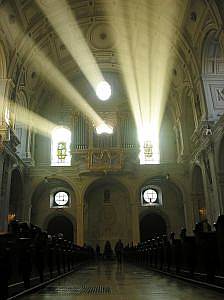
New light in an old churchFour more issues we need to address in this series of “21 Steps to a 21st Century Church.” (Previous installments: #1 and #2.) If you start to see a trend here, well…it’s intentional.

12. Be a church for all kinds of people
It bothers me as a Caucasian to look around on a Sunday morning and see no faces that look different than mine. While it’s true that our churches draw from surrounding neighborhoods, I know that while my neighborhood is predominantly white, it’s not exclusively so.It bothers me that at most churches the second a family hits the lobby they scatter. Mom goes to her MOPS class, Dad goes to his men’s class, while each child is sent to a separate classroom. Poof! They’re vapor. We talk about unity of the Body, but the designs of our churches and their programs tell a different story.

The singles are herded into a corral with other equally sexually frustrated people and we expect them to behave. Nor do we really want to know what they’re up to so long as they don’t whine about it.

Same goes for the elderly, because God knows that once you’re old you no longer have any viable purpose. (No wait, perhaps I’m confusing the Church in America for the movie Logan’s Run.)

Yet a body cannot function compartmentalized. Cut the heart off from the rest of the body and we know what happens. Remove something as small as the pancreas and see how long the body lasts.

Why we think it’s healthy to compartmentalize people in our churches is a real head-scratcher.

Somehow we’ve gotten it all backwards, thinking that our little nuclear families are the ne plus ultra of God’s design. Jesus turned that idea upside-down, though, when He said that the Christian family does not consist of those who share a biological relationship, but of those who do His will.

A healthy family is available to all its members. It doesn’t shunt its elderly off to a home to die. It doesn’t let its singles twist alone in the wind. It doesn’t believe that the five-year old can’t contribute. The foreigner and the alien are welcome and given a place of honor. Angels are entertained without our knowing.

Why are our church programs segregated by age and various other distinctions? Why do we have separate educational materials for each age group rather than a unified curriculum around a set area of study that is taught age-appropriately to all people in our church? Why do we set up parents to fail with their kids because they never know what the kids learned in Sunday School?

I believe we need to start asking questions why our churches look all white, all black, all middle class, all young, or all old. If the Church on Earth is a representation of the Church in Heaven, then why aren’t we preparing now to look like that Church at the End of All Things? I wonder if God is asking the same question.

I’m not filled with answers on this one, mostly questions. Still, I think that all of us need a gut check on this issue because it causes the Body of Christ to suffer needlessly in the long run. I’ve written a few smatterings on this topic before, so I won’t needlessly rehash old posts. Let’s just agree that this is an area of growth we should be pursuing in order to make our churches all they can be, not only for the Lord, but for all His people.

11. Conduct a proper self-examination
Ever encounter a truly humble person? I haven’t met many, but one characteristic stands out in the few I have met: they live in peace with all men. Why? I think the major reason is that they’ve truly believed that all have sinned and fallen short of the glory of God.This past year, the garrulous tone that the Godblogosphere took on disheartened me because it was a rush to self-justification. Each side in whatever battle was picked launched into the other with fingers wagging and hearts pounding. Jumping into some of my favorite blogs lost its allure. After awhile I was just sad.

If I learned one thing in 2005 it’s that all of us have sinned and fallen short of the glory of God. Sure, I’d memorized that verse a long time ago from my Navigators Topical Memory System days, but the deeper meaning behind it had gone undiscovered. What I learned this year is that most people don’t get up in the morning plotting evil. Usually evil comes as they try to go about their day using whatever flawed coping mechanisms they’ve acquired in time. The result is shattered lives and bondage to sin.

This is not an attempt to diminish sin, only an acknowledgment that none of us are perfected yet.

Before we launch into a tirade about homosexual activists, our snooty neighbor, or the promiscuous girl in the youth group, perhaps we should put ourselves in their shoes first. Maybe then we can better examine ourselves to see how far we’ve fallen and carefully note the chinks in our own armor. That homosexual activist may be a slave of sin, but he’s there at the bedside of every friend who has ever died of AIDS. The snooty neighbor who needs to know Christ gave a third of her income to help destitute children in Africa, never saying anything about doing so. The promiscuous girl who is fornicating her life away tutors dyslexic kids every day at her school.

Where are we? And just how big is the log sticking out of our eye?

We need better self-examination, folks. If we’re not putting ourselves in front of the Holy Spirit daily to allow His Light to root out our darkness, then we need to be doing a whole lot less finger-pointing. Ironically, when we do put ourselves under the Spirit’s illumination we do a whole lot less finger-pointing anyway.

There but for the grace of God go I. The humble man realizes this because he’s been there. He knows the depth of his own failure, so he’s less likely to grouse about someone else’s. I pray that our churches would be filled with that kind of humility.

10. Fire the youth pastor…then rehire him for his true purpose
Okay, now I’ve ticked off the multitudes of youth pastors out there, but hear me out. Trust me on this one.If you’re familiar with the
Business series I wrote this last summer, then you know that youth ministry started as a reaction to industrialization in England in the early 19th century. Young people were leaving farms to come to the big city to work in factories. Alarmed by the loss of parental support and the tendency of youth to turn idle hands into the devil’s toolkit, well-meaning Christians attacked the problem by creating a new kind of ministry.

The only problem is that no one thought to ask was if there was a better way. In truth, for centuries there had been a better way: parents taught their children at home about the Lord.

In taking the role of teaching one’s children about Jesus and placing it in the hands of supposed experts, the Church in industrialized nations created a monster. Teens today don’t work in sweaty factories or live in factory-sponsored dormitories, but the model used to meet that need is still paraded as the best way to reach young people.

Yet by every measurable standard, today’s youth ministry is a devastating failure. Every poll shows that Christian youth are indistinguishable from their pagan counterparts. Same amount of sexual sin, same pathetic understanding of Scriptural truth, and on and on. The model is not working, yet we continue to believe it is.

Why not take what was usurped and turn it back over to the people who once did it right? In other words, why are we using youth ministers to instruct our children in the faith rather than using their parents? It’s the parents’ responsibility anyway, isn’t it? Aren’t we simply undermining that responsibility?

Fire the youth pastor. Then rehire him for his true purpose: teaching parents of youth how to teach their own kids about the Faith.

Today’s parents were never shown an example of how to raise their children for Christ. Most don’t have a clue. I find it hard to believe that this was the case with Christian families two hundred years ago. The failed reality remains, though. We have to do something about it.

Already in a tailspin from its heyday in the 1950s, the early 1990s saw the wholesale shuttering of Christian Education departments within churches. Time was that every church had a paid person on staff responsible for overseeing the education of people within the church, but this has long since gone the way of the dodo. In many cases, the Christian Ed department was there for the very purpose of helping adults instruct their kids in a holistic Christian worldview. Now it’s gone.

But a youth ministry 180 degrees from the typical youth ministry model of youth pastor and clan of kids can counter that loss. A youth pastor dedicated to teaching parents how to instruct their kids in the faith puts the pieces back in their rightful place. It betters families, improves parent/teen communication, and also saves the youth pastor from the typical two-year burnout and rampant divorce patterns that have plagued youth ministers for the last thirty years.

This doesn’t mean that a youth group must go away, only that it be better incorporated into the full functioning life of the entire church. The elderly are involved, entire families are involved, and parents get to take back what they let slip away.

It’s time we moved to this model. (If you didn’t get enough here, I may write on this again in the future.)

9. Be hospitable
In the latter half of last year I wrote series called “The Little Things.” One of those little things that has gone unnoticed is our lack of hospitality in our churches and our homes. This lack of hospitality manifests itself as an unspoken message of division and exclusivity. Rather than reinvent the wheel here, I’ll point you to “The Little Things” post on hospitality and hope it speaks as well now as it did then.

Follow the link below to part 4…

    ***