The Finger in the Mirror

Standard

We hear the word repentance bandied about in Christians circles, and in some of those circles, it’s practically a mantra. The list of things we Christians need to repent from is an arm long, filled with things like lust, jealousy, faithlessness, failure to tithe, lack of a decent quiet time, etc.

We also hear pastors and parachurch leaders going on and on about the culture wars. Each day seems to bring a new call to arms from some ministry or self-appointed Christian leader to pray and/or write our political reps over homosexual marriage, abortion, Obama’s health care package, illegal immigration, the rise of Islam and jihad, and so on. The list is nearly endless.

But what I NEVER hear is a combination of the two messages that asks Christians to repent for our complicity in helping to empower the very culture war problems we fight. Never.

A friend sent me a call to prayer for the gathering of Muslims due to take place Friday, Sept. 26, 2009,  in Washington, D.C. Evidently, Islam is trying yet again to market itself as the religion of peace, even as it promotes Sharia law, says little about terrorism,  and advocates a host of legalistic follies that oppose the Gospel of Grace and send millions into a Christless eternity.

When I read that call to prayer arms, I had to ask the question that Christians in America avoid at all cost: In what ways am I at fault for this?

A few thoughts to consider:

  • If American Christians had continued to follow the way of Jesus in ministering to the sick, would we have the health care debate now tearing our country apart?
  • If American Christians had continued to follow the way of Jesus in caring for the orphan, the widow, and the elderly, would we have abortion on demand and a nearly bankrupt Social Security system?
  • If American Christians had continued to follow the way of Jesus in visiting the prisoner, would we have a sky-high recidivism rate?
  • If American Christians had continued to follow the way of Jesus in caring for the poor, Do we truly believe He is the answer?would we have government welfare and the burden of having fostered a society-wide victim mentality?
  • If American Christians had continued to follow the way of Jesus in loving the outcast, would we still be fighting the homosexual agenda on its proponents’ terms or battling race and illegal immigration  issues?
  • If American Christians had continued to follow the way of Jesus by actually obeying His  Great Commission, would we be fighting Islam in this country or dealing with any of the culture wars we seemingly can’t wait to engage with calls to prayers and letters to our congressman?

I would offer that the answer to these and other questions like them is a simple NO.

I would offer that we Christians are as much to blame for the condition we find ourselves in as any of our supposed foes are, but you won’t hear that from the pulpits or from parachurch ministry leaders.

When the Church of Jesus fails to do what the Gospel asks of us, something will fill the vacuum created by our absence. And I can guarantee this: We will not like what fills the vacuum.

Honestly, the denial on our parts sucks the life out of me. And yet we will go on and on about our foes, the way the government does things we don’t like, or the next moral truth to come under assault.

We talk about our nation being a Christian one, but in truth, we’re Christian in name only. If we’re not living the Gospel, then of course everything will go to hell. Why would we be surprised at that?

Do we still believe that Jesus changes lives? Do we believe that Jesus is the answer to all of life’s issues? Then we better stop living as if we don’t.

Equipping the Saints: Murder in the Church

Standard

Talk to enough Christians and it’s apparent that whatever is wrong with the world is also wrong with believers. Not a person reading this doesn’t know a dozen Christians who struggle constantly with their Faith, staggering from one ditch into another.

For years, I used to be on a team at church who prayed for folks who came up after the service. The stories I’ve heard…more hair-curling than a beauty salon. What I’ve learned in those times makes for discernment that never fails and a word of wisdom that always applies.

What did I learn? It’s in these words of Jesus:

For whoever would save his life will lose it, but whoever loses his life for my sake and the gospel’s will save it.
—Mark 8:35

The reason many Christians suffer needlessly is because we don’t know what it means to die to self. Nearly every problem we make for ourselves we make because we’ve skirted the cross and gone on our own merry way.

Consider any issue facing the American Church today. Below the surface, the crux of that issue goes back to one thing: not enough dead-to-self Christians.

Take the phrase “not enough are dead to self ” and see how remarkably it answers the following questions:

Why aren’t Christians more interested in evangelism?

Why do so few Christians know the Bible?

Why are Christians so prayerless?

Why do so few Christians serve their neighbors?

Why do so many Christians look just like the world?

Why do so many Christians get divorces?

Why do our Christian youth apostasize in such large numbers while in college?

Why are Christians making so little impact on our society and culture?

The number of such questions that can be answered with “not enough are dead to self ” accumulates rapidly.

A chilling verse:

For many, of whom I have often told you and now tell you even with tears, walk as enemies of the cross of Christ.
—Philippians 3:18

The Cross...I’m sure each of us could draw up a list packed with names of people or groups we would deem enemies of Christ.

But notice Paul’s phraseology. He chooses his words carefully. He did NOT say “enemies of Christ” but “enemies of the CROSS of Christ.”

That hits harder because it hits closer to home. In fact, such enemies may populate our churches. Worse yet, they may be you and me.

Paul concludes:

Their end is destruction, their god is their belly, and they glory in their shame, with minds set on earthly things.
—Philippians 3:19

Sounds like America 2009, doesn’t it?

What else explains the crossless preaching from our pulpits that tickles so many ears?  What else explains Christians who can’t seem to abide even the lightest correction or systematic discipleship? What else explains Christians who look just like the world?

Simple: They haven’t been to the cross.

Perhaps one Christian in 1,000 can say the following without risk of perjury:

But whatever gain I had, I counted as loss for the sake of Christ. Indeed, I count everything as loss because of the surpassing worth of knowing Christ Jesus my Lord. For his sake I have suffered the loss of all things and count them as rubbish, in order that I may gain Christ and be found in him, not having a righteousness of my own that comes from the law, but that which comes through faith in Christ, the righteousness from God that depends on faith– that I may know him and the power of his resurrection, and may share his sufferings, becoming like him in his death, that by any means possible I may attain the resurrection from the dead.
—Philippians 3:7-11

Jesus makes the the dividing line even more obvious:

So therefore, any one of you who does not renounce all that he has cannot be my disciple.
—Luke 14:33

And that dividing line is the cross.  The cross is death to anyone who lays hold of it with both hands:

But far be it from me to boast except in the cross of our Lord Jesus Christ, by which the world has been crucified to me, and I to the world. For neither circumcision counts for anything, nor uncircumcision, but a new creation.
—Galatians 6:14-15

Set your minds on things that are above, not on things that are on earth. For you have died, and your life is hidden with Christ in God.
—Colossians 3:2-3

But for those who die at the cross, a new hope exists:

I have been crucified with Christ. It is no longer I who live, but Christ who lives in me. And the life I now live in the flesh I live by faith in the Son of God, who loved me and gave himself for me.
—Galatians 2:20

Therefore, if anyone is in Christ, he is a new creation. The old has passed away; behold, the new has come.
—2 Corinthians 5:17

The saying is trustworthy, for: If we have died with him, we will also live with him…
—2 Timothy 2:11

Here’s one of the strongest spiritual truths: People who aren’t dead to self are nigh unto useless for the Kingdom. Most of what they do for God will be of the flesh, and that junk neither lasts nor produces genuine fruit.

But a man or woman dead to self and alive to Christ is unbounded. You can’t shame such people because you can’t shame the dead. You can’t hurt the dead because they feel no pain. You don’t have to dance around the willfulness of the dead because, hey, no will of their own; they pretty much do whatever you tell them.

And that’s the kind of person God will use immensely.

If we want to talk about equipping the saints, we also have to talk about de-equipping them of themselves.

Too few Christian leaders are bold enough to tell people to their faces that the sole reason for the majority of their annoyances is that they aren’t dead to self. Too few Christian leaders have the cajones to go up to lingerers at church and say, “The reason you’re useless for God is because you have no idea what it means to be dead to self. Maybe if you stopped crawling off the altar God would use you to fix the problems in His church that you’ve been griping about for decades.” Or something to that effect.

If people get offended, too bad. It’s one of the signs they’re not dead to self. Sadly, the cemeteries are filled with the bodies of those who walked away from God because He didn’t fulfill their expectations. And each one of those people left because they couldn’t get past the cross and dying to self. Isaiah, in one of the most potent verses in Scripture, describes such people vividly:

“Woe to him who strives with him who formed him, a pot among earthen pots! Does the clay say to him who forms it, ‘What are you making?’ or ‘Your work has no handles’?
—Isaiah 45:9

You can tell when someone isn’t dead. While a dead body reeks of decay, a person not dead to self reeks of something far worse: pride.  Meanwhile, the sweet aroma of the Christian who is dead to self is that of humility, the first fruit of the image of Christ.

If we aren’t getting people to the cross, then all the equipping in the world will be worthless. If the raw material we’re hoping to see molded into the image of Jesus isn’t dead first, we might as reevaluate our fancy-dancy educational programming until it is.

Will that be hard? Heck, yeah! But it’s the only way that achieves great results for the Kingdom.

The Three Marks of Genuine Power Evangelism

Standard

In my previous post, “Fumbling the Gospel,” I noted that many charismatic churches are using what is known as “power evangelism” to reach the lost. Power evangelism employs the Holy Spirit-given charismatic gifts to heal and speak words of knowledge and prophecy into the lives of people who do not know Jesus.

I fully support power evangelism done by genuine believers who can fully articulate the Gospel. Whether that’s the case in what passes for power evangelism in some sectors of the Church today is the question and the gist of my previous post.

Today, I feel compelled to add one more point to that post.

When you closely examine the “gospel” that many churches in America preach today, it is not the real Gospel. In too many cases, it fails to emphasize three core principles of the real thing:

1. Conviction of sin in the presence of a holy God

When the prophet Isaiah had a vision of God, notice his response:

In the year that King Uzziah died I saw the Lord sitting upon a throne, high and lifted up; and the train of his robe filled the temple. Above him stood the seraphim. Each had six wings: with two he covered his face, and with two he covered his feet, and with two he flew. And one called to another and said: “Holy, holy, holy is the LORD of hosts; the whole earth is full of his glory!” And the foundations of the thresholds shook at the voice of him who called, and the house was filled with smoke. And I said: “Woe is me! For I am lost; for I am a man of unclean lips, and I dwell in the midst of a people of unclean lips; for my eyes have seen the King, the LORD of hosts!”
—Isaiah 6:1-5

In the presence of a God called “Holy, Holy, Holy,” Isaiah, though called to be a prophet of God, immediately was undone by his own sinfulness in the presence of supreme holiness. As Isaiah stared into the reflecting mirror of God’s holiness, he saw a creature of his worst nightmares staring back. And he cried out in his guilt for being a sinful man.

The Bible notes that Isaiah is not alone:

…for all have sinned and fall short of the glory of God…
—Romans 3:23

2. The death of self at the cross

The Apostle Paul writes of the one thing of which he must speak boldly:

But far be it from me to boast except in the cross of our Lord Jesus Christ, by which the world has been crucified to me, and I to the world. For neither circumcision counts for anything, nor uncircumcision, but a new creation.
—Galatians 6:14-15

All the world’s religions, save for Christianity, are little more than rules that no one can fully abide by. Each of us has sinned and fallen short of the glory of God, no matter how many religious rules we try to keep. Only Jesus Christ perfectly kept the rules of God, and so being perfect, He took our place of punishment on the cross and served as the perfect sacrifice for our sins. As one popular Christian song states, “The cross has said it all.”

Paul said earlier in that same letter to the Church in Galatia:

I have been crucified with Christ. It is no longer I who live, but Christ who lives in me. And the life I now live in the flesh I live by faith in the Son of God, who loved me and gave himself for me.
—Galatians 2:20

If people don’t make it to the cross, then they never die to self. And if they never die to self, then they are not new creations. Because the only kind of Christian that God can fully use is the one who has died to the self that was the old man and been born again into Christ.

3. Genuine repentance

Sadly, the portrait of Jesus often sold to people today is of the weepy-eyed sort who loves infants and little lambs. Yes, that side of Jesus is real. Yet He had another side that too many churches fail to promote as part of the whole Gospel:

There were some present at that very time who told [Jesus] about the Galileans whose blood Pilate had mingled with their sacrifices. And he answered them, “Do you think that these Galileans were worse sinners than all the other Galileans, because they suffered in this way? No, I tell you; but unless you repent, you will all likewise perish. Or those eighteen on whom the tower in Siloam fell and killed them: do you think that they were worse offenders than all the others who lived in Jerusalem? No, I tell you; but unless you repent, you will all likewise perish.”
—Luke 13:1-5

Jesus called John the Baptist the greatest of the prophets. What was John’s message?

In those days John the Baptist came preaching in the wilderness of Judea, “Repent, for the kingdom of heaven is at hand.”
—Matthew 3:1-2

Shortly after being baptized by John, Jesus began His own public ministry. His message?

From that time Jesus began to preach, saying, “Repent, for the kingdom of heaven is at hand.”
—Matthew 4:17

After Pentecost, when Jesus had been resurrected, had ascended into heaven, and the Holy Spirit had been poured out on the disciples who had followed Jesus, they had something to tell the world. That message?

And Peter said to them, “Repent and be baptized every one of you in the name of Jesus Christ for the forgiveness of your sins, and you will receive the gift of the Holy Spirit. For the promise is for you and for your children and for all who are far off, everyone whom the Lord our God calls to himself.”
—Acts 2:38-39

Do you think repentance is a big deal to God?

That last verse I quoted, Acts 2:38-39, is preceded by the Holy Spirit falling in power on the followers of Jesus at Pentecost. Those indwelt by the Spirit spoke in tongues and exhibited the power of the Holy Spirit’s gifts, the charismata. That power was so stunning that 3,000 people watching the events of that day surrendered their lives to Jesus. Talk about power evangelism!

But what immediately preceded verses 38-39 is a telling response by the crowd of unbelieving onlookers to the words of Peter concerning the truth of Jesus and the power they had seen wrought in that gathering place by the Holy Spirit:

Now when they heard this they were cut to the heart, and said to Peter and the rest of the apostles, “Brothers, what shall we do?”
—Acts 2:37

This is not a simple question but a desperate one, the same kind of angst-filled reply that burned in the heart of Isaiah when confronted with the holiness of God and the true nature of his state before that holy God. It’s the conviction of sin.

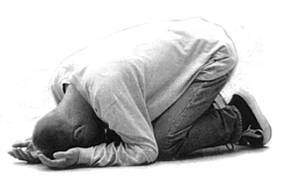
When the Holy Spirit touches sinful people, He ALWAYS brings conviction of sin because He is HOLY, HOLY, HOLY. Prostrate before the Lord in repentanceEvery great revival of the last 300 years of recorded history has been marked by conviction of sin, people fleeing to the cross, and genuine repentance. The First and Second Great Awakenings, the Welsh Revival, the Azusa Street Revival—when Christians (especially charismatics) start talking about the Holy Spirit in revival, the results always lead to conviction, the cross, and repentance. ALWAYS.
So when I’m told about power evangelism supposedly being done in the power of the Holy Spirit, if I don’t hear about people coming to conviction, dying at the cross, and genuinely repenting of their dark sins in the light of the purity of the Holy Spirit, then I have got to wonder. Without those three essentials occurring in the lives of people touched by some sort of powerful spirit, I wonder just what spirit they received. Is it possible they are being influenced by a spirit who is not the Holy Spirit of God?

Real power evangelism done through the genuine power of the real Holy Spirit will convict people of their sins, drive them to the cross, and lead them to repentance. The Bible tells us this, and the great revivals of history add their own yes and amen.

If you are doing power evangelism and conviction of sin, dying to self at the cross, and repentance are not immediately following people’s power encounters, then stop what you are doing and ask yourself if you are truly ministering the genuine Holy Spirit to people.

We have got to stop being ignorant of the truths of God. This is simple stuff, but people are not using even basic biblical discernment to understand these truths. It’s just another example of how a lack of understanding of the words of the Bible leads to all manner of error. Better to know the Bible inside and out before one attempts anything resembling power evangelism.