
Banking on God: Theology, Part 2

Standard

The prosperity gospel. You know it. You probably despise it.

Just the thought of some loud, sweaty, Armani-wearing “preacher” telling you that sending him $100 as “seed faith” money guarantees an increase of three, ten, or even a hundredfold…No, not this guy...the OTHER prophet Joel...well, the veins start pounding in your forehead and you’re wishing you could reach into your TV and slap the guy a good one.
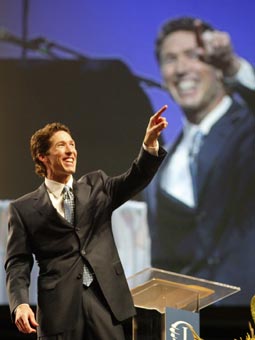
“God wants you rich!”

“If you can envision it, you can have it by faith!”

“If words of death come out of your mouth, you’re going to reap death. Speak words of life!”

“Why ask God for a Ford when you should be asking for a Lexus?”

“You don’t have to live with disease if you have faith in God.”

“The power of wealth creation is in your tongue, so speak out that wealth!”

“You’re a child of the King, and you’ll never see a prince or princess enjoying anything less than the best the world has to offer.”

Now I made all those up. I’ll bet, though, that at some time or other a prosperity gospel preacher said something pretty darned similar. In fact, we could almost make a game of it by coming up with outrageous claims by prosperity teachers who teach a gospel without a cross, without sin, without holiness, and without—unbelieveably enough—Jesus.

These “preachers” of prosperity sucker millions of dollars from millions of people. Naifs who fall under the spell of these slick-talking, Bible-waving, perfectly coiffed “evangelists” often come to a sad—and savings-less— conclusion. Those prosperity preachers like to call everyone “Brother ” or “Sister,” and they often go by titles like “Apostle” and “Bishop.” And sadly for the rest of us charismatics, they claim Pentecostal and Assemblies of God backgrounds.

I feel for the people taken by these manipulators. For the most part, many of the fleeced are poor to begin with. Or perhaps it’s better to think of them as the working poor, especially in America. They have jobs; they’re just not good jobs.

Consider a mom and dad who collectively bring home about $16 an hour with no decent benefits. They have a car, but it costs more to keep it running than it’s worth. Things break in their home and they can’t afford to repair them. Doctor? Who can afford one when there’s no insurance and a simple office visit costs a day’s wages (and there’s always more days at the end of the month than there are wages). Taxes keep going up. Energy keeps going up. Prices for everything are up, up, up. Yet for these folks, wages stay the same. They’re the ones getting destroyed in this recession.

And every day they see themselves sinking further and further down with no hope of recovery. Think they’re going to latch onto anyone who can give them hope of getting out of their predicament?

The two question I ask amid all this is Where are we and what hope do we give them?

And that’s a problem for us Evangelicals who gag every time we think about the prosperity gospel.

Here’s a clue for us suburban McMansion-dwellers in our newly-erected, mega-community-churches: Poor people don’t like being poor.

It stinks to be poor. When your kid needs glasses and you can’t secure a pair because you’re too “rich” for government aid yet you’re not rich enough to afford them outright…well, it stinks even more.

I live in a not-so-rich area. Many of the houses on my road aren’t houses; they’re trailers. The state of the economy is putting a terrible squeeze on these already-squeezed people. So when they start putting faith in the prosperity gospel, I’m not surprised. The real Church hasn’t given them much other hope. Billy Joe Jim Bob Preacher Boy with a Gilt-fendered Escalade was there when the real Church wasn’t.

Do we remember Acts 2 & 4?

And all who believed were together and had all things in common. And they were selling their possessions and belongings and distributing the proceeds to all, as any had need.
—Acts 2:44-45

There was not a needy person among them, for as many as were owners of lands or houses sold them and brought the proceeds of what was sold and laid it at the apostles’ feet, and it was distributed to each as any had need.
—Acts 4:34-35

I would contend that if we in the Church actually lived as those four verses describe, there wouldn’t be any need for anyone to rush to prosperity teachings for hope. But when we simply ignore those passages, especially in light of those parents who don’t know how they’re going to pay the hospital bill for their kid’s broken arm, then we’re assisting the prosperity message through our inability to live by the Bible so many of us call inerrant.

But you want to know the craziest part of all this? As bad as these prosperity preachers are, as little as they care about the cross and bearing it, they’re not wrong on everything.

Psalm 112 says this:

Praise the LORD! Blessed is the man who fears the LORD, who greatly delights in his commandments! His offspring will be mighty in the land; the generation of the upright will be blessed. Wealth and riches are in his house, and his righteousness endures forever. Light dawns in the darkness for the upright; he is gracious, merciful, and righteous. It is well with the man who deals generously and lends; who conducts his affairs with justice. For the righteous will never be moved; he will be remembered forever. He is not afraid of bad news; his heart is firm, trusting in the LORD. His heart is steady; he will not be afraid, until he looks in triumph on his adversaries. He has distributed freely; he has given to the poor; his righteousness endures forever; his horn is exalted in honor. The wicked man sees it and is angry; he gnashes his teeth and melts away; the desire of the wicked will perish!
—Psalms 112:1-10

Well, is that true or not?

That passage embodies many of the teachings found in the prosperity gospel.

And what of this?

Is anyone among you suffering? Let him pray. Is anyone cheerful? Let him sing praise. Is anyone among you sick? Let him call for the elders of the church, and let them pray over him, anointing him with oil in the name of the Lord. And the prayer of faith will save the one who is sick, and the Lord will raise him up. And if he has committed sins, he will be forgiven. Therefore, confess your sins to one another and pray for one another, that you may be healed. The prayer of a righteous person has great power as it is working. Elijah was a man with a nature like ours, and he prayed fervently that it might not rain, and for three years and six months it did not rain on the earth. Then he prayed again, and heaven gave rain, and the earth bore its fruit.
—James 5:13-18

Do we believe that or not? The scary thing is that the prosperity preachers do.

And that’s a problem for us. Because there’s little difference in the eyes of the Lord between someone who preaches the wrong kind of faith and someone who has no faith at all.

Recently, I visited a few sites where people who believed God for healing terminal diseases came under fire from commenters. That made me livid. While it may be true that the commenters were wise enough to see through the phony promises of prosperity preachers who took money from the sick in exchange for a promised healing, is that any worse than not believing for healing at all? When I read those commenters, this quote struck me:

“Your daughter is dead. Why trouble the Teacher any further?”
—Mark 5:35b

Isn’t that the voice of resignation? Isn’t that the voice that says to give up? Isn’t that the voice that says to just make peace with the suffering?

Isn’t that the voice of the Enemy?

To which Jesus replies:

“Do not fear, only believe.”
—Mark 5:36b

I’m convinced that when we get right down to it, for many of us, our so-called faith is a sham. We may pray, “Give us this day our daily bread,” but which of us actually lives from one day to the next dependent on God to provide that day’s food? Can’t we buy our way out of almost any trouble we encounter? Why do we need God for anything?

Sure, Christ died and with His blood secured eternity for us who believe. No, we couldn’t do that ourselves. But beyond having faith that He will take us to heaven at some future date, how well do we live in the dark moments before then?

What happens should we find ourselves on the tight loop of the downward spiral? That time when we can no longer afford medical care, even if we have insurance? What happens when we confront some expensive-to-deal-with disease. Will we have faith then that God will come to help when before we counted on our money to make it all better?

Or will it all be suffering?

Prosperity preachers don’t like suffering much. In fact they pretty much hate suffering in every form. Boo on them, because we should expect suffering in life, right?

Funny thing is, the Scriptures tell us that one of the reasons Christ came was to relieve suffering:

“The Spirit of the Lord is upon me, because he has anointed me to proclaim good news to the poor. He has sent me to proclaim liberty to the captives and recovering of sight to the blind, to set at liberty those who are oppressed, to proclaim the year of the Lord’s favor.”
—Luke 4:18-19

Isn’t our Gospel supposed to be Good News to suffering people? How then did we turn it back into being about suffering? Isn’t the Kingdom of God a Kingdom that drives out that wicked kingdom filled with suffering? I mean, if we should be content in our suffering, I guess all those sick folks and families of demon-possessed people had it all wrong when they cried out to Jesus to come and take away their suffering.

And while we’re at it, what is so wrong with speaking positive things by faith? The prosperity gospel people always talk about making a positive confession:

From the fruit of a man’s mouth his stomach is satisfied; he is satisfied by the yield of his lips. Death and life are in the power of the tongue, and those who love it will eat its fruits.
—Proverbs 18:20-21

True or not true? Obviously, I believe it’s true. Why then do so many act as if it’s not? I’ve got to believe the world would be a better place if Christians, especially here in the States, showed their faith more effectively to the world by speaking words of life rather than so many deadly words that only drive the lost further from Christ. And even in our own lives, how many times do we condemn ourselves by the negative words we speak with regard to our own lives? If a man truly reaps what he sows, what is reaped by the negative things we say about ourselves or our neighbors?

So as much we say we despise these prosperity preachers for filling desperate people with naive hope while draining their wallets, I look at my own life and the lives of a lot of other Christians who oppose those charlatans and wonder if our faith is even visible at all.

Now which problem should concern me most?

***
Banking On God: Series Compendium

Banking on God: Church Finances, Part 2

Standard

Yesterday, I mentioned the problem of cost overhead in our churches. It’s a big problem, too, as many of you thought your church should spend its money on more important things than mortgages and office supplies.

Let’s not talk about those first. Instead, I want to alienate every pastor who reads this blog by tossing out one word: bivocational.

I look at it this way: We should most definitely pay our pastors. We should also pay the head of the children’s ministry. In fact, we should pay a lot of people, because, let’s face it, the church secretary is truly the one who runs the church. Next to the Lord, that is.

I think those folks are worth money. However, I also think we spend too much money on staff salaries, especially at these massive churches that have 100+ people on staff. That’s nuts. And it’s a big drain on the mission of the church.

How so? Well, we somehow found a way to separate the lowly from the priestly class, a sort of sequel to the Old Testament’s temple system, the very system Christ fulfilled and therefore put to rest.

That separation gave us a full-time clergy and the “well, someone else is doing the ministry for me, so I’ll concentrate on everything that isn’t ministry” laity, an artificial distinction that pretty much denies the idea of the priesthood of all believers. As George Orwell wrote in Animal Farm, some are “more equal than others.”

In many ways, this has been a train wreck for pastors because no one treats them like a fellow brother in Christ. They are not one of us, so to speak, a view that facilitates all manner of craziness (cults of personality, depression, marital infidelity, and so on) that derails churches left and right.

Still, the greater hurt comes when those who aren’t “professionals” decide to lay down and do next to nothing to advance the cause of Christ. Sadly, under the bifurcated system of ministry we have today, that’s all too often the outcome.

Which is why I believe that pastors need to have a job outside the church. Even if it’s only a small part-time job, the pastor needs that dose of reality, that connection to the life his flock leads. Talk to some pastors and it’s all too clear they have no idea what goes on in the cubicles today. (I know. I read books by pastor/teachers talking about the modern work world and they just have no idea.) That works against them in many ways. I remember a pastor who preached that it didn’t matter what you looked like or how old you were, yet at the same time there were people in his congregation who were getting Botox injections so they wouldn’t be the old-looking one in the office and therefore subject to the first pink slip when the next round of downsizings came.

But more than that disconnection with the world of their congregations, having pastors work in the “real” work world affords churches the chance to have more than one pastor. A church could hire two pastors for the cost of one if both worked outside the church a few days a week. For a lot of churches who can afford only one pastor, having two bivocational pastors for the price of one full-timer would open up many more options and better broaden the giftings of the leadership in that church.

I also think that having bivocational pastors forces the people in the seats to step up. And that’s always a good thing. No one should be irreplaceable, even a pastor, and the more the congregation takes over the roles it should be handling apart from the lone office of the pastor, the better for their church.

Like I said, that won’t curry me any favor with the pastors who read this blog, but that’s my stance and I’m sticking with it.

I’m also going to quote this:

And Peter said to Jesus, “Lord, it is good that we are here. If you wish, I will make three tents here, one for you and one for Moses and one for Elijah.”
—Matthew 17:4

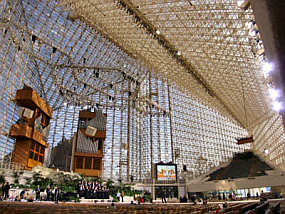
Our tendency in the Church is to want to pitch that tent. This is why we have so many church buildings. In 2007 dollars, the price tag would have been $55 million...That tendency is also why the Lord Himself oversaw the destruction of the temple in 70 AD. He wanted the Church to get out there. To move. To not be tied to one place, to a building that can so easily become like cement shoes.

When it comes to church finances, for many churches, that church building has become the impediment that keeps them from running. Its very convenience slows them down, keeps the people thinking small, keeps them stuck in one place, imprisoned by a multi-million dollar mortgage.

But the temple? Well, you are the temple and so am I. Wherever we are is where the Church is. The Light moves where we move.

Track revivals around the world. Those revivals last until someone decides to pitch a tent, until the building committee comes together. Then it quietly peters out. That’s why revival burns bright in Chinese house churches and not so much here. It’s why God is using the poorest of the poor in today’s world to be the best evangelists of the message of Christ. They don’t even have the money for the tent so many others want to pitch. Somehow, making do with what they have is good enough for them. Because they’ve got another paradigm, a heavenly one.

I can’t help but think that our churches can be better by making do with less. By not being tied to the earth by wealth any more than a lone individual should be. Yet you look at so many church building projects and they seem a lot like this:

And he told them a parable, saying, “The land of a rich man produced plentifully, and he thought to himself, ‘What shall I do, for I have nowhere to store my crops?’ And he said, ‘I will do this: I will tear down my barns and build larger ones, and there I will store all my grain and my goods. And I will say to my soul, Soul, you have ample goods laid up for many years; relax, eat, drink, be merry.’ But God said to him, ‘Fool! This night your soul is required of you, and the things you have prepared, whose will they be?’ So is the one who lays up treasure for himself and is not rich toward God.”
—Luke 12:16-21

I look at that passage and it’s all too easy to see a church enamored of numbers talking about even bigger numbers and a place to store them all. Tearing down the old church building to build an even bigger one, and in the process losing sight of what really matters to God.

As Americans, I think it’s knit into our DNA to have a building. The American Dream’s foundation is built on home ownership, and I suspect that ideal translates into our compulsion to erect a church building. And just as nature abhors a vacuum, a church abhors being plain. Funny how expensive it is to rig up a church building for maximum entertainment and comfort value nowadays.

Between paying staff and paying for a building (and its upkeep and utilities—ask to look at the electrical and heating bills sometime), a big chunk of cash goes away from fulfilling the overall mission of the Church, especially as it pertains to the world outside the walls of that very building.

I think a church that ran without a full-time pastorate and a semi-utilized building would find itself less burdened by titles and mortgages and more burdened by the lost. It would be a church that cornered on a dime rather than running up on the sidewalk like a semi.

It’s a hard sell, though.

I keep hoping some day that we get a flat-tax or value-added tax in this country, but then you’ve got an entire industry of tax-prep and legal people screaming bloody murder that their livelihood—based as it is on the arcane, cryptic mess our tax code is—will up and go poof. I’m sorry, but it needs to up and go.

And so it is with the way we do church, especially when it comes to spending too much of our money on things that may not be advancing the Kingdom. Too many people are deeply invested in the crusty institutions our churches have become. They’ll find a way to hang on kicking and screaming, resisting what may be better for us in the long run, so that they can maintain the status quo.

Unfortunately, the status quo ain’t doin’ all that well for us anymore.

***

Banking On God: Series Compendium

Banking on God: The Tithe, Part 2

Standard

See Acts 4:34-35Today’s post is a tough word that may anger a few people. Asking people to give is always a tricky proposition. In the Church, it’s an even more sensitive issue because we have tied giving with our spirituality. Plenty of churches still exist where one’s piety is measured by how readily one ponies up the moolah.

And that brings us to the tithe.

My belief on giving money within the church is what I call “The Quick, Dead Priest” model. And nope, you won’t be hearing anyone else labeling what follows by that name. I believe, though, that this model best represents the true New Testament model of giving.

The first truth: Christians have been crucified with Christ and are now dead to the world.

The Bible is full of legal truths, the kind lawyers love. And one universal legal truth is that a dead man can’t own anything. Whatever once belonged to the deceased must be passed on to heirs. You can’t take it with you. End of story.

For you have died, and your life is hidden with Christ in God.
—Colossians 3:3

As Christians, we have been united to Christ in His death. The stamp of the death certificate on your life and mine is the cross. Being in Christ means being in no one or no thing else. You, therefore, are not your own. You have been bought with the price of Christ’s death.

Outcome? You own nothing, not even yourself.

Therefore, all this talk of “what is mine” is just that, talk. Christians have no legal precedent to claim they own anything. God may indeed bless you with property and possession, but under the legal system of the Kingdom of God, you are merely stewarding what belongs to someone else. And that someone is God.

The second truth: The death and resurrection of Jesus permanently ended the temple system instituted in the Old Covenant.

This understanding is critical. We no longer perform sacrifices because Christ, the perfect sacrifice, died, satisfying the demand of blood as a covering for sin. Because Christ satisfied all conditions of the Law in Himself, if we are in Him, then we no longer must strive to fulfill the Law. (Don’t believe me? Sit down and read the entire book of Galatians in one sitting. Then read it again for good measure! Follow that up with the entirety of Hebrews.)

One of the hallmarks of the old temple system was the Aaronic priesthood. The giving of tithes in the Old Testament went to support the work of the Aaronic priesthood. The temple economy, based on the tithe of one-tenth, existed to keep the temple system running, to care for the priests (who were allowed no other forms of income under the Law), and to ensure the purity of the people before God through the sacrifices.

But Christ eliminated the old temple system. The sacrifices are gone. The flawed Aaronic priesthood and all that pertained to it, including the mandatory one-tenth tithe used to support it, was put aside, surpassed by the perfect priesthood of Christ. To prove the case even more thoroughly, the Sovereign God oversaw the destruction of the temple itself in 70 AD.

The old has passed away. The new has come.

Under that new priesthood of Christ, you and I are the priests. For all you Protestants out there, the Reformation was built, in part, on the idea of the priesthood of all believers:

But you are a chosen race, a royal priesthood, a holy nation, a people for his own possession, that you may proclaim the excellencies of him who called you out of darkness into his marvelous light.
—1 Peter 2:9

But our priesthood is radically different. It’s a priesthood of equals. It’s a priesthood of community. It’s a priesthood that has God living inside each priest, not in a temple built by human hands. And that truth radically transforms how we must view giving.

The third truth: Each priest in the Kingdom of God in Christ is quickened by the Holy Spirit and that quickening informs giving.

The priests of the Old Covenant did not have the Holy Spirit’s indwelling, hence the need for a man-made temple. The priests of the New Covenant, however, do have God living inside them. We see how that plays out immediately after Pentecost:

And all who believed were together and had all things in common. And they were selling their possessions and belongings and distributing the proceeds to all, as any had need.
—Acts 2:44-45

That concept is expanded two chapters later:

Now the full number of those who believed were of one heart and soul, and no one said that any of the things that belonged to him was his own, but they had everything in common…. There was not a needy person among them, for as many as were owners of lands or houses sold them and brought the proceeds of what was sold and laid it at the apostles’ feet, and it was distributed to each as any had need.
—Acts 4:32, 34-35

Upon being filled with the promised Holy Spirit, the first thing the new priests of Christ did was to ensure that no one among them lacked for anything. They sold houses, properties, whatever, to ensure that the new priests were provided for. The difference in this priesthood, though, was that everyone was a priest, so all were entitled to the largess of the community, not just a certain tribe or class. All. And the payment? Everything, to the point that no one claimed personal entitlement.

Another truth emerges. The new priesthood did not build on the ashes of the old. It was and is a new thing that God has done. It relies not on Law, but on the indwelling Holy Spirit.

God created a new economy and with that economy comes a radically transformed idea of giving:

The one-tenth tithe has been abolished. Totally. It does not persist in any way in the new Kingdom economy.

As the Bible says:

In speaking of a new covenant, he makes the first one obsolete. And what is becoming obsolete and growing old is ready to vanish away.
—Hebrews 8:13

The new standard of giving has replaced the old. The old was for men and women who did not have God dwelling inside them. The old was for men and women who had not been crucified with Christ and therefore dead to the world. The new asks everything of us. It asks for our houses, our possessions, our jobs,our kids, our spouses…even our very lives. It’s all on the table and can be used for the purposes of the Lord any way He chooses, even if that means that we must be martyred so as to accomplish His goals for the Kingdom.

How will you know how much to bring and whether His call on you is to simply give $20 or go so far as to sacrifice your life?

The Bible tells us:

“When the Spirit of truth comes, he will guide you into all the truth….”
—John 16:13a

And

For all who are led by the Spirit of God are sons of God.
—Romans 8:14

The mark of our acceptance into the new economy of God, into His new Kingdom, is that we are led by the Spirit of God. The truth revealed by the Spirit will show us exactly what we should be doing with the money He’s given us to steward.

So how is it that far too many of us cling to patterns of given obsoleted by God’s new economy? Why do so many continue to endorse a ten percent tithe?

Because it’s easy.

It’s easy because it requires so little of us.

It’s easy because it asks nothing of going before God to inquire of Him by the Spirit to know what we should be giving in any and all situations

It’s easy because it doesn’t require us to live by “Give us this day our daily bread.”

It’s easy because it doesn’t ask us to give until it hurts, to take up our cross daily and follow Christ.

And that’s the problem in a nutshell. The old economy asked very little. The new economy in which dead men and women made alive in Christ are priests in a new Kingdom…that economy looks messy, fuzzy, and difficult compared with the old economy. However, the new is one thing the old is not: perfect.

If we want to see the Church be what She is intended to be by Her Bridegroom, then we MUST start living under the new economy of His Kingdom. Not the old economy, but the new.

Now if only more of our churches in America understood this.

***

Banking On God: Series Compendium