You had to be living under a rock to miss the brouhaha over Mother Teresa’s confessionary book detailing the profound absence of the presence of God in her life. Not only did the secular media sources jump all over that news, but so did the Godblogosphere.
While I apologize for being late to this news story due to situations here at home, I feel the need to comment nonetheless. Perhaps in the wake of this story’s looming obsolescence (as is common in today’s frenetic media environment) people have had a chance to ponder it a bit more—or forget it completely. No matter the case, I hope to add grist to the mill or refresh your memory.
You can read the original Time article here.
I appreciate Mother Teresa’s work in India to the extent that she cared for the dying. Few of us would be so dedicated in such a hellhole as the one she ministered in. In that regard, she’s a far better person than I am.
On the other hand, no evidence exists that she told dying, hell-bound people how to be born again in Jesus Christ. To have ephemeral earthly comfort without eternal spiritual comfort is no comfort at all.
So in the end, I have strongly mixed feelings about Mother Teresa.
If you cruise the Christian blogosphere, you’ll find all sorts of opinions about the state of her soul. Some would damn all Catholics to hell, saying Teresa’s crisis of faith was due to a complete lack of saving grace; she didn’t feel Christ’s presence because she wasn’t born again. Others sympathetic to the Catholic cause are more lenient, claiming she partook of Christ’s sufferings by enduring an incredibly long, God-ordained “dark night of the soul.”
I’ll let readers decide where they stand on that continuum. Seeing as Teresa ministered in one of the bleakest spots on the planet, the slums of Calcutta, I can see how she might tend toward that dark night. Still, for the purposes of this post, I want to make the issue less about Teresa and more about you and me.
The longer I’m a Christian, the more people I encounter who put on a brave face concerning their own encounters with Christ. If I had to choose a side, I would say that I know far more Christians who would confess in secret that they never experience the feeling of God’s presence in their lives. In that way, they understand what Mother Teresa endured because they feel the same disconnection. That experience nags at them daily.
Can we be honest here? For every one Christian who claims an intimate, uniquely personal encounter with the person of Jesus Christ, I suspect there’s ten who have not.
That’s not a figure we Christians like to trumpet. I think it’s the dirty secret we don’t wish to discuss–ever. Why? Because it calls one’s salvation into question, at least by the standard that some Christians use.
When we talk about having a “personal relationship with Christ,” how many people can claim that this relationship resembles in every way (and better) the kind of relationship one has with a spouse?
To some people, to even ask that question is nuts. “Of course a person doesn’t have a relationship with God, a spiritual being, in the same way as a flesh and blood human being,” some would say. Others would argue, “Anyone who doesn’t have that kind of kind of relationship isn’t really filled with the Spirit and may not be a Christian at all!” Still others would say, “The truth lies somewhere in-between.”
I’ve had some interesting conversations with men of late. More than once I’ve heard them say that God responds to their wives’ prayers in a way that they themselves do not experience. One even went so far as to say that when something he’s been praying for happens in his favor, he has to check to see if his wife was praying the same thing. If she wasn’t, then he can rest knowing that God answered him alone.  Otherwise, he fears that his prayers go unheard if they don’t overlap his wife’s. (I may unpack that fear in a later post.)
If I polled men here, I would suspect that some of them are squirming in their seats over hearing this revelation.
Given this, I suspect that a lot of the Godblogosphere’s most vocal proponents of the Gospel harbor a real dryness on the inside for that voice of God they never seem to hear. And given how readily some talk and talk about the little two-sided chats they have with God every day, you won’t hear those dry folks fessing up.
In the case of Mother Teresa (or those of you out there who share her lot), I can say without hesitation that no matter what we might say about her spiritual state, she did one thing right: she pressed on.
One of my favorite passages in Scripture puts it this way:
“Come, let us return to the LORD; for he has torn us, that he may heal us; he has struck us down, and he will bind us up. After two days he will revive us; on the third day he will raise us up, that we may live before him. Let us know; let us press on to know the LORD; his going out is sure as the dawn; he will come to us as the showers, as the spring rains that water the earth.”
—Hosea 6:1-3
Most of us know the last sentence, v. 3. I like the other two as well, for they are Messianic prophecies that also apply to us Christians. Sometimes it takes two days out of three before God revives us. In a life of 80 years, that may be a long time to be dry. But His promise is sure if we press on, isn’t it?
I know plenty of atheists who gloated over Mother Teresa’s dryness. “See, see!” they shouted. “If Mother Teresa can’t touch God, there’s no one’s up there in heaven.”
But the thing about atheists is they know nothing about pressing on. They gave up before the second day, before the rains came.
I know a little about the rains. We’re officially at 19″ of rain for the year in my part of Ohio. The normal? Oh, about 30″. Now combine that with the hottest August on record around here, with five days over 100. Folks, it doesn’t get drier than that. My property looks like a moonscape with all the craters of dead, scorched grass. But as someone who fancies himself a farmer, I don’t give up. Because I know some day the rains will come. Maybe not tomorrow or the day after that, but some day.
So we press on.
As the Scriptures say:
I love those who love me, and those who seek me diligently find me.
—Proverbs 8:17
I believe that. I hope everyone reading this does.
I don’t know about Mother Teresa. I know about me, and I’m not always a fountain of refreshment. Still, the faraway God comes in intimate times and I find Him. Sometimes I find Him when I’m not pressing on. And sometimes I don’t find Him when I am. But He’s still there, and I take comfort in that knowledge.
I pray that you’re finding Him. If you’re not, know that you’re not alone. So don’t be discouraged; press on. If you simply can’t press on by yourself, enlist someone to press on with you. And don’t be surprised if you see in the one who helps you the very person of God.
Be blessed. And bless others.

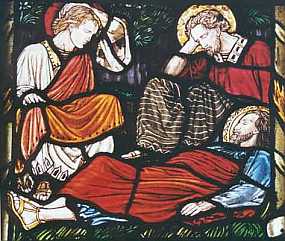 That’s a tragedy of untold sorrow. Yet it’s what too many Christians face each Sunday in either their dead churches or their dog-and-pony-show excuses for a live one.
 It’s the question of whether we see ourselves as sinners or saints.