
Have the Protestant Reformation and Democracy Harmed Christianity?

Standard

I enjoy reading Coffee with Jesus, one of those minimalist Comics 2.0 strips where the images don’t really matter but the text does.

While I normally nod my head in agreement, a recent strip bothered me:

Coffee with Jesus -

Is it naive to think that all you and I really need is Jesus? That He is the only one we should listen to?

I mean, Paul said to imitate him as he imitated Jesus. And we are a Church, which is meant to function as a Body, which means communication between the parts. And my spiritual gifts are not intended just for me alone.

The other day, I was considering whether two of history’s most respected events/institutions have actually amplified our confusion within the Western Church. Anyone who has a pair of eyes and ears can look and see that the Church is struggling in what seems to be a losing battle against a degenerating culture, while simultaneously drifting along with what that degenerating culture deems important, breaking down into 40,000 sects, schisms, and strains as a result.

The Protestant Reformation attacked the singular authority of the united Roman Catholic Church and deemed that each man and woman has been empowered to be his or her own priest. Reading the Bible for oneself and coming to a personal understanding of what it says was a hallmark of the Reformation. This idea broke the (genuine) stranglehold the RCC had on most of Christianity. It wrested power away from the controlling, organized clergy and put it back into the hands of the people.

Most would consider the Reformation an improvement.

In the New World years later, democracy took hold in the federal republic of the nascent United States of America. The idea that power rests in the will of the people mimics politically those spiritual concepts found in the Protestant Reformation. The two go hand in hand, and it’s hard to imagine America as a democracy without Martin Luther and his “rabble-rousing” kin.

Most would consider democracy an improvement.

But were the Protestant Reformation and democracy an improvement for the Church?

Reading that Coffee with Jesus above, one wonders. In turning every man and woman into his/her own spiritual authority, have we introduced too much confusion into the Christian faith?

If I am my own authority while I listen to the Redeemer, what happens when I encounter someone who thinks he is the authority while he listens to the Redeemer? What happens is that he drifts into a sect of his own leaning while I drift into another.

The comic above nails the problem. But does it only muddy the solution?

One of the most damning verses in the Bible:

In those days there was no king in Israel. Everyone did what was right in his own eyes.
—Judges 17:6 ESV

While spiritual people will clearly note that this “right” was too often downright wicked, what happens when we in the Church get into a situation where the Good is the enemy of the Best?

Paul says that when a revelation is given, the spiritual will debate its veracity and usefulness so as to arrive at a united understanding. Does this happen, though? Or are we too quick to start another sect because we can’t reach unity because we have made everyone his own authority?

A joke many have heard, but it applies here:

Once I saw this guy on a bridge about to jump. I said, “Don’t do it!” He said, “Nobody loves me.” I said, “God loves you. Do you believe in God?”

He said, “Yes.” I said, “Are you a Christian or a Jew?” He said, “A Christian.” I said, “Me, too! Protestant or Catholic?” He said, “Protestant.” I said, “Me, too! Which denomination?” He said, “Baptist.” I said, “Me, too! Northern Baptist or Southern Baptist?” He said, “Northern Baptist.” I said, “Me, too! Northern Conservative Baptist or Northern Liberal Baptist?”

He said, “Northern Conservative Baptist.” I said, “Me, too! Northern Conservative Baptist Great Lakes Region, or Northern Conservative Baptist Eastern Region?” He said, “Northern Conservative Baptist Great Lakes Region.” I said, “Me, too!”

Northern Conservative†Baptist Great Lakes Region Council of 1879, or Northern Conservative Baptist Great Lakes Region Council of 1912?” He said, “Northern Conservative Baptist Great Lakes Region Council of 1912.” I said, “Die, heretic!” And I pushed him over.

The Coffee with Jesus strip above certainly had this joke in mind. Yet as much as the comic says the answer is to listen to Jesus alone, it seems doing so still resulted in 40,000 sects, schisms, and strains.

Makes you wonder sometimes about the Reformation and a democratic mentality.

Humility, Unity, and the Overly Opinionated Christian

Standard

If Americans are known for one thing globally, it’s that we’re a bunch of opinionated cusses. And if anything, social media and the Internet have not only made us more so, they have made us militant about ensuring we express those opinions in public spaces.

Take the recently concluded legal case of George Zimmerman, accused of shooting black teenager Trayvon Martin. My Facebook Wall had a number of people commenting on this case. In addition, the Internet practically swelled with opinions on the verdict.

Here’s the breakdown:

Whites = Justice was done. Now let’s move on.

Blacks = Justice was stymied. The verdict needs to be thrown out.

I happen to know the religious affiliation of many of those with an opinion, and here is what I noted:

White Christians = Justice was done. Now let’s move on.

Black Christians = Justice was stymied. The verdict needs to be thrown out.

If I were not a Christian, the only conclusion I could draw from that outcome is Christianity makes no difference in the way people think. Their upbringing, race, viewpoints—whatever—are untouched by their faith. Being “born again” doesn’t really change anything.

What a terrible witness!

The problem as I see it is that we Christians too often let our opinions overwhelm our Christianity. The average unsaved person sees this happen so often that they immediately form “antibodies” against the truth of the Bible and, ultimately, against Jesus. That’s not the fault of the Lord, but it is the fault of us who bear His name.

There’s a second problem. In the case of the Zimmerman trial, neither you nor I were privy to all the details of that trial, yet we are commenting on it like we are experts. We offer an opinion based on incomplete facts, and then we spout that ill-informed opinion to the world and draw our line in the sand for everyone to see.

And that’s a sin.

What the Bible says:

Let what you say be simply ‘Yes’ or ‘No’; anything more than this comes from evil.
—Matthew 5:37 ESV

But avoid foolish controversies, genealogies, dissensions, and quarrels about the law, for they are unprofitable and worthless. As for a person who stirs up division, after warning him once and then twice, have nothing more to do with him, knowing that such a person is warped and sinful; he is self-condemned.
—Titus 3:9-11 ESV

Put on then, as God’s chosen ones, holy and beloved, compassionate hearts, kindness, humility, meekness, and patience, bearing with one another and, if one has a complaint against another, forgiving each other; as the Lord has forgiven you, so you also must forgive. And above all these put on love, which binds everything together in perfect harmony. And let the peace of Christ rule in your hearts, to which indeed you were called in one body. And be thankful.
—Colossians 3:12-15 ESV

There is something in the American Collective Experience that makes it a crime not to have an opinion about this topic or that. Christians cannot fall for that lie. If we are to be salt and light to a dying world, our response must always be 180 degrees from the prevailing wisdom of the world. Always.

If we are to truly let our yes be yes and our no no, then there are times when our only response to situations in which we lack all the facts is to say:

“I don’t have all the facts, so I’m going to refrain from speculating rather than potentially dishonoring the Lord by offering my unenlightened opinion.”

Blasting our opinionWhat if each of us who claims to be a Christian started responding that way?
Feels a little humbling, doesn’t it? Suddenly, we’re not a subject matter expert on every little topic that comes down the pike. In addition to humility, not having an opinion all the time may actually cut down on the dissension that is ripping apart our society and even our churches. Did you spot that word in the list of things Paul said Titus should avoid? Well, are we avoiding dissension or not? Or is letting others know our opinion more important than unity?

This is not to say that we cannot speak truth when it needs to be spoken. However, much of what we pass off as truth is just our fact-deficient opinion about something we probably know less about than we think we do.

And I, when I came to you, brothers, did not come proclaiming to you the testimony of God with lofty speech or wisdom. For I decided to know nothing among you except Jesus Christ and him crucified. And I was with you in weakness and in fear and much trembling, and my speech and my message were not in plausible words of wisdom, but in demonstration of the Spirit and of power, so that your faith might not rest in the wisdom of men but in the power of God. Yet among the mature we do impart wisdom, although it is not a wisdom of this age or of the rulers of this age, who are doomed to pass away.
—1 Corinthians 2:1-6 ESV

Therefore, if anyone is in Christ, he is a new creation. The old has passed away; behold, the new has come. All this is from God, who through Christ reconciled us to himself and gave us the ministry of reconciliation; that is, in Christ God was reconciling the world to himself, not counting their trespasses against them, and entrusting to us the message of reconciliation. Therefore, we are ambassadors for Christ, God making his appeal through us. We implore you on behalf of Christ, be reconciled to God.
—2 Corinthians 5:17-20 ESV

Christians are to know Christ alone and Him crucified. Our charge is to be ambassadors for Christ. Our message is to be one of reconciliation.

Which is more important then, our opinion about some topic about which we most probably lack many of the facts, or reconciling people to Jesus?

Are we driving away people from Jesus because we feel compelled to comment on some political happening? Is our identity in Christ that weak that we must ensure people know where we stand on issues we actually know little about? Are we that arrogant that we think our input is the deciding factor? Are we drawing lines in the sand over some opinion based on grains within that sand rather than the truth of God?

I’m going to start defaulting to this more often:

“I don’t have all the facts, so I’m going to refrain from speculating rather than potentially dishonoring the Lord by offering my unenlightened opinion.”

How about you?

When the Church Gets All OT on You

Standard

Can’t stop thinking about this…

Whenever Church leaders talk about how great it is to be a follower of Jesus, does it ever bother you that they always go back to the Old Testament for props for their teachings and sermons?

In the Old Testament, the reward in this life for faithfulness included the following:

Health

Material prosperity

Freedom from want

Large families

Respect from the community

Long life

But then in the New Testament, something else enters that idyllic picture and seems to replace it. The reward in this life for faithfulness in the New Testament:

Persecution

Separation from family

More persecution

Martyrdom

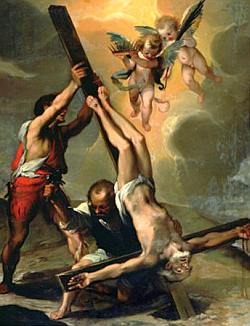
"The Crucifixion of St. Peter" by Ventura SalimbeniAmid all those sermons on all the great stuff you’ll now get from claiming OT promises, no one seems to talk about the hallmarks of NT faithfulness and what its rewards now look like.

My son and I are reading through the entire NT together, and that thread of persecution for following Jesus is simply unmistakable. Not only this, but Jesus Himself states that much of what was thought to be the hallmark of Old Testament faithfulness and reward would look different in the Kingdom of God that Jesus was instituing and that expectations should change. Something larger was now here, and it eclipsed what was thought to be the be all and end all of faithfulness and reward.

We don’t talk about that though.

What if instead of thinking about the OT reward of long life and material prosperity we instead thought of the blessing of having our head lopped off at age 30 by people who hated us and our Christ?

What does that do to “counting the cost”? Can any of us who have bought into the OT reward mentality truly accept the NT reward reality? Or do we keep retreating to a place that lessens the likelihood that we should ever receive a genuine NT reward—the only kind that truly matters.

Because, hey, someone once called me a bad name on my Christian blog, and I felt all persecuted.  🙁