

Unless…

Standard

Unless...My favorite Dr. Seuss book is The Lorax. The eponymous main character looks something like an angry groundhog with a walrus mustache. Claiming to speak for the mute trees, he stands in the gap when the story’s narrator, The Once-ler, rides into the pristine forest with profit on his mind. As the Once-ler has his way with the world, despoiling every last square inch of land, chopping down every tree, forcing the forest creatures out, only the Lorax remains to stand up to him.

Many years later, in relating the sad tale of the destruction of the last truffula tree to a boy, the chastened Once-ler speaks these haunting words:

The Lorax said nothing. Just gave me a glance…
just gave me a very sad, sad backward glance…
as he lifted himself by the seat of his pants.

And I’ll never forget the grim look on his face
when he heisted himself and took leave of this place,
through a hole in the smog, without leaving a trace.

And all that the Lorax left here in this mess
was a small pile of rocks, with one word…
UNLESS.
Whatever that meant, well, I just couldn’t guess.

That was long, long ago. But each day since that day
I’ve sat here and worried and worried away.
Through the years, while my buildings
have fallen apart, I’ve worried about it
with all of my heart.

But now, says the Once-ler,
Now that you’re here, the word of the Lorax seems perfectly clear.
UNLESS someone like you cares a whole awful lot,
nothing is going to get better.
It’s not.

The lesson of The Lorax goes far beyond a simple environmental message. It reinforces a Biblical truth that today’s Church in America best heed—the reality of UNLESS.

UNLESS we Christians share the message of Christ with the lost, they’ll endure eternal punishment for all eternity.

UNLESS we feed the hungry, they’ll succumb to malnutrition.

UNLESS we fight for justice for the disenfranchised, they’ll continue to be exploited.

UNLESS we visit the prisoner, they’ll die in a prison of their own loneliness.

UNLESS we minister to the sick, they’ll get sicker and perish, forgotten.

UNLESS we show the world love, it’ll never know what true love is.

UNLESS….

We can fill in a thousand statements behind that UNLESS, can’t we? The job Christ left us to do is vast and not getting any less so. We are the Body of Christ—His hands, His feet. And UNLESS we do the work He’s called us to, it simply won’t get done.
The Cornelius Factor

Standard

At Caesarea there was a man named Cornelius, a centurion of what was known as the Italian Cohort, a devout man who feared God with all his household, gave alms generously to the people, and prayed continually to God. About the ninth hour of the day he saw clearly in a vision an angel of God come in and say to him, “Cornelius.” And he stared at him in terror and said, “What is it, Lord?” And he said to him, “Your prayers and your alms have ascended as a memorial before God. And now send men to Joppa and bring one Simon who is called Peter. He is lodging with one Simon, a tanner, whose house is by the sea.” When the angel who spoke to him had departed, he called two of his servants and a devout soldier from among those who attended him, and having related everything to them, he sent them to Joppa.
—Acts 10:1-8

I don’t normally reiterate here at Cerulean Sanctum what I hear in the previous Sunday’s sermon at my church, but my pastor mentioned a passing point that struck me, so I’d like to expound on it.

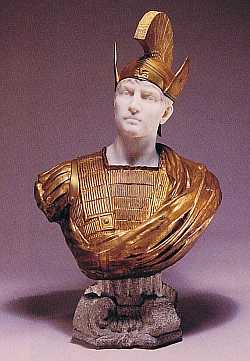
In the Acts 10 passage above, the Roman centurion Cornelius receives mention. Roman Soldier by Luigi BelliThe Scriptures describe three distinctives of this soldier:
  • He feared God (as did the rest of his household).
  • He gave generously to the needy.
  • He prayed continually.

Luke goes on to write that an angel appeared to Cornelius and prepared a way for his family to go down in history as the first Gentile believers. As a result, his name is forever enshrined in the Scriptures.

Let’s concentrate on those three distinctives of Cornelius. Because he proved faithful, God looked upon him and decided to use him in a special way to forever change the course of human history. This man’s dedication and humility marked him as the perfect choice for receiving the Holy Spirit apart from any Jewish lineage. It’s not hard to align the manner in which Cornelius conducted his life with this well-known verse:

He has told you, O man, what is good; and what does the LORD require of you but to do justice, and to love kindness, and to walk humbly with your God?
—Micah 6:8

Sounds like Cornelius, doesn’t it?

Note what caught the Lord’s eye about this man:

Your prayers and your alms have ascended as a memorial before God.

Prayers and giving to the needy.

I think we miss how easy it is to live out a life faithful to the Lord. We add rules and subtract others. We get sidelined in the kind of affairs that would never distract a true soldier of Christ. We can’t spend one hour in prayer. We can’t do without our wants so that others can receive their needs. We fear not keeping up with the Joneses, we fear what the neighbors might think, and we fear the wrong party will see their candidate become the next president, but we don’t truly fear God.

So we don’t receive visions. Angels don’t deliver messages to us. And perhaps God chooses to use a more faithful believer on the other side of the world to alter the course of history.

In the end, we say that visions are passe. Angels don’t come around anymore. The tongues that Cornelius and his family spoke were for another time, but not ours.

And our faith grows smaller for our dismissals.

Is it really that hard to fear God in America 2007? Or to pray continually? Or to put down the mail-order catalog long enough to meet the needs of someone dashed on the rocks by the vicissitudes of life?

Is it?

Lord, I pray that you would mold each and every person reading this into the kind of believer Cornelius was. Bless us as you did Cornelius, and use us to change the world.

The Two Christianities: Comparison Table

Standard

JesusThis week we’ve looked at insights I received last weekend concerning American Christianity’s bifurcation into two streams of thinking and operation, Externally Motivated (EM) Christianity and Internally Motivated (IM) Christianity. To go back to the sources, please read “The Two Christianities” and “The Two Christianities: Reader Feedback….”

To put a final note on what we’ve discussed—and thanks to all you readers for an outstanding discussion!—I offer a table comparing EM and IM Christianity:

Externally Motivated (EM) ChristianityInternally Motivated (IM) Christianity
Our theology/doctrine is…ConservativeConservative
Our praxis is…ConservativeLiberal
The covenant that forms the basis for our belief system is…The Old—The LawThe New—Grace
Our mission:Preservation of power structures that serve as evidences of godlinessDisciple-making
Our source(s) of motivation and power is/are…Existing political and social authorities manipulated to preserve systems and institutions deemed godlyThe Holy Spirit
Power rests on…Dynamic, media-savvy, big-name leaders who determine which power structures are worth supportingNameless, faceless individuals who love not their lives unto death
Power is maintained through…Fear of lossDying to self
Failure is perceived as…Losing the culture warNot fulfilling the Great Commission
When threatened, our response is…An eye for an eyeTurning the other cheek
When threatened, we become…Aggressors (or martyrs for the cause should we fail)Joined to Christ in His sufferings
We counter threats with…The systems and institutions we empowerHumility and patient endurance
We suffer for…Our causeThe Lord
Persecution is to be…PreventedExpected
Christianity exists to be…PreservedGiven away
Our faith is…A means to an endIts own reward
Evidence for our faithfulness exists primarily in…Following a strict list of do’s and don’ts derived from the BibleManifesting the gifts and fruits of the Spirit
The community of faith exists primarily to …Preserve the American civil religion and protect the rights of the faith communityReach out to the lost and build up the household of faith
The community of faith seeks justice for…ItselfFor all
Our attitude toward benevolence is…God helps those who help themselves (though we may intervene for the very worst cases)Acts 2:44-45
We meet the needs of those who…Most directly benefit our causesAre needy, regardless of their ability to benefit us
We have what we have…Because we have done what is rightBecause God is gracious
We are righteous because of…Our compliance with the moral code we’ve constructed from Biblical principlesWho Christ is
We seek relationships with …Our own kindAll people
We make our way in society by…“Christianizing” secular systems and cultureDiscerning by the word and the Spirit what is worthy of our time and attention
We root out sin in…OutsidersInsiders
We judge…The secular society and its cultureThe household of faith
We believe people are motivated to obedience by…External forces (usually political when dealing with secular society) applied through a Biblical moral codeBeing born again, filled with the Spirit, and fellowshipping within a grace-filled community
We validate our apologetic through…WordsActions
We spread truth through…DebateThe way we live in obedience to Christ
Our ministry is the ministry of…Reproof and correctionReconciliation and compassion
Our spiritual focus is…InwardOutward
Our leadership is…Concentrated in a few powerful peopleDispersed throughout the group
We prioritize…Earthly goals first, spiritual goals secondSpiritual goals first, earthly goals second
We are…GuardiansAmbassadors

I’m sure more comparisons exist. I thank readers for prompting some of comparisons seen here. Some day in the future we may revisit this issue and I’ll add more to the table.

Until then, I pray that this week’s discussion has blessed you and made you consider moving on past the EM life into that of the IM Christian.