American Church leaders love buzzwords. Toss a buzzword around long enough and you seem smarter, more with it. “He uses that word a lot. He must be an expert.”
Past buzzwords of note include these “winners”:
Visioncasting
Transformational
Impact
Best of breed
Leverage
Organic growth
Long tail
For the past five years or so, the American Church has fallen over itself to let potential local church members and disaffected believers looking for an “active” church know that it groks its mission to the world. The answer it offers is missional.
The word missional came from the title of a 1998 book assembled under the auspices of the World Council of Churches that sought to rediscover the true mission of the Church in the 21st century. It outlined de-emphasizing the Church as an institution and instead concentrating local church purposes on the “gospel mission,” doing the things the Bible depicts the Church doing in Acts.
All that sounds great—well, except for the World Council of Churches’ involvement.
Cerulean Sanctum exists to help Christians consider what it means to be New Testament believers living in 21st century America. When someone mentions the Book of Acts, my ears prick up. Missional appears to align perfectly with this blog’s intent.
But as I’ve watched churches scamper to redo their mission statements to include the word missional, even as church after church rejiggers its advertising to ensure people know it’s missional, I get a bad feeling about this swing to focusing on mission.
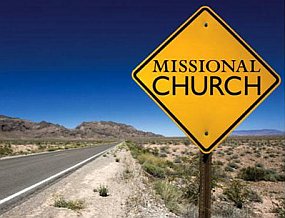 Serving the poor is great. Healing the sick is a beautiful calling. Living simply is a must. Putting the mission of Jesus central in all we do is wonderful.
Or is it?
The problem with the massive move to missional in the Church is that Christians ARE doing a much better job of putting the gospel activities of the Church central. More and more churches are effective at being less institutional and more missional.
So how is that a problem?
Making the activities of Christian mission central is subtly distinct from making Christ Himself central.
In the midst of all this missional hubbub, I wonder if we have forgotten Jesus.
A couple weeks ago, a friend mentioned that he was seeing a massive shift in the local church ecosystem. Large churches known for their programs were banding together to be more aggressive in missional practice, uniting under the banner of a missional program known as 3DM.
On the surface, this sounds amazing. Never mind that unifying under something calls into question that something’s ultimate message, Christians have long seen a need to be both more ecumenical and more mission-focused. This looks like a possible answer.
But as my friend described what was actually playing out, it sounded to me like a lot of great work done, but without a lot of “being.” in other words, this missional thrust looks super as an action, but what is going on in the spiritual depths of the people doing all those missional activities?
One of the most startling verses in the Bible, spoken by Jesus:
And this is eternal life, that they know you the only true God, and Jesus Christ whom you have sent.
—John 17:3 ESV
Jesus gives us the very definition of eternal life: Knowing God and knowing Jesus Himself.
Knowing.
Knowing is distinct from doing. It is possible to do and not to know. One can take part in activities that look and feel godly without knowing God. Fact is, this is what Protestants have accused Catholics of since the Reformation.
Is it possible to be missional and yet not know God and Jesus Christ whom God sent?
Sadly, I believe it is.
Consider the source of the word missional, a World Council of Churches book. Does a more doctrinally suspect organization exist? While that may be a “guilt by association” argument, researching the beliefs of those most ardent about missional uncovers compromises, usually with regard to traditional orthodoxy. The most missional-focused folks on the national stage often seem fuzzier about who Jesus is or what He says. They sometimes make statements that it’s OK to be a Muslim-Christian or a Buddhist-Christian. Or that the Church must embrace whatever the latest spirit of the age is to stay relevant. Relevance seems to be critical to being missional. As long as one stays relevant, one stays missional, so it doesn’t matter what happens to 2,000 years of Christian doctrine.
But if people who claim to know Jesus don’t track true to what His entire word says, in what way are they really following Him?
If a person does Gospel-looking activities but doesn’t adhere to everything in the Gospel, how can it be said that person is a Christian? How can the argument be made that such a person knows the real Jesus at all?
Jesus had a response to this:
Now as they went on their way, Jesus entered a village. And a woman named Martha welcomed him into her house. And she had a sister called Mary, who sat at the Lord’s feet and listened to his teaching. But Martha was distracted with much serving. And she went up to him and said, “Lord, do you not care that my sister has left me to serve alone? Tell her then to help me.” But the Lord answered her, “Martha, Martha, you are anxious and troubled about many things, but one thing is necessary. Mary has chosen the good portion, which will not be taken away from her.”
—Luke 10:38-42 ESV
In many ways, missional is a reaction against a moribund Church that sat at Jesus’ feet and soaked up the goodness—without doing anything with what was soaked up. But like so much that happens in the American Church, fleeing to one polar extreme after dwelling at the other is not the way to achieve balance.
Christians can’t just do works that look Christian. We must know Jesus. We must sit at His feet and dwell there. It is as important to be as it is to do. In fact, as we see in the above passage from Luke, it may be MORE important.
We can do everything that looks like Christian mission and yet not know Jesus. The Muslim world has studied how Christian ministry works and now models many new Islamic charities off their Christian counterparts, which is winning converts to Islam. In short, missional success, just without Jesus.
Jesus is the difference. We must know Him. We must know what is truth. A Christianity that acts like the early Church but doesn’t know Jesus well—or at all—will fail because it is the arm of flesh and not the working of the Spirit.
How tragic to someday find yourself before the Lord and hear Him say He never knew you, despite all the missional things you did.
People are dying to know Jesus. Really, that’s all that matters. If our churches neglect to give Jesus to people in ample measure, all the missional in the universe will not save them.
 Engaging the conversation in 2014 means a near-constant return to the Garden. Any time some postmodern Socrates chips away at traditional morality or invokes an alternate interpretation of truth, you can hear hissing between the words.