Ravenhill Returns

Standard

One of the most perplexing parts of the Bible occurs whenever we have people wondering whether a deceased prophet has "returned" in the spirit of a new prophet. Consider this passage:

And Jesus went on with his disciples to the villages of Caesarea Philippi. And on the way he asked his disciples, "Who do people say that I am?" And they told him, "John the Baptist; and others say, Elijah; and others, one of the prophets."
—Mark 8:27-28 ESV

Today, some highly confused people use this to endorse reincarnation, but the reality of what is said above is reflected in another passage:

And he [John the Baptist] will turn many of the children of Israel to the Lord their God, and he will go before him in the spirit and power of Elijah, to turn the hearts of the fathers to the children, and the disobedient to the wisdom of the just, to make ready for the Lord a people prepared."
—Luke 1:16-17 ESV

John wasn't Elijah, but he preached by the same powerful Spirit that compelled Elijah. 

Leonard Ravenhill was one of my favorite preachers, but he passed on to glory a few years back. I haven't encountered anyone who can preach in the spirit of Ravenhill—that is until recently.

If you haven't heard the blistering message delivered by Paul Washer at an SBC youth rally, then you haven't heard one of the most pyrotechnic sermons since Ravenhill departed this sphere. Washer even mentions Ravenhill mid-sermon, so you know he's done his homework listening to that great saint. 

I heartily encourage you to listen to Washer's sermon by any of the means possible at the SermonAudio.com site. Several bloggers have linked to Washer's message, and I thank them all. I think every Christian in America needs to hear this one, myself included. It's an hour spent you won't regret.

No, Leonard Ravenhill hasn't come back. But it's good to see that men who minister in the same spirit and power as he did still exist. 

The Character of Christian Characters

Standard

Right now, I’m deeply enmeshed in edits for my novel. My whole being seems wired to the craft of writing at this moment, so I’m reading more fiction in order to stimulate my own chops.

So here comes the off-topic, obligatory writing post.

Having been sick most of last weekend, I finished three novels:

Monster by Frank Peretti

Presumed Guilty by James Scott Bell

Eleanor Rigby by Douglas Coupland

The first two are by Christian authors who typically fall into the Christian market. I can’t say anything about Douglas Coupland’s faith, but he sure can write.

I have some pretenses to being a novelist some day. Hoping to be listed as a novelist who is a Christian as opposed to the standard Christian novelist moniker, my current work is aimed squarely at the secular marketplace. However, having a Christian main character forced my book into the Christian marketplace. Any pretenses I had at being a “bridge” author collapsed the second most secular publishers decided to jump on the Christian bandwagon. With the Christian fiction marketing growing faster than any other (and with sales to match), I suspect I’m typecast. “Your character’s a Christian, well, that’ll be great for our new Christian imprint!”

Ugh.

But I digress…

After reading a book like Monster or Presumed Guilty, I’ve finally concluded why I read so little Christian fiction. It’s not that the writing isn’t good (it’s improving daily), or the stories aren’t interesting (the creative dam has burst in that regard), but I just can’t get past the characters.

Every time I read a work of Christian fiction, I struggle immensely with the characters. A secular novel like Coupland’s Eleanor Rigby lives or dies by the quality of its characterizations and the quasi-magic-realism that enlivens that author’s works. Hey, Bob, shake hands with the Lord of the UniverseBut every time I pick up a Christian novel, the same question comes through: Who ARE these people?
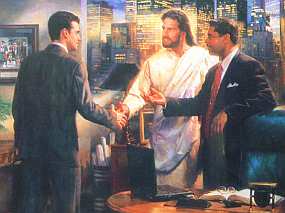
I feel like the characters in most Christian novels dropped to Earth from another planet light years away from my normal existence.  They don’t resemble any Christians I’ve ever met in my life. If identifying with the characters grabs a reader, each time I read a work of modern Christian fiction, I’m tempted to haul out my old college anthropology texts to see if they can shed some light on the humans that inhabit these books.

Not to pick on Bell too much, but he writes a pastor’s wife with a semi-lurid past who’s been neglecting her husband in the intimacy department. When she hears he just sold a big book deal worth millions, she decides to slither into her  tight jeans and frilly blouse, then put out a couple of glasses of sparkling apple cider. What she doesn’t know is that her husband’s in a motel room getting a few intimacy lessons from a pornstar.

Now I don’t know about you, but I read that and just scratch my head. Never mind that pastors all across this country are supposedly struggling with the issue of how to keep from succumbing to the temptations of the pornstars they counsel. What’s the deal with the tame response of a wife trying to save her marriage? I can’t speak for every Christian woman out there, but is that realistic—even in the slightest? Tight jeans and a couple of glasses of fizzy apple cider? Now one could assume that Bell’s not trying to titillate here, so he plays to the censors and keeps it tame. But then the husband’s out having an affair with a pornstar, so what’s the titillation factor on that one?

This illustrates the problem of plastic characterization that’s the bane of most of the Christian fiction I read. The people in these books don’t talk, pray, romance, play, or act in any way that seems real.

In contrast, when Coupland talks about the peace his protagonist’s made with her loneliness, man, I’m right there inside her head:

We cripple our children for life by not telling them what loneliness is, all of its shades and tones and implications. When it clubs us on the head, usually just after we leave home, we’re blindsided. We have no idea what hit us, We think we’re diseased, schizoid, bipolar, monstrous and lacking in dietary chromium. It takes us until we’re thirty to figure out what it was that sucked the joy from our youth, that made our brains shriek and burn on the inside, even when our exteriors made us as confident and bronzed as Qantas pilots. Loneliness.

Now you may not agree with all that, or fail to identify with each point, but I’ve got to believe that some of that got through and resonated on some level with you. More so than a wife hoping to spice up her marriage with a bottle of sparkling apple cider.

The curse on all Christian fiction is not that Christians are a diverse lot and not every characterization is going to work, but that Christians are a diverse lot, yet we seem to be ashamed of our own diversity. We don’t tend to enjoy living all that much, either. There’s dying to self and then there’s asceticism.

If I wrote that pastor’s wife, I’d have her go out and buy a fake fur, a bottle of good port, and then have her greet the husband holding two full glasses, wearing the fur, a smile, and nothing else. Why? Because it’s more real, more alive, more human. And most of all, it’s more joyful.

But here’s where the shame at our diversity comes in. As real as that might be as I choose to pen it, too many Christians would howl. And they’d probably howl as much about the port as they would the naked pastor’s wife in a fur. Others would have no problem with a scene like that. But to make all characters palatable to all persuasions of Christians, we have to whittle them down until they’re unrecognizable.

What that leaves is characters who are curiously two-dimensional, free of zest, and who epitomize a sort of barrenness that should never be part of a grace-filled life. Worst of all, it salutes characters who were more interesting prior to meeting Christ than afterwards. What a sad statement to make!

Perhaps we Christian readers are too easily offended. I know so many Christians who watch a show like Desperate Housewives on TV, then turn around and shout out, “Well, I never!” when reading a Christian work that deals with the same content, albeit with true redemption offered. Maybe we like plastic characters who endorse our particular brand of Christianity, even if we ourselves don’t resemble those characters.

Several Christian novelists read this blog, and if you’re reading this now, I hope that I haven’t offended you in any way. Truthfully, I feel for the situation we’re in, always trying to please all of the people all of the time. I know that I’ve struggled with that immensely in my novel, where the characters enjoy wine with a meal, have never read Joshua Harris’s I Kissed Dating Goodbye, enjoy dancing, and grow in the Lord by ditching sanitized Evangelical stereotypes of what two twenty-something Christians must be.

We can do better if we move beyond appealing only to the widest audience. Christian fiction is growing, but if we’re to truly write redemptive works, we’ve got to take more chances. The call is out to be “grittier,” yet Presumed Guilty is as gritty as it can be, while still giving us characters whose Christianity is so odd that we can’t relate at all. Nor do we need to foul up our Christian characters until they’re just one smidgeon away from being considered unregenerate. Just make them real people, even when they’re facing unreal circumstances.

Suffer Little Children…

Standard

Then were there brought unto him little children, that he should put his hands on them, and pray: and the disciples rebuked them. But Jesus said, "Suffer little children, and forbid them not, to come unto me: for of such is the kingdom of heaven."
—Matthew 19:13-14 KJV

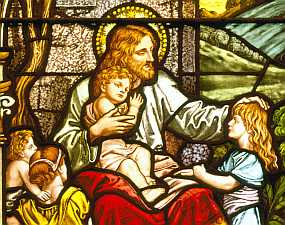
Earlier this week I posted a More Cowbell Award , handing out "The Award No One Wants to Win" to children's Christian education programs (including Sunday School, Vacation Bible School, and Christian summer camps). That Stained Glass of Jesus Blessing Childrenparticular post generated more comments than any other More Cowbell Award I've given out. When it comes to educating the next generation of Christians, plenty of opinions exist.

I suspect even more opinions exist about the nature of children and salvation.

My son is nearing six years old. He's quite intelligent, loves God, enjoys church, spontaneously prays for others and for his own needs, and has a decent knowledge of the general truths of the Bible for his age. He continually surprises me with his questions about God, and surprises me even more with some of his answers. He'll always answer positively when asked if he believes in Jesus.

But is he saved?

For most of my adult life, I've leaned toward credobaptism. I was baptized as an infant in the Lutheran Church, but grew convinced of the need as an adult to show my own faithfulness toward God by being baptized as a confessing adult. (I kept this secret for many years from my parents. My brother felt the same as I did, got baptized, and told my folks, bringing lots of grief down on him and them.)

Later on, I worked in ministry to children and grew increasingly distressed about the issue of whether or not a child under ten understood the Gospel well enough to be justified. Probing kids for any information that might shed light on their eternal status yielded few results. Kids are such natural mimics that it's hard to discern whether they truly believe or are just mimicking what they know adults like to hear.

Kids don't make it any easier when it comes to the fruit of genuine Christian belief. Kids whose parents adamantly claim are rock-solid, baptized kiddie believers can be as rotten as those kids whose parents make no such claims. If a kid shares his milk and cookies with his friends and can rattle off a few memorized Bible verses are those actions proof of a genuine conversion?

For adults, the issue isn't always clear, but it's still far easier to discern. The dope fiend in gothic drag who comes to Christ and then goes on the mission field—that's an easy one. But truthfully, as long as I've worked with kids under ten, I'm not sure what an honest-to-goodness conversion looks like in a young child.  And I don't think I'm the only one.

This whole sticky wicket poses enormous theological problems. A quick scan of the great Christians poised in every possible corner on this issue makes a less diligent believer like me feel extraordinarily uneasy.

Our inability to come to any unified answer on the topic of the justification of children clearly shows in our split on credobaptism (baptizing confessing believers) and paedobaptism (baptizing children, though without a profession of their own personal faith in Christ.) While I don't believe in regenerative baptism—and most Protestant's don't if they truly hold to the truth that justification is by faith alone in Christ—it's still clear that Jesus put an extremely high mandate on baptism:

Jesus answered, "Truly, truly, I say to you, unless one is born of water and the Spirit, he cannot enter the kingdom of God."
—John 3:5 ESV 

Obviously, one can go too far with this, though. I once had a friend whose boyfriend got mixed up in the Boston Church of Christ movement. That group believed in regenerative baptism. After he'd made a profession of faith, there was a delay in getting him baptized, and he basically locked himself up in his room until that day, afraid he'd be killed accidentally before he got baptized.

We read that and shake our heads, but if we extend the baptism beliefs of many Christians out to their logical ends, some relatively normal denominations pretty much believe the same thing—or else have to do a lot of intellectual shimmying to make their beliefs fit. I wrote a piece last year that talked about this issue after Steve Camp wrote a blistering predestination piece that pretty much came right out and said that the infant who dies in childbirth is predestined to hell. I don't know about you, but as a parent it's pretty hard to take to think that any child of mine that might have died in childbirth went straight to hell because God predestined him/her to die in childbirth. That seems a rather strict limit on God's mercy and any covenants He makes with believing parents.

Whether you're a credobaptist or paedobaptist, the questions remain:

  • What constitutes a genuine conversion in a child? And isn't it only by being converted that we are saved?
  • How do we know a child truly believes and isn't just repeating what he or she heard in Sunday School (or is mouthing what receives the most attention and adoration from Mommy and Daddy)?
  • Is there a covenantal aspect in the faith of believing Christian parents that ensures God's mercy and grace upon their children, whether baptized or not, believing or not?
  • For paedobaptists: If we're truly saved by faith alone, what good is baptizing an unbelieving child? And doesn't your baptizing of that child before a profession of faith only later lead to a false confidence in that child for his/her salvation? And what about the murky area of being "rebaptized" after a full confession of faith?
  • For credobaptists: How confident are you in credobaptism that you would risk letting your children die unbaptized?

It doesn't give me much comfort that so many good Christian sources are split on this. I noted earlier this week that Monergism.com highlighted the split, with solid theologians occupying both sides of the baptism argument. Ironically, most Arminians are credobaptists, so you would think the Calvinist monergists would be 100% in opposition, falling completely into the paedobaptist position. But even Jonathan Edwards was conflicted on this issue, baptizing infants but giving that baptism no efficacy for salvation. (What's the point then, Jonathan?)

Apart from the issue of baptism, Jonathan Edwards presents another unusual case that takes us back to our original question of the salvation of children: he states he was converted at four (or was it his wife—I can never remember). I talked to a member of my wife's family who told me last week that his kids were converted at that age. Honestly, I don't know how anyone can tell that for certain in a child that young, and if one can't (and happens to be a credobaptist), I'm not sure that baptizing them is a wise move.

In the end, this issue troubles me greatly. I'm sure I'm not the only one who's bothered by it, though.

You can't go to the great Christians on this issue because so many diverge on their opinions on baptism. Others fail to give any standards for judging if a child is saved or not. And like I said in my post from two days ago, what do we do when the pantheon of Christian greats can't answer the question?  I certainly don't want to trust the opinion of a man on this one, either, if salvation is truly on the line.

If we go to the Bible, we can find plenty of verses that go either way on baptism, so I dunno. And as to telling when a child is saved or not, well, the age of accountability doesn't exist in the pages of the Word, nor is there a truly solid "age-related" guide for discerning whether a child is genuinely espousing the faith or just trying to win "mommy points."

Other ideas have problems, too. If we are to receive the Kingdom as a child does, is this implying that children are already in and they can only fall out? So much for original sin. And if Jesus readily healed children in the course of His ministry, why would He do so if those kids would only grow up to either forget Him or reject Him? What's the point of healing people who are only destined for hell? And what of the perseverance of the saints if a child comes to Christ innocently in their young childhood, then completely rejects Him in adulthood? How many people can each of us name who did exactly that?

I get (wrongly) accused of being a blogging Christian know-it-all, but I'll be honest: this issue has me stumped. If there was ever a topic that I wish the Bible was more explicit on, it's this one.