Not So Wild About Harry

Standard

I’ve ignored writing on all things Harry Potter over the years, but this weekend forced me to change my mind. With my wife’s sister’s family down for the weekend, we were looking for things to do. Unfortunately for us, the city we live near was in the grip of Pottermania and half the activities in town were geared to the release of the latest book.

I’ve written a few posts about the world of fiction in the last couple weeks, but this isn’t going to be a diatribe about J.K. Rowling’s billions or the quality of her writing. The problem is not one of literary aspirations. To me, Harry Potter is a symptom of the much larger problem.

When I was a kid I watched Bewitched, I Dream of Jeannie, and any host of shows that featured magic. Some Christians would say that I was leaving myself open to all sorts of negative spiritual forces for doing so, but what no one could claim then is that they knew real witches. I certainly didn’t at that time. There weren’t any girls in my school that fancied themselves to be a witch (or even sympathetic to the witch’s cause.) The worst thing you could say about some young woman was that she had the lousy ’70s and ’80s fashion sense to dress just a little too much like Stevie Nicks. But witches? Nah. In fact, it was more likely that guys could be accused of witchcraft because Dungeons & Dragons was insanely popular by the time I graduated from high school. At Carnegie Mellon University in the early 80s I knew guys who skipped all their classes just to play D&D, sitting around getting high and drawing arcane symbols on the walls of their dorm rooms.

While some of the signs for a groundswell were in place even when I was a child, it can be argued that the later syndication of those TV shows I mentioned above lowered the defenses for witchcraft for the generation that came after mine when added to later societal changes. Today, everywhere you look, you can’t seem to get away from all things Wiccan or pagan. In fact, I have to believe that the fastest growing religion in the United States is not Islam, but the same one that has captured so much of the British population in recent years, Neo-paganism. Sorcery, vampire cults, an affinity for the goth lifestyle, even postmodernism—all of it has roots in paganism. Couple this with a societal outlook that is rational but growing more irrational by the day, and Neo-paganism looks ready to explode in the West.

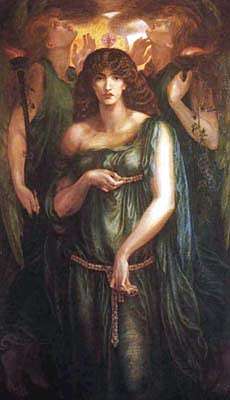
Why? Nature abhors a vacuum. Especially human nature. With Christianity on the down side in the Western world, people who are searching for answers, particularly those answers that cater to humanity’s fallen need to have power and control, are finding what they want in paganism.'Astarte Syriaca' by Dante Rossetti Earth religions are picking up adherents left over from the New Age movement, the children of the Haight-Ashbury crowd, and the rise of “organic culture.” (My wife and I are trying to get an organic farm going and it is shocking how much the “religion” of some organic farmers is rooted in goddess worship and fertility cult thinking.)
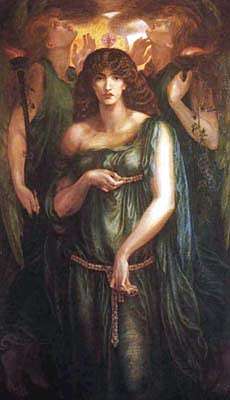
Earth religions have been around nearly as long as there has been a planet with that name. The Bible contains numerous commands of God to keep trees and natural distractions away from His altars lest they be construed to have anything to do with the worship of nature (Deut. 16:21 is an example.) The entire religion of Astarte/Ashera/Ishtar that bedeviled the prophets and kings of the Old Testament is the same earth goddess worship we see today (much of it penetrating Christianity in the form of the Roman Catholic Church’s Marian cult.) There truly is nothing new under the sun.

With the desire to worship the creation rather than the Creator comes the desire to control the creation; this leads us to witchery and the rise of Wicca as a religion to be reckoned with in the United States. While the number of self-identified witches, pagans, and Wiccans is wildly variable (anywhere from 100,000 to over three million adherents in the United States), the one truth is that their numbers are growing rapidly.

But nowhere has there been greater capitulation to Neo-paganism than in the UK. With studies showing that less than 3% of the population of Great Britain attends church on the weekends, Neo-paganism has filled the void left behind by the abandonment of Christianity. Even some high-ranking church officials in that country have been linked to the ancient Druid religion, and druid gatherings have been picking up in number, with more and more people flocking to see druidic ceremonies performed.

So it comes as no surprise that Britain gave Harry Potter to the world. Say what you will about the books, they are certainly a phenomenon we’ve never seen before. The problem here lies in the fact that Harry Potter could very well be the poster child for Neo-paganism. As a recruiting tool par excellence, nothing will break down the walls to the further acceptance of Neo-paganism than a boy sorcerer intent on saving his friends, his school, and the confused, non-“gifted” Muggles from evil machinations that threaten the world.

The problem then of Harry Potter that separates him from other books featuring magic is not only the craze that has developed around the books, but that reality is being blurred. When I was watching Bewitched I knew that witches weren’t real. People didn’t go around saying that they were witches. It put a kibosh on anyone thinking that being a witch was a likely choice of religion. But not so today. In my county alone there are several recognized covens. Elsewhere I had mentioned that a young couple came into the Christian bookstore I worked in many years ago and told us they had just left a coven that was actively attacking the bookstore via prayers and incantations. Needless to say, I was naive to this modern reality.

We cannot afford to be naive. If Harry Potter had hit the scene in the 1940s, I believe his impact would have been negligible compared with today. But given that the environment into which he’s flown is primed for his brand of Neo-paganism, I believe the influence of Rowling’s books is far more dangerous. While some might claim that I’m cutting my own throat as a writer of speculative fiction, I can’t keep silent while a generation’s defense against Neo-pagan thought is being systematically disabled by what many Christians consider a harmless story. Fantasy novels of all kinds are some of the bestselling books in bookstores and it is safe to say that the most rabid fans are the ones who are most likely to self-identify not as Christians, but something more akin to Neo-paganism.

Although this may seem like a broad brush, the fact remains that the Harry Potter generation will be the backbone of Neo-paganism in the next dozen years. They’ve been groomed with what on the surface was a mere gripping read, but which planted a seed that will grow into a noxious fruit that we Christians of 2020 will have to confront. We must fight it now and work to deprogram kids before they grow up as enemies of the Lord.
Books to Recommend to Searchers and New Finders

Standard

Tim Challies did a review of John Stott’s Why I Am a Christian, and while the review itself is fine, something Tim said gave me fodder for this post:

Why I Am A Christian is a good book and one I can recommend with only a small amount of hesitation. It is well-suited to provide to a friend or family-member who is interested in learning more about the Christian faith. It is a good “giveaway” book. I can’t say that it would be my first choice, but you could certainly do far worse.

As someone who likes to give or recommend books for people who are interested in learning more about the Christian faith, or have just given their life to Christ, I’ll be the first to admit that I’ve gotten stale in my recommendations.

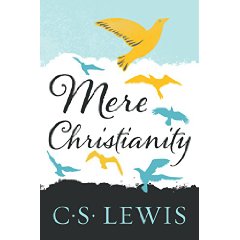
Mere Christianity by C.S. Lewis

Mere Christianity by C.S. Lewis

C.S. Lewis’s Mere Christianity has been my go-to work whenever I talk to someone about the Lord or hear that someone is investigating Christianity. I’ve given away so many of these over the years that I once visited a church and stopped by its library, only to find the copy on the shelves was one that had my name, address, and phone number in it! You can’t beat the logical presentation and the fact that Lewis goes back to First Cause and reasons from there. I’ve always thought the de-emphasizing of Biblical citations actually works in favor of the book, too, especially when read by people who criticize making “circular” references to the Bible to prove the case for the Lord.

And while I’ve read Evidence that Demands a Verdict by Josh McDowell and Lee Strobel’s The Case for Christ, I haven’t yet made them staples of my book giving. I recommend them to searchers, but I’ve long wanted to supplement my recommendation of Mere Christianity with something else.

I think I do better with book suggestions for new Christians though, and while there are plenty of good books out there, I’ve stuck with some proven choices.

The Fight by John White

The Fight by John White

For years my book of choice for new Christians has been John White’s The Fight. This classic has worn well over the years and InterVarsity Press still keeps it in its catalog. Good for them. There aren’t enough books that I know of that do such a good job of covering the basics of how to start in the Christian faith. When someone I know surrenders to the Lord, I always give them this book.

Another moldy oldie that I absolutely love for numerous reasons is Tony Salerno’s Life in Christ: A Manual for Disciples. It’s a Bible study/workbook that covers just about every aspect of the Christian life, but it delves into topics not found in most books of its type, including study sections on the baptism of the Holy Spirit, making restitution to those you’ve wronged before your salvation, the nature of the Church and its functions in the world, spiritual warfare, the believer’s commissioning from Christ, and even a section that functions as a scrapbook of one’s coming to faith.

Life in Christ by Tony Salerno

Life in Christ by Tony Salerno

And even though it was first published in 1983, it can never go out of style because it features an astonishing set of engravings of Christians scenes from the Bible and elsewhere by the likes of Gustav Doré and others. Let me say that the art direction for this book is top notch and has not gotten old even though the book itself has roots in The Agape Force (memories anyone?) Lastly, it contains a forward by David Wilkerson and preface by Leonard Ravenhill, along with quotes and sidebars by Moody, Spurgeon, Torrey, Goforth, and other greats of the Faith—how can anyone ask for more? Unfortunately, I fear this fine book is no longer being offered by Bethany House Publishers, although it is still being available from Amazon, but only as used. If that’s the case, I suspect it only went out of print in the last couple months. (I always told myself that I should buy about a hundred of these, but the cost for that many has always been an issue.) I hope it goes back into print soon. As one of the only books of its kind that addresses the Faith from the vantage point of charismatics and Pentecostals, it is absolutely needed.

Disciple by Juan Carlos Ortiz

Disciple by Juan Carlos Ortiz

Disciple by Juan Carlos Ortiz does a fine job emphasizing the Lordship of Christ in the believer’s life. (Ironically, Amazon lists its “Better Together” partner as White’s The Fight.) It goes all the way back to 1975, but returns to print from time to time—right now it is still available. Ortiz, formerly the pastor of the largest church in Argentina, brings his distinctly Latin American sensibilities to the book and it reads very simply yet profoundly at the same time. His illustration of the believer’s handing over his life to Christ has gotten a lot of mileage in Christian circles. If you’ve read this book, you’ll know what I mean. Still, I think it started with this book. Back in the early 1980s, just about everyone I knew had read this one and loved it. For years it was my favorite book. Don’t let the fact that Ortiz once ran the Hispanic ministry of Robert Schuller’s Crystal Cathedral dissuade you from reading this; it contains nothing resembling Schuller’s message.

I’m just now reading C. J. Mahaney’s The Cross Centered Life and it may very well enter my list of recommended works for baby Christians. As easy to read as Disciple (and even shorter), Mahaney gets to the point in an age when the cross has fallen out of fashion in too many churches. Centering one’s life on the work of Jesus on Calvary was good enough for Paul; it should be good enough for us. A desperately needed message, for sure.

So, dear readers, what do you recommend in books for those investigating Christianity and for the newly converted? I welcome you to fill the comments section with anything you think is worthwhile. This is a need in the Body of Christ and I hope what we discuss here will help all of us and those people with whom we share these books.

That Nutty Small Group Dialectic

Standard

Diane over at Crossroads: Where Faith and Inquiry Meet discusses one of my pet issues when she takes on the Hegelian dialectic. For those unfamiliar with this philosophical term, Diane explains:

Georg Wilhelm Friedrich HegelHegel basically created his philosophy to explain the process of history. First there is one view or event called the thesis. Then there is the opposing view or event called antithesis. Out of these two (many times a compromise of the two; other times simply the end process of the two clashing) is the synthesis.

Here is an example from Hegel’s writings:

THESIS: In Ancient Greece the stoics believed in a moral absolute that applied to everyone.

ANTITHESIS: During the Enlightenment period, Rousseau believed that the individual decided what was right and wrong for him.

SYNTHESIS: Society decides what is right and wrong for its citizens.

In the continuing process, the new synthesis then becomes the new truth or thesis. Then an antithesis is introduced which culminates into synthesis which becomes the new truth or thesis and so on—the process continues ad infinitum.

The obvious problem with the dialectic is that it can be used to come to a synthesis that is blatantly false. As a perfect example of this, consider

    Thesis: All men are sinners and doomed to hell unless their sin is dealt withAntithesis: Jesus took away the sins of the world

    Synthesis: Because Jesus broke the power of sin, now no one will go to hell.

If this kind of reasoning seems familiar to you, it’s because nearly all small group Bible studies are beholden to the Hegelian dialectic. After nearly thirty years of Christian small group experience, I can say without reservation that every small group I have been in (spanning ages, sexes, denominations, and maturity levels) has employed this kind of faulty reasoning at some time or other to make pronouncements on spiritual truth.

The crux of the problem is the group leaders. By and large most small group leaders are either too passive to rein in flawed group synthesis or they lack the command of the Bible they absolutely must have to counter a heretical synthesis with the actual truth of God. Fast-growing churches are bedeviled by this, assigning (or allowing) group leaders who have no business leading a group because they lack Christian maturity and the inner witness needed to stop mangled synthesis in its tracks.

Now here comes the controversial part.

Though I have studied under some of the best-known small group proponents in Christendom, I believe with all my heart that small groups are a disastrous place for people to learn the Scriptures. Let them be about fellowship, prayer, worship, service to others, or anything else, but not about studying the Bible in depth. The tendency for synthesis of ideas that contradict the Scriptures is rife within these groups. Time and again I’ve heard leaders assent to heretical ideas synthesized by a group trying to reach some consensus. The need for group leaders to maintain peace at all cost necessitates this, even if truth is sacrificed.

I have come to this sad pronouncement because too many churches are using small groups as their main means to teach the Scriptures. Seeker-sensitive churches where the preaching on Sundays is more chatting than teaching, where the sermons are not sermons on the Word but reflections from life on some topical idea that demographic studies say the people want to hear, suffer from this to an extraordinary extent. The outcome is that a person desiring sound biblical exposition and a knowledge of the Scriptures instead sits through a small group study where the conclusions reached by the group may contradict the word of God. That person never develops a comprehensive view of the unity of Scripture because the topical teaching doesn’t provide it, nor does his small group.

The naivety of church leaders is to blame for this. A couple hours of weekend trainings for a month doth not a small group leader make; it is silly for churches to believe that small groups can possibly provide the depth of Bible exposition that a trained and approved handler of the Scriptures—supposedly the pastoral leadership of the church—can provide. Yet too often the pastor in the church preaches topically on Sundays and believes that a small group meeting during the week led by someone with a passing comprehension of Scripture can make up for what he’s leaving out.

That’s just plain crazy, if you ask me.

The small group movement and its emphasis on moving Bible study to these groups to make it more accessible has instead compounded the very lack of understanding of the Scriptures that it sought alleviate. Preachers who abandoned expositional preaching and teaching made this worse because they gave no opportunity for their best seekers to hear the Bible in its complete context. Is it any wonder then that the people who fill our churches on Sunday have no holistic Christian worldview?

Unless we have small group leaders who know the Bible inside and out and can take firm control of a group striving for heretical synthesis and steer them back to real truth, I think we should stop studying the Bible in our small groups. Put Bible study and teaching back into the hands of workmen approved to handle the Scriptures. If that can’t happen in small groups or adult Sunday School classes, then put it back into the pulpit. As the word of God says,

My people are destroyed for lack of knowledge….
—Hosea 4:6a ESV

Thanks to the Hegelian dialect and the loss of sound expositional preaching from the pulpits across America, the destruction continues unabated.