

Modern Evangelicalism: An MAO Inhibitor?

Standard

A pharmacological cornucopia!I rarely watch more than two hours of TV a month, so I’m no expert on ads or what’s happening in the TV scene. No matter how little TV you may consume, it’s darned near impossible not to encounter a plethora of Big Pharma ads hawking this prescription drug or that. See enough of those ads and its clear that every single drug on the market comes contraindicated whenever the prospective user’s downing MAO inhibitors, a type of antidepressant that comes with some serious side effects and warnings.

MAO is monoamine oxidase, an enzyme in the body critical for proper neurological functioning, hence the use of MAO inhibiting drugs for treating nervous system diseases. Are you yawning yet? Ready for the tangential slide?

Okay, here it comes…

The Godblogosphere’s been bloated with enough posts on “returning to Rome” to gag the Pope and all his Cardinals. A few noted Evangelical leaders jumped the Reformation Ship and the handwringing, fingerpointing, and accusations flew. In other words, typical Evangelical Sturm und Drang.

Amid the voluminous posting on this leap from Evangelicalism into the Roman Catholic Church (heck, one post I read even had Elisabeth Elliot pining for the papacy), plenty of volcanic theological discourse erupted, but I heard very little about MAO—the other MAO, that is.

The MAO I speak of is Mystery, Awe, and Otherness. You know, the stuff modern Evangelicals jettisoned on their way to a bookshelf full of systematic theologies, dusty pages of do’s and dont’s, and three-points-and-a-conclusion sermons. In their rush to be real and down to earth, Evangelicals found a way to make God dull. In short, modern Evangelicalism has become a theological MAO inhibitor.

I can’t help but think that most of these “un-converts” who fled to Rome did so in part because of the radical vivisection Evangelicalism got away with concerning the Body of Christ. I happen to believe that God placed in each one of us a yearning for mystery, awe, and otherness. That desire drives us to God as the source for all meaning, even if that meaning can never be fully grasped. This isn’t postmodernism’s vacuous “There can be no absolute truth” stupidity, but a genuine recognition that God is wholly other and therefore contains an element of mystery that generates awe in those who encounter Him.

How so? Remember when you basked in the throes of the first ache of passionate love? The object of your affection seemed like some strange creature from another planet that you’d walk across burning coals to know, even if that knowledge was little more than a favorite book he or she loved. Remember that first kiss? The electricity! That mystery, awe, and otherness found in the kiss of your beloved! (Song of Solomon explodes with mystery, awe, and otherness, doesn’t it?)

Now imagine kissing your sister. (Or your brother, as the case may be.) Where’d all that passion go? Now imagine Evangelicalism turning every day supposedly devoted to passion into just another day of kissing your sister. Now who can blame anyone for bolting that dry familiarity for a place that still kindles mystery, awe, and otherness?

Don’t get me wrong. I’m solidly in the Reformation camp. I see the RCC as a dead-end and always have. I feel sorry for anyone so seduced by a need for mystery, awe, and otherness that they’ll abandon truth for it.

Yet I still understand why they do it.

So plenty of Evangelicals go slack-jawed at these bolters who make for the Seven Hills. They’ll go on and on with analyses—psychological, theological, and otherwise—in their attempts to understand why they couldn’t keep ’em down on the Reformation farm. But sadly, they’ll never ask “What did we do wrong?” See, that question begs an answer and the answer gets a bit too close to the heart of the problem. Evangelicals today are loathe to put the words we and wrong in the same sentence, so they affix blame anywhere they can so long as that anywhere doesn’t involve looking in a mirror.

In the end, it does little more than make me tired. The false either/or propositions about what we should do and believe. The tired arguments against emotion. The constant sniping about mystery. If Evangelicals want to drive it all out, then they shouldn’t be surprised that people go elsewhere looking to fill that God-given need for mystery, awe, and otherness. Folks will go to the RCC, to the Orthodox, to whatever source fills that vital need. They’ll look for a way to stop taking the MAO inhibitors the self-appointed “doctors” of the Evangelical Church prescribed.

And someday Evangelicals will scratch their heads and wonder where all their adherents went.
And Now a Word from Our Sponsor…

Standard

I read another blogger’s comment that she received some words prayed over her this last weekend. Now comes the mulling of whether or not those words constitute a clear leading of God.

I can sympathize with that conundrum. I use the word conundrum because we receive a lot of “words” in today’s Church, but all too few of them turn into anything at all, making receiving such a word a dicey proposition.

It shouldn’t be that way.

Though I count myself a charismatic and thus have been exposed to hundreds of words prayed over me in my lifetime, I can count on two hands the number that truly reflected the intervention of God. That’s a darned poor track record for “words.”

Scarier still: all the ones I can verify as legit came from the same two men, one an oldster in the Faith and the other a young man old in soul.

Two men in thirty years of my Christian life. Two.

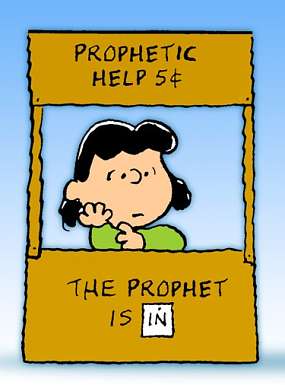
You’ve got to wonder at the damage all those phony messages from God cause. The prophet is in!If I hear another person mention they’re going to a prophecy conference I’m going to lose it. Those folks follow these so-called prophets around like groupies and it’s sad. Considering the accuracy of today’s modern prophets, you’ve got to wonder how many of those conference attendees have had hundreds of words prayed over them, none of them amounting to more than so much air. Yet the addiction’s there, so they go, always seeking, but never finding.

Don’t get me wrong here. I believe in modern day prophecy and gifts of wisdom and knowledge. I’ve given out a few of those in my life, emphasis on few. I’m hearkening back through time and I can count perhaps three—at the most. Why so few? I don’t speak unless I’m absolutely sure of my source.

It bugs me that for all these prophetic words, almost none of them resemble Jesus’ warning to the man at the pool of Bethesda: stop what you’re doing or something bad is going to happen to you. Usually the word consists of some vague reference to how God loves the person receiving the word so much and has grandiose plans for him or her. Every once in a while, you do get someone calling out a “Jezebel spirit” just to keep from seeming too positive. (All I can say is that this Jezebel spirit’s getting a workout in some charismatic circles. Must be exhausted by now.)

It’s all too easy to make up some high-falutin’ spiritual language talking about great nations, lampstands, and watchmen. Curiously enough, none of those handful of accurate words prayed over me ever contained such language. Most were just plain talk. But at least they were right.

On the bogus side, I once received a word from someone telling me I would be a great nation. I’m not truly sure what that’s supposed to mean, although I’m convinced my wife wouldn’t go along with it. Our pastor came from a household with fourteen kids and I can tell you that the Mrs. shudders at the thought. Another time, two very earnest women insisted I’d be getting back into camping ministry “in the next few months,” but my phone’s not rung for that idled career in fifteen years. That’s a whole lot of months.

Pity the poor person who has those mistaken words turned against them, too. When some minor prophet makes a pronouncement and it doesn’t come to pass, it’s never the prophet who’s wrong. It’s the poor unfortunate who received the bad word who gets his or her mustard seed of faith questioned. I don’t know about the prophet, but when I read the Scriptures it says that God’s words don’t return void.

I wish I didn’t have to write this post. Yet with all these “words from the Lord” being bandied about, someone needs to speak up.

About ten years ago, I remember a church meeting where a man stood up and relayed a highly specific word. (Note: the details have been changed for privacy concerns.) This man had a word of knowledge about a woman whose teenage daughter Josie had run away from home, traveled south, and was now deeply immersed in the drug culture of Miami. She’d been gone for three years now, effectively missing, though the mother had heard from her once in that time. The man went on to say that the mother needed to contact her daughter at that last known phone number, even though the daughter had not been at that number for more than a year. The man then said the daughter was afraid to call her mother, but if the mother called her first, God would do a great healing in both their lives and they would be restored to each other. But the mother needed to make that call to the only phone number she had.

My wife turned to me and noted that we didn’t know anyone in the church who fit those details and she suspected the word was wrong. Our small church met in a rented facility, and what no one knew was that a woman had come in to prepare the building for another activity later that day. She was in a back room and heard that word over the building’s sound system. Amazed, she wandered up front to the man who gave the word and told how astonished she was that anyone knew her situation. She prayed with some folks, then went home and called her daughter at that phone number. And yes, everything the man said came to be.

Now THAT’S a word folks. It’s specific. It contains information that can only be spiritually discerned. It intersects with known realities. It meets a need. It makes something happen because of the faith of the hearer who trusts it. And, most of all, it comes to pass.

I guess I’m tired of the burden of proof falling on the one receiving these supposed words from God from someone else. I don’t want to seem glib, put I think “put up or shut up”—a most earthy sort of spiritual testing— applies. If all these folks delivering words have a track record that resembles a 500:1 shot bound for the glue factory, then they need to sit down and stop hurting others with their “gift.”

And yeah, I get a little steamed thinking about it. I wish more of us did.

Blind, Deaf, and Dumb

Standard

I don’t normally change my plans for posts for the week, but my brother e-mailed me a story yesterday I just couldn’t believe. And I couldn’t believe it on so many levels that I could probably blog about it for the next month and not limn its depths.

As a musician, I enjoy a wide range of music. I think I can appreciate just about any genre of music. Punjabi sitar to punk rock to Pavarotti singing “Nessun Dorma”—hey, I like it all.

Which is how I know of Joshua Bell.

Sort of the classical music version of Bono, Bell’s the pre-eminent violinist of our times, under-forty, charismatic, and a lady-killer, too. He plays the noted “Gibson ex Huberman” Stradivarius worth $3.5 million. He commands $1,000 a minute performances all over the world.

But the Washington Post wondered what might happen if Bell were asked to dress down and play as a street musician near one of the busy subway connections in DC. An experiment in sociology, so to speak. Famed musicians were asked to weigh in on what might be the outcome. Most predicted problems. The biggest worry? Crowd control.

So Bell, dressed in jeans and a long-sleeved T-shirt, took his multi-million dollar Strad down to the Metro to play incognito for morning rush hour. Hidden video camera still of Bell playing in DC subwayHe chose superb violin works unperformable by the less skilled. He played masterfully for the commuters.

And…

The Washington Post has the whole tale (plus hidden camera video) in a fascinating story called “Pearls Before Breakfast.” Please read the whole thing.

Leonard Slatkin, the noted conductor, when asked what he thought might be the outcome, suspected that Bell would draw a large crowd and garner about $150 for his effort. The result proved far less stellar.

In truth, less than a dozen of the 1,097 people who passed by seemed to notice Bell’s presence. Fewer yet paused even momentarily to listen to the finest music in the world played by a virtuoso. Of those who did stop, a couple possessed past experience with the violin, enough to know the guy with his case left open for tips played on a level far beyond what could be expected from a street musician. One woman recognized Bell and stayed around simply because she couldn’t understand what she witnessed. She tossed in a bemused $20, making Bell’s total take for 43 minutes of stellar playing $32.17. And yes, a few folks threw in pennies.

I find it impossible to read that story and not consider that something’s profoundly wrong with us. In our hurtling from one place to another, our lives on perpetual fast -forward (at least until we hit the numbing reality of the cubicle), we’ve allowed the system we live in to rob us of time, relationship, culture, beauty, and every other mark of true humanity that simmers in our God-breathed souls. We act as if wonder itself might be purchased at Target for $9.99 on sale. We get our cheap, adulterated fix, then it’s head down and don’t get in our way.

One vignette within this cautionary tale tells of a mother whose three-year-old kept tugging her away from her objective so he could pause to listen to the guy playing the fiddle. I couldn’t help but think, and a child shall lead them.

Jesus Christ didn’t die simply to secure us a ticket to heaven. He died and rose again that we might have life and have it more abundantly.

In her book The Companions, science fiction author Sheri Tepper imagines a future in which people wear veil-like clothing in public in order to preserve their own cocoon of privacy. In many ways, I fear that Tepper’s world is already our own. What else can explain the silent shrouds we wear that cut us off from others, that speak to a child and tell him not to want to listen to the beautiful music, or to interact with the man playing it. That shroud descends over all of life, smothering it.

When I hear people telling me they prefer attending their local megachurch because it affords them some anonymity, I wonder when Jesus gave His divine imprimatur to our privacy. Yet we guard ourselves to the point of losing our souls. We numb our hearts to life going on around us. Wrapped in our cocoons, we literally fail to stop and smell the roses—or listen to Joshua Bell playing a Bach piece that once summoned tears to even the driest eyes.

Are we that beaten-down? That blind, deaf, and dumb?

It comes as no shock to me that much of Jesus’ ministry dealt with healing the blind, deaf, and dumb. We understand the physical component, but do we understand the spiritual and emotional portion of our marred humanity that compels us to walk by the world’s greatest violinist and not even pause for one moment to revel in his skill? To drop out of the ever-rushing torrent to soar on music crafted by the greats? Bach wrote “To the glory of God” on every work he penned, yet that glory wafts past us and we perceive it not.

How can it be that we have fallen so far, even those of us who claim to be Christians?