
What Past?

Standard

I play drums on the worship team at my church. It's no stretch to say that you'd be hard pressed to find drums in a church sanctuary before 1970, but that's a whole 'nother post.

Having been involved in church music for years, I know a bit about the mindset of worship musicians. Universally, these folks honestly love using their musical talents for the Lord and for the edification of others. And while you do encounter a few moody introverts, my experience is that folks on worship teams are some of the most honest and open people you'll find in a church.

So it's always been odd for me to hear their reactions when I bring up the issue of playing some old hymns now and then and not the same praise and worship-style music we're trapped in. The response 99% of the time: "Yeah, wouldn't that be great? I sure miss singing those old hymns."

And yet we never get around to playing them. It's like those hymns are from a distant past so dusty that to even trot one out would cloud the gleaming modern edifice we call "The 21st Century Church."

Now some of you are saying that this is not your church. Yours sings those hymns with gusto. Fine. But somewhere in your church a paradigm shift occurred that relegated anything from the Christianity that existed before 1860 to the dark recesses of history, regardless of whether you know who Isaac Watts is or not.No Augustines I've yet to encounter an Evangelical church that doesn't seem to live solely in the moment.
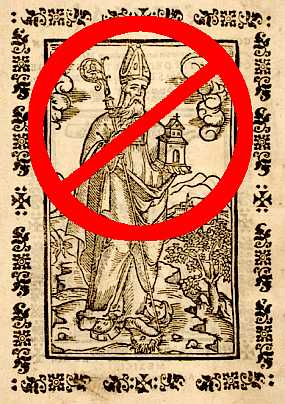
Too many churches today act as if the Church sprang into existence after the Civil War. Eighteen and a half centuries flew by and with the exception of a couple of crusty old Europeans with names like Luther, Calvin, and Knox, Christianity didn't actually exist. Heck, history didn't actually exist, right?

One of the most tortured experiences I ever had in a Third Wave church was when the pastor of the one I was attending was given a portion of the text of Isaiah that was unearthed in the Middle East. It was more than a thousand years old. The group presenting it was tickled pink about their gift, but despite the fact that nearly three thousand people sat packed in the church, I would suggest that maybe ten folks in the seats weren't intellectually yawning. "So what?" would be the collective mantra.

I'd like to know when the American Church put a gun to the head of the Ancient Church and pulled the trigger. What happened that we got so arrogant and self-centered that we looked back on all those Christians who came before us, folks who often went to the flames for their faith, and said, "I'll take a pass, thank you," without considering the ramifications of that stance?

The simple truth about every pitched doctrinal battle now erupting in numerous denominations of Evangelical and Mainline Christianity is that the furor would cease to even be a whimper if we gave credence to what Christians a thousand years ago were saying. The Emerging Church, Open Theism, you name it, someone dealt with it a long, long time ago. But post-Enlightenment, it seems that our minds are stuck on our perceived superiority to what those Dark Ages savages thought.

I'd like to make an exceedingly controversial statement. It's not proffered in most genteel circles because some people would consider it borderline racist or sexist. At the risk of losing readers, I'm going to say it anyway. Just hear me out and think past the rhetoric.

I believe that one of the reasons that many American Christians today have rejected pre-Civil War Christianity as having anything useful to say to us today is because of slavery. The belief here is that if we got the slavery issue wrong back in those days, what else did we get wrong? If there were Christians in those days that thought it was okay to own slaves, then obviously folks back then weren't as smart as we are.

The same goes for how some might perceive women as being treated before that war. Afterwards, we got women's suffrage, their leadership in the temperance movements, and women moving into the workplace. But before that there was only ignorance.

Those two issues (and some others, like the Crusades), I believe led today's Christians down a dark path of swearing fealty to anti-traditionalism. Trying to rationalize older Christian positions on topics that make us queasy have led us to abandon en masse any previous age that did look like our more "enlightened" one.

No one is advocating a return of slavery! But our collective guilt about those less enlightened days must not force us to abandon everything associated with them, particularly the solid theology espoused by spirit-filled men and women of God who lived prior to women's suffrage and the Emancipation Proclamation. Many of those older theologians advocated for greater roles for women in society and the church or were staunchly anti-slavery—but we're just not willing to read them, so they cease to exist.

We cannot live believing that we who comprise the Church in America are the pinnacle of Christian thought. Millions have gone before us blessed of God and we are fools to think that we have nothing to learn from them. Their faith then means something for our faith today. It should come as no shock then that the fact we are adrift in so many parts of of the American Church is that we've grown to despise the very history that has made us who we are.

{Image: Woodcut of Augustine of Hippo, artist unknown}

Christian Blogging: A Waste of Time?

Standard

Future blogger?Everyone and his dog has a blog now. If there were eight million blogs a few months ago, it’s surely ten million today. The Truman Show didn’t overtake us while we were sleeping. No, we volunteered to be on it.
But is there a point to all this blogging?

My incendiary question for this week is this: If Christian blogging isn’t advancing the cause of Christ, aren’t we just wasting time?

I started Cerulean Sanctum in 2003 because I saw that there was a vacuum in the blogosphere for people who were looking for the reality of the 1st century Church in 21st century America. I’ve always looked at this blog as a ministry. There weren’t any blogs talking about Christian living and whether the Church we have today is the Church God means for us to be, and I rectified that a tiny bit.

Much has changed in the last few years since this blog’s inception, though. From my perspective, a quick perusal of the Christian blogosphere makes me wonder if anyone is really becoming a better Christian because of what is bandied about on blogs. If anything, the rapid increase in the number of blogs has resulted in a “ditto” mentality, where blog readers eventually turn their reading away from the blogs they disagree with and toward those to which they can shout a hearty “Amen!” It’s becoming one big choir preach-in.

I’ve noticed a change in comments because of this. More and more the comments sections of Christian blogs aren’t filled with dissenters, but the people who always agree with whatever is posted. (While I realize I did get many dissenting comments on my Myths of Homeschooling series, I suspect that this is more the exception—because of the incendiary topic and its relative newness in the scope of the last fifty years—than the rule.) Truthfully, I wonder how that helps anyone.

Blogs started out as online daily diaries, and I guess there’s still a case that can be made for that purpose, but honestly, I don’t read genuine online diaries. Pictures of someone else’s cat and said feline’s litterbox adventures won’t hold most people. Some blogs serve as news sites, too, but don’t people tend to read news sites that cater to their own preconceptions rather than sites that conflict? If we hang out at blogs with views in conflict with ours, aren’t we merely looking to pick a fight most of the time? We aren’t there to come around to that differing way of thinking, are we?

More and more book review and info blogs are cropping up daily; I read some of them. But I can say with all confidence that there’s not a book review blog existing today that will give a positive review to both a John MacArthur book and one from Watchman Nee. Doesn’t that bother any of us even a little bit? You’ll get plenty of awesome Spurgeon material from Phil Johnson at Pyromaniac, but you’ll never see a thing from Phil covering Spurgeon’s more charismatic contemporary, Andrew Murray. The comfort zone exists and most readers are cool with it, but don’t you ever wish that some blogger would bust out—just once? Christian ghettoes are a sad reality, and while each one will label themselves “The Remnant,” do people ever walk up to the second floor of the house that is their own self—a la that old tract, “My Heart, Christ’s Home“—and open the door to that room they’ve never explored just to peek at what’s inside? If we don’t break out of our spiritual comfort zones from time to time, how do we ever grow in Christ?

Any Arminians who have become Calvinists after stumbling across one of the many Calvinist blogs out there? Anyone? Has a blog changed anyone’s mind on any topic related to faith? Please correct me if I’m wrong, but for the clashes that occur on blogs, don’t the combatants eventually retreat to their own corners, completely set in their monolithic ways?

As for the Great Commission, I suspect the unsaved aren’t reading our Christian blogs, so we’re not really doing evangelism. Are we making disciples? I can’t tell. Again, a blog would need to toss grenades into established thinking in order for growth to occur, and I see fewer dissenters hanging out at most blogs. They’re frequenting blogs that tickle their ear itch. I mean that as no indictment of blog readers, but as a fact of human nature. Still, what can be expected from that conformity?

If these contentions are true, then what is accomplished by Christians blogging?

From my perspective, if any measurable good comes out of the Christian blogosphere it’s that bloggers occasionally meet face-to-face with other bloggers. Blogging may be a substitute networking and relationship-building tool for some. I have no problem with that. Recently, I broke bread with megablogger Jared Wilson of The Thinklings, Mysterium Tremendum, and Shizuka Blog, plus Robin Lee Hatcher of Write Thinking, Katy Raymond of Fallible, and a host of folks who hang out at Faith*in*Fiction (and most of them have blogs, too.) I would love to meet Tim Challies, La Shawn Barber, Matt of The Gad(d)about, Bob over at Gratitude & Hoopla, Diane at Crossroads, Milton at Transforming Sermons, Seymour at The Light Is Sweet, Lars of Brandywine Books, and a whole host of others, including all the fine people who comment here at Cerulean Sanctum and the other blogs I frequent. Truly, I’d get more from those personal meetings than anything else. If not for the cost and the distance, I’d be front row and center at GodBlogCon for no other reason than to hang with other likeminded bloggers.

That said, though, is our blogging only a way to make friends? Are bloggers blogging because they’re lonely, in need of support, or feel like no one is listening to them otherwise? I’m not sure most bloggers would contend that relationship-building is the primary reason they blog.

So what is the point? And if there is no point, then why are we blogging?

Just How Hard Is It to Be Saved?

Standard

About midnight Paul and Silas were praying and singing hymns to God, and the prisoners were listening to them, and suddenly there was a great earthquake, so that the foundations of the prison were shaken. And immediately all the doors were opened, and everyone’s bonds were unfastened. When the jailer woke and saw that the prison doors were open, he drew his sword and was about to kill himself, supposing that the prisoners had escaped. But Paul cried with a loud voice, “Do not harm yourself, for we are all here.” And the jailer called for lights and rushed in, and trembling with fear he fell down before Paul and Silas. Then he brought them out and said, “Sirs, what must I do to be saved?” And they said, “Believe in the Lord Jesus, and you will be saved, you and your household.” And they spoke the word of the Lord to him and to all who were in his house. And he took them the same hour of the night and washed their wounds; and he was baptized at once, he and all his family. Then he brought them up into his house and set food before them. And he rejoiced along with his entire household that he had believed in God.
—Acts 16:25-34 ESV

…if you confess with your mouth that Jesus is Lord and believe in your heart that God raised him from the dead, you will be saved. For with the heart one believes and is justified, and with the mouth one confesses and is saved. For the Scripture says, “Everyone who believes in him will not be put to shame.”
—Romans 10:9-11 ESV

No one can come to me unless the Father who sent me draws him. And I will raise him up on the last day.
—John 6:44 ESV

Therefore I want you to understand that no one speaking in the Spirit of God ever says “Jesus is accursed!” and no one can say “Jesus is Lord” except in the Holy Spirit.
—1 Corinthians 12:3 ESV

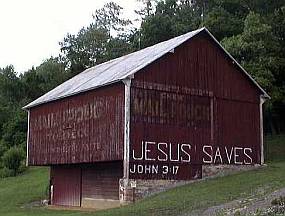
I like to follow trends in the Church and in the Christian blogosphere. One trend that is gaining power attempts to tell who’s in and who’s out by questioning if some people who think they’re saved really aren’t. Jesus Saves barnAny consistent readers of Cerulean Sanctum will know that on more than one occasion I’ve quoted Leonard Ravenhill asking if only 2% of professed Christians are truly born again. So even here there’s been some of that same rhetoric.

John Piper has a new book out called God Is the Gospel and it’s stirring up controversy about this very topic of how one is saved. Over at Old Truth, there was a post about decisional regeneration that adds fuel to the fire.

The debates about who’s in and who’s out rage, but I have to wonder if we are making it too hard. Look at the four verses posted above, for instance.

In the case of the jailer, look how simple his conversion was. Believe on the Lord Jesus Christ and you’ll be saved. Did the Lord draw him? Yes, in the middle of despair, the Holy Spirit was drawing him. Did Paul ask anything of him other than to believe? Not that’s listed here. Nor does Luke list anything different said by Paul than what the apostle himself outlines in the Romans passage above.

We can try to second-guess God on this, piling up other requirements, but isn’t that adding to the Gospel? If someone confesses with their mouth that Jesus Christ is Lord, why is there reason to believe that God has not drawn that person?

My confession is that I’m a Lordship salvation person. Have been for a long time. But that puts me in the company of others who make coming to Jesus a real trial.

Perhaps the problem here is one of theological systems.

The Calvinist position is hard to hold because persistence of the saints becomes a problem. What do you do with people who profess Christ then seemingly fall away. The out for Calvinists is saying that those people never really were drawn by God in the first place and therefore never made a true profession of faith. But do the Scriptures above, when taken together, paint that picture? It sure doesn’t seem so. It certainly appears that someone can be drawn of God, confess Christ with their lips and believe in their heart and still have the possibility there for falling away. Saying they were never a Christian in the first place seems like a lazy out.

Those against decisional regeneration are confronted with the fact that the jailer responded not because he was confronted with the full measure of the Gospel, but because he was in despair. He was ready to be saved without hearing a full Gospel presentation. He didn’t say to Paul, “I’m a sinner under full conviction of the Spirit as He’s brought me to the foot of the cross!” His rationale was that his boss was going to kill him OR he was astonished at the miracle earthquake that made it possible for the apostles to leave. I know plenty of people who became Christians at a remarkably low point in their lives or because they were confronted with a miracle. Is their salvation null and void? Can God not use situations to draw people? Do the passages above say that?

A Lordship salvation person, like me, struggles for a couple reasons. One is that I’m forced into an Arminian position, even though I don’t want to ascribe to it, simply because I have to struggle with the same issue as the Calvinists: what to do with people who fall away. The other is that the verses above do not say anything about the actual living out of the Lordship of Christ in one’s life. It’s assumed, obviously, but the question must be asked then if the process of Lordship begins at conversion and progresses, or is completely in place at conversion. The former makes salvation progressive while the latter makes it instantaneous. A quandary, obviously.

I could go into great deal about how all the other views on this struggle, but that doesn’t provide a solution to the original question: are we adding too many qualifiers to a person’s coming to Christ?

I would truly like to hear what other people think about this. Just how hard is it to be saved?