
One Empowered, One Not

Standard

Edna had a problem. Her computer’s printer stopped working correctly. The computer followed a day later.

Fortunately for Edna, both devices came with on-site service.

John from the printer company and Chuck from the computer company arrived almost simultaneously at the little house at the end of the lane. John held a thick manual for the printer and was dressed in a spiffy, navy blue uniform with his name embroidered above his heart. Chuck came loaded with tools, drives, and devices and seemed less put together. He also carried a thick manual. He wore a uniform too, but it was faded and had a hole in one elbow, and the headphone/microphone contraption strapped to his head made him look alien.

Both repairmen greeted Edna.

“Just happy you boys are here,” the elderly woman said.

“We’re happy to be here,” the two answered.

But soon, one of the two had less happy news.

John had looked at the printer’s screen and read the code. “I can’t do anything about this,” he said.

Edna frowned. “You looked in your manual and it didn’t tell you what to do?”

“No,” John answered. “Well, actually yes. Yes, it did tell me some of what to do, but protocol requires I call in an engineer who was on the design team. I mean, I know the manual backwards and forwards, but this is how we do it. Only the engineer at HQ is authorized.”

Edna was incredulous and started, “But—”

“—when will it get fixed?” John finished. “Well, the engineer may take his time. He should be back in this area next week.” John stared out a window. “Or the week after that.”

Chuck watched the wind go out of Edna’s sails.

“But I need to print a flyer for the ladies’ auxiliary fund-raiser. It’s next week.” Edna replied.

John offered her a frog-like frown and said, “Sorry. That’s the best I can do. The engineer is really good, though. I’m sure he’ll have you fixed up.”

“Don’t see much of the point of having on-site service if it comes down to this,” Edna said to herself.

But Chuck heard it. Despite the frustration in the words, he smiled.

Edna escorted John to the door.

“A pleasure serving you,” John said. The repairman got in his truck, which was shiny and new, and drove off.

Edna walked back to her little home office. Chuck had out a small notebook computer. He was talking into his microphone. To Edna, it sounded like so much gibberish, but she was sure it was something technical. The repairman stared intently into his computer’s display. “Thanks,” he then said to no one in the room.

“Good news,” Chuck announced. “I was able to discern what your problem is.”

“That’s great!” The woman’s countenance brightened.

“I was talking with the engineer at our company, and he sent a patch that should fix the issue on the computer. Turns out, it was an OS update glitch.”

To Edna, Chuck seemed to rise up an inch taller.

“Yeah, a lot of people got hammered by that one,” he continued. “Those auto-updates sometimes create problems.”

“Yes, they do sometimes,” Edna said.

“Well, I’ll make things better than ever,” the repairman reassured. Edna was surprised to see him move to the printer. Intently, he glowered at the printer’s display.

“I think this is a firmware update glitch,” Chuck said.

“How do you know that, young man?”

“I just know. I think I can fix it.”

Chuck connected his notebook to the malfunctioning computer and ran the patch he had received. With a reboot, the computer was fixed. The repairman then shut off the printer, reached for a button on the back that had escaped Edna’s notice, held it down, and flicked the printer’s switch back on. The printer came on and ran through its startup procedure.

“A miracle!” Edna proclaimed, beaming.

Chuck laughed. “Not quite yet. It won’t run right without that update. I’ll download it and install it.”

Which he did. And soon, both the computer and printer were working right again.

But to Edna’s surprise, Chuck wasn’t done.

“I’m pretty sure your computer was running a bit slow lately.”

Edna was beginning to wonder about this Chuck fellow. He seemed to know things he shouldn’t.

“Yes,” she said. “It hasn’t been itself.”

“‘Hasn’t been itself,'” Chuck repeated to himself with a chuckle. “Yeah, sometimes these things have their own personality, don’t they?”

“My husband could be cantankerous too,” Edna said.

Chuck saw the woman glance at a picture on the wall. “I’m sure he was a great man.”

Edna nodded. “He was.”

The repairman smiled and turned back to the computer. “The hard drive needs defragmenting—badly. The source of the slowness, I’m sure. I’ll take care of that, and you’ll be as good as new.”

And an hour later, for Edna and her little home office upon which the ladies’ auxiliary depended, it was as good as new. Or better. Thanks to Chuck.

On his way out, Chuck handed Edna a business card. As he pulled away in his decade-old truck that had probably seen better days, Edna waved. She examined the white card. Handwritten on the bottom it read, Call anytime—for any reason.

Later that afternoon, Edna phoned the printer company and canceled her service call. She figured if she had a problem with the printer in the future, she had someone better to call.

***

There’s a conference going on this weekend on the West Coast. The equivalence of that conference is to do something about “repairmen” who are out of bounds, especially if they are more like Chuck than like John. That may be well and good, but if folks like Chuck get ground up in the process, that’s not good. Sadly, it does not appear that those running the conference care much about the difference. Maybe they do, but I suspect the Chucks of this world are going to get short shrift anyway.

We need empowered people in the Church. God empowers people by His Spirit because He intends for us to do the work. Wherever we may be, if we are so empowered, we are fulfilling His intent for us, and subsequently, we are helping in the way that He intends. If we reject that empowerment, then we become like John in the story. We can show up, but what good are we?

I want to be like Chuck. Don’t you?
Reading Between the Lines of Paul’s Letters

Standard

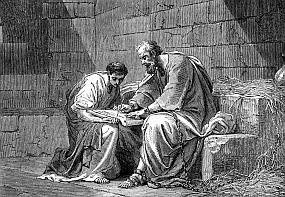
'Paul, The Apostle' by Gustave DoréMy son and I have been reading out loud through the New Testament this summer. We’ve tried to read as much as we can of one book in one sitting so that the harmony of the books is maintained. I’m convinced that we too often approach the Bible with a piecemeal mentality that ends up losing the bigger picture. This is especially true of the epistles, which should never be read any way other than in one piece. Reading them this way spotlights the confusion that our over-reliance on chapter and verse markings has created.

While I’ve read through the Bible many times in my life, I’ve never tried to read it both out loud and in the biggest chunks I can manage. That another person is listening as I read makes an additional subtle difference that forces me to be clear in how I pause and phrase the written word. Truly, it makes a difference. Try it.

This time through the New Testament, I’ve focused on most everything BUT the theology. Too often when we read the epistles, we tend to gloss over the credential establishments, the callouts to this person and that, and the real humanity depicted by the writers as they communicate to their readers.

For this post, I want to share a few thoughts from reading through Paul as if I were a long-ago church leader reading to an assembly of new believers who were going against the flow of the age.

A baker’s dozen thoughts on the Pauline epistles:

  1. We tend to see Paul as a dry, driven, exacting, Type A personality, but his emotional life is more rich on these pages than we give him credit for. This shows us that Christians need to be in touch with their emotional lives and bring emotion to our assemblies. Ours is not an arid, intellectual faith, though a quick perusal of Christian blogs and websites often communicates it as such. There is much to grieve—and also much to be joyful over. You can sense Paul’s melancholy and father-heart when he talks about his love for these young churches. His imprisonment weighs on him, and you can feel the sadness in the distance it creates. His writings show how important a solid network of Christian confidants and supporters is to our emotional well-being.
  2. Paul faced enormous opposition, often from people who seemed to be genuine Christians but were slightly off. (Sounds like today, right?) That so much of Paul’s writings consists of establishing his credentials is both illuminating and sad. This Christian life is more fragile than we imagine, and it is easy to go off the rails from simple carelessness regarding truth.
  3. To a modern age we think of as truly connected, Paul’s writings hammer the importance of Christian community, the need for loving, caring community that functions with peace, order, and utter dependence on God for direction. (Are our churches living that way?)
  4. Church hopping isn’t a 21st century phenomenon. Witness the number of companions to Paul who fade in and out of his life, many starting off well but finishing badly.
  5. As much as we look at Paul’s letters as theological treatises, the majority of their text, both opening and closing, is dedicated to connecting with specific people and establishing what Paul is all about.
  6. Personal holiness, perseverance, and a sober understanding of the age are themes in nearly every one of Paul’s books. So is the reality that Christianity is not another religion. The Christian faith cannot be equated with other streams of religious thought because it is not a dry—and ultimately empty—system like those others. Instead, Christianity is a dynamic relationship with Jesus Christ, based in complete reconciliation, and awash in grace for living each day.
  7. The Christian is to be the most average of people but one who lives an extraordinary, eternal life. Humility, gratefulness, and discipline are hallmarks of that life.
  8. Sins of a sexual nature and those that afflict male-female relationships are extraordinarily prevalent and a major stumbling block for many, but Christ can forgive, redeem, and restore.
  9. Paul’s letters repeatedly note that many people will wash out of the faith, and while we can have confidence in God’s preservation, the number of people who get sidetracked and seduced by the world’s offerings is larger and more common than we understand.
  10. The Christian life is NOT a set of rules and can never be. People who teach a set of rules are false teachers.
  11. Grace in our present age is largely misunderstand and rarely dispensed to the extent that Paul writes that it should be.
  12. Most of what Paul writes about isn’t rarefied, theological ponderings but practical Christian living. He points out how faith translates into real life and how practical our beliefs must be.
  13. A believer not living by the Holy Spirit is not living. The Christian life is less scripted than the religious life of the day, which is what makes it so exciting.

Those are a few thoughts on the writings of Paul from an overarching perspective. I hope they resonated with you. Have a blessed day and week.

The Problem with Christian Criticism

Standard

Recently, I wrote “Humility, Unity, and the Overly Opinionated Christian.” In it, I noted that too often we lack the facts to comment and should probably, in humility, refrain from adding our two cents.

Seems some may consider me part of the problem. 😉

At Christianity Today, Rachel Marie Stone, in her “Why Criticism Belongs in the Christian Blogosphere,” argues the merits of Christian opinion. She equates it to iron sharpening iron, and she wonder how it is that Christians are refraining from offering much-needed criticism.

I would like to offer my answer.

1. Many people are tired of angry discourse on the Internet. It doesn’t seem as if anyone has enough couth to criticize without resorting to sinful expressions of anger and resentment. Stone notes her own criticism of others has often resulted in ad hominem counterattacks. Well, yeah. That’s where we Americans are in 2013. Still, some thoughtful people—thankfully—are tiring of this.

2. Our critical vision as Christians is too small. Nearly all criticism by Christians on the Web is directed at individuals rather than at systems. Problem is, it’s mostly the systems mucking up everything. While it is much easier to criticize individuals, doing so rarely changes anything on a larger scale, because the power of that larger scale is not in individuals but in systems.

3. Systems are ridiculously hard to address. Criticizing the guy next door for letting his dog poop on your grass may accomplish getting him to keep his mutt out of your yard. But if your state determines your house is ground zero for a new shopping mall for “the public good,” good luck with your criticism of the state. And many systems are more complex than even a state government. Try criticizing the result of the Industrial Revolution and changing it through criticism. That system is far harder to assault because it is enormous and nebulous at the same time.

4. Criticism of individuals does not lead to change on a larger scale, while criticism of a system often gets absorbed by the immensity of that system. That tendency toward “lose-lose” explains the result Stone laments in her article.

For too long, some Christians have focused too much anger in their criticism, reserving much of it for individuals. So and so is a heretic! You don’t know your Bible! And on and on. This does not get us far. More people now recognize this. They also note that much of that criticism was not wrapped in love but in self-righteousness and pride.

Where Christians should be focusing our criticism is on systems, yet almost no one does. No one talks about workplace justice. No considers whether our lifestyles are based on fallacies locked in place by deviant cultural assumptions. No one asks whether the Reformation and democracy have led Americans to no longer fear of God. For the most part, Christians are not offering criticism of these larger thoughts, ideas, and systems because we’re too intellectually lazy and too satisfied with the status quo. Why rock the boat and bring down the system on our little heads?

I stopped reading most Christian blogs because they went after the minuscule. They strained for gnats. And then when they did, they were too often mean-spirited about it.

I think many people are tiring of the mean spirit. Meanwhile, few are willing to wade into larger battles. Stone talks about how hard it was to receive criticism for her criticism of another writer’s book.  If that’s the size of our vision, then all is lost already. Taking on systems, which is what we Christians SHOULD be addressing, is costly, complex, and tedious. Our criticism needs to be laser-like, educated, and relentless if we are to fix entire systems in the name of Christ.

Christians of long ago were up for that task. I’m not so sure we are today.

Oh, look…

“Hey, you! Get your dog off my lawn!”