
Regulation, Ritual, and Remembrance

Standard

This last week, I celebrated Saint Nicholas day at the home of Eric and Jennifer. We go back almost twenty years and have shared in each other's faith journeys.

The gathering featured good cookies, plenty of candles, and a hearty dose of Christmas carol singing. Eric and Jennifer instituted the Saint Nicholas remembrance as a way of keeping old traditions and rituals intact. In my own childhood, we put up our Christmas stockings on December 5, and Saint Nick filled them during the wee hours of the following morning. My mom sought to keep that tradition alive.

The Bible says this: 

Jacob left Beersheba and went toward Haran. And he came to a certain place and stayed there that night, because the sun had set. Taking one of the stones of the place, he put it under his head and lay down in that place to sleep. And he dreamed, and behold, there was a ladder set up on the earth, and the top of it reached to heaven. And behold, the angels of God were ascending and descending on it! And behold, the LORD stood above it and said, "I am the LORD, the God of Abraham your father and the God of Isaac. The land on which you lie I will give to you and to your offspring. Your offspring shall be like the dust of the earth, and you shall spread abroad to the west and to the east and to the north and to the south, and in you and your offspring shall all the families of the earth be blessed. Behold, I am with you and will keep you wherever you go, and will bring you back to this land. For I will not leave you until I have done what I have promised you." Then Jacob awoke from his sleep and said, "Surely the LORD is in this place, and I did not know it." And he was afraid and said, "How awesome is this place! This is none other than the house of God, and this is the gate of heaven." So early in the morning Jacob took the stone that he had put under his head and set it up for a pillar and poured oil on the top of it. He called the name of that place Bethel, but the name of the city was Luz at the first. Then Jacob made a vow, saying, "If God will be with me and will keep me in this way that I go, and will give me bread to eat and clothing to wear, so that I come again to my father's house in peace, then the LORD shall be my God, and this stone, which I have set up for a pillar, shall be God's house. And of all that you give me I will give a full tenth to you."
—Genesis 28:10-22 ESV

And later…

And [God] said, 'Lift up your eyes and see, all the goats that mate with the flock are striped, spotted, and mottled, for I have seen all that Laban is doing to you. I am the God of Bethel, where you anointed a pillar and made a vow to me. Now arise, go out from this land and return to the land of your kindred.'"
—Genesis 31:12-13 ESV 

And later still…

Now Moses and the elders of Israel commanded the people, saying, "Keep the whole commandment that I command you today. And on the day you cross over the Jordan to the land that the LORD your God is giving you, you shall set up large stones and plaster them with plaster. And you shall write on them all the words of this law, when you cross over to enter the land that the LORD your God is giving you, a land flowing with milk and honey, as the LORD, the God of your fathers, has promised you. And when you have crossed over the Jordan, you shall set up these stones, concerning which I command you today, on Mount Ebal, and you shall plaster them with plaster.
—Deuteronomy 27:1-4 ESV

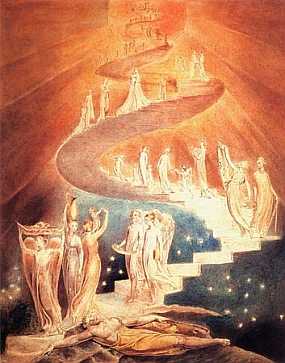
I don't understand Evangelicalism's obsession with wiping out the past. In many parts of the American Church today, a flagrant disregard for what and who has come before us dominates all expression toward God. It's as if today's Christians must live in a self-imposed vacuum. "Jacob's Ladder" by William BlakeWe are told by the more "learned" to build no Bethels. Soon, forgetfulness washes over us like a dulling fog.
Part of this unhealthy contempt for the past springs from mistaken notions about the New Testament Church. Some sectors of the American Church believe that all practices of the Old Testament ceased at the empty tomb. But that notion casts doubt on the immutability of God and the essence of how we experience Him.

Yes, the Holy Spirit now dwells inside us, but this does not do away with remembrances. God does not want us to forget what He has done. The healthy expression of Christianity in today's world should still erect remembrances, as Jacob did, when encountering the living God. When God set the rainbow in the sky, it formed a remembrance—not only to us but to God as well—of God's promises. I don't see that the indwelling of the Holy Spirit erased rainbows from the skies. Remembrances of the past matter.

The Saint Nicholas gathering is a remembrance, the kindling of a ritual designed to remember the generosity of a man who gave away his money so that three poor sisters would have dowries and not wind up in prostitution. Do you know the story? If not, then it only goes to show how poor we American Christians have become in our crazed effort to establish ourselves as the pinnacle of historical Christendom.

When I moved out of the Lutheran Church of my youth into full-fledged Evangelical "superiority," I looked down on rituals and observances as mere icing on an already tasty cake. Who needs an advent wreath at Christmastime? Why read the same Bible passages yearly on the Sundays leading up to Christmas? Why have rites of passage for our youth? Why do anything that smacks of ritual?

"Only take care, and keep your soul diligently, lest you forget the things that your eyes have seen, and lest they depart from your heart all the days of your life. Make them known to your children and your children's children– how on the day that you stood before the LORD your God at Horeb, the LORD said to me, 'Gather the people to me, that I may let them hear my words, so that they may learn to fear me all the days that they live on the earth, and that they may teach their children so.'
—Deuteronomy 4:9-10 ESV

One of the curious artifacts of the Saint Nicholas party concerned the children. They sang "Rudolph the Red-nosed Reindeer" with unusual gusto, but stumbled through the old carols of their parents' youth. Those kids only know an Evangelicalsim devoid of rituals, their lives lacking what I experienced as normative in my childhood. Children grow up without rituals that root them to all of Christendom before them. Today's Evangelical children float in a secularized sea, cast there by well-meaning Christian leaders who employ "regulations" that denounce rituals or scry pointless contemporary "alternatives" to tradition. Is it any wonder that our children reach age eighteen and have no roots to keep them from being torn away from the Faith? How easy is it to depart from God when the experience of God one's been fed has been solely intellectual, tradition relegated to weepy-eyed emotionalism by people who rarely weep!

And it's not only churches that adhere to modern worship music that suffer from this. Some that perpetuate the old carols unwittingly toss aside others rituals and remembrances. Catechism—gone. Studying the history of Christianity after the deaths of the apostles—gone. Gone too are the sights, sounds, and smells of traditional, historic Christianity: incense, candles, organ music, and stained glass.

Fluff? Hardly. All those things root us. They create Bethels that call to mind history and help us remember the eternal and perpetually valuable in our lives. They mark an experience of God that persists through generations. Unfortunately, Evangelicalism's righteous assault on all thing ritualistic has turned us into shallow people unfamiliar with the sacramental, yet we call this "progress" and "spiritual maturity."

What will our children call it?

We have every opportunity in the world to make our experiences of God like Jacob's. Each family can preserve its own traditions recalling what God has done and is still doing in the lives of His people. So can each church. I'm glad that Eric and Jennifer saw fit to call us all together every year on the Feast Day of Saint Nichololas in order to prepare our hearts for the coming King of Kings. I'm even more happy for our children. How much better that our preparation for Christmas begins by remembering someone whose heart lay with the poor and downtrodden, just as our Savior's was.

Let us never forget the Lord, even in the seemingly inconsequential. Because even the small things may have lasting effects. 

In the Eye of the Beheld

Standard

God couldn’t have filled a woman with more admirable traits than Cassie possessed. She cooked like Julia Child. Entertained others as well as Martha Stewart. She had a faith as big as Corrie Ten Boom’s. She lived every word from Elisabeth Elliot’s books on womanhood. In short, she would have made the perfect wife.

I suspect she’s still waiting for that gold ring, though.

You see, to call Cassie “pretty” would have confused Webster. No heads swiveled when she walked by. Young guys on Sunday never anxiously dropped the question, “Have you seen Cassie in church today?”

No, Cassie wasn’t blessed with the one thing so many men crave above all else: physical beauty.

Cassie loved me. I didn’t return “those feelings,” though. Sure, her dowry of other fabulous qualities overflowed, but I could never get past the fact that she wasn’t physically beautiful.

I lost track of her years ago.

Looking back, I probably had two or three other Cassies in my single days, girls whose hearts would have leapt if I asked them out.  Fact is, each was a better person than I could ever hope to be.

I turned 44 last week. In thinking over my life, I realized I’d done all those Cassies wrong. I love my wife immensely, don’t misunderstand me. I had my 25th high school reunion and I can say with confidence that despite all the gorgeous girls in my high school back in the early Eighties, at the reunion my wife eclipsed them all. I’m very fortunate to have married a physically beautiful woman.

But I still dealt poorly with Cassie. Only now do I realize that the one thing Cassie was missing in her life was a real flesh and blood Christian man to tell her she was beautiful.

Time has a way of giving us room to think. As I look around this country and witness the Girls Gone Wild culture that threatens to tear our social fabric apart, I can’t help but think that most of those girls are dying on the inside. Why? Because they simply don’t believe they’re beautiful because no man they respect has ever told them so.

I don’t know what dads are doing at home that they turn out these shattered girls. Either dad doesn’t tell his daughter she’s beautiful, or he doesn’t command enough respect for his word to mean anything. Melancholy girlAnd we all know the story: If a girl doesn’t get admiration from her closest male relatives, she’s going to search for it elsewhere. And elsewhere isn’t always a nice place.
Ultimately, in our churches, the fault lies with Christian men of all ages. I perpetually hear how men in the church are bored. Yet when our young people are getting mugged by the world, where are all those Christian men? If we’re supposed to be the image of Christ, what are we saying about Him by our silence?

I can’t imagine what it does for a young woman to hear from a Christian man she respects, “God made you beautiful.” I don’t think there’s enough of that candor in our churches today. I think a lot of young women are dying to hear that they’re beautiful, but for whatever reason they never hear it. Or they hear it from the wrong people.

It’s sad to me that we’ve fouled this up so badly. Whether we can ever redeem this lack in our churches without it seeming “weird” is a question I can’t answer. Perhaps the older men in the church could pull this off without it being judged inappropriate. I don’t know. All I do know is that young women today simply aren’t hearing it enough from the right people.

Cassie needed to hear she was beautiful. No, she’d never be confused for Miss America. But how did we ever get to a point that her other traits garnered her no accolades? If we looked in her eyes, could we not find the beauty of God?

No doubt Cassie stayed true to the Lord, even when the rest of us didn’t give her the time of day. Still, I’ve got to believe that plenty of young women not as devout as Cassie would have found a word or two said in their favor to be all they needed to keep from straying.

I’m not sure that we cherish our young Christian women as much as we should. Few of us men stand in the gap for them. We don’t pray for them and their families. We don’t keep a watch out for them. We don’t build them up as we should.

Is there a young woman in your church who gets overlooked? Someone needs to tell her she’s loved and appreciated. Someone needs to encourage her to use her gifts for the Lord.

Someone may even need to tell her she’s beautiful.

Being the Body: How to Forge Real Community, Part 4

Standard

It’s discouraging how disconnected we are as people. Even Christians live like there’s no one else outside the walls of their church. Sadly, in many cases, we erect walls inside the church, too.

I continue to receive private e-mails from folks who are resonating with this series because they’ve been victims of our lack of community. Their churches gave them the “God helps those who help themselves” line and let them twist in the wind.

It tears me up to read those stories. Yet they keep coming in increasing number.

In some ways, I can’t blame people for choosing self-sufficient isolation and a hands-off attitude toward others. Prayer circleWe’re inundated by those two messages. As much as we believe that no one can tell us Americans what to do, we live in a culture that bombards us with a million takes on how we should live. Every day, no matter how much we believe we’re our own guides, media saturates us with messages we heed without much thought. Don’t believe me? Did you tailor your wardrobe or plan your activities today based on what the weatherman said? That’s just one simple example.

While Joe Meterologist at KRPP TV isn’t certified to teach, his message is educational nonetheless. Our teachers outnumber us, and few of them teach a message that upholds basic Christian thought. We tell ourselves we ignore the pedagogical aspects of the messages we hear, yet they still impart a worldview. We Christians need to understand that just because we spend ten minutes a day in Bible reading doesn’t mean we’re inoculated against the diseased mantras the world chants around us.

One of the worst messages we Americans receive focuses on the idea that each of us is our own man (or woman). But as pointed out in the first installment of this series, that message conflicts with God’s message of community. We Christians must mercilessly counter the propaganda of self-centeredness by understanding that

#7 – Godly education builds godly community.

Just as people don’t start out seeking good, they don’t start out seeking godly community. Nor do they even know what it is, considering so few truly see it practiced.

Seeing it practiced lies at the core of how our churches need to begin educating Christians to be a community. Several educational practices, if correctly instituted in our churches and homes, can help us develop true community:

a. We must teach community.

Community is at odds with the selfish way we live. Living selfishly takes no conscious training at all. Simply allow a child to absorb our culture as it stands today and that kid will grow up thinking of one person and one person only.

Our churches need to start teaching the “We”  and the “Us” instead of the “I’ and the “Me.” Our worship songs need to be about our community worshiping God, not just individuals. Our Sunday School curricula must stress that none of us lives or dies to himself. We must train our children to get their focus off themselves and onto the Lord and His people. We need to make it clear that Christians do not go the way of the world, making us a countercultural community that must increasingly swim against a cultural and societal current that works against everything community is. For that reason, we must hang together or the stragglers will get picked off.

Children who are taught to value the community will stay in that community. Our kids must know that they are part of a much bigger picture, the entire story of God’s redemptive plan.

b. We must teach a holistic Christian worldview.

It’s time we got serious about starting in Genesis and teaching through Revelation, underscoring God’s relationship with His called-apart people. Each Christian must fully grasp they are part of a community of faith. They must know what makes that community special. They must also know the worldviews that war against Christianity, understanding them for what they are, while also understanding how those other viewpoints fight to suppress community within the Body of Christ.

c. We must teach a unified curriculum.

One of the reasons that so many churches have problems with cohesiveness starts with their teaching. Very rarely does a church teach a unified, age-specific curriculum. By failing to teach this way, we send people home with no basis for further conversation. A family of five might have had the parents, teen, tween, and kindergartner receive totally different teachings, giving the parents no clear way to use what the kids were taught throughout the rest of the week.

But if the entire family received the same teaching geared for their level of understanding, everyone benefits from the community of learning fostered. In this way, the community teaches and learns together, unifying the Body.

d. We must teach the way of Christ to mastery.

Years of lousy achievement test scores have provoked public, private, and parochial schools into teaching to mastery. Students must master a topic before they advance.

Yet our churches seem to have no clue about mastery. The Bible hints there are levels of mastery in knowing Christ, but our church-based education systems (and in many cases, our teaching at home) reflects a cavalier osmosis approach to education.

But what if we discipled people to mastery?

Take serving. We should teach serving in our churches until people actually serve or else we don’t move on. We teach honesty until people are honest. We teach selflessness until people are selfless.

Radical idea, I know. But if our current system of making disciples is any indication, we have no clue how to make disciples. Mastery education will make the difference. Our churches will be profoundly altered if each person in them were to learn one truth of the Gospel a year and fully put it into practice—just one!

(I’ll be expanding this idea in a future post.)

e. The truths and values that we teach our church communities should always be visible.

I’m a strong advocate of churches putting up a huge plaque at every gathering spot within a church building stating what the core truths and values of the church community are. Obviously, affirming the kind of theological truths found in historic Christian creeds (like the Apostles or Nicene) would be included. Yet each church community is unique, therefore the Holy Spirit will be doing unique things in that body. A church located in a wealthy suburb will probably have fewer opportunities to work with the poor in their neighborhoods than an urban church would. Their truths and values would differ. Their plaque should reveal their community’s uniqueness.

If we’re to develop true community, we cannot avoid reinforcing the truth of the community’s shared creed. Making it readily visible to all in the community through plaques and remembrances is critical.

More importantly, the values a community believes and the truths it upholds must be seen in its practice of them. Actions do speak louder than words—or in the case of Christianity, godly actions permit the message to be received and believed. A community at odds with the practice of the Gospel will have zero influence in the lives of those in the church community and the lives of anyone they seek to reach for Christ. For this reason, the greatest means for upholding the Gospel within a community is truly living it.

f. Theological disputes must be handled as a community.

This may not seem unrelated to education, but the manner in which a church handles theological disputes proves to the community that everyone in it can learn from the collected godly wisdom of the group.

Sadly, one of the great gains of the Reformation has also turned into the great tragedy of Protestantism, in that we do not seek truth as a community, but as individuals. Though I fully support breaking from the hellish Roman church, we Protestants have not done well in upholding a unified interpretation of community truth. The freedom given for individuals to come to the Scriptures as unique persons results in a few too many unique views completely lacking in God’s imprimatur. A return to a community-based interpretation of Scripture would strengthen our churches’ educational programs by allowing the community to approach interpretation rather than just the individual alone.  (David Fitch discusses this marvelously in The Great Giveaway.) It also acknowledges the truth that the Holy Spirit not only dwells in the individual, but also in the midst of the church assembly. That understanding reduces opportunity for heresy and creeping error.

Having seen so many churches undercut by a winner-take-all approach to theological disputes, I think it’s high time we find a better alternative. A community approach may just well be the best way of all to educate our people even in the midst of controversy.

I fully believe that rethinking our education models within our churches to better align with community goals would greatly amplify our teaching and, ultimately, our success—a success for both making disciples and building godly community.

Look for the last set of suggested ways to build vital church community tomorrow.

Posts in this series: