
Arrogance, Ignorance, and “I Don’t Know.”

Standard

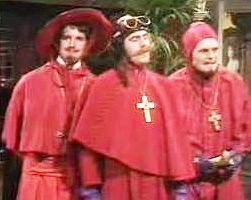
Nobody expects the Spanish Inquisition!Slice of Laodicea notes an Al Mohler article that brings up good talking points about the state of today’s Church in light of the proliferation of cults. Mohler’s basic comment is that poor doctrinal defense and an inability to nip error in the bud have resulted in Christianity being dogged by a plethora of pseudo-Christian cults all clamoring for legitimacy. Given that Eerdmans, long a stalwart in Evangelical publishing, just published a defense of Mormonism, fueling the growing desire of Mormons to be considered mainstream Christians (rather than gladhanders in bleached white Oxfords trying to dig up the remnants of a civilization as non-existent as Plato’s Atlanteans), Mohler may have a point.

But then again, nah.

Mohler’s piece is written as if no Church existed before 1800. Witness this assertion:

Writing early in the last century, J. K. Van Baalen argued that “the cults are the unpaid bills of the church.” Van Baalen’s influential work, The Chaos of the Cults, represented one of the very first comprehensive efforts to evaluate the various cults of the day from the vantage point of orthodox Christianity. Van Baalen’s survey considered movements and groups such as Spiritism, Theosophy, Christian Science, Rosicrucianism, Swedenborgianism, Mormonism, and the Jehovah’s Witnesses, among others.In Van Baalen’s analysis, orthodox Christianity had opened the door for the cults to emerge and to proliferate throughout the culture. Sidelined by pragmatism, distracted by divisions, and committed to a “smallest common-denominator faith,” the orthodox churches had left the larger culture, and even some of their own members, unprepared to meet the challenge of the cults.

If anything, the problem is more acute in our own day. The seductions of postmodernism and the complexities of a pluralistic culture compound the difficulty involved in engaging, understanding, and confronting the cults.

Is the problem more acute in our day? Well, if the Scriptures are to be believed, the first NT writings were not even dry on the page before the Church was confronting cults. We know that the Apostle John wrote to counter the nascent Gnostic heresies and that the Lord Himself called out the Nicolaitans in Revelation. In fact, as long as there has been Christianity there have been cults of Christianity. Paul was constantly squashing one heretical belief after another and even came into conflict with Peter over the Judaizers, a group that Mohler would be forced to tag as a cult if it existed today.

The list of heretical leaders and the groups that formed around them in the early days of Christianity’s spread could take up a leather-bound tome in itself. Mohler’s amnesia here is startling: Marcion, Pelagius, Apollinarius, Montanus, Arius, Nestorianus and on and on. Yes, the Church did put them down, but even today groups of pseudo-Christians cling to the remnant teachings of these heretics. Still, their ideas did not die; even a casual glance around proves Pelagianism is alive and well in the 21st century.

The issue of what constitutes a cult in the history of the Church is also difficult to ignore. To the orthodox Church (and Mohler makes much of what is “orthodox”), Martin Luther and his band of German ne’er-do-wells were a cult. Same goes for that Calvin guy and that fellow Knox. To those early Lutherans and Presbyterians, the Roman Catholic Church was a cult and plenty of Christians today still maintain that view.

In fact, you can trace every modern denomination in Christianity to a blistering reaction by that denomination’s adherents to an “apostate orthodox church.” Methodism, the Restoration Movement, the Quakers, the Puritans, all had a start as folks who came out of a church that was backslidden and given to cultic practices—at least as they saw it. How Mohler fails to consider this is beyond me.

Worse still, Mohler attributes the problem of cult proliferation in the last one hundred-fifty years solely to the Church’s inability to promote correct doctrine. To be honest, I don’t believe that this is the whole story, especially since Mohler lumps seeker-sensitive and Emerging churches in here. Again, an honest assessment shows that these two came not out of bad doctrine, but a reaction against an orthodox Church in America that simply wasn’t doing its job. A lot of denominations started out that way, but when they left their parent churches, the angry ones left behind were bellowing, “Heretics!” even as they smarted over the possible truth behind the breakaway group’s leaving. It was easier to blame them for bad doctrine than it was for being right about the status quo’s calcification and deadness.

Every doctrine of the Church is not nailed down. If we were honest with ourselves we would have to admit this. Get one hundred Christians of all “orthodox” persuasions in a room, and you’ll have at least twenty distinct eschatologies. And while some may say that eschatology makes no difference, many of the cults that arose in the mid-Nineteenth century did so because of eschatological beliefs. Nor does one’s eschatological view exist in a vacuum. The very way we live our lives every day is a reflection of how we think the world will end. If you don’t think that’s true, then compare and contrast Booth’s Salvation Army with today’s Christian survivalists.

I’m going out on a limb here and will certainly get angry comments, but even Paul didn’t have his theology crystal clear on all points—at least as many orthodox Christians might see it today. We know that Paul publicly confronted Peter over his falling in with the Judaizers, but Paul was not so sure of the issue of circumcision early on in his ministry (Acts 15), but then after it was decided that circumcision was not necessary, Paul went ahead in the very next chapter and circumcised Timothy in order to get a better opportunity to preach to the Jews who would have disqualified his testimony because of his uncircumcised co-worker in the Faith. Later on, we have Paul abiding Nazarite vows and ritual cleansings in Acts 21, acts that would drive batty those orthodox believers who eschew anything that looks like a ritual or smacks of legalism.

So just who is wrong here? And better yet, who’s willing to admit it?

It’s that latter sentence that may explain some of the reason why we have cults: dogmatism. Cults— and Christian denominations—exist in large part due to inflexibility of beliefs. They are all backlashes against a rock-solid dogma that chafed. Sometimes (and yes, I know, not always) we Christians must acknowledge some negotiables. Paul did so when he circumcised Timothy. Who here is willing to toss him out for that act? Was it a sin? Was he violating doctrine? Or was the Holy Spirit leading him outside the newly established boundaries just this once in order that some might be saved? That Paul also consented to a similar act (the vows) later on in order to win some to the Lord should give us pause.

Frankly, if Mohler were honest, he’d just skip to the punchline and say, “I’m a Baptist. From my perspective, anyone who baptizes infants is a heretic and their church is a cult.” The problem is, he can’t bring himself to say that because he mentally assents to some doctrinal “wiggle room” himself.

I’m not positive on a lot of points of established “orthodox” doctrine. I believe that because Man is made in the image of God, he’s a tripartite being, just as God is. Wayne Grudem, whose Systematic Theology is a work I deeply respect, does not share that belief. That makes one of us wrong. Applying the standard that Mohler asks, one of us is therefore a heretic.

The Holy Spirit will guide us into all Truth, as the Scriptures say, and yet we see through a glass darkly. I believe both those statements. I believe that the Holy Spirit will progressively make me more like the Lord and I will take on more of His Truth in doing so, but I also believe that I will not have all the answers in my lifetime. As Paul’s “man caught up into the third heaven” can attest, there are answers to questions we may never ask this side of eternity. And if we’ve never asked them, how then can we be perfect in our doctrine?

Arrogance led to erecting a gospel of stone, a weight that not only were the cultists not ready to accept, neither were the leaders of Christian denominations who broke off from the accepted teaching of the day and went down another path. On the other hand, there is no purity in ignorance. Certainly ignorance accounts for the cults and some of those same Christian denominations—ignorance of the Word and of sound doctrine.

Perhaps the reality we face this side of heaven is that on some issues the believer must be more humble, even to the point of saying, “I don’t know.” While I don’t ascribe to the belief that everything is a mystery, neither do I believe that everything is set in granite. I don’t believe that Jesus came to establish a set of dogmas used to crush ordinary people with, and yet He never tolerated erroneous teaching, either.

No matter what the case, we all need a bigger dose of humility when it comes to this issue of who is right and who is wrong. We use the word “heretic” far too often today. The Christian blogosphere is choking on the brutal arguing going on over who’s perfect and who isn’t. I don’t want any part of that anymore. It’s possible to call others to holiness without strangling them to death with a noose of righteousness. That’s the way I’m going to try to take, because in the end, I’m not perfect.

Now where’s my comfy chair?

God Is Still Speaking

Standard

IlluminationThis is a response to Steve Camp’s post “Worship Wars.” While I greatly respect Steve’s teachings in general, I believe there is a problem with his limited view of God’s speaking to people today. The underlying idea he expresses is that God ceased to speak to us once the canon of Scripture was closed. This perspective is very common and I hear it all the time in the Christian blogosphere, but I contend it makes Christianity into a dead religion that was codified in a book by a God who once spoke, but does so no longer.
At issue is this quote from Steve’s article:

Worship cannot be about my feelings or personal moorings based on what I think God is mystically communicating to me in a supernatural way.

While it is true that feelings cannot be the basis for worship, what God is communicating to us when we are communing with Him is critically important, especially if that communication is “supernatural,” as Steve puts it. Steve limits what God can say only to what He has chosen to have written down in the Bible.

I start my response with a man who intimately knew God in a way that few do today:

In the beginning was the Word, and the Word was with God, and the Word was God—John 1:1

An intelligent, plain man, untaught in the truths of Christianity, coming upon this text, would likely conclude that John meant to teach that it is the nature of God to speak, to communicate His thoughts to others. And he would be right. A word is a medium by which thoughts are expressed, and the application of the term to the eternal Son leads us to believe that self-expression is inherent in the Godhead, that God is forever seeking to speak Himself out to His creation. The whole Bible supports this idea. God is speaking. Not God spoke, but God is speaking. He is, by His nature, continuously articulate. He fills the world with His speaking voice. One of the great realities with which we have to deal is the voice of God in His world. The briefest and only cosmogony is this: “He spake, and it was done” (Psalm 33:9). The why of natural law is the loving voice of God immanent in His creation. And this word of God which brought all worlds into being cannot be understood to mean the Bible, for it is not a written or printed word at all, but the expression of the will of God is the breath of God filling the world with living potentiality. The voice of God is the most powerful force in nature, indeed the only force in nature, for all energy is here only because the power-filled Word is being spoken.

The Bible is the written word of God, and because it is written it is confined and limited by the necessities of ink and paper and leather. The voice of God, however, is alive and free as the sovereign God is free. “The words that I speak unto you, they are spirit and they are life” (John 6:63). The life is in the speaking words. God’s word in the Bible can have power only because it corresponds to God’s word in the universe. It is the present Voice which makes the written Word all-powerful. Otherwise it would lie locked in slumber within the covers of a book.
—A.W. Tozer, excerpt from the chapter “The Speaking Voice” from The Pursuit of God

Agree or disagree?

Does God not still speak to us? If He does not, then what is the purpose of having the Holy Spirit placed in us if God did not intend to continue to speak through His Spirit? The Spirit is more than a stamp of salvific approval on the Christian. If He were only that, then there would be no reason for Him to be a living Person. Stamps do not speak, only persons do.

And what of inspiration or the words of a preacher like Whitefield brought to life by the unction of the Spirit? If God does not still speak, then there is no sense for us to be Christians any longer, for all inspiration is lost. It may have been codified once, but there is nothing more to say, therefore there would be no reason for us to speak a single word to anyone, preaching going the way of the dodo. Anyone here believe that to be true?

While I greatly respect Mr. Camp, he may one day come up against a person who meets the very criteria Camp himself sets forth, someone who is delivering the voice of God. What then?

Why are we so very afraid that God may still be speaking? Why should we be afraid of the Voice today? The Spirit blows where He wills; does He do so no longer? If He still does, would He come without a message? By no means! Because it is the very nature of God to always be speaking.

You could open your Bible anywhere and find God speaking to His human creations, but the one I choose here is God speaking to His wayward prophet Elijah. After God’s trouncing of the prophets of Baal through Elijah and the subsequent destruction of the Baalites, Elijah fears for his life and takes off into the wilderness, hiding from King Ahab and his wicked wife Jezebel:

Then Jezebel sent a messenger to Elijah, saying, “So may the gods do to me and more also, if I do not make your life as the life of one of them by this time tomorrow.” (3) Then he was afraid, and he arose and ran for his life and came to Beersheba, which belongs to Judah, and left his servant there. (4) But he himself went a day’s journey into the wilderness and came and sat down under a broom tree. And he asked that he might die, saying, “It is enough; now, O LORD, take away my life, for I am no better than my fathers.” (5) And he lay down and slept under a broom tree. And behold, an angel touched him and said to him, “Arise and eat.” (6) And he looked, and behold, there was at his head a cake baked on hot stones and a jar of water. And he ate and drank and lay down again. (7) And the angel of the LORD came again a second time and touched him and said, “Arise and eat, for the journey is too great for you.” (8) And he arose and ate and drank, and went in the strength of that food forty days and forty nights to Horeb, the mount of God. (9) There he came to a cave and lodged in it. And behold, the word of the LORD came to him, and he said to him, “What are you doing here, Elijah?” (10) He said, “I have been very jealous for the LORD, the God of hosts. For the people of Israel have forsaken your covenant, thrown down your altars, and killed your prophets with the sword, and I, even I only, am left, and they seek my life, to take it away.” (11) And he said, “Go out and stand on the mount before the LORD.” And behold, the LORD passed by, and a great and strong wind tore the mountains and broke in pieces the rocks before the LORD, but the LORD was not in the wind. And after the wind an earthquake, but the LORD was not in the earthquake. (12) And after the earthquake a fire, but the LORD was not in the fire. And after the fire the sound of a low whisper. (13) And when Elijah heard it, he wrapped his face in his cloak and went out and stood at the entrance of the cave. And behold, there came a voice to him and said, “What are you doing here, Elijah?” (14) He said, “I have been very jealous for the LORD, the God of hosts. For the people of Israel have forsaken your covenant, thrown down your altars, and killed your prophets with the sword, and I, even I only, am left, and they seek my life, to take it away.” (15) And the LORD said to him, “Go, return on your way to the wilderness of Damascus. And when you arrive, you shall anoint Hazael to be king over Syria. (16) And Jehu the son of Nimshi you shall anoint to be king over Israel, and Elisha the son of Shaphat of Abel-meholah you shall anoint to be prophet in your place. (17) And the one who escapes from the sword of Hazael shall Jehu put to death, and the one who escapes from the sword of Jehu shall Elisha put to death. (18) Yet I will leave seven thousand in Israel, all the knees that have not bowed to Baal, and every mouth that has not kissed him.”
—1 Kings 19:2-18 ESV

Notice a few things concerning Elijah and the Lord here:
1. Elijah was consecrated to God in the same way as we read in Romans 12:1 (“I appeal to you therefore, brothers, by the mercies of God, to present your bodies as a living sacrifice, holy and acceptable to God, which is your spiritual worship.) He was a true worshiper of God.

2. Even though Elijah trusted God, he was afraid and depressed enough to die. While we don’t associate fear and depression with faithfulness, there was no doubt that God still considered Elijah faithful and still spoke to Him in a personal way.

3. God spoke to Elijah through the exact means needed to reach him. God’s tenderness is shown to the prophet. And while we are not to base our worship on feelings, God is mindful of the emotional state of His prophet and takes this into account in the way that He deals with His servant.

In light of this encounter, should any of us believe that God does not speak to us in the same way that He spoke to Elijah? As true worshipers, is the depth of relationship we have with God somehow capped so we can never experience the level of intimacy that Elijah experienced when God spoke to him in the whisper? Are we somehow perpetually lesser servants of God? I see nothing in the Bible that says that God cannot speak to me in the same way that He spoke to Elijah, even when I am afraid or depressed, just like the prophet. Why should we limit God? In fact, with the Spirit of God actually indwelling us, I believe that our potential for intimacy with God, to have amazing conversations with Him, are even greater than in the days of the Old Testament when God would periodically dwell on people rather than remaining in them.

Therefore, not only does God speak, but He speaks personally. He speaks to each one of us. His intimacy is with each one of His children, those who bear the Holy Spirit within. And not only does He still speak, but He speaks to our need, our place in Him, and in measure to our ability to respond. If Steve Camp has any fair remark it’s that too many self-appointed and highly immature “mouthpieces for God” want to talk when they should be listening, allowing God to mature them to the point where He will truly use them to speak if He wills. However, that fair criticism is used in a blanket way to establish a rule by which no one can ever relay the voice of God for an individual or group in the moment. By Steve’s rule, God would never speak in the way that He does here:

While they were worshiping the Lord and fasting, the Holy Spirit said, “Set apart for me Barnabas and Saul for the work to which I have called them.”
—Acts 13:2 ESV

If that kind of speaking is out today, then how are we to function as a Church?

Lastly, as the bearers of His Light, that Light speaks out from us to those in the darkness. Even our lives can be the words of God to mankind. Because God is still speaking, we should not be surprised when the person sitting next to us on the bus hears the Lord’s voice in our very countenance.

So if God is still speaking, the only question that remains is, Are we listening?

Another Look at the Church’s Missing Men

Standard

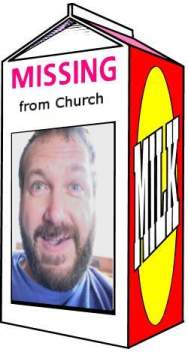
Dan is Missing!Last June, I blogged about the George Barna report that showed that the American Church’s face was largely female, with many men skipping church altogether. Since that time, another male-centric book has appeared on the market, David Morrow’s Why Men Hate Going to Church. This tome joins the mania created by John Eldredge’s Wild at Heart in seeking to find out why men feel bored in the pews on Sunday. Morrow even has a website www.churchformen.com that delves deeper into the mystery of the church’s missing men.

Like John Eldredge before him, Morrow’s solution focuses on recovering lost masculinity. While Eldredge aims to recover a masculine “adventure,” Morrow looks at masculinizing the Church:

We have to give men opportunities to use their strengths and their gifts in the service of God instead of trying to squeeze them into roles that they feel are feminine or emasculating. We need to start valuing masculine traits such as aggression, boldness, and competitiveness and figuring out ways that we can integrate that into every area of church life.

But are these assertions the real reason behind the church’s missing men?

Having been a part of two churches with extensive ministries that were strongly male focused, I contend that Morrow’s response does not play out in reality. One of those churches had a popular sports ministry and brought sports illustrations into nearly every sermon. The pastor of the church served as chaplain to a number of professional sports teams and was a well-known author. Still, that church was about 60% women. Again, in the second church, wacky humor, Eldredge’s reliance on movies to pitch the Gospel, numerous men’s groups, and plenty of ministries that called on uniquely male gifts did not budge the number of men. They were still only 40% of the attendees.

So what is the problem?

I alluded to this earlier in my post “Advertising Ashes.” The main reason that men are not in church is that they simply are not seeing the Holy Spirit move in power. At the risk of alienating the many women who read Cerulean Sanctum, I want to make a bold point: even if the Holy Spirit were not present in a supernatural way in our churches, I still believe women would still show up on Sundays. The Church has no problem attracting women because women are naturally drawn to the community and relationships that a church provides. However, this attractor does not work for many men. Men need a profound experience of God in order to get them to sit up and take notice. If the Holy Spirit doesn’t fall on them in power, then the positives a church can provide outside of the supernatural make little difference. A church can hypermasculinize itself to death and still not break that three women to every two men ratio if the Spirit is barely discernible on Sundays. Men have a better built-in B.S. detector than women do and function more out of the rationale of “prove it to me.” Without the manifest presence of the Holy Spirit in our gatherings, we have little to combat a set of crossed arms and a raised eyebrow.

The second problem is also one I have mentioned in the past, the issue of a man’s career. You almost never hear any sermons about jobs. Most churches have nothing in place to help the unemployed within their ranks. And the Church in America no longer speaks to the business world on issues of cut-throat downsizing, outsourcing, discrimination against older employees, and the relentless expectation that employees put in longer hours at work. In short, the Church in this country has almost nothing to say about the one thing men spend more hours doing than anything else in their lives. That silence speaks volumes to men.

In an e-mail I received from David Morrow in response to this, he wrote that as many women work today as men, yet despite their jobs and greater limitations on their time, women still make it to church. To this, I have a few counters:

  • Our society still defines men by their jobs. Introduce a man to a group and the first question he’s asked is, “So what do you do for a living?” This emphasis on work is taken to extremes because the gold standard espoused in Evangelicalism is that the husband is the sole breadwinner while the wife stays at home with the kids. A man without a job has no place in society’s eyes, but a place is still available to women who do not work.
  • A caste system still exists for men. Men are categorized by their work and valued accordingly. The doctor and the mechanic are not viewed as having the same worth, even within many churches. Again, this system does not plague women to the same extent. The man making minimum wage is perceived in a far worse light than the woman who works for the same pay. No one ridicules women in traditionally male jobs, but a man who performs what has traditionally been a female job is usually held up for scorn—particularly by other men.
  • Women marry with an eye to financial security, but this is not the case for men. Therefore, the onus is always on the man to bring in money. To meet this need, the man is usually the one striving to succeed in his career. Our society continues to reinforce this for men, while placing less burden on women to reach the pinnacle of success in their field.

A woman’s job and a man’s job, therefore, are not the same. To treat them as such is to ignore cultural mandates that simmer beneath everything a man does in his life. If the Church in America cannot grasp this, then we should not wonder why men see the Church as having little to say about how they define themselves using the cultural constructs placed on them in our society. With this paucity of wisdom about the key role a man plays for eight to ten hours a day, why should men abide church at all?

I believe that the reason the message of Eldredge and Morrow resonates with many men is that those men can’t put a finger on what they are truly missing. If you’ve never tasted champagne, why would you miss it? In this way, if our church gatherings are not filled with the Holy Spirit and our churches are not speaking to the one thing we still use to define a man, then the loss of both cannot be fully appreciated by the man who feels empty after the church service is over. All he knows is “Well, that wasn’t it.” So he goes off to hunt bear with a pointy stick or to climb mountains like Eldredge says. And while that might captivate him for a while, it does not fill the vacuum in his soul. His expectation then becomes that of simply muddling through the day. He can’t even look forward to the gold watch at retirement because the company he works for now fires (or forces into an early retirement with subsequently diminished benefits) everyone over fifty before the watch can be attained. At sixty-five and with his funds cut short, the job as a greeter at WalMart never looked so good.

We as the Body of Christ have got to do better than this or we may someday look around our churches and see no men at all.