Considering the conversation online in the last week, today’s post can be described not so much as a gearshift, but more like getting out of the cab of a manually shifted 18-wheeler and into a 4-speed automatic minivan with a melange of interesting foodstuffs ground into the fabric of the back seats.
Yes, I’m going to talk about homeschooling again.
A couple months ago I featured a series on homeschooling (1, 2, 3, 4) that many folks found interesting, even if it made some throw a wobbly. (That’s for you British homeschoolers, all two of you!)  In this post, I’d like to get a little more personal and perhaps help some folks calm their fears about homeschooling.
I have a degree in Christian Education, having studied all the educational theorists and those who pontificate on all things educational. How much did that steel me for homeschooling? Not one wit. God only gives you a few kids and experimenting on them with the latest “too good to miss” educational theories is enough to give any normal person the willies. I mean, just how bad can you mess up a kid? Will they be old enough to drive and still be doing book reports on One Fish, Two Fish, Red Fish, Blue Fish?
Despite my educational pedigree, I was actually worried about being too lax. I like a lot of what John Holt wrote about children being natural learners and so I tend toward a less structured teaching time, hewing to the idea that all time is teaching time. That’s just one of the things I’ve put into practice that has worked with our son.
This last March he read his first book through without any mistakes (Where Is the Green Sheep? if anyone is interested in finding a good book for a beginning reader.) Now, just eight months later, he’s at a third grade reading level.
What did I do? Well, not much really. But what I have learned, I’d like to share for anyone who is interested.
1. Set an expectation in your children at an early age that you will answer any question they ask—then answer them
Seems simple, but kids have a need to know that they can ask questions without getting the brush off. I try to answer every question my son asks, even if it means dropping a conversation I’m having with someone else. The great part about this is that kids realize that they’ll get answers and won’t keep asking the same questions over and over. I’ve found that giving my son answers right away lowers the chance that he’ll butt into my conversations anyway. Everyone’s happy.I know that every parent feels inadequate to answering some of the things kids ask, but take a stab at it and you’ll find that they’ll usually be happy with simple explanations. And if stumped, what a marvelous thing it is to live in a day when the Internet is loaded full of answers to just about every question there is! If you don’t have Wikipedia bookmarked, here’s your chance. The best part of this is that a child who is encouraged to ask questions is more likely to be a self-starter in learning. That’s one of the best gifts a parent can give their kids. A love of learning will always serve them well.2. Be the role model in learning
Kids are natural mimics and sponges. What they see you do, they will copy. If you spend all your time in front of the TV, your kid will grow up thinking that TV is all there is. Better that they see you reading books and discussing them with others. They’ll want to read, then, just like mommy and daddy do.
Make your own learning and the use of what you’ve learned obvious to your children. If you are confronted with a real life math problem, let your child in on the math skills you are using. Talk over the problem in front of them. The grocery store is an excellent place to drive home the need for math skills. Between judging which products are better deals for the price, or determining how much of an item is needed for a meal, kids see that math is essential for everyday living.
3. Ease up on the teaching schedule!
One of the most interesting studies to have come out recently has proven that children actually learn better if they are given days off between lessons. This flies in the face of the theory that reinforcement needs to happen daily.
I took this tactic with our son and was shocked at how well it worked. We did about a half hour to forty-five minutes of reading and phonics study Monday, Wednesday, and Friday instead of every day (although we still read to him every day), and his reading blossomed phenomenally. No, I have no control subject for this little experiment, but I have to think that a kid barely into five-years old reading at a third grade reading level speaks for itself.
Now I concentrated on the reading skills from very early on because I think that reading early sets the stage for every other learning discipline that comes afterward, so we are just now starting to add in disciplined math concentration. The nice part here is that I can give him a math book and he can read it himself now. That makes my work a whole lot easier when it comes to reinforcement. We can still have a personalized lesson, but he can now do follow-up himself.
4. Your child does not have to be a genius by first grade
I’m glad my son can read well, but I’m not pushing him to be a genius. We only spent about two hours a week on formalized reading instruction. I see kids who are being groomed to be Doogie Howser that are suffering under the onslaught of learning their parents feel compelled to deliver in order to keep up with the wunderkind next door.
My mom was a preschool and kindergarten teacher—a very good one. One of her favorite sayings was that you have to allow a child a childhood. Despite the fact that my own mother was a teacher, she never pushed us out of our childhood years before our time. When I hear of six-year old kids who are suffering stress-related diseases because their schedules are filled with everything from Suzuki violin and soccer tournaments to ballroom dancing and Latin classes, it breaks my heart. Whatever happened to a game of Kick the Can versus organized sports leagues? Must our kids be forced into the same mania we impose upon ourselves? At what point does all this frenzy dishonor the Lord?
5. Play is learning
I’m not entirely an advocate for the unschooling movement, but I do think that we underestimate the role of play in learning. I’ve always thought that games help kids think strategically, but I didn’t have much luck teaching my son simple card games—that is until I tried Uno. Though the game is recommended for kids eight and older, I thought the concepts were easy enough (and the game is just random enough) so that a child my son’s age could pick it up. Well, he beat me eight of ten hands the other day, so I think my theory holds up.
Chess and Go are heavily studied by childhood educators and both are predictors of how well kids will do in other areas of study. Even if a child is not a chess genius, simply playing the game routinely brings up test scores.
It’s not all mental games, either. Physical play helps, too. You can even mix the two. At one of the camps I worked for, I was responsible for boys’ curriculum and programming. I put a spin on the classic Steal the Bacon game by having the kids solve math problems that I called out in order to know who was being called to run. One sixth grader later came up to me and told me that he always hated math, but enjoyed it tremendously in the game. In fact, the boys wanted to play the game constantly after that.
6. Computers help, but only so much
Another study has shown that kids learn best with a mix of personal instruction time and time on the computer. If I remember correctly, the best mix was about two-thirds personal and a third computer. Close behind is 100% personal, followed distantly by 100% computer time. So despite all the flim-flam from the computer industry. Personal time, even as the kids get older, is still essential.
7. Always be asking your kids to think
Use your senses to teach. If you see something that catches your eye, use it as an opportunity to teach your kids. If you see the sun in the sky, ask them why it is hot and gives off light. When a cashier at a store says “Thank you,” ask your child why they say that. The possibilities in any day are endless.
The only caveat to this is that you better know the answers before you ask them or else show an attitude of learning by telling your child that you’d like to find out the answers, too—then look them up together.
8. Always take learning back to God
As much as possible, don’t allow learning to fester in a godless vacuum. As much as possible, I try to tie every bit of learning my son does in a day back to God. I just mentioned asking about why the sun is hot and gives off light. Examine that with your child in light of the Scriptures and let him or her know that the sun has no power unless God gives it power and that without God to hold it together the sun would dissipate like mist. If we truly believe that the Lord undergirds everything that is, we need to ensure our children know that there is no divide between life and God—everything goes back to God.
9. Of the making of books, there is no end
Or so it says in Ecclesiastes. And so it is with educational theories. You can drive yourself insane looking for the best curricula to use with your kids. I say, Be yourself and let your kids be themselves. If you’re calm about learning, so will your kids be. The best theory is the one that involves you in your children’s educations.
10. Grace
Even as God is graceful to us, we need to permit ourselves as our children’s teachers to experience grace. And most of all, dole out plenty of grace to them. Using education to crush a child’s spirit will only lead them to hate learning, making our jobs harder. If your child doesn’t get some tidbit of educational wisdom, the sun will still come up tomorrow. Try something different and don’t sweat it. Most of all, if you can’t get a concept across to your child, don’t be afraid to call on others for help. We all have our gifts and our weaknesses. Acknowledge them and move on. That goes for homeschooling as much as for anything else.
Have a great weekend.

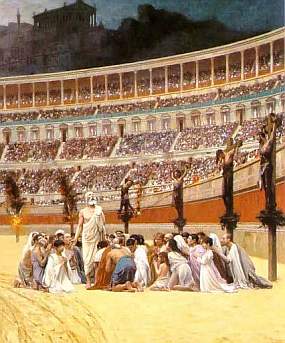 for the crime of printing Bibles for the Chinese people to read.
 The fact is that there are entire sites that have sprung up in the last few months that do nothing but assault harebrained practices in the Church, so I felt like all the good commentary was already being rendered up for bloggers. Why add more?
 A
A