
Speed Kills the Christian Soul–Part 2

Standard

Q1: What is the chief end of man?

A1: Man’s chief end is to glorify God, and to enjoy Him for ever.

— Westminster Shorter Catechism (1674)

My small group met this last Friday and the theme that came out in prayer requests and other revelations was simple: folks are struggling under a load of things to do. FranticPeople are going to bed at 4 AM and getting up at 7 AM. Homeschoolers are scheduled to the max trying to pack requirements in every day. Life has become a clumsy dance of “do this, then do that” and our days have come to resemble little more than a succession of nags.

One mom wondered what would happen when her lone hour a day to herself went away come August. Too many of us know exactly how she feels.

In the last few weeks, I spent

  • Eight hours on the phone trying to schedule a plane flight for three people
  • Three hours trying to get information on my phone service (and still no response)
  • Several hours trying to enroll my son in a state-approved homeschooling program (and I’m still not done)
  • Cramming six errands spread across the city into two-and-a-half hours
  • Mowing the grass to the tune of nine hours
  • Switching my entire Web presence to a new host, new domains, and new software—untold hours
  • Switching from Eudora (after twenty years of use!) to Thunderbird, and laboring through all the bureaucratic importation nonsense that went with that switch
  • Attending six worship band practices
  • Dealing with car maintenance issues
  • Spending a couple hours wrangling on the phone with a service company that didn’t perform the service I asked of them
  • And, sadly, finding very little time to glorify God and enjoy Him forever.

There are countless unmentioned experiences in that list, but suffice it to say, my candle’s had more than two wicks burning at the same time. While this may sound like whining, I suspect it’s a whine all too common in most people’s lives. The pace of life continues to speed up.

One commenter to Part 1 said the answer was in moving to the country. Well, I already did that and only found a new set of problems. The issue is not so much where we live, but how we live.

When I look at what consumed most of my time the last few weeks, much of it had to do with the following:

  • Bureaucracy, usually made concrete by the endless filling-out of forms or jumping through hoops
  • Technology, our new master
  • Maintaining possessions, the things we own that ultimately control us
  • Lack of personal community, wherein we must individually do what the community used to do for us collectively

Those four issues form a quadrilateral in no way like Wesley’s, yet they’re just as spiritually significant. Not only that, but they feed off each other. We have bureaucracy because we no longer live in communities of trust. Our lack of community leads us to self-sufficiency, the stepfather of technology. Our bureaucracy safeguards our possessions, of which an increasing number are technological. We ultimately replace people with items and then call our lives good.

Modern Man’s dilemma is not so much that we cannot make time for ourselves, but that the things we’ve created to make time for ourselves ultimately consume all our time and destroy relationships. Not only relationships with flesh-and-blood human beings, but with God Himself.

It’s difficult to imagine not having a car in the United States, but how hard do we have to work to buy and maintain that car? In my own case, it seems not a month goes by that I don’t have something to do related to vehicles: oil changes, tire rotations or replacements, licensing, insurance, various bits of maintenance, and working hard enough to afford the cost of $3 gas alone. With gas that high, every trip becomes a logistical nightmare. How many errands can I run in one sprint into the city? When? How? And what if something comes up that upsets that delicate balance? The dentist wants to reschedule? Ugh.

Cars are a simple one to question. There’s the bureaucracy of simply owning one, with all the titles, government regulations, and yearly paperwork. It’s technology, and it’s gotten so technological that no one can service his own anymore. I can’t get my 13-year old truck an oil change at many oil change centers because they don’t have the right wrench to remove the specific kind of plug that’s on my oil pan. Multiply that by several million cars and you’ve got a tech nightmare. And you thought computer operating system differences were a hassle!

Cars also mean insurance, because in our litigious society no insurance means no legal way to drive in most states. That’s an added—costly—hassle. And as I mentioned earlier, there’s expensive maintenance. And community? Well, there’s not much personal community in a car. Most of us don’t carpool, and it seems odd to even have a neighbor or friend in our cars. Our cars are meant to hold our nuclear families and that’s usually about it.

But unlike Europe, which developed in self-sufficient burghs, America is a vast, spread-out place that astonishes non-Americans. Almost every Japanese I’ve met in America is swift to comment on our interstates and the amount of time we spend on them. And we have to spend a lot of time on them because everything sprawls in this country. A few weeks ago I asked how many of you lived within fifty miles of extended family and I would say that 90% of you did not. So we depend on cars to get us there—if we want to see extended family, that is.

Multiply cars, phones, jets, computers, insurance policies, and the like. My eight hours on the phone trying to schedule a flight is the length of the flight there and back. Hmm. What gained then? And for a family reunion, too. Isn’t family supposed to be nearby? If 90% of us have none within fifty miles, then I guess not.

I’m getting snarky here and I apologize. Already this post has failed my usual test for quality. But still I must ask, What has all this bought us except hectic lives that go full throttle 24/7/365?

And what about God? Do we even have time for Him, much less to truly enjoy Him?

It bothers me that it’s the hardcore green liberals that are asking the question that Christians should be asking but aren’t: Is our daily existence dictated by evil, rather than by good? In our case, we understand that God is the good here, but the problem does not go away by defining good.

On this issue, I took Al Mohler to task over his non-answer when he usually has one. Perhaps that was unfair. To Mohler’s credit, he does quote Francis Schaeffer’s book title. Schaeffer asked, “How then shall we live?” in that eponymous book, and it’s a valid question.

I believe we are living in an evil construct. There is no good to be found in much of our activity. In past posts I’ve wondered aloud where the Christians are who are envisioning communities that eschew pharisaic bureaucracy, man-handling technology, devotion to things, and a lack of devotion to people. A few are cropping up, but not nearly enough to make a dent in the dialog in our churches. Mostly, those folks are seen as cranks or environmentalists or some other irritant not worth engaging. That’s too bad.

Not only are our lives being stolen by bureaucracy, technology, possession maintenance, and lack of community, but I genuinely believe that there are demonic components behind those four issues. We dismiss too easily and laugh at the notion, but could there not be a better way, a way that more fully expresses the life of God in the individual rather than the individual at the mercy of his surroundings? I believe that reality exists and is possible, but only if better people than me start working toward it.

In Song of Solomon, it says:

Catch the foxes for us, the little foxes that spoil the vineyards, for our vineyards are in blossom.
—Song of Solomon 2:15 ESV

Our vineyards today are overrun with little foxes, but we are not catching them. In fact, we take them for granted, have made our peace with them, and then no longer wonder why we aren’t fruitful. We take barrenness as the natural state of living.

If we desire to glorify God and enjoy Him forever, something has to give.
Speed Kills the Christian Soul–Part 1

Standard

If you’ve been a longtime reader, you know that one of my pet peeves is the speed at which our lives today fly by us. Too many Christians are caught in a perpetual hamster wheel of activity. None of that benefits us, the Church, or the Lord.

But what to do about it?

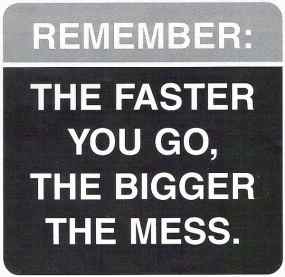
Al Mohler asked the same question earlier this week, lamenting the “sound byte-ing” of classical music. Even on a classical music station, you can’t hear an entire symphony anymore, just its best passages. As a classical music fan myself, I know exactly what he means. Speed KillsStations have ratcheted up the speed to fit leisurely classical music pieces into hectic schedules. Next thing you know, they’ll be time compressing the “Moonlight Sonata.” You can read his post here.

I blow hot and cold with Mohler, though. While he’s a big name in the Reformed Baptist camp, his posts and writings usually tell people what they should be doing, but without the means or info needed to do those things. Again, consistent readers know that I loathe that kind of “do this, but don’t ask me to help you do it” mentality in so many parts of the church.

But Mohler, usually quick with an answer, has no response to fixing the blatant hurriedness quagmire we find ourselves in. That’s also pretty typical of large swaths of the Church in America—recognize the problem, but offer no way to deal with it other than to say that we need to slow down.

Part of the problem here is that the Church, at least in this country, may have created the problem—or at least abetted it.

I’ve long contended the way to fix our issues with time is to correct the way we work. Ten hour days with additional two hour commutes is a good place to start repairing. People can’t have normal lives devoting twelve hours a day to work far away from home. Sadly, the very Protestant work ethic this country was founded on powers our work ethic today.

There’s nothing inherently wrong with the Protestant work ethic that arose from the Reformation’s freeing of workers to know that their work honors God. Where it goes astray is when it is removed from local economies and translated into the typical “drive downtown to the office” kind of work we grew used to working during the Industrial Revolution. If you’ve read my series on “The Christian & the Business World“, you’ve got the basis for understanding the depths of the problem. (Read the series—you won’t read anything like it anywhere else in the Godblogosphere.)

So here’s what I recommend to Al Mohler. He’s a big name and has a large readership, far larger than mine. The plea:

Dr. Mohler,

Please use your considerable base of readership to start challenging the entire concept of how Christians should work. Throw out every assumption about work that’s been foisted on us by “The System.” Start asking what a genuine expression of Christian work should look like in the 21st century. Start asking how we can revitalize local economies and restore the simpler joys of working cooperatively with our neighbors. Read a book by Wendell Berry and ask if even a single thing he says makes sense for Christians today. Take the “red pill” and help others break out of the Matrix.

Don’t just concede and say, “It’s a tough problem and I’ve got no answers.” Christians are supposed to have answers. You expect your readers to have answers to the questions you raise and to solve those issues you point out in their own lives. Why not expect it of yourself?

Help us to institute the kind of life God desires of His children from the very first day He placed them in the Garden and gave them the command to work and steward the Earth.

Thank you. May God give you and other Christian leaders the vision to help us break out of the rat race and live life like the human race, the life God intended.

Speed Kills the Christian Soul—Part 2.

For 2006: The Church’s Brave New Brain—Part 3 (Conclusion)

Standard

In the previous installments of this series (#1, #2), we examined the increasing role that right-brained thinking will take in our era and what that means for an American Church largely given to operating out of the left hemisphere.

Having been increasingly disenfranchised by Evangelicalism in America, right-brained thinkers fled to other non-Evangelical Christian sects or abandoned the Church altogether. The Human BrainThe irony of this flight is that conservative Christians have lamented the death spiral of our culture, fighting tooth and nail against the threat of degraded culture, a culture largely derived from the vacuum created by the same conservatives' inability to keep the right-brainers in the pews.

Now the world is changing and left-brainers aren't adapting well. The transition from the left-brained Information Age to the right-brained Conceptual Age is creating a paradigm shift so extraordinary that churches in this country will need to adapt or find themselves increasingly marginalized as what is deemed essential in communication shifts from data, facts, and logic to relationships, art, and narrative. The problem facing the Church in this dramatic shift is that the whole of Christendom can't find a balance point from which to address this change. We've been so long in the left-brained aspect of Christianity that incorporating right-brained thinking in our message smacks of compromise to some. But right-brained people, long disenfranchised both inadvertantly and calculatingly, want to know Christ, too. And in many cases, our heavily left-brained presentation of the Gospel hasn't gotten through to them. Jesus is our model. Note his teaching method in the following:

Then the Pharisees went and plotted how to entangle him in his talk. And they sent their disciples to him, along with the Herodians, saying, "Teacher, we know that you are true and teach the way of God truthfully, and you do not care about anyone's opinion, for you are not swayed by appearances. Tell us, then, what you think. Is it lawful to pay taxes to Caesar, or not?" But Jesus, aware of their malice, said, "Why put me to the test, you hypocrites? Show me the coin for the tax." And they brought him a denarius. And Jesus said to them, "Whose likeness and inscription is this?" They said, "Caesar's." Then he said to them, "Therefore render to Caesar the things that are Caesar's, and to God the things that are God's." When they heard it, they marveled. And they left him and went away.

—Matthew 22:15-22 ESV

What we find in Matthew 22 is a classic case of logical teaching addressed to the left-brained intelligentsia of the day. The Pharisees, Sadducees and scribes who were constantly trying to trap Jesus into saying something that violated the Law were operating out of their tendency toward facts, data, and logic. Most times in the Gospels when we see people marveling at what Jesus said, more often than not it is a left-brained teaching He has given; He's trumped the intelligentsia at their own game.

But that is not the only way He taught:

And he told them many things in parables, saying: "A sower went out to sow. And as he sowed, some seeds fell along the path, and the birds came and devoured them. Other seeds fell on rocky ground, where they did not have much soil, and immediately they sprang up, since they had no depth of soil, but when the sun rose they were scorched. And since they had no root, they withered away. Other seeds fell among thorns, and the thorns grew up and choked them. Other seeds fell on good soil and produced grain, some a hundredfold, some sixty, some thirty. He who has ears, let him hear." —Matthew 13:3-9 ESV

Here we have narrative, the backbone of right-brained teaching. The images, in stark contrast to the Matthew 22 passage, are metaphorical. Jesus ends by saying that those who can understand should understand—not a left-brained summation at all. In most cases we do not see Jesus teaching the intelligentsia using parables—those are usually shared with the common people.

Jesus taught both ways: literally and metaphorically. If He truly is our model, we need to understand the balanced model He gave us. The pendulum is swinging from left-brained to right-brained. Where we Christians need to be wise is that we can't jump all the way over to the right-brained side, even if the world goes that way. But neither should we hoot about being dragged to the middle because, frankly, we need both approaches if we are to model the Gospel to the world in the same way that Jesus did.

"Change" becomes the word of agony and ecstacy here. Left-brainers have long viewed change as meaning that the Gospel will be changed. They have every right to fear losing the heart of the Gospel to overly nebulous and metaphorical language. On the other hand, I would offer that our failure in America (and other parts of the West) is that we've presented the Gospel in a way that is too left-brained. The result is that we've inoculated many people against Jesus.

Where this comes into play is when we start talking about changing the way we present the Gospel in 2006 and beyond. Large swaths of our culture are inoculated against the Gospel because they've heard it as nothing more than a set of facts for so long that they're immune to it. In the days of the early Church, no one had heard the message of Jesus. Today, though, people in America who have not heard of Jesus are a rarity. Because of this, the way we present the Gospel to that inoculated group must change to add more right-brained presentation. This does not mean that the Gospel is changed or compromised! Only that we consider enhancing our message with narrative, empathy toward others, the arts, and the other hallmarks of the right brain.

No longer can we rely on left-brained methodologies alone. The left-brained approaches worked okay (but not perfectly) in a culture skewed toward left-brained thinking. But as we've seen, the left-brained world is surrendering its crown to a brave, new, right-brained world.

We must also raise up the next generation of Christian right-brain thinkers to take back the cultural lead in the arts. Christians once dominated the arts, but do so no longer. Our lack in this area is telling to the lost. We've inadvertently sent the message that Christianity is the antithesis of all that is beautiful and creative. This clearly dishonors the Lord! Why should the lost be attracted to a warped Christianity that has so fervently stomped on the creative community the last hundred and fifty years? We look like we hate life.

Sadly, we look like we hate each other, too. I've blogged many times in the last year about the Traditional Church/Emerging Church war. That this war is left-brained versus right-brained should be obvious to anyone who is willing to stand back and look at the two sides objectively. The selling points of the Emerging Church are directly out of the right-brained handbook: community, arts, relationship, sensory experience, and mystery. Likewise, the Traditional Church's talking points have long been doctrine, knowledge, tradition, individuality, and certainty. Where the two sides cannot agree is that their strengths are both good! And the weaknesses on both sides are terrible—easily ignored by the afflicted side, too.

If the Church is to be all Christ desires of it, then we must take action to resolve this battle of the left and right hemispheres. One of the most memorable ads of the 20th century went like this:

    {While eating their favorite food, two people walking down the street collide.} "You've got chocolate in my peanut butter!" "And you've got peanut butter on my chocolate!" Two great tastes that taste great together…

Reese's Peanut Butter Cups, right? We all know that one. Many of us will agree that chocolate and peanut butter blend nicely for a taste that's more than the sum of its parts. I like peanut butter and I like chocolate—but I'm crazy about them together. When the Traditional Church and the Emerging Church fight, it's a little bit like "I love my peanut butter and hate your chocolate!" and "Oh yeah? Well I love my chocolate and hate your peanut butter!" Meanwhile, we're missing how well they go together when mixed properly. It's like that with our brains, too.

I got the idea for this series from the story of Jon Sarkin in Reader's Digest (January 2006). Sarkin, a chiropractor (left-brained), suffered brain damage after a botched surgery. Part of the left side of his brain was destroyed. What was unleashed in the aftermath of his trauma was a buried artistic skill that has since been featured in The New Yorker and snapped up by art collectors. Yet while he gained something post-surgery, he also lost something.

The Church is not meant to live like a stroke victim. We can't gain a skill at the expense of another. God made each of us with two hemispheres. I believe that Adam expressed himself well out of both sides of His brain. More to the point, the Second Adam, Jesus Christ most certainly did. Not only did He teach to both sides of the brain, but His chosen profession, carpentry, is expressed through the rigor of facts and the grace of creativity.

The corpus callosum is a band of nerves that connects the left and right hemispheres of the brain. If ever we needed someone to be that part of the Body of Christ, it's now. We need people who can bridge that gap and bring doctrine and beauty, facts and mystery, and community and individuality together. Those might sound completely incompatible, but to a bridge person, they're not. The Church's brave new brain must work completely out of both sides if we are to fully reach the world for Christ and live in the fullness of what Christ gives us.

With the world shifting toward the right hemisphere in the way it thinks, we better beef up that side of our own if we are to bring the whole Gospel to the whole Man. Even then, just being in our right, earthly minds is not enough. We need to incorporate the mind of Christ, a mind that goes beyond earthly thinking into the realm of faith, the invisible, and the impossible.

But that's a whole 'nother series.

Thanks for sticking with this one. Hopefully it challenged both sides of your brain!