
Preaching for Results

Standard

Jared Wilson at The Gospel-Driven Church pointed out six framing questions for preaching the word as suggested by Mark Driscoll of Mars Hill Church in Seattle. I think this list is outstanding, but I also think it is missing a critically important #7. The list:

1. The Biblical Question: What does Scripture say?

To answer this we need to check translations, do our word studies, and find out exactly what words best convey the meaning of Scripture.

2. The Theological Question: What does Scripture mean?

Here we need to interpret what is said, which requires commentaries, cultural background studies, etc. At this phase, John Glynn’s Commentary and Reference Survey is a must-have for every preacher and teacher. He rates all of the best commentaries and other reference material on various books of the Bible and theological topics.

3. The Memorable Question: What is my hook?

A word, image, concept, doctrine, emotion, or person needs to be the hook that is woven through the sermon. Without a unifying hook, the sermon will not be memorable for the hearer and will end up seeming like a number of disjointed thoughts.

4. The Apologetical Question: Why do we resist this truth?

Here we are assuming that people will not simply embrace God’s truth but fight it with their thoughts and/or actions because they are sinners who, like Romans 1:18 says, suppress the truth. So, we attempt to predict their objections so that we can answer them and remove their resistance to get them to embrace God’s truth for their life. This part of the sermon must be confrontational and often results in people walking out, standing up to argue, and sending nasty emails, all of which indicates you’ve hit a nerve like God wants you to. The real fight begins at this point and a preacher needs to come with his hands up looking for an opening much like a boxer. The issue here is uncovering the idols that people have and breaking their resistance to the truth of the gospel. This is also accomplished by co-opting their cultural hopes and presenting the gospel as the only answer to their deepest longing.

5. The Missional Question: Why does this matter?

We need to connect all that we have said to a missional purpose for our lives, families, church, and ultimately God’s glory. Something may be true but if people do not find it to also be important, they tend not to act on it. On this point I like to connect Scripture to the character of God, nature of the gospel, our mission in our city, and the quality of our lives both individually and collectively as a city of God within our city.

6. The Christological Question: How is Jesus the hero/savior?

The Bible is one story in which Jesus is the hero. Therefore, to properly teach/preach the Bible we have to continually lift Him up as the hero. Any sermon in which the focus is not on the person and work of Jesus will lack spiritual authority and power because the Holy Spirit will not bless the teaching of any hero other than Jesus.

Like I said, great stuff.

But I also think there’s a glaring omission.

As I look around the Church in America today, I see and hear a lot of preaching that is nothing more than pop psychology packaged in spiritual terms. It’s Christianity as self-help therapy, stripped of the cross, the blood, sin, redemption, and the Lord. In truth, it is no gospel at all.

On the other hand, I see and hear sermons that contain the full Gospel of grace. Yet something is still missing. Curiously, the item that is missing is the one item that previously mentioned pop-psych sermons address very well. And that’s to ask

7. The Praxis Question: So what are the next steps toward daily living out this truth in your life and mine?

If you read my post “The Question No One Wants to Ask…” you’ll know that our preaching today has not been very effective at making disciples. I give some reasons why in that post and note what we can do to help address the problem. I think what Driscoll lists above is very valuable at fixing the problem also. He’s just missing that seventh step.

The #5 Missional Question comes close to #7, but it’s still too conceptual. People in the seats are dying to know how the Gospel works in a practical way in their modern lives. They might hear the world’s best theological explanation of the cross, but if no one will tell them what to do to make that explanation real in their own lives, the message becomes like seed sown on hardened, baked soil.

Those of us in the seats today are clueless. Seriously, we are. Most of the foundation of Christianity that undergirded this nation is gone. We’ve got people today who don’t know what a hymn is. Even if what was in the past was merely a reflection of American civil religion, at least people understood that language and what to do with it. Today, few do.

Folks today have to be shown. They need to have someone tell them in detail what to do. Just as the Paul explicitly told the Philippian jailer what he needed to do to be saved, preachers today must give some idea what the next step should be. 'Jesus & the Rich Young Ruler' by Heinrich Hoffman“Jesus is Lord!” Yes, now what must we do next? “Sin kills!” Yes, now what must we do next?
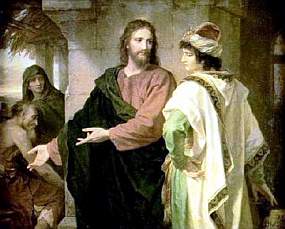
Jesus, whenever He spoke with individuals or small groups, absolutely taught this way. Consider His example of washing His disciples’ feet. I think they got that message of love and service pretty clearly because Jesus showed them what to do next. Or take the negative example of the rich, young ruler who asked the high concept question about the commandments. Jesus responded by telling him what the next step should be in response. Jesus left no doubt as to what to do next; the ruler simply didn’t want to do it.

I’m not sure we’re preaching what to do next in Gospel-centered churches. I think we sometimes spend too much time filling people with knowledge they can’t figure out how to use. But if the difference between the sheep and the goats in Matthew 25 is what they did and didn’t do, then the people in the seats have to know what the godly next step is for what they have learned. They must have a clearly directed outlet for praxis.

Not only this, but as Jesus showed, people need something else that very few preachers are willing to offer—and that’s for the preacher to model the truth so obviously in true servant fashion that no one can miss how the message is supposed to be lived out.

It’s one thing to say that Jesus Christ is the only way to salvation, quite another to show how that should inform our evangelism, and quite another again to have the preacher model how it’s done. Yet I would guess that the number of churches where that occurs in all three steps can be listed in the single digits percentage-wise. I suspect that in the biggest churches with the most famous pastors it’s impossible for the average Joe to even scheduled a meeting with that pastor, much less hang out with him doing door-to-door evangelism together.

We need that #7 question. And we need our leaders to draw alongside the people and show them how it’s done.

Lord, Help My Unbelief!

Standard

On our refrigerator, attached by a random series of accumulated fridge magnets, is this verse:

And the LORD will guide you continually and satisfy your desire in scorched places and make your bones strong; and you shall be like a watered garden, like a spring of water, whose waters do not fail.
—Isaiah 58:11

I stood in our kitchen today and stared at that small, yellow page. My handwriting. The encouragement I wrote for my wife during a tough time she faced. The Lord guided me to that passage and it sang in my soul that day so many months ago.

But times are even tougher now, not so much for her, but for me. And I look at that verse written in my own hand and I want to believe it, though I can’t see it.

That verse is just one of many things I want to believe.

I want to believe that a man can work a sixty-hour week, spend quality time with his wife and kids, be involved in his community, find time for leisure, and still be an effective disciple of Jesus Christ. He wants me to believe, too.The kind of man who prays big prayers and knows God intimately for those prayers. The kind of man who readily leads many others to his Savior and disciples those same people to maturity. I want to believe, but I don’t know any men like that.

I want to believe that it’s possible to drop into a majority of churches in any town in this country and find a thriving community of saints that not only loves God passionately but finds time for each other. And not just talk about community, but a church that meets more than a couple days a week in each other’s homes for meals, talk of Christ, prayer, fellowship, and simple fun. And when the times are not so fun, that this same group of people can find the time to comfort each other. I want to believe, but I don’t know any churches like that.

I want to believe that people who call themselves Christians and live in America could be deliriously happy in the Lord Jesus even if everything they owned was taken away from them. Not just refraining from buying the latest update of the iPod or Prius, but actually losing everything they owned.I want to believe, but it seems impossible to.

I want to believe that the Church of Jesus Christ still takes the Great Commission seriously. A Church made up of selfless people who would crawl over miles of broken glass to save one soul from hell. I want to believe, but it’s hard to do so.

I want to believe that things are getting better and not worse. That churches are vital, not impersonal museums or dog-and-pony shows. That the people I know who are Christians are growing closer to the Lord and more distant from the world, ready to be martyred for the faith if need be. People who love not their own lives, even unto death. I want to believe, but the evidence for that reality is so sparse.

I want to believe that it’s not too late. That the Lord will tarry and we’ll somehow get a reprieve, time enough to wake up and get serious about getting serious. I want to believe, but I also know the darkness is coming when no man can work.

I want to believe! Lord, help my unbelief!

How to Improve Your Body, Mind, Soul, and Spirit

Standard

Living the life God intended...Ever feel out of whack?

Beginning at the Fall, mankind has been mangled as a being. A dead spirit, chaotic soul, dumbed-down mind, and a body that wastes away—not too promising, eh?

All of us struggle with the integration and integrity of body, mind, soul, and spirit. So here are a few suggestion for Christians for improving ourselves for the King and His Kingdom. If practiced regularly, these things will keep us sharp for the Lord.

Body

Sleep no less than seven hours a night. Too few of us get proper sleep, never making up the sleep deficit we accumulate. This make us dull and easily swayed by ungodly voices.

Get up at dawn and go to sleep before midnight. God made the day and night for a reason. I’m convinced that one of the reasons that so many people suffer from depression today is that they don’t get enough sleep or they stay up too late. I know that my own mood brightens when I go to bed before midnight and get proper sleep.

Stop overeating. Almost two-thirds of American are overweight. From what I’ve seen in the pews, I’d say that three-quarters of Christians over the age of 30 are. Gluttony is a sin. Being fat makes us sluggish and slow. Plus, it incurs a litany of health problems. (Charles Spurgeon may have been a godly man and a great preacher, but his issues with eating shortened his life.) God doesn’t want his people to live that way.

Stop eating bad food. Junk food makes us fat—don’t eat it. Buy organic. Cut out the sugar and high-fructose corn syrup. Stay away from artificial ingredients, especially man-made sweeteners like aspartame (NutraSweet) and sucralose (Splenda). Keep the carbohydrates down (see this and this). The closer a food is to its natural state, the better it is for you, so stay away from the heavily processed stuff. God knew what He was doing with the basic foods He gave us. Why then do we have to mess them up?

Get out of the chair and exercise. Walking is one of the best ways to stay fit—do it. And with someone else!

Mind

Read a book! Though the study numbers don’t always agree on the exact numbers, the truth remains that the majority of Americans don’t read books, with some never picking up another book after they graduate from high school or college. That’s horrifying! An uneducated populace only makes Satan’s job easier, as ignorance is one of his chief weapons against us. (Remember that Adam’s intellect was perfect before the Fall.)

Learn the basics of logic. Don’t know a genetic fallacy from a tu quoque? Though our culture no longer values right thinking, Christians must. Learn more here.

Get out of the Christian ghetto and find out more about an opposing viewpoint. Narrowmindedness begins when we fail to grasp all sides of a belief system. None of us should spend time wallowing in filth, but if we fail to recognize those worldviews that set themselves up against Christ, we do the Kingdom a disservice.

Kill two birds with one stone and engage another face-to-face concerning a difficult topic. Wrestling with tough issue is fine. But doing so with another person or a group of people fulfills the “iron sharpens iron” idea in Proverbs. If we isolate ourselves, we fail to learn from our neighbors—and they may have great wisdom to share with us. And let’s not be selfish with what we learn; share it with someone else. Who knows how that wisdom may help another! Too many Christians bury their intellectual talents and they never grow to bless others. If that great book we’re reading isn’t used by us to challenge others, then perhaps we’re wasting our time.

Soul

Learn empathy. Weep with those who weep. Rejoice with those who rejoice. We must make our lives available to others and share in their ups and downs. We’ll never learn what it means to be godly people if we don’t connect with others.

Listen to classical music. Yes, Mozart and guys like him. It’s good for us.

Write music, also. Even if it’s just a simple tune, we can reflect the heart of the God who sings over us.

Write letters. Write them to God. Write them to friends. Write them to strangers. But write! Our letter may be the only one someone gets in a month. Make the most of it.

Cultivate beauty. We need to make beautiful things. God is an artist, and we are made in His image, so we should create. Also, we must find beautiful places filled with beautiful items and spend time amid that beauty.

Get in touch with the land. God intends that we till the land and take care of it. Are we doing so? Why not? Find time for the natural world. Learn the names of plants, trees, birds, and such.

Get out of the house! If we’re spending all our time shut up within our personal fortresses, we’ll never make an impact for the Kingdom out there where the lost people and our fellow Christians live.

Spirit

Pray more than an hour a day. We simply cannot know God if we toss off a prayer or two. Remember: knowing God IS eternal life. And this is not “practicing the presence” or journaling, either, but concentrated prayer on our knees.

Read the Bible intently. I recommend this plan. We should be reading for deeper discipleship and understanding, not just to tick “Read the Bible” off our checklists!

Cultivate godly horizontal relationships with others. With Christians: fellowship, service, and discipleship. With unbelievers: friendship, service, and evangelism.

Ruthlessly eliminate those things that interfere with our spiritual lives. If we don’t have enough time to pray an hour a day, read the Bible thoroughly, and cultivate horizontal relationships with others, then we need to eliminate all interferences. Turn the TV off, put down the newspaper, and log off the Internet. And if materialism and idolatry are keeping us from God, then we eliminate those items that keep us from growing in grace.

Practice the spiritual disciplines. We can’t help but grow in the Lord if we pray, study, meditate, fast, embrace solitude, practice submission, live simply, serve others, worship, confess our sins, seek guidance, and celebrate.

If we do these things, we will most certainly be better for the doing.

Now, how do you nourish your body, mind, soul, and spirit?