The Condition of Your House and Mine

Standard

This morning, I planned on going back to reading Philippians as part of the Bible reading plan I talked about earlier this year, when the Lord redirected me elsewhere: to Haggai of all places.

Haggai.

That’s probably not a book in the Bible that you’ve spent much time perusing. I really only am familiar with one well-known passage out of Haggai, and then I even forgot it was in Haggai. I thought it was in Isaiah:

The silver is mine, and the gold is mine, declares the LORD of hosts.
—Haggai 2:8

So I cleared the cobwebs off my mental filing cabinet and stashed that passage in the Haggai folder.

But what struck me from the redirection I received this morning was the following passage. I think it fits perfectly in the theme that’s been running here for the last several weeks:

“Is it a time for you yourselves to dwell in your paneled houses, while this house lies in ruins? Now, therefore, thus says the LORD of hosts: Consider your ways. You have sown much, and harvested little. You eat, but you never have enough; you drink, but you never have your fill. You clothe yourselves, but no one is warm. And he who earns wages does so to put them into a bag with holes.
—Haggai 1:4-6

The state of our spiritual temple?Context: the Jews had returned to the land after captivity in Babylon, had restored much of their old land, but the temple lay in ruins. God didn’t appreciate that the people had restored their former dwellings, but left his dwelling place a shambles.

Notice the contrast here of working hard and receiving little, while the house of God lies neglected. The people ran after their own satisfaction, but it was never enough. Meanwhile, God dwelling place rots.

Most of us reading this post are seasoned Christians. We know the lingo and know enough Bible to be dangerous. I’m sure most know about the symbol of houses in Scripture. I’ll lay out a premise anyway.

God never intended to live in a house built by human hands. His intent, before the spirit inside of Man departed at the Fall, was to have His Spirit animate us and lead us:

Yet the Most High does not dwell in houses made by hands, as the prophet says, “‘Heaven is my throne, and the earth is my footstool. What kind of house will you build for me, says the Lord, or what is the place of my rest? Did not my hand make all these things?'”
—Acts 7:48-50

After the death and resurrection of Christ Jesus, our dead spirits were made alive when we repented and believed in Him. Now the Spirit of God can return to the home intended from the beginning:

Do you not know that you are God’s temple and that God’s Spirit dwells in you? If anyone destroys God’s temple, God will destroy him. For God’s temple is holy, and you are that temple.
—1 Corinthians 3:16-17

And more than just you and more than just me, the Spirit of God dwells in the sum of us, His collective people. This explains the necessity of the Church. (Evangelicals forget this truth to the detriment of the Church Universal: Jesus isn’t just a personal Jesus.) While God restores each of us by dwelling in us individually, he also dwells in the community of the saints:

So then you are no longer strangers and aliens, but you are fellow citizens with the saints and members of the household of God, built on the foundation of the apostles and prophets, Christ Jesus himself being the cornerstone, in whom the whole structure, being joined together, grows into a holy temple in the Lord. In him you also are being built together into a dwelling place for God by the Spirit.
—Ephesians 2:19-22

So while it is important to understand Haggai’s prophecy in terms of its original context, we must not ignore God’s reasonings behind it and what those reasonings mean for us today.

How many of us continue to build our houses, our little worlds, in the physical but neglect the spiritual house of God? You, I, and us together are that spiritual house. We are the dwelling place of God, His temples.

It saddens me that men and women will spend thousands of dollars and hours decorating their homes, but spend so little time resurrecting the ruined house that is their spiritual lives. We live in McMansions on the outside, but we’re content to let God dwell in the dump that comprises our inner lives, the house in which He came to dwell so long ago when we first came to Christ.

And what is the result of this?

You have sown much, and harvested little. You eat, but you never have enough; you drink, but you never have your fill. You clothe yourselves, but no one is warm. And he who earns wages does so to put them into a bag with holes.

That last sentence just slays me. A bag full of holes. If that doesn’t describe the state of the American Church today, I don’t know what does.

If we’re to restore the ruin that comprises our spiritual house, the dwelling place of God, then we need to get serious about what distracts us from that purpose. We’ve been talking about materialism and discontent the last few weeks. We’ve looked at how overconsumption makes us sick, not only in our bodies but in our souls. In short, we’ve examined how well we’ve “paneled our houses” as Haggai notes, while the house of God lies ignored.

The refugees who’d returned to the land got the message of Haggai and repented:

Then Zerubbabel the son of Shealtiel, and Joshua the son of Jehozadak, the high priest, with all the remnant of the people, obeyed the voice of the LORD their God, and the words of Haggai the prophet, as the LORD their God had sent him. And the people feared the LORD. Then Haggai, the messenger of the LORD, spoke to the people with the LORD’s message, “I am with you, declares the LORD.” And the LORD stirred up the spirit of Zerubbabel the son of Shealtiel, governor of Judah, and the spirit of Joshua the son of Jehozadak, the high priest, and the spirit of all the remnant of the people. And they came and worked on the house of the LORD of hosts, their God, on the twenty-fourth day of the month, in the sixth month, in the second year of Darius the king.
—Haggai 1:12-15

Th people took seriously the word of the Lord. They turned from picking out new drapes for the kitchen and worked to rebuild the most important house in their community: the temple of God.

The results?

Now then, consider from this day onward. Before stone was placed upon stone in the temple of the LORD, how did you fare? When one came to a heap of twenty measures, there were but ten. When one came to the wine vat to draw fifty measures, there were but twenty. I struck you and all the products of your toil with blight and with mildew and with hail, yet you did not turn to me, declares the LORD. Consider from this day onward, from the twenty-fourth day of the ninth month. Since the day that the foundation of the LORD’s temple was laid, consider: Is the seed yet in the barn? Indeed, the vine, the fig tree, the pomegranate, and the olive tree have yielded nothing. But from this day on I will bless you.”
—Haggai 2:15-19

If we wonder why so little spiritual prosperity shows up in your life and mine, if we go to the vat of wine and find twenty measures instead of the fifty we thought were there, perhaps we’ll understand why now.

What’s the state of your spiritual house? Are you spending all your time on the material in your life, neglecting the dwelling place of God? Should you be surprised when the spiritual reserves aren’t there in times of trouble (or even in times of plenty)?

God isn’t going to contend with Man forever.
In the Bedroom

Standard

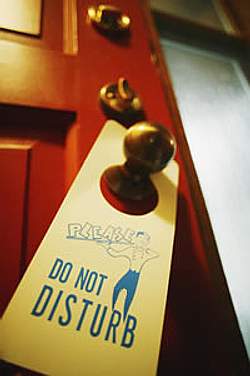
Ssshhhh! It's happenin' behind that door!Ah, that special someone!

You receive a letter, read it, and you’re smitten. The words. The passion. It’s love!

Your heart knows no limits when it comes to that special someone. Discovering little details about that unique person. It’s a thrill, a preoccupation. You can’t go even five minutes without thinking about that one who makes your heart leap.

Every day that passes you dedicate to making yourself the right person for your special someone. You get buff, become your best.You throw yourself into doing nice things for the one you love and for any friend associated with that perfect person.

And isn’t that dull ache of longing rapturous? Just to catch sight of that radiant face from far across the other side of your church! It’s delicious, isn’t it?

So the years go by, and the dull ache lingers. At some point, all that longing keeps going unmet. You catch glimpses of that special someone, and you read all the love letters, but frustration sets in. Talking about your frustration…well, most people don’t talk about it at all. Sure, a whole lot of others are in your same shoes. They have that perfect person in mind, too. They’re achey, and maybe even breaky for it. But the whole lot of you keeps a stiff upper lip while each talks about that special someone glimpsed once from across a crowded room. Some enchanted evening. A long time ago.

And the hope chest gets bigger—but emptier at the same time.

I’ve been married now for eleven years. First met my wife a little more than twelve years ago. If you asked me what it would be like to still be engaged after twelve years, never having made it to the bedroom, I’d say it would be a sort of living hell, actually. (Or something like this.)

I know too many Christians who have never made it to the bedroom with the Lord. They may very well love Him with a passionate love, but when you get right down to it, they’re missing out. They may be able to talk for hours about the Lord, but you can almost tell that something’s missing. They’re a lot like that poor fellow in the link. Hyped up, seemingly aware, but ultimately clueless.

And Adam knew Eve his wife….
—Genesis 4:1a

Now it doesn’t take a genius to comprehend the kind of knowing Adam and Eve engaged in.

And they shall teach no more every man his neighbor, and every man his brother, saying, Know the LORD: for they shall all know me….
—Jeremiah 31:34a

Yep, same root Hebrew word for know in both those cases. But then, you already knew that. 😉

All kidding aside, getting to the bedroom is vital:

And this is life eternal, that they might know thee the only true God, and Jesus Christ, whom thou hast sent.
—John 17:3

Eternal life is knowing the Lord. Not knowing about Him, but knowing Him intimately. Yet how few people ever get to that intimate place! They go years and decades and it’s a life filled with frustrated longing that eventually turns to numbness and duty. The truly sad truth is that many Christians drown in that numbness and duty. They put on their game face every Sunday, but go home feeling like Charlie Brown trapped in an endless string of losses, back to the cold ground, naked save for boxers, staring at the sky from the pitcher’s mound after another line drive up the middle tore the clothes off again, all the time wondering, Why do I do this?

But who wants to admit to that kind of perpetual defeat? So the fake smile comes out until five minutes into the drive home. Then it’s packed away until the next Christian encounter.

So how do we end the frustration and make it to the bedroom?

We’ve got to want it. More specifically, we’ve got to want Him. No lukewarmness. No pretenses. We need a burning desire, and…

We need to drop the fear. I think the world is probably filled with nervous brides and grooms who while trying to find an outlet for their ardor on their wedding night are practically eaten alive by butterflies. Sure, it may be a bit nerve-racking that first time in the bedroom, but if we let fear consume us, we’ll never know consummation. Nor can fear be mitigated by controlling the circumstance of getting to the bedroom. Instead…

We need to allow the Lord to lead. He knows His way around the bedroom. He made the bedroom! In fact, He created what goes on in the bedroom. We simply can’t be like the bride who locks herself in the closet and then proceeds to tell her groom exactly how this thing is going to proceed. No, if we’re going to make it to the bedroom, we need to abandon the idea that we’re in charge. We need to relax our hold on our sobriety because the bedroom overflows with wine, the drink of gladness and joy, not duty and rules. We’re not to dictate to God what we will and will not accept. Nor do we need to be in control because…

No shame exists in the bedroom. One of the blessings of being married for several years years comes from the total freedom experienced in the bedroom. Freedom exists where shame vanishes. Each of us can be carefree in the presence of a spouse who has no agenda, who willingly and continuously says, “Yes, love.” In the same way, in Christ there is no shame for the one who trusts Him unconditionally. And this is a necessary understanding for us because…

Only in the bedroom is life created. The circle completes. We must want Him if we desire life. Rivers of living water flow out of even the dryest eunuch who finally enters the bedroom. Life is there—and life is birthed through the ones who dwell there. We must desire that life flow through us as if our very next breath depends upon it. Because it does.

I don’t know many people who make it to the Lord’s bedroom, but they’re unmistakable when I encounter them. The smell of the Lover’s cologne lingers on them. Their faces shine with the warm anointing oil of the Spirit. And their words drip with life and healing.

That person God uses for His glory.

You?

Time for us all to forsake the question, “So what’s it like?” and take the Lover’s hand.

You are altogether beautiful, my love; there is no flaw in you. Come with me from Lebanon, my bride; come with me from Lebanon. Depart from the peak of Amana, from the peak of Senir and Hermon, from the dens of lions, from the mountains of leopards. You have captivated my heart, my sister, my bride; you have captivated my heart with one glance of your eyes, with one jewel of your necklace. How beautiful is your love, my sister, my bride! How much better is your love than wine, and the fragrance of your oils than any spice! Your lips drip nectar, my bride; honey and milk are under your tongue; the fragrance of your garments is like the fragrance of Lebanon. A garden locked is my sister, my bride, a spring locked, a fountain sealed. Your shoots are an orchard of pomegranates with all choicest fruits, henna with nard, nard and saffron, calamus and cinnamon, with all trees of frankincense, myrrh and aloes, with all choice spices—a garden fountain, a well of living water, and flowing streams from Lebanon. Awake, O north wind, and come, O south wind! Blow upon my garden, let its spices flow. Let my beloved come to his garden, and eat its choicest fruits.
—Song of Solomon 4:7-16

Still-in-the-Red Friday? – Further Thoughts

Standard

Last Friday, after witnessing parking lots lacking the usual Black Friday crush of cars at local malls and shopping centers, I wondered if this holiday shopping season would disappoint retailers and further depress our struggling economy. I wrote “Still-in-the-Red Friday?” and closed my post by asking if the Church is ready for the economic issues coming our way.

If you’re a regular reader, you know that I take the position that God tabbed the Church to do the work of ministry. Yeah, you...Yes, He may rain manna from heaven for the starving, but since the Church was established, His primary means to meet needs is for the Church to meet them. That’s the plan, folks. You can’t read the New Testament and miss that very important fact. (I’ve quoted all the relevant Scriptures in dozens of previous posts. We should all know them anyway.)

What does a Church look like that doesn’t read the signs of the times? What does a Church look like that isn’t prepared to continue to meet the needs of others when times are brutally hard?

I can’t remember quoting a comment in toto, but David Riggins wrote an epic in response to last Friday’s post. I think it encapsulates the issue perfectly:

Interesting the confusion regarding how the Church faces reality. When economic hardships come, people lose their jobs, and when they have no income, they lose their homes. With the current stupidity regarding credit and its uses, people will lose their jobs and homes at a rapid rate. Two million sub-prime ARM loans are up for adjustment in the next 8 months. Those upward adjustments will often add 30% to the current payment those people are paying. Most of those people won’t be able to afford the higher monthly payments, putting $600 billion in bad loans on the books of already tightly stretched lenders like Countrywide. The loan industry has already lost 100,000 jobs in the last six months.

Each of those jobs is responsible for an average of four other jobs in the private sector, from auto salespeople to the bagger at Kroger. With the continuing collapse of the housing sector, home builders will start to go under, following the example of Neumann Homes in Illinois, which filed for bankruptcy protection this month. As more and more sectors of our economy are affected, an estimated 3 million jobs could be lost. This isn’t about spending more to motivate the economy, this is about making sure that what you spend actually has an effect on our economy. What you spend at Wal-Mart, Target, Circuit City or Home Depot lines the pockets of businesses from China to Indonesia, but little of it stays here. The credit used to buy housing is a commodity that pays for the estimated $18 billion net income of the major trading houses on Wall Street, where bonuses are expected to be down 5% from the average $136,580 in 2006. And this is a “bad year. It trickles down, but nothing like it flows up.

All this can be directly attributed to a lack of action on the part of the Church. Our society is corrupt because the Church is corrupt. Greed has run rampant, not merely in the corridors of power and money, but in the desire of the the Church to be seen as relevant and growing. We have created cults centered on charismatic pastors and exciting music, and have abandoned our role.

Is the church ready to take care of the people in the body who will lose their jobs, their homes, their savings? Are we willing to take people into our homes when they’ve lost theirs? If we don’t, who will? Is the Church ready to feed the homeless, provide care for the widow and orphan? As the mortgage crisis wipes out retirement funds, will we take care of the elderly who now only have social security?

I know most church-goers would scoff as these concerns. These are, after all, the responsibility of the government.

Not according to God, they aren’t. And ultimately, it is God we will answer to. I know that, personally, I am not ready to do anything to help anyone. I also know that our church is certainly not ready, and beyond a food pantry for the holidays, has no plan for taking care of the needy, either within or without our congregation. As conditioned as I am to clarion call of independence, I would find it hard to take care of someone who didn’t plan for hardship. It’s only by the grace of God that my family made it through the jobless times we’ve faced. It certainly wasn’t through the help of the “body.

Soon, the entire country could be facing the same situation that Ohio is in, with unemployment up over 7%, but this time, the price of fuel will be triple what it was in the last recession, and that will affect the price of everything else. Are you ready? Is your church? This is about looking out for your neighbor, and making sure they have what they need. This is about making sure your Church body is focused on meeting the real needs of the body, not bottle feeding the 200 pound infants.

We need to grow up, and it seems that we are about to enter one of those times when we either grow, or wither on the vine and get pruned.

Regardless of how well retailers do this Christmas shopping season, the issue remains: Are we as a Church the five wise virgins or the five foolish ones? Are we the Church who by prophetic word hears of the famine to come and prepares for it (Acts 11:38-40)? Are we hearing from God during the fat years so we are prepared for the lean years?

And so what if the lean years don’t come in 2008 or 2080. The issue is Are we ready?

Leonard Ravenhill once said,

The Church today wants to be raptured from responsibility.

That’s a stunning thought on dozens of different levels. Perhaps it even explains why we are not preparing as we should.

What will happen in our churches when we have dozens of unemployed families without medical insurance? What happens when someone in one of those families undergoes a medical emergency and gets stuck with a huge medical bill? What are we doing to be the church known for supernatural healings should that become the only means by which most people receive medical treatment?

As David mentioned above, what happens when people lose homes should the economy go down the tubes? What will your church do? What do you have in place right now to address that issue? And if your church has nothing in place, why not?

What will happen to evangelism when we’re trying to keep our heads down at work to lessen the chances of being the one pink-slipped when the inevitable downsizings come? Are our churches ready to pick up the pieces when our frontline people take that kind of hit? Or will that be chalked up to “the cost of doing ministry” with us leaving those frontliners to struggle in the aftermath?

We went through a precursor the last recession, which many believed lasted almost five years. What if the next recession is eight years and far deeper? It may have been your neighbor who got whacked last time. Tough for him, right? What if it’s you this time? What happens when you turn to your brothers and sisters in Christ and they look the other way?

What happens when the lost, people without the hope we have in Christ and without membership in the Body of Christ, come to us desperate for help and direction? Do we toss them a Bible and say, “Be warm and filled,” because we didn’t take our own membership in the Body of Christ seriously enough to seek the Lord so we knew in advance how He would have us prepare?

I’m not fearmongering here. What I’m doing is asking why the American Church is oblivious to these issues. Rather than being proactive, we’re reactive—and long after the damage has been done. We can’t continue to be so unprepared.

It’s not enough to say, “God will provide,” when the means by which He’s chosen to provide is asleep at the switch.

I ask again, “Church, are we ready?”