
Jabez, Swaziland, and Christmas

Standard

The Wall Street Journal earlier this week broke the story of Bruce Wilkinson's African folly. The Prayer of Jabez author prayed his patented prayer and yet still managed to bomb out in his attempt to transform Swaziland's orphans into productive citizens populating a Disney-esque dude ranch and tourist trap. The intentions were good: The Prayer of Jabez Coverthe money for this lofty idea—called Dream for Africa—would be plowed back into fighting AIDS and poverty in a country where the heads of AIDS-ravaged households are the eldest children left behind in the wake of death and sorrow. Dream for Africa was the quintessential utilitarian Christian response to devastation.

But unable to crack the vagaries of African culture, Mr. Wilkinson resigned from heading his visionary venture, pulling up his personal stakes in Swaziland and taking his figurative ball back home. This has left his supporters in the country in a lurch. The end result is bitterness. (Like they say, read the whole thing.)

Wilkinson has taken quite a bit of flak from some Christians who are hooting over his failure. Their point is that the Rick Warren model of Christian dominionism that Wilkinson epitomizes is anti-Christ. I contend that there is a greater reality here.

First, although I'm a firm opponent of the Evangelicalized version of the Pentecostal "Name It and Claim It" theology that The Prayer of Jabez espouses, I must ask this of Mr. Wilkinson's critics: What have you done for orphans in Swaziland? How simple it is to point fingers in the aftermath of Dream for Africa's failure and say, "I told you so." How hypocritical to judge someone else's failure when we ourselves have done little or nothing. Frankly, I find this piling on by supposed Christian people who want to get their licks in on Bruce Wilkinson to be despicable and anti-Christ. There—I said it.

However, Wilkinson is not without blame here. His is a cautionary tale that all Christians should heed:

Unless the LORD builds the house, those who build it labor in vain. Unless the LORD watches over the city, the watchman stays awake in vain.
—Psalms 127:1 ESV

It is one thing to believe we are doing the Lord's work, but quite another to be doing it as He alone leads. Dream for Africa's greatest mistake was to try to do things on Man's timetable with Man's strength using Man's cleverness. Wilkinson had a decent vision to help the poor, orphaned, and ill in Swaziland. But the hubris at work here is the way it was planned and executed. In short, the Lord was not allowed to build the house.

Part of the blame here goes to Western presumptions about whether God works in mysterious ways or easily explainable, manufactured ones. In far too many churches today there is a mentality that we go ahead with our plans and ask for God's blessing. When this is coupled with the raging anti-supernaturalism inherent in so much of Western Christianity, God becomes little more than a rubber stamp on what we desire for an outcome. As Bruce Wilkinson learned, we can pray the Prayer of Jabez till we're blue in the face, but unless the Lord makes all the pieces fall into place, we're building a house that will not stand.

Wait for the LORD and keep his way, and he will exalt you to inherit the land….
—Psalms 37:34a ESV

Waiting is, indeed, the hardest part. Somehow, today's expression of Evangelicalism has developed an inability to wait on God for anything. The history of world missions consists of laborers who went years and sometimes decades without seeing a single convert, but then the floodgates of heaven were opened and the harvest made plentiful. Wilkinson's African involvement was cut off after three years. So much for waiting.

Again, what we see in Wilkinson's Swaziland disaster is a greater problem with Evangelicalism in America in the 21st century. We want things done now and we want them done according to our plans. Sadly, this kind of brute force manipulation of God's will amounts to little more than wind. And while the most vociferous of Bruce Wilkinson's critics are hooting over his failure (and their hope that Rick Warren will fail miserably in Rwanda), they, too, often embody this problem—only in a blind way that is uniquely theirs.

Even though I don't approve of the manner in which Dream for Africa charged in and did things under Man's power, it saddens me even more that there are people gloating over its failure, while offering nothing else in return. Surely there are people out there who God has blessed with a heart for Africa that are willing to take the decades it may take to bring about the end of AIDS, orphans, and poverty in Africa by God's way alone and only under His timetable.

Two thousand years ago, the religious intelligentsia thought they knew it all, but God built a house His way. He brought His Son into the world in poverty, made His Son's Kingdom not of this world, and confounded every person who thought they knew just how the Messiah would come and what He would look like. Man's confusion as to God's way made it all the more easy to take that supposed Messiah and crucify Him. Those upholders of all that was right knew what they were doing, or so they thought.

One of these days, we'll see just how many of our enterprises failed because we second-guessed God. It's all too easy for any of us to do. Bruce Wilkinson and Dream for Africa failed. And yet, so many of our own whims have gone up in flames for the very same reason.

Phariseeism is not far from any of us.

Hidden Messages of American Christianity: “Family Cocooning Session: No Trespassing Allowed!”

Standard

PadlockThis is the sixth in a series of posts covering the hidden messages that sneak into American churches’ proclamation of the Gospel. For more background, please refer to this post.
We had a single mom of young boys over to our home last Sunday. After enjoying her company and the company of her sons, she confessed that more than anything else she wishes there were a man around in her boys’ lives to give them the masculine influence they need.

This last week, I had an anonymous commenter who lamented that many people have no place to spend Christmas day because of broken families, family located distantly, or similar issues. While I was always fortunate in that regard, I know others who have not been. We should all feel their loneliness and do more than talk about it. (No one in the commenter’s church stepped forward, but unbelievers did. What message does that send?)

At a time when so many of our churches are obsessed with Focus on the Family-like “family” ministry, why are so many so lousy at being a family to the family-less?

It’s hard to escape the message. A quick sampling of church Web sites is enough to show that we’re infatuated with family. Somewhere on the homepage of your average church there’s a JPEG of a smiling family of Mom, Dad, big Bro and little Sis (plus that half child for statistical reasons—the ultrasound’s scheduled for next week.) Given the tenor of today’s church messages, there’s a fair chance you’ll see an ad for the upcoming sermon series on how to have a great sex life—with free earplugs provided for the singles, widowed, and divorced. Thousands of times in a given weekend, churches will be trumpeting the family message, all the while failing to understand what it’s doing to those whose families failed, fell prey to death, or never were.

There’s cocooning and then there’s sin. We may very well be teetering toward the latter. Jesus had this to say about family priorities:

Then Peter said in reply, “See, we have left everything and followed you. What then will we have?” Jesus said to them, “Truly, I say to you, in the new world, when the Son of Man will sit on his glorious throne, you who have followed me will also sit on twelve thrones, judging the twelve tribes of Israel. And everyone who has left houses or brothers or sisters or father or mother or children or lands, for my name’s sake, will receive a hundredfold and will inherit eternal life. But many who are first will be last, and the last first.
—Matthew 19:27-30 ESV

And…

Whoever loves father or mother more than me is not worthy of me, and whoever loves son or daughter more than me is not worthy of me.
—Matthew 10:37 ESV

What is also not worthy is promoting the family message in our churches while failing to meet true Kingdom family needs. Loving Christ more than anyone else means that our attitudes toward family must become like His. And His look radically different:

While he was still speaking to the people, behold, his mother and his brothers stood outside, asking to speak to him. But he replied to the man who told him, “Who is my mother, and who are my brothers?” And stretching out his hand toward his disciples, he said, “Here are my mother and my brothers! For whoever does the will of my Father in heaven is my brother and sister and mother.”
—Matthew 12:46-50 ESV

We’re always thinking about the needs of our own biological families, but Jesus turned that on its head. The single mom I referred to above wants nothing more than the time of a man or two to invest in her sons—not tomorrow, not a year from now should she have a proposal from a boyfriend, but right now. (How about taking them to some ballgames or to the movies?) The unmarried man who lives in Burbank while his folks are in Bangor shouldn’t have to sit alone on Christmas. A Christian family should be making certain he spends that day with them (and have a gift for him, too.) Wouldn’t that young single woman in your church who’s from out of town love to have a home-cooked meal at the table of a Christian family willing to make her a part of theirs?

Are we making any of that happen? Or are we cocooning so brilliantly that no one from the outside can penetrate our perfect little shell? (What message does that send our kids about “outsiders”?)

All families are a gift from God, be that physically formed or spiritually created. Despite our obsession with family, our inability to incorporate the less easily incorporated folks into our physical families means that we may not be doing a good job with those spiritual families. Those on the outside looking in hear the ubiquitous family message, but it sounds to them like, “You’re not invited.”

Yeah, I know that there are churches that huddle the guys up to do oil changes and car repairs for single moms. We need more than that, though. While a mechanic may be nice, a surrogate dad for that mom’s kids is even more needed. And if single people embarrass us so much that we have to shove them into their own little groups to do whatever single people do today (nice temptation, huh?), why can’t we do a better job of incorporating them into our families and looking out for prospective mates? In my bachelor days, I knew plenty of singles who would have loved a bit of help with both.

No, the messages we send are hopelessly hypocritical when it comes to family. Too often we treat single moms and dads with an attitude that they’d be better off if they were married. That may very well be, but what are we doing to make that possible? Are we willing to watch their kids while they engage in a real dating life? If we want them to make a good selection in a mate, it may take a year or two. Ask yourself: If I don’t do it, who will? From what I’ve personally witnessed, there’s no line forming, so you may be the only one.

And who’s to say the elderly widow or widower in our churches can’t become another grandma or grandpa to our kids? God knows that my own family would be delighted to have someone filled with sixty years or more of godly living to replace my deceased parents in my own son’s life. His other set of grandparents are 220 miles away. Can any of us have too many God-fearing family members nearby? If you love the Lord and want to be a part of my family, the house is open!

No one said any of this would be easy. It asks something of us, whether we’re blessed with a nuclear family of 4.5 or we’re single, divorced, widowed—whatever. But if we’re not willing to treat like real family those that fall outside the boundaries of what our rule books say is “real family,” then we have no right to talk about the Church being the family of God because we’re not modeling it.

The early Church made a family for the widows and the orphans. Are we doing the same?

Canceling Christmas Sunday

Standard

And day by day, attending the temple together and breaking bread in their homes, they received their food with glad and generous hearts, praising God and having favor with all the people. And the Lord added to their number day by day those who were being saved.
—Acts 2:46-47 ESV

Now Peter and John were going up to the temple at the hour of prayer, the ninth hour.
—Acts 3:1 ESV

And let us consider how to stir up one another to love and good works, not neglecting to meet together, as is the habit of some, but encouraging one another, and all the more as you see the Day drawing near.
—Hebrews 10:24-25 ESV

The God who made the world and everything in it, being Lord of heaven and earth, does not live in temples made by man….
—Acts 17:24 ESV

I appeal to you therefore, brothers, by the mercies of God, to present your bodies as a living sacrifice, holy and acceptable to God, which is your spiritual worship.
—Romans 12:1 ESV

As one who writes about church issues, I can't ignore the recent furor erupting over the plans of some churches—mostly megachurches—to not have Christmas Day services this year.

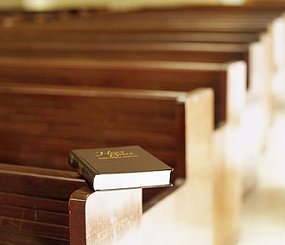
Anyone who comes by here enough knows that I hold the feet of American churches to the fire for a number of reasons. Empty pewsMy hope is that the Church in this country will live up to the high calling for which the Lord offered Himself. I love the Church, else I wouldn't be doing any of this.

But honestly, on this issue of canceling Sunday services on Christmas morning, I think too many folks are missing the bigger picture.

The tradition I grew up in called for us to go to Christmas Eve services at my parents' Lutheran church. That service started at 11 PM on the 24th and ended around 12:10AM on Christmas Day. Until Christmas 2000, that was the way my family did it, even after my brothers and I got married. However, I can't remember ever attending a Sunday service that fell on Christmas Day. We'd met together as the Church just nine hours before, right? Honestly, I don't recall if that church had a Christmas Day Sunday meeting.

As much as I crusade for a Church that resembles that of the Book of Acts, not a single person reading this right now carries on a church life that resembles what the early believers followed.

The temple was destroyed in 70 AD and there hasn't been one like it built since then. While the early believers may have gone there regularly for prayer, the temple no longer exists. (God doesn't dwell in temples made by human hands anyway.) Do any of us go up at the appointed prayer hours to pray at our church? Unlikely.

The believers met in their homes for fellowship on what may have been a daily basis. Even house churches don't meet that regularly. Are you enjoying the daily fellowship of believers?

Considering the worship and fellowship patterns of the early Church, are we truly following any of them perfectly? If we're getting hacked off by some churches canceling Sunday services because Christmas is on Sunday, why are we not incensed about our the failure to fellowship in each other's homes several days a week?

When you boil it all down, the biblical command is that we not fail to meet together.

My wife's side of the family is filled with one Evangelical pastor after another, but they don't go to Christmas Eve services at all, and I suspect we won't go to this Christmas Sunday service, either. But I can guarantee you this: We most definitely will be gathered together as believers singing hymns, reading the Word, encouraging one another, demonstrating love, honoring the Lord, and being the church in my in-laws' home. Doesn't that fulfill the mandate God set forward for the Church?

And those megachurches? I'm sure there are people who attend those churches that don't have what I have. Those folks may very well lose something by their church giving up on a Christmas Sunday meeting.

So let's have the right perspective here. It's not about a legalistic "show up on Sunday come hell or high water" attitude, but Christians meeting horizontally with each other and vertically with the Lord. Truthfully, most of us can do that no matter what the time or venue, especially on a day like Christmas. Does it have to be at a physical church location at a set time? For many of us, the clear answer is no.

However, I'm not going to let those "kill the meeting" churches off so easily. They may very well be depriving some people of the ability to meet together with fellow believers that week. Not all of us are as blessed with a steady supply of the saints. If anything, a church that cannot provide that kind of fellowship on any other given day of the week is missing far more than just a canceled Christmas Sunday meeting; the whole of their fellowship is lacking. And the real tragedy is that this is true for many of the churches that ARE meeting on Christmas Sunday. As we see in Acts, the believers met together almost every single day. If we who claim the upper hand here aren't careful, we may also fall under our own condemnation.

Just something to think about whether we're in a church building on the 25th or not.