
Frauds

Standard

By the time I’d counted my tenth radar-wielding cop in only twenty miles, I could only shake my head. I’m no speed demon, don’t get me wrong. Still, I knew our ride back home from visiting the in-laws over Memorial Day would be more snail-like than usual. People get cowed by all the law enforcement and they take on a herd mentality that makes good driving impossible.

When a mobile cop car pulled onto the highway, I knew we were done for. Every lead-footed, Top-Gear-watching, Michael Schumacher wannabe suddenly spazzed and downshifted into second. Think “trailing the pace car” kind of gridlock here as about forty vehicles all jammed together behind the cop car, each driver petrified of passing him. Three lanes of gear jockeys cursing their dumb luck scrunched onto I-71 heading south through Amish country. Oh, joy.

What did I think? What a bunch of frauds.

And they were frauds twice over, too. If they truly were crazed speed enthusiasts, you’d think one would have the guts to pass the cop (who was doing about 55 in a 65 zone). On the other hand, they all acted like law-abiding little old ladies out for a Sunday drive in their pristine K-cars—another lie.

Frauds.

I think most of us are frauds, each in his or her own way. Our society doesn’t reward honesty. Doesn’t give out medals to people who keep it real. We may think Jeff Bridges’ iconic character from The Big Lebowski, The Dude, epitomizes a guy just being, but he’s a fictional character in a movie mouthing fictional statements written by someone else. The whole thing smacks of fraud when you distill it down to its essence.

I think most people in this country would die a thousand times over if other people knew what they were truly like, could know their thoughts, could feel their insecurities. I think most spouses have never scratched the surface of what the other looks like deep in his or her heart of hearts.

I’m convinced that far too many Christians in churches around this country live a fraudulent life filled with keeping up an aura of spiritual perfection. They go through life as someone they’re not. FraudsA few live in such self-deception they don’t even know they’re doing it. Still, most do know—and they hate themselves for it.

In the very early days of this blog, I’d get e-mails from folks castigating me for being holier than thou simply because I pointed out a few things I thought we all could do better. Me, holy? No, I’m just as fraudulent as the next guy. I think as time went by, people saw through whatever mask they thought I was holding up. But what they didn’t see was the more subtle one I wear all the time. It looks like me, only better, stronger, sharper, and swifter—but most of all, more spiritual.

When we age, the first thing that goes is pretense. Suddenly, the young punk down the street we used to dust in pickup basketball is creaming us every Saturday. We reek of wintergreen the day after, too. In the silence of our homes, we hear the knees creaking.

It happens the same way in the soul of the Christian attuned to the Lord. (At least it should.) We wake up and see that same masked face in the mirror. And when we pray, the Holy Spirit shows us that same lingering shadow of the Old Nature. He tries to get us to admit we’re frauds, but it doesn’t come easy. People talk. People have opinions. People, people, people—that same old fear of men. A snare, the Bible says.

The Bible also says this:

Therefore, if anyone is in Christ, he is a new creation. The old has passed away; behold, the new has come. All this is from God, who through Christ reconciled us to himself and gave us the ministry of reconciliation; that is, in Christ God was reconciling the world to himself, not counting their trespasses against them, and entrusting to us the message of reconciliation. Therefore, we are ambassadors for Christ, God making his appeal through us. We implore you on behalf of Christ, be reconciled to God. For our sake he made him to be sin who knew no sin, so that in him we might become the righteousness of God.
—2 Corinthians 5:17-21

We are ambassadors of Christ, and as such we represent the government of a new Kingdom with reconciliation as its message. And ambassadors don’t get to be ambassadors by clinging to fraudulent identities. No, they endure a character trial that proves their mettle. In other words, No Frauds Allowed.

All of creation awaits our coming into our ambassadorship. It’s groaning, in fact, that we come into our own, that “own” Christ established before the foundation of the world.

If only we’d put down the fraudulent lives, the fears, the secrets, and step into the Light.
Better Than You

Standard

This last week proved exceptionally busy, as it seemed I had to be in about eight different places at once every day. With no time to do grocery shopping, I put things off until the last second. On Saturday, I finally hit Kroger for replacement sundries.

Standing in the coffee and tea aisle, I heard a commotion, looked left, and witnessed a red-faced mother yelling to her child, “If you don’t shut up, I’m going to smack you in the mouth!”

On hearing this, I looked over at my son and thought, Thank God I’m a better parent than….

Then it hit me.

It doesn’t take much for us to compare, does it? The senses take in data and the judgmental wheels start grinding. Too often, they grind up others Jesus said are my neighbors.

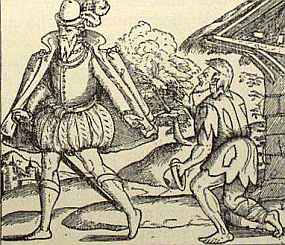
I see an out-of-control parent fighting an out-of-control child and I think of that parent in terms of “I’m better than you.” 'Giving Alms to a Beggar' by AnonymousI talk with a baby Christian who doesn’t have his doctrine down right and “I’m better than you” rattles around in my head, bouncing off every slightly off statement that newbie pronounces. I consider all the things I own, then look to some poverty-stricken soul in Africa, and I start singing the “I’m better than you” song.

Only that tune grates on the ears. Maybe not mine, but the Lord’s.

It’s easy to call it pride, but it’s more than pride. Even someone who considers herself a loser can still find someone to be better than. The poverty-stricken guy in Africa looks at the poverty-stricken child who lost a leg to a landmine and thinks, Well, at least I’m better than he is.

Isn’t this “Better than you” mantra the source of many of our problems in our churches? Get to the root of any church split and “Better than you” grows like a fungus. I wonder if the Godblogosphere promotes a lot of this poisonous “Better than you” smack that gets talked up on this blog and that. All it does is ruin people in their souls, though.

The Bible says this:

Do nothing from rivalry or conceit, but in humility count others more significant than yourselves. Let each of you look not only to his own interests, but also to the interests of others. Have this mind among yourselves, which is yours in Christ Jesus…
—Philippians 2:3-5

When I considered that yelling mother in Kroger, did I have the mind of Christ when I trotted out the comparison? Not at all. Did I look to her interests in any way? Hardly. What I looked to was my own need to feel better about myself by judging another human being.

What is the mind of Christ in this regard? Humility—plain, unadulterated humility.

It pains me to say that I don’t know many truly humble people. Seems to me that the ones that overflow with this most godly of traits sport plenty of gray hair, as if being around long enough qualifies one to grasp humility. Perhaps it’s the fading of the flesh’s power that renders us more humble. All I know is that I could learn a few things from those senior saints.

What would a truly humble church look like? I would suppose that most persecuted churches know humility. Kind of hard to swagger with a boot heel on your neck. If that’s what it’s going to take to make for a humble Church in America, then perhaps we should be joining in prayer with our Chinese brothers who are praying that persecution comes to this country so that the Church here wakes up.

As for me, I would hope instead that our humility comes by another means, that the Spirit might change us from the inside. For all this talk of “Better than you” starts on the inside in the natural man, a straggler unwilling to budge save that Christ budges him for us.

This “Better Than You” talk kills us in the long run, makes us impervious to grace, blackening our souls. I suspect if we truly did esteem others better than ourselves, someone outside the Church might sit up and take notice.

I pray that’s sooner rather than later.

The Pastor: Not One of Us

Standard

Blood on the collar?Does the title of this post bother you? It bothers me.

I’ve known pastors in my life who crashed and burned. They flamed-out, transgressed, or a combination of both. In each case, he faded into the ether like some double-agent, either by choice or by his ex-congregation expunging his name like he’d never been in the pulpit.

No vulture-like obsession with the carrion once known as Ted Haggard washed over me, but reports that he’s hightailed it out of Colorado Springs still caught my eye. Made me shake my head, too, but not for the reasons one might think. Everywhere one looks in Evangelicalism, the story’s the same: pastor falls, congegation responds by acting like he never existed, and he’s out of town on the next red-eye to Obscurity.

Time and again the unintended message we Evangelicals send to the world shows that we don’t truly bury our wounded, as goes the common in-joke. Instead, we act is if they were never part of us to begin with. “Our wounded? No, someone else’s wounded.”

You encounter a lot of handwringing in some sectors of the American Church from those upset at a lack of church discipline. Why is it then that this group typically consists of those who fire their fallen pastor, kick him while he’s down, and run him out of town on a rail? They decry the fact the Church can’t seem to discipline, but is it “discipline” for them to toss their pastor’s carcass on the burn pile and wipe their hands clean of the whole mess? What kind of church discipline is that?

The way we operate in American Evangelicalism forces our pastors into a no-man’s land of fellowship. We may crow about our renowned community, our loving fellowship, and on and on, but if we were honest with ourselves we’d have to admit that holds true for everyone BUT the pastor. He’s different. He’s not truly one of us.

Part of the problem comes from our shocking inability to raise up pastors within our own congregations. I would venture to guess that at least 90 percent of churches are pastored by the product of some other church’s educational system. He didn’t grow up in the church he pastors. Has no real familial ties to the church, either. He’s already an outsider from the second he takes the call. This disconnection of history and relationship only further aggravates the tendency to affix him to the pyre the second a problem arises.

In some churches, we’ve also developed this wacky idea that the pastor is Wholly Other, like some enlightened paraclete who transcended to a lofty plane inhabited by the rarefied likes of Paul, Moses, Peter, and Elijah. His decision to leave Abraham’s Bosom to visit us poor mortals is almost shocking in its humble bravura. So when he finally stumbles like a normal human being, we—like some cannibal tribe no longer impressed by our white-fleshed gods who descended to us out of the belly of a metal bird—cook the poor sucker and eat him.

But any quick perusal of the New Testament makes it pretty clear that the Lord Jesus wanted his Church to be brothers, not lords over each other. The pastor is not first among equals; we’ve made the mistake of equating him with Christ Himself. No, the pastor’s a fallen human just like you and just like me.

In that case, why is our discipline for pastors so radically different from what we mete out to others in our congregations?

Perhaps we need an adjustment of how we view pastors. Not that we hold them to some slack standard, but that our dedication to restoration match our swiftness to discipline.

Restore a fallen pastor? What a novel idea! I’d love to see it happen. In truth, I’ve never seen it happen. I’ve seen pastors blackballed from their denominations, but I’ve never truly witnessed one restored to his own congregation.

It shouldn’t be that rare. In fact, it should be the norm—at least the way I read the Scriptures.

As long as we’ve got this pedestal we put Church leaders on, we’ll continue to see assaults on the pedestal and the persons atop it. What happens when the whole thing comes crashing down should be something we address in a healing community. Instead, we heat up the tar and feathers. No wonder these guys vanish like smoke.

Sure, once in a while a real con artist dons a clerical collar, but I suspect that most guys who get into the ministry do so because they genuinely love the Lord and love other people. If all have sinned and fallen short of the glory of God, then there’s not a guy preaching today who’s not guilty of something. If we blackballed them all, we wouldn’t have a Church. Still, people line up to cast the first stone…

In the end, the messages we send to those in the pews when we run guys off like this should cause us some real soul-searching. I could post on those messages for the next week, but I’ll leave you to think about the between-the-lines preaching we do to the impressionable in cases like these.

Oh, well, why not just one: Don’t you ever mess up or we’ll treat you like toxic waste, too. Doesn’t sound very Christ-like, does it?

I’d love to see a Church that treats pastors as fellow laborers and saints, not grand exalted poobahs. A Church that deals wisely with a pastor’s sin, rather than marking him like Cain before he’s driven off into the wilderness. But to get there, we need a total paradigm shift in how we view THE MINISTRY or else we’ll perpetually fall into the mode of shooting first and asking questions later.