It started with a lack of bacon.
Too many people at Wendy’s ordered items with bacon, so the crew had to cook more. The bacon lovers in line were told it would be six minutes, so we gathered calmly off to one side and began to chat.  One man steered the conversation to politics. In minutes, I wondered if a riot would break out.
While people were willing to wait patiently for food items filled with bacony goodness, patience is in small supply when it comes to waiting till November to “throw the bums outta Capitol Hill.” People aren’t just mad at the condition of America 2010, they’re downright enraged.
People are livid at overreaching government, at seeing their tax dollars given to scoundrels, at watching themselves move down the class ranks, at losing their jobs, at losing their homes, at losing out on every dream they once had.
They seethe because the gulf fills with oil while the people responsible for the disaster lie about its severity. Companies that created the economic mess ask for more aid and then give it as bonuses to leaders responsible for the mess. The country has lost control of its borders. Nuts and flakes in Iran build the Bomb. Corporations lay off hardworking people and reward sloth because the slothful know where the skeletons are buried. Health insurers begin terminating policies, arguing that Obamacare will take care of everyone—some day—leaving the average Joe buried in debt as he pays either outrageous costs for replacement insurance or nightmarish costs for health care, living in dread that he may one day get sick and need medical attenti0n that will cost him all his savings, his kids’ college funds, and even his home.
The inability to stop this downward spiral breeds fear. Like a tapeworm, powerlessness eats at people’s guts. They can’t stop the insanity; they can only be carried along with it. And that spawns this stark rage that many feel.
I have known Christians who seem to escape these trials. I have known Christians who have been buried by a relentless series of landslide-like events. Both groups have been faithful, yet one seems to attract trouble like a bare bulb at night brings in the summertime moths.
And it goes much deeper than just calamity or human failings. I was talking with a friend on Monday about the way we live our lives, and it seems to both of us that trying to fall back to a more sane position only creates chaos in the poorly thought-out systems we’ve created for ourselves. Eating locally grown food sounds like a wise idea, but what instabilities are created by a large-scale move away from food trucked in from long distances, instabilities whose ripple effects can’t be predicted easily?
It is one thing to pray that God will deal with the wicked people who knowingly hurt others in the pursuit of cold, hard cash. But what of the janitor who cleans the wicked people’s buildings? Is he in collusion with evil? And is he us?
And how does one pray about entrenched systems that are not so much empowered by evil principalities but by mistaken notions that were innocent five decades ago but which have now bred dependencies from which we cannot escape readily? Are all wrongs rightable? And was that wrong truly wrong at the time of its conception? What do we do when black and white have dulled over time to gray?
If others are like me, then I suspect more and more people wake up feeling inadequate to the task. In simpler days, choices seemed to come easily. Now, though, it feels as if every decision that life presents is like a bucket of murky water with something awful lurking at the bottom out of sight. We have made everything in life so complex that any simple act of deciding is fraught with danger, consisting, in many cases, of wondering whether the potential sea snake hiding in one bucket is more lethal than the possible blue-ringed octopus in the other.
What this means for modern Christians is hard to fathom. Are we immune to bad outcomes? If not, how then do we navigate the complexity of modern life? How does one break out of the system when one is a product of that system? Would Jesus even have us attempt to break out? Or does conformity and relenting not matter in the wider scheme of things? Is powerlessness good or bad? And is numb consent to the downright infuriating aspects of life a sin?
We in America are definitely control freaks; we want everything just so. That’s not of faith. But then the counter to that is to wonder whether simply allowing ourselves to be swept along powerlessly is not of faith either. And if it isn’t, where is the happy medium?
As a Christian, my tendency is to immediately answer by saying that faith, prayer, abiding in Christ, and Bible reading are the answers. Certainly, faith brings us through all trials. Yet what is the faithful answer to a nuclear Iran that will certainly attack Israel? How do we meet the health care needs of people without bankrupting our country? Does every issue have a solution, or are some problems destined always to diminish us?
And most of all, how should you and I, such small people, live in the face of these issues?
I feel for angry people. I truly do. Jesus has an answer for them. My deficiency is that I don’t always know what that answer might be or how to bring it about. And I believe that if we were honest with ourselves, many of us will realize that more and more issues are harder to resolve than we might think—that is, if we are thinking at all.

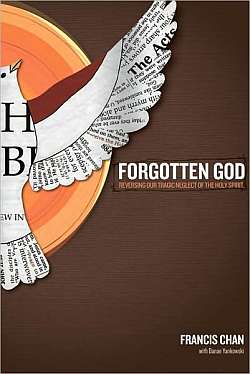 A heads up for readers: June 2010’s free audio book from Christianaudio.com is Francis Chan’s Forgotten God: Reversing Our Tragic Neglect of the Holy Spirit. You can get it—and all the other free downloads each month—here: http://christianaudio.com/free.