
The Great Giveaway, Part 1

Standard

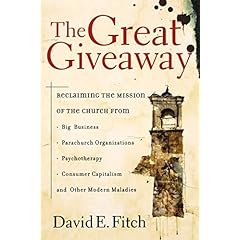
The Great Giveaway David E. Fitch’s The Great Giveaway: Reclaiming the Mission of the Church from Big Business, Parachurch Organizations, Psychotherapy, and Consumer Capitalism is the best Christian book I’ve read since Nancy Pearcey’s Total Truth. A fantastic primer discussing how the Church must live in a postmodern age, The Great Giveaway examines the ways the Church bowed the knee to modernism and gave away her soul. By allowing alternative scientific approaches to spirituality to trump the Gospel of Christ, the modern Church distanced itself from historic faithfulness. In keeping to this premise, The Great Giveaway does not attempt to critique postmodernism, but finds the everlasting truths of Christ and asks how they reveal themselves in this age.

If that sounds like emerging church rhetoric, trust me, it’s not. Fitch manages to step out of the emerging church versus traditional church battle and show where each is lacking. What makes The Great Giveaway better than all the books critiquing the American Church today is that Fitch not only sees the problems, he offers the best solutions I’ve encountered. (Much of what you’ve read on Cerulean Sanctum since the inception of this blog is mirrored in the pages of The Great Giveaway, so if it sounds like I’m tooting my own horn here, I’m trying to be as objective as I can under the circumstances.)

Is this a perfect book? By no means. Serious flaws spring up here and there. A couple months ago a commenter asked how I could recommend flawed books. (I had issues with some of the concepts in Randy Frazee’s two books, though I recommend them highly). I’d like to turn that around and ask what books besides the Scriptures are without flaws? Discernment, so utterly lacking in the Church today, necessitates that we read every book by every author—our favorites or not—with an eye toward error and truth. Real discernment is not blanket condemnation, but rather wrestling with ideas with the aid of the Holy Spirit and the Scriptures.

The Great Giveway features the following chapters, and I’ll deal with each in turn this week:

  1. Our Definition of Success
  2. Evangelism
  3. Leadership
  4. The Production of Experience
  5. The Preaching of the Word
  6. Our Understanding of Justice
  7. Spiritual Formation
  8. Moral Education


Our Definition of Success

Overview

Fitch begins his book with an easy target: “Megachurchianity,” as I call it. Numbers, he writes, do not translate into faithfulness. Church Growth Movement thinking owes more to business principles than Scripture. The result of working toward bigness is a consumeristic outgrowth of church that places rugged individualism and business efficiency at the core of church health rather than faithfulness to Christ. Faithful churches instead center their life in Christ and genuine community. That community is measured by real relationship with fellow believers that speaks hard truths into people’s lives, sees the need for confessing sin in a grace-filled local body, and calls on church members to partake in discerning prayer needs for each person’s life and the church as a whole.

Comments

Since most of the people who read Cerulean Sanctum agree that an obsession with numbers tends to curtail real discipleship, I have little comment. The Great Giveaway starts with an easy target and doesn’t add much to the discussion. We agree that consumerist Christianity fails. We know how megachurch religion missed the boat on every living and active part of the Church. Fitch doesn’t add much to the conversation. Think of this chapter as a touchstone for everything else that follows.


Evangelism

Overview

Fitch points out that postmodernism is the death-knell to evangelism that relies solely on apologetics. Postmoderns are not impressed by talk that does not follow walk. In fact, walk is proof of talk. Postmoderns are much more willing to listen to Bible truth when that truth is preceded with Bible walk.

Evangelical obsession with evangelistic methodology comes at the expense of real relationships with people. We’re more interested in getting someone saved than being their friend. The days of that thinking are numbered, though. What people today need to see in Christians is the actual living out of the evidence of Christ in us. This puts the evangelistic onus back on the community of believers rather than the individual. Individuals can still attest to Christ by their own life changes and Christ working through them, but the real power is in a transformed community. The early Church’s influence came about because people saw Christ in that community.

To that ends, hospitality, praying for others in need, showing mercy to those who desperately need it, and bringing justice to those without it are stronger evidences of the veracity of Christ than merely running through The Four Spiritual Laws or The Romans Road. Fitch by no means subjugates the Scriptures to experience, but instead shows that love overcomes roadblocks that enable the truth of Scripture to permeate the hardened hearts of people today. It’s the sun that melts the snow in Isaiah 55:10-11.

In an age when we in America have virtually no sense of real community, developing a worshipful community that embodies genuine relationships that alter how we live every day should fuel our evangelism. Fitch also seeks to recover the importance of our baptism into a worshipping community, stating that too much attention has been put on one singular act of conversion and not enough on the kind of long-term discipleship that Christ calls for in the Great Commission. He also sees Church planting as the healthy expression of a growing church rather than the tendency to grow into a megachurch.

Comments

We need to always be careful when someone states that God’s Word needs outside proof to be reconciled as true. Postmodernism’s obsession with avoiding absolute truth is infamous, but I don’t believe that Fitch is saying that walk makes talk true. God’s Word is true by itself. However, to a generation raised on hearing the Bible constantly—who can truly escape it in America?—but without seeing it practiced much by the Church, we need to consider how we walk out what we believe in front of others because our walk is supposed to be a reflection of the truth of the Gospel.

The failure of church bodies and individuals to live out what they believe is largely responsible for the mess we see both inside and outside our churches. Call it sin, unbelief, or laziness, but whatever the label, we blew it.

I agree with Fitch on most every comment and solution he offers in this chapter. We Christians do need to start living as an alternative community within the larger society rather than finding the church co-opting that society’s patterns of living and broken solutions to problems.

If I have one problem, I don’t believe that planting more churches is the answer. We have enough churches. Now if an existing church is growing so large that it naturally must subdivide, that’s a different response than simply planting churches. I think Fitch favors subdivision, but he doesn’t make that entirely clear when he discusses church planting.


The review of The Great Giveaway continues with Part 2 and Part 3 .

My Hope for What the Church Will Be, Part 2

Standard

Therefore encourage one another and build one another up, just as you are doing.
—1 Thessalonians 5:11 ESV

In part 1 of this two-parter, I outlined how a secular meeting carried in it all the hallmarks of real community, the kind that should power the Church. However, I don't believe that we understand how vital community is to the believer, therefore we tend to wander like lone rangers thinking "Christ is all I need," but forgetting that it is in the Body of Christ that He chooses to express Himself before He returns.

What would the Church in America look like if we took 1 Thessalonians 5:11 to heart and made it bedrock to our interactions within the Christian community?

I guarantee that not a single person reading this wakes up in the morning thinking, "How can I build up other believers?" I'm not sure even our pastors think that way. I don't think that way.

But what if we did?

We talk about service, but service is nothing more than putting aside my need to meet the need of someone else. The Bible that we read and study so that we can be equipped for every good work stays mere words unless we let the Holy Spirit change our minds about those good works within community. Christ gazing down at the throngsIf I'm not reading the Scriptures with a heart inclined toward service, then the word remains unfruitful in me. I may say that I want to be like Jesus, who came to serve and give Himself as a ransom, but that aspiration means nothing unless I die to self and take on His mantle of service to others.

Last year was a bad one for the Christian blogosphere. I can't ever remember so many horrible arguments paraded in public like I did some of the blog posts from 2005. Yet how slim were the words of encouragement! We had our proportions reversed and it showed in vitriolic commentary as foes arose where none were before.

This lack of up-building comes from daily repeating the world's mantra that I am all that is. Me. Myself. I. As much as we Americans like to think of ourselves as generous people (and we are to some extent), we still wear our self-centeredness on our sleeves. We've even made the Jesus who died for the sins of the world into a personal savior. Not his. Not hers. But mine.

I now understand that some Christians are requesting that their personal information be left out of church directories in order to protect their private lives! Listen, when we became Christians, we gave up all rights to a private life. People of the world dead in their sins have a private life, but the Christian doesn't. The Christian has a public, communal life. That community is key to everything the believer does and is! You can't build a temple to the Lord out of one stone, but with a quarry of them you can.

When each of us fixates so much on his or her own thing, is it any wonder that so many people have been burned by the Church? Worse yet, some people make spiritual excuses for that hurt. Earlier this year, I read a comment on another blog that excused hurting fellow believers by claiming that it's God's will for the hurt to happen. I thought, Then by all means, let's treat each other more savagely so that grace may abound! Let's be even MORE self-centered.

Benjamin Franklin, when confronted with the enormity of the independence he and his colleagues proposed, proclaimed, "We must hang together, gentlemen…else, we shall most assuredly hang separately." How sad that so many of us in the Church in this country have chosen to hang separately. We let our brothers and sisters fend off the Enemy's attacks alone. Families fall to the ground and so few take it to heart, instead shaking heads and saying, "Thank God that wasn't us."

But time, and what comes with it, is fickle. One day, it might be us. What then? When we weren't there for others, how can we expect anyone to be there for us?

I get so many letters from people in dire straits who turned to their churches for help and got a door slammed in their faces. I could blog for the next year by doing nothing more than posting those e-mails from the very first day I started writing about these topics on this blog. Isn't that sad?

What will it take for us, when we're confronted with a need, for our first words to be, "How can I help?" Isn't that the character of Jesus Christ right there? Whenever He was confronted with a person's need, He didn't say, "Oh, I'll pray for you next time I draw away to a mountain top." No! He did something about that need right then and there. He met the needs of His community, the ones who lived in His region of Palestine so long ago. 

We need each other, folks. The Church that God blesses is the one that works like an athlete's finely-tuned body, not like a bunch of organs held together by sheer force of will and a set of gritted teeth. My hope for the Church would be the same one that Paul desires: that we encourage each other and build each other up. If I'm in pain, you're there for me. When you need money, I offer to help. Even if my contribution looks more like the widow's mite than the enormity of the Bill and Melinda Gates Foundation, I still give it, even if that means I have to give up something I crave like crazy to make it possible.

Paul wrote this to the Corinthians:

So with yourselves, since you are eager for manifestations of the Spirit, strive to excel in building up the church.
—1 Corinthians 14:12 ESV

If we ever want to see the Spirit take our churches to the next level, building each other up, whether spiritually or by meeting the physical needs of the brethren, is the catalyst for empowerment. If we watch each other's backs and truly hang together, I know we'll be better for it in ways we can only dream of.

That's my hope for what the Church in America 2006 (and beyond) will be. 

My Hope for What the Church Will Be, Part 1

Standard

As someone who revels in the outdoors, most of my hobbies get me out into nature. I've been birding since I was fourteen, taught outdoor education in zoos and camps, and would rather spend a night out under the panoply of the heavens than any stuffy old bedroom.

When I consider the heavens, the work of Thy fingers, the moon and the stars that Thou hast appointed, what is Man that Thou art mindful of him, and the son of man that Thou dost care for him? Every time I catch a glimpse of the night sky, Psalm 8 rolls off my lips from out of my heart.

I recently added geocaching to my arsenal of outdoor activities. Together, my son and I have found 55 hidden caches in our area in our first six weeks. It's a challenging activity and a whole lot of fun.

Geocaching presents another intriguing benefit. Not being in the typical workplace, I've witnessed my personal network dwindle to only a handful of names. Since I have no hobbies that require other people to make them happen, I decided to attend a geocachers meet-up to broaden my contacts and get my face out there.

Last Friday, my son and I met up with our fellow geocachers. About 33 people showed up. Curiously, I knew most of them by their "cache name" nicknames as I'd already come across their log entries in the caches and in the electronic logs at Geocaching.com .

I was new. No one knew me. Everyone greeted me and my son. We were immediately welcomed into the greater body of local geocachers.

Time ticked on, but none of us noticed. People shared their exploits. Stories about hard-to-find caches abounded, including one notorious one that had sent my son and me sliding along with trees and rocks for about a hundred feet when the hillside we were standing on collapsed. (Yes, very scary, but God was faithful and we were remarkably unhurt.) When I got engrossed in the conversation, the lady presiding over the get-together spontaneously watched my son so I could hang with the veterans and soak up the geocaching wisdom. And while the meeting felt like a throwback to the kinds of engineer parties I remember in Silicon Valley (I now know the hot sport for techies in my area), everyone was glad to have me there. They clued me in to insider talk, showed me their collections of treasures harvested from various caches, and made me feel like I'd been a part of their little cadre forever. We had to leave a little bit early, so we didn't get to see the gifts handed out to those geocachers who had achieved certain milestones (like 1000 caches found). That would have been nice to witness, though.

Driving home, I couldn't shake a few thoughts about that meeting:

  1. Though I was a sheer beginner, no one looked down on my lack of experience and feeble knowledge. They respected me for how far I'd already come.
  2. People made sure my son and I felt included.
  3. The wise among them wanted to let me know their secrets.
  4. The host looked after me, took care of my child so I could learn more, and dropped me an e-mail later to say how glad she was that we'd been able to attend.
  5. People there were genuinely excited about what they did and shared stories that bolstered comraderie and the activity itself.
  6. Anyone who shared in the love of the activity was welcomed. Old people, families with young children—it didn't matter.
  7. If people didn't immediately grasp all the rules, that was okay. Questions were eagerly answered and without judgment.
  8. The very best among them were esteemed for what they'd accomplished. 

You can probably see where I'm heading, so I'll just say it:

Wouldn't it be great if all our churches in America were like this?

Honestly, a geocache box is nothing in the scheme of things. Geocaching will pass away like all things in time. But why then do we Christians, the ones who are ambassadors of the Living Christ, seem far less excited about Him than these geocachers do about a piece of Tupperware hidden inside a hollow log in the woods?

Wouldn't it be great if our meetings were filled with people talking about what Jesus meant to them? Unity, Mercy, LoveWhat He'd done in their lives today, yesterday, and the day before that? If people can get excited about finding a 35mm film canister wedged in a woodpecker hole, why do we seem so bored with Jesus, who is Lord of the Universe?

We wonder why it's harder and harder to get the lost to take notice of Jesus. I can say with all honesty that if we were as excited about Him as these geocachers are about their sport, and we conducted our meetings as welcoming and as informative as that geocachers get-together, our churches might be packed—or at least people wouldn't write them off so easily.

If you're a Christian, then you have a built-in network of people who should be on your side for eternity. Yet all too often that network suffers in comparison to some of the networks the world has to offer.

When his buddy upchucks the evening's revelry, the barfly cleans him up. When the drug addict has no place to sleep, he calls another addict who lets him crash at his place. The bartender, out out on the town on his own for once, leaves his waitress a big tip because he knows how it is.

The Bible says this:

For the sons of this world are more shrewd in dealing with their own generation than the sons of light.
—Luke 16:8b ESV

The sons of this world get it. They know they have to fight for everything because they have nothing else to back them up. That's why a real friend means something. A real friend will cover your back.

We take for granted what the Lord bought for us when He created the Church.

That's where we'll pick up in the concluding part of this pre-hiatus series. Look for it before the week is out.