
Ministering Money the New Testament Way

Standard

The other day, I mentioned a post about Ted Haggard and his return to the role of pastor. Regardless of what one might think of Haggard, his church offers some interesting takes on standard church practice.

Here’s the section in that post that grabbed me most:

Ted instructed everyone to take out an offering, not their tithes, but an offering. Then when everyone had it [in] hand, he further instructed that we share our offering with someone in attendance as we felt led of the Lord.

The purity of that action speaks volumes:

1. Money isn’t automatically designated for the leaders or for the church grounds or functions.

2. Giving is focused on the needs of the church body as individuals.

3. The Holy Spirit is given free rein to direct the actions of church members.

Right now, I’m sure people in your church and mine need just that kind of practice of giving, yet how rare it is to see such a true-life example!

Be a futurist for a second: What do you think would be the end result, good or bad, of churches in America ministering money in this manner?

No More Touchdown Jesus

Standard

Touchdown Jesus, Big Butter JesusIf you’ve not yet heard (despite the fact that it was the #1 Googled phrase on the Web so far today), the massive Jesus sculpture on I-75 north of Cincinnati burned to the ground last night after being hit by lightning.

Some have called this “Touchdown Jesus” for the pose. Others labeled it “Big Butter Jesus” for its odd, buttery color.

Now it’s just a pile of ashes.

As I live in the area, I’ve driven by the statue many times. Like many people I’ve talked with, I feel strange about it. While I know other Christians who find it a source of inspiration, I was always uncomfortable when I saw it. To me, it depicted not the Savior of the World but the worst of Evangelical excess and misdirection.

At the risk of sounding like Judas, I’ve always been struck by the question, “Couldn’t this money have been used in a better way?”

I mean, I live in Ohio. Forbes.com noted recently that most of the major cities in Ohio made their Top 20 Most Miserable Cities list (including all the major cities in northern Ohio). With all that misery here in one state, you’d think Christians would have something to say—and do—about it.

Instead, we got a fiberglass and steel sculpture.

I dunno. Maybe I’m just a soulless crank. Still, I’ve got to pose that Judas question again.

Because, to me at least, nothing speaks faith more than Christians investing their time and money in the imperishable Kingdom, sowing into people’s lives in an unforgettable way.

The statue cost Solid Rock Church a quarter million dollars to build. Recently, it was repainted and repaired—more money.

Consider just these few ways the church could have used that money:

1. To help members adopt children currently living in orphanages or extended foster care.

2. To start an outreach to the many Ohio unemployed.

3. To plant churches in countries where no church previously existed.

4. To work toward racial reconciliation in downtown Cincinnati.

5. To provide loans to local people in poorer areas so they could start their own companies and break the grinding cycle of poverty.

Those are just five ways. Millions more exist.

The name “Touchdown Jesus” pokes fun at the depiction of our Lord with outstretched arms. But whenever I saw the 6-story sculpture, only one not-so-funny verse spoke to me:

I spread out my hands all the day to a rebellious people, who walk in a way that is not good, following their own devices…
—Isaiah 65:2

Right now, the loss of this statue seems to me to be a metaphor. A few years ago, Evangelicals were crowing about their newfound power and prestige. Now we seem to be on the ropes. And it is mostly our own doing, as we have forgotten what we’re truly to be about. We got enamored of earthly kingdoms, and the only true Kingdom was left to fend for itself.

Perhaps, yesterday, that Kingdom fended for itself in an unusual way. And perhaps that message needs to sink into our hearts just a little bit deeper.

Unemployment Lines Filling with…Pastors?

Standard

Reader Brian Auten passed along an Out of Ur post (“Will Preach for Food“) that riffs off a Wall Street Journal article (“Joblessness Hits the Pulpit“). I would highly encourage you to read both, but here’s the relevant stats:

Unemployed pastors in 2005: 2,000
Unemployed pastors in 2007: 3,000
Unemployed pastors in 2009: 5,000

Thirty percent of church attendees report reducing their giving since November 2009.

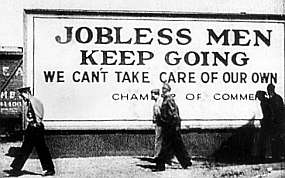
The articles also note that it is megachurches enacting the majority of layoffs.Jobless men, keep going...

While the articles are eye-opening, if you truly want to witness a train wreck, read the comments to the Out of Ur post.

This seemingly innocuous Ur comment was the one that most grabbed me and illustrates everything wrong with American Christian thinking:

Nobody goes into ministry for the money, to be sure, but we have families and college tuitions to pay for just like everyone else, plus many of us have debt from seminaries. A worker is worth his wages. We don’t need much, but fair pay shouldn’t even be a question. Posted by: Mike at May 22, 2010.

Anyone other than me note the extreme concession to status quo in that comment?

This is why the Church in America is failing. We are not asking the hard questions. Instead, we simply relent to the system.

A few questions that immediately spring to mind:

Why do Christians burden their families with outrageous education expenses?

Why aren’t Christians developing church-grown alternatives to higher education?

In what ways does the traditional paid pastoral staff hamper the “laity” from doing the mission of the Church? How is that problem magnified in megachurches?

What percentage of these jobless pastors have stayed on as “laity” at their former congregations? How are those congregations meeting the many needs of the pastors they cut loose?

In what ways does our cultural mindset on traditional employment hamper our ability to be a vital Church?

At what point does Acts 4:32-35 enter into this equation?

When did we stop trying? When did we get to the point that we let society/culture dictate the way we Christians live? Where are the genuine leaders? Where is the dialog on alternatives to status quo?

And isn’t anyone else troubled by this?

At the most granular level, the way we live is broken, yet we keep trying desperately to not only prop it up but also fool ourselves into thinking this is the way it has to be.

All I can say is “Maranatha.”