This Thing in My Hand

Standard

We had to eat lunch out today because of a hurried schedule. Just my son and I, little doubt existed where we’d wind up eating: some fast food joint that stuffs a toy into their kids meal.

My problem comes from knowing how those toys come to be.

At one time, middle-class Americans made those toys. Now they’re made by very young adults (and in most cases, children, as some estimates say up to 250 million children between five and fourteen-years-old slave away) in factories in countries many Americans can’t find on a map. The factory owners house them in barracks where they sleep head to toe. They work twelve to sixteen hour days, seven days a week, 365 days a year, and even on their limited breaks are typically not allowed to venture off the factory property without supervision. In truth, they have nowhere else to go. Worst of all, if we found the kind of coinage lying on the street that those workers make as their hourly rate, we’d think it not worth the risk to bend over.

While some may say that a few cents on the dollar goes a long way in one of those countries, Click image to read more...most of those factory workers have to pay for their food and lodging in the factory barracks. That rent may equal their pay.
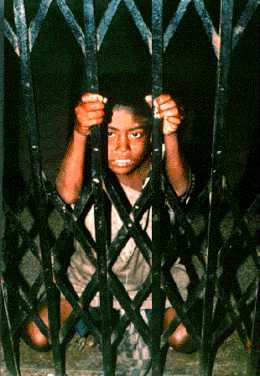
They are 21st century indentured servants.

Some of these workers drop dead from overwork. They live in constant fear they may get ill, won’t be able to keep up, and will be replaced. We in the West may talk about failure not being an option, but these poor unfortunates live it.

They have no voice.

They have nowhere to turn.

They have no future.

They have no hope.

I’ve talked to missionaries who say that this kind of factory work may be the one thing that will stymie the revival going on in many of those lands.

Think about that for a second. So my kid and yours can have a toy in their kids meal. A toy they play with for fifteen minutes before it’s buried under a sea of other forgotten toys in an overflowing chest.

And it’s not just kids’ toys. It’s grownups’ “toys,” too.

Anyone out there heard a sermon on this lately? Anyone? Bueller?

I’m not a stupid person. I can do a reasonably good job positioning Ivory Coast, Togo, Sierra Leone, Gambia and the rest of eastern sub-Saharan Africa in their proper positions along the coastline. Singapore and Sri Lanka? Easy.

But I was stumped when I noticed a pair of pants I wore to church said “Made in Macau.” Yeah, I’d heard of it, and could guess it was probably in the Pacific somewhere, but that’s as close as I got.

If I don’t know where Macau is, do I really care to know that some fifteen-year-old girl in a 95 degree sweathouse making fourteen cents an hour during her thirteen-hour day stitched the pants I wore to church to worship God?

You see, our excess costs something. We may never see where the thing in our hands was made or the semi-slave who made it, but God does.

It’s devilishly hard to say no to one more bauble, isn’t it? Large multinational corporations (who play shell games with their headquarters’ addresses to avoid having to answer for the way they treat that 15-year-old Macau girl) pride themselves on the fact that you and I don’t really care where it came from or how, just so long as we can get it cheap. And get it in neverending quantities.

I don’t sleep well at night much anymore. These things trouble me. I think they should trouble all of us. But they don’t. Not really. Out of sight, out of mind.

I won’t go into how all this damages the United States economically in the long run. That’s another post. But I do want us to think about our Christian responsibility to stand for justice. If our rampant materialism creates injustice, then we Christians should be on the forefront of speaking against it.

I look around at all I have and anymore it just sickens me to know that most of it got into my hands in a circuitous route that should have me weeping at who did what to whom and how. I’m going to have to answer for that some day.

This is why I’m trying to live with less. I won’t buy something unless I’m replacing what wore out. And even then, some items I simply won’t replace. I’m going to try to buy American if possible, to keep jobs in a country that still has some labor laws to protect people. If I need to buy two pairs of shoes, I’ll forgo one pair if it means spending a bit more to keep my neighbor from losing his job. Maybe that will send a message to those corporations paying slave wages in some country I can’t place on the map.

As Christians, we need to be more vocal about justice in work. I’ve posted quite a bit about unjust work situations in this country, but it’s even worse overseas. Our materialism makes it worse. For this reason, we can’t keep silent.

Whoever closes his ear to the cry of the poor will himself call out and not be answered.
—Proverbs 21:13


The Invisible

Standard

Detail from Salvation Army ad campaign posterShe dutifully drags her mop across the tile floor of the Taco Bell, head down, absorbed in her work. Once finished, she locates a clean towelette and wipes down each table, taking care to avoid spilling anything on the pristine floor.

While my son and I eat, I study her. She’s working every time we stop in, infrequent though our visits may be. I think she’s about thirty, but I may be wrong. Folks with Down Syndrome don’t always look their age.

In the county seat near us, at a McDonalds, she has a counterpart in a young man, also with Down, who also mops the floors of that restaurant and tends the tables. Both the Taco Bell and McDonalds maintain a level of cleanliness unmatched in other fast food restaurants thanks to two hard workers who will never be like the people they serve.

Each time I have the opportunity, I make certain I thank them for keeping the restaurants so neat and clean. I hope next time to remember to ask them their names. Something in me always forgets to ask. Something ingrained. Something that hates to be exposed.

In my observations, the one thing that grips me each time I encounter these two isn’t so much about them, but the people around them. The restaurant patrons don’t look their way, don’t greet them, don’t interact with them in any way. I don’t see the other restaurant employees talking with them, either. For all intents, the two Down Syndrome cleaners don’t exist.

But someone cares for them, I know. The woman carries a cell phone, to my surprise, and she once talked with someone while taking her break. Parents? Guardian? I know the fear of every parent of a Down child, that one day death will come too soon (as many parents of Down children gave birth to them in their older years), then who will look after their special child?

I don’t know the spiritual state of people born without all the faculties we possess. I confess I don’t know how to witness to someone who might not grasp the finer points of sin and redemption. I worked with Down kids in my years in camping ministry, but always felt helpless when it came to knowing how to address their spiritual needs. In the end, I decided that love might be the best I can give them. So in the case of the cleaners, that’s what I try to offer—a smile and a word of thanks.

People don’t have to be afflicted with a genetic disorder to become invisible to us. American society is such that when someone yells, “Hey! Look at me!” we look. In many cases, we can’t tear our eyes off the attention junkies. In our staring at those enjoying their fifteen minutes of fame, we miss those who blend into the background, living, breathing people Christ died to save.

Ann sold high-tech electronics. Her bright smile and smart attention to fashion gave her a twinkle I didn’t find in the other reps who came into our store. When she talked with customers and other sales staff, you could tell she genuinely cared. Her job wasn’t just to sell gizmoes, but meet the needs of others. Her “ministry” consisted of helping other people take charge of their lives.

Little things set Ann apart. On Halloween, she came into the store in an elaborate costume I could tell she’d made herself. Perfect makeup, including prosthetics, and a wig that blended seamlessly completed the look. Dressing up like that meant something to her, the attention to detail telling others how much she enjoyed her work.

In her thirties and divorced, Ann hung around some days longer than her job entailed. I suspect she didn’t have much to go home to, just an apartment or small house filled with echoes. That never sat well with me. She had a lot to offer, but she was still invisible.

When the cuts came at her company, I knew I wouldn’t be seeing her again, and I never did. People like her don’t get noticed. They work hard. They care more than most. But the world doesn’t exalt people like her. And it never will.

We live in an era of the invisible. Despite all the boasting of empowerment, despite laws forged to ensure equality, I can’t help but feel we’re minting more invisible people than ever before.

The illegal immigrant. The single dad. The shy kid in class. The homeless. The old lady in the nursing home whose only crime is she got too slow for the rest of the world. The guy who put in ten good years in the office only to one day clean out his desk against his will and vanish into the ether.

We take people made in the Imago Dei and stick them in front of a computer in a vast array of cubicles and this becomes their life for half a day. And when The Big Cheese phones in from his yacht the day after the stock tanks, someone like Ann finds herself looking for another job at yet another company that could care less that she sewed her own costume for Halloween just to give a thrill to the kids who came in with dad to some podunk electronics store.

In the not-so-distant past, companies used to have Personnel departments. Now they have Human Resource departments. From Person to Resource. I don’t know about you, but I prefer to be a person rather than a resource. When I hear a term like “human resource,” I can’t help but think Soylent Green.

Former GE honcho Jack Welch, who seemed to make a career out of being as visible as possible, did a great Darwinian disservice to employees everywhere by reducing even the impersonal human resource into human capital, like so many $20 bills (used to light his cigars after a fine day of downsizing what used to be known as people, I guess). Folks like Jack render people invisible with a snap of their fingers and a drag on their Cuban.

But corporate bigwigs aren’t the only ones who can’t see. Ordinary Joes like us do it, too. You won’t confuse Taco Bell or McDonalds with Le Bernardin or The French Laundry, but even in a fast food joint, we all too easily look right through someone with an 80 IQ and no means.

Jesus said this:

“The kingdom of heaven may be compared to a king who gave a wedding feast for his son, and sent his servants to call those who were invited to the wedding feast, but they would not come. Again he sent other servants, saying, ‘Tell those who are invited, See, I have prepared my dinner, my oxen and my fat calves have been slaughtered, and everything is ready. Come to the wedding feast.’ But they paid no attention and went off, one to his farm, another to his business, while the rest seized his servants, treated them shamefully, and killed them. The king was angry, and he sent his troops and destroyed those murderers and burned their city. Then he said to his servants, ‘The wedding feast is ready, but those invited were not worthy. Go therefore to the main roads and invite to the wedding feast as many as you find.’ And those servants went out into the roads and gathered all whom they found, both bad and good. So the wedding hall was filled with guests.”
—Matthew 22:2-10

We’re surrounded by invisible people, but God calls us to go out into the highways and byways, to look hard for them, to find them wherever they might be found.

You see, as Christians, you and I are invisible, too. We’re invisible because we died at the cross, so we no longer live, but the very visible Christ lives in us (if we’re living for Him). So we’re uniquely geared to understand the invisible of the world. And the Lord would have us perpetually seek them out.

The invisible might be the Down Syndrome mop-wielder or she might be the salesperson who caught a couple bad breaks. The Holy Spirit will let us know just who’s invisible if we depend on Him to show us. He wants to show us. We just need to be listening to Him.

Because in His eyes, no one is invisible.

{Image: Detail from an ad campaign poster for the Salvation Army. Other posters can be seen here.}

The ChristCon Con

Standard

Each week in North America, thousands of Christians gather together in hundreds of different Christian conferences scattered across the continent. In the course of a year, millions will attend thousands of these Asleep in the Light ID Tagconferences to hear celebrity preachers preach, learn from massively credentialed Christian teachers, and enjoy fellowship with likeminded believers.

Yet we have no revival.

Pastors, worship leaders, and Sunday School teachers will attend conferences for pastors, worship leaders, and Sunday School teachers. Men, women, couples, singles, seniors, and youth all have conferences geared to their unique needs. We have countless denominations conferencing to handle policy and chart the future of their group.

Yet we have no revival.

We sponsor conferences on theology, ecclesiology, purity, pastoral care, eschatology, hermeneutics, biblical archeology, and any topic within Christendom we can imagine. We even have conferences on evangelism.

Yet we have no revival.

We drop millions of dollars on airfare, trainfare, boatfare, and gasoline to get to conferences. We line the pockets of innumerable conference speakers, teachers, facilitators, and facility owners. We have the monetary equivalent of the GDP of a small African nation to spend on lodging, dining, and even sightseeing within conference host cities.

Yet we have no revival.

On the other hand, in China, where the flames of revival burn white-hot, the Communist Chinese police hope against hope that the Chinese house churches will start arranging conferences. What better way to round up renegade Christian leaders by the conference-full, bind them in shackles, and toss them into some prison hell-hole—some never to be heard from again.

But born-again Chinese Christians know better, so they don’t hold conferences.

Consider:

Chinese Church: No Christian conferences. No one attending conferences. No money spent attending conferences. Yet revival gloriously blazes on.

North American Church: Thousands of Christian conferences yearly. Millions of people attending conferences. Untold millions of dollars spent attending conferences. Yet we have no revival.

Concerning the status of the North American Church and its love for conferences, the Bible supplies us an apt phrase: Chasing after wind.

I make no pretense toward the prophetic, but I have a word for us all:

One day, you and I will stand before the Lord at His Judgment Seat and He will ask us if we told the lost about Him, discipled others to spiritual maturity, fed the poor, clothed the naked, attended the sick, and visited the prisoner.

But He won’t be asking how many Christian conferences we attended.

Some will object to this post. I simply ask this: Are our churches so weak that we can’t disciple anyone to any reasonable level of maturity, so we have to send everyone running off to a plethora of conferences to take up the slack? If so, we should instead be staying home and fixing our churches with prayer, fasting, and faces-in-the-dust repentance. But do we do this? No. We pack people off to conferences. And as we’ve seen, we have thousands of conferences and yet we have no revival.

Do we understand how seriously we’re squandering the Lord’s resources? If we did, we’d get serious about this Faith we supposedly hold dear and stop treating it like a hobby (with fancy conferences that make us feel good about ourselves—yet accomplish next to nothing eternal).

What if each of us took the money we had allocated to yet another conference on our calendars and instead used that money to pay for medical care for the uninsured single mother with four kids who lives down the street? What if we took the weekend we would have spent with our posteriors planted in some padded theater seat soaking up a message we already know from yet another “gifted” speaker we’ve heard a bazillion times already and instead spent that time fixing up the house of one of the elderly in our congregation? What if we actually took all the things we’ve already learned about Jesus and put them to use telling others about Him and doing good works in His name so that when we have to stand before Him we look like sheep, not goats?

Perhaps if we raised the bar for those who get to attend conferences. Perhaps if we set a standard so that before we’re allowed to attend another conference we must help lead five people to Christ and disciple them to some semblance of Christian maturity.

Funny thing is, if we did that, I suspect that many of us would be asking what the point of conferences is anyway. Maybe then, our love for Christian conferences would be replaced by a love for the lost and for the brethren.

And then we would have revival.