
The Superspiritual

Standard

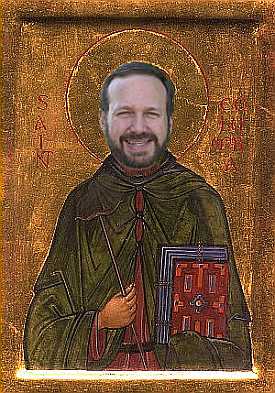
Saint Dan of PhotoshopolisA number of people I know have had recent encounters with strange persons who appear to be on the increase in the ranks of Christians in America. There’s no known genus and species name for these unusual creatures, so most people are forced to refer to them by their collective name, The Superspiritual.

I’m sure at least a few folks out there have crossed paths with this particular beast. For those unacquainted with The Superspiritual, a few of their traits stand out:

  1. They have a tendency to get up before the sun and have incredibly long quiet times that rival those of the great saints of old. In fact, the saints of old were pansies compared to these folks.
  2. They’ve memorized large swaths of the Bible—and in multiple translations. Ask them to quote a specific passage—they’re dying to share it with you.
  3. They have an answer to every possible theological question anyone might have. The best of them will offer multiple perspectives given by a chosen set of favorite authors. Always a very narrow selection of authors. Come to think of it, those authors always agree with each other on everything, so there isn’t much variation of perspective when you get right down to it.
  4. Their library of Christian books, if sold on eBay, could feed a hundred AIDS orphans in Africa for a decade, though it is doubtful they’d ever part with those books. Go ahead, try to snatch one out of their hands. (Fast reflexes, eh?)
  5. If they own a business, that business will be founded on, run by, and ever beholden to “Christian principles.” Those principles appear to include making as much money as possible by any means available.
  6. If you’re a heathen—meaning you’re not as spiritual as they are—you’re held at arm’s length until you ARE as spiritual as they are.  (Good luck! Typically it’s taken decades for them to reach their own peculiar nirvana.)
  7. “Christian practice” is defined as going to church on Sunday mornings, Sunday nights, Wednesdays nights, and at least a small group or two on a free night. Oh, and there’s a number of church boards to sit on, too. Christian practice is critical for enhancing one’s standing in order to maximize #5 above.
  8. They talk, talk, talk about family values, and you can’t help but think they’ve got the insular family thing down to a T, seeing that no one else associates with them. Just don’t bring up their middle child in conversation.
  9. They do an outstanding job of  telling you what the Bible says we should be against, but stumble a bit when pressed on what the Bible says we should be for.
  10. They have a way of making anyone who stands near them feel oddly guilty.

Sound familiar now? Certainly you’ve met one of these folks.

As to #2 above, their memorization skills are indeed impressive, but The Superspiritual seem to have mentally misplaced a few verses. Consider the following verses that routinely get overlooked:

And as you wish that others would do to you, do so to them.
—Luke 6:31 ESV

For judgment is without mercy to one who has shown no mercy. Mercy triumphs over judgment.
—James 2:13 ESV

And he said to him, “You shall love the Lord your God with all your heart and with all your soul and with all your mind. This is the great and first commandment. And a second is like it: You shall love your neighbor as yourself. On these two commandments depend all the Law and the Prophets.”
—Matthew 22:37-40 ESV

If anyone says, “I love God,” and hates his brother, he is a liar; for he who does not love his brother whom he has seen cannot love God whom he has not seen. And this commandment we have from him: whoever loves God must also love his brother.
—1 John 4:20-21 ESV

My brothers, show no partiality as you hold the faith in our Lord Jesus Christ, the Lord of glory. For if a man wearing a gold ring and fine clothing comes into your assembly, and a poor man in shabby clothing also comes in, and if you pay attention to the one who wears the fine clothing and say, “You sit here in a good place,” while you say to the poor man, “You stand over there,” or, “Sit down at my feet,” have you not then made distinctions among yourselves and become judges with evil thoughts?”
—James 2:1-4 ESV

What good is it, my brothers, if someone says he has faith but does not have works? Can that faith save him? If a brother or sister is poorly clothed and lacking in daily food, and one of you says to them, “Go in peace, be warmed and filled,” without giving them the things needed for the body, what good is that? So also faith by itself, if it does not have works, is dead. But someone will say, “You have faith and I have works.” Show me your faith apart from your works, and I will show you my faith by my works. You believe that God is one; you do well. Even the demons believe—and shudder!
—James 2:14-19 ESV

All joking aside, I’m growing tired of hearing stories about people afflicted with the disease of Superspirituality. And it  truly is a disease because it infects impressionable people who come under the tutelage of those already diseased.

  • What explains the Christian businessman who fires employees to cut costs rather than examine the careless way in which he doles out company money to ministries in order to get on their privileged donor list?
  • Or an upper-middle-class church that splits over outreach to a Hispanic neighborhood because the people they sought to evangelize in that neighborhood had the nerve to actually start showing up in the church on Sunday?
  • Or a radio ministry that promises a helpful book that can aid those who are struggling with long-term unemployment and its resulting financial ruin, but when calling in it’s a mandatory $30 “love gift” for the book—which Amazon sells for $8.99?
  • Or the Christian company that requests a prospective employee twice fly out for a job interview, only to later fail to reimburse the prospect for the plane flights or even bother to give her a follow-up phone call about the job?
  • Or the Christian organization that exists solely to help people with one specific kind of problem, but who gets a client in further trouble by failing to file critical paperwork because they were too busy preparing for a big evangelistic outreach they sponsor?

Don’t those just rip your heart out? What should be done with folks who have every appearance of being paragons of Christian virtue, yet they purposefully ignore the most basic aspects of the faith?

What would happen to us as a Church in this country if we spent the next year doing nothing that even vaguely resembled Superspirituality, instead simply doing unto others as we would have them do unto us? How hard is it to ask ourselves whether or not we like to be treated as badly by other Christians as we sometimes treat others?

I don’t think The Superspiritual ever ask themselves that kind of question.

A number of years ago, a friend, noting the sheer number of trivial things I know about highly useless topics, congratulated me on having filled my mind with so many facts. My response to him? I’d trade it all to be able to know the Bible inside and out.

Today, I realize that this response was Superspiritual. In reflecting about this issue of Superspirituality, it occurs to me that the less Superspiritual answer—and the one closer to the heart of Jesus—is this: that I be able to put into practice the amount of Bible I already know, rather than simply marinating my brain with it.

I mentioned this in a post last week, but what is the point in correctly learning and handling the Scriptures?

All Scripture is breathed out by God and profitable for teaching, for reproof, for correction, and for training in righteousness, that the man of God may be competent, equipped for every good work.
—2 Timothy 3:16-17 ESV

The end goal is good works. Good works are always others-centric. If we’re not putting into practice the things we already know, investing ourselves in the lives of our brothers and sisters in Christ, in the lives of the poor and needy, and in the lives of the lost, then all that Bible knowledge we’ve crammed into our craniums has no outlet. It puffs up our heads and leaves no room for our hearts.

The lost around us will argue our facts and figures, but they find it hard to argue when they’ve had a serious illness strike their household and we show up on their front porch with a homemade dinner. They used to refer to such selfless benevolence as “the milk of human kindness.” Trust me, folks; that’s “meat,” not “milk.”

James says this:

Religion that is pure and undefiled before God, the Father, is this: to visit orphans and widows in their affliction, and to keep oneself unstained from the world.
—James 1:27 ESV

And we already know that all the prophets were reiterating the same message of God: God desires that men love Him and love their neighbor as themselves.

Superspirituality is all too easy to catch, but there’s a way to avoid its disease. If we surrender ourselves lovingly to God and give of ourselves to our neighbors, there’s not a lot of us left over for that awful virus to infect.

Have a blessed week! And please show the love of Christ to someone this day who might not otherwise experience it.

{Image: Major apologies to the artist who crafted the icon of Saint Columba}

“Unshackling the American Church”—The Complete Series

Standard

For anyone seeking the complete list of posts in the "Unshackling the American Church" Series, I present the following links:

“Unshackling the American Church” Series Announcement

Unshackling the American Church: The Tyranny of Modernism

Unshackling the American Church: The Sacramental

Unshackling the American Church: Fraternitas

Unshackling the American Church: Treasuring the Creator’s Handiwork

Unshackling the American Church: Cultivating Essential Beauty

Unshackling the American Church: Mammon

I pray these bless you as you seek to stay true to what God values.

Bruised Reeds, Smoldering Wicks

Standard

Lone reedI promise my series on "Unshackling the Church" WILL continue, but I cannot write the next installment, which deals with community and fraternity, unless I go back to what is basic. Milk.

The last couple weeks have seen some real rancor in the Godblogosphere and I'll be frank in saying that I'm progressively sickened by the appalling meanness we ambassadors for Christ heap on each other in a sort of theological one-upmanship. I refrained from saying anything about the now infamous Mark Driscoll roasting that began at Tim Challies' otherwise normal site and spread out like so many firebrands to sites across the Godblogosphere. But as no one wants to let this one drop, I can't be silent when brother turns on sister turns on brother.

For this very reason, make every effort to supplement your faith with virtue, and virtue with knowledge, and knowledge with self-control, and self-control with steadfastness, and steadfastness with godliness, and godliness with brotherly affection, and brotherly affection with love. For if these qualities are yours and are increasing, they keep you from being ineffective or unfruitful in the knowledge of our Lord Jesus Christ. For whoever lacks these qualities is so nearsighted that he is blind, having forgotten that he was cleansed from his former sins. Therefore, brothers, be all the more diligent to make your calling and election sure, for if you practice these qualities you will never fall.
–2 Peter 1:5-10 ESV

Many smart people inhabit the Godblogosphere, certainly some of the most knowledgeable people you will find this side of a divinity school. We show off our knowledge of infralapsarianism, dispensationalism, trinitarianism, and a whole lot more -isms than some of us can name, wielding it like a weapon to slay enemies. Unfortunately, too often those enemies are our brothers and sisters in Christ.

Peter's progression is informative. The starting point in Christian maturity is faith, then goodness. Most of us are there, I hope. Then comes knowledge.

The problem with those of us who have knowledge is we too often stop there and believe it is the be all and end all of the faith, a dire mistake and the source of much of the pummeling that occurs on the Web. Knowledge must be supplemented with self-control, otherwise we become a human bomb, blowing up and damaging others with what we know. Everyone of us has encountered a know-it-all and few of us like being around them. The reason? They lack an off switch. They also tend to lack all the other traits Peter mentions that follow self-control.

We may think we're mature, but what does Peter put at the end of his list? Brotherly kindness and love, two traits increasingly missing from the Godblogosphere. Instead, we see the spiritual blackjack, the whip to stun our opponents.

Paul spoke of this type of correction, but had nothing good to say about it:

What do you wish? Shall I come to you with a rod, or with love in a spirit of gentleness?
—1 Corinthians 4:21 ESV

Paul seems to be saying the same thing as Peter. Are we Godbloggers listening?

I don't think so. Instead, what we seem to be listening for is our opponents to drop down on both knees and confess that we are right and they are wrong. Strange, I don't see "being right all the time" as one of the qualities in Peter's list. Even if "being right all the time" were in that list, it would be trumped by brotherly affection and love.

We've got to ask ourselves at what point the following verse becomes true:

Above all, keep loving one another earnestly, since love covers a multitude of sins.
—1 Peter 4:8 ESV

Anyone? 

Now some will say that wielding the knowledge of the Scriptures compels us to right bad theology at all cost. Those some would be dancing around the greater meaning of knowing the Scriptures, though. 

A favorite passage of those folks:

All Scripture is breathed out by God and profitable for teaching, for reproof, for correction, and for training in righteousness, that the man of God may be competent, equipped for every good work.
—2 Timothy 3:16-17 ESV

What is the chief end of knowing the Scriptures according to this passage? For what reason do we know the Bible inside and out? To pummel others with it? No, to serve. The chief end of knowing the Scriptures is that we be quipped for GOOD WORKS. In other words, serving others. Serving others means only one thing: putting others first.

Stephen was a model Christian. His defense of the Lord and the entire plan of salvation before his stoning is a masterful exposition by a man who understood the Scriptures like few others. What role did Stephen play in the nascent Church? He served food to widows and orphans. His godliness was not measured by what he knew but how he served others humbly, lovingly, and without complaining. By esteeming the forgotten and the least of these, Stephen was mourned and cried over by strong men.

The least of these…

Of the Lord it says,

…a bruised reed he will not break, and a faintly burning wick he will not quench….
—Isaiah 42:3 ESV

In the house of the pharisee, we see the bruised reed, the smoldering wick:

One of the Pharisees asked him to eat with him, and he went into the Pharisee's house and took his place at the table. And behold, a woman of the city, who was a sinner, when she learned that he was reclining at table in the Pharisee's house, brought an alabaster flask of ointment, and standing behind him at his feet, weeping, she began to wet his feet with her tears and wiped them with the hair of her head and kissed his feet and anointed them with the ointment. Now when the Pharisee who had invited him saw this, he said to himself, "If this man were a prophet, he would have known who and what sort of woman this is who is touching him, for she is a sinner."
—Luke 7:36-39 ESV

In the minds of judgmental men who have no real love of God in their hearts, the first thought is "Who let the filthy whore in here?"

See, these men possessed enough knowledge to rightly distinguish just what kind of woman this was. Not only that, but their own pride that they did guess correctly—while some backwoods rabbi was evidently clueless—puffed them up. I'm certain a few chuckled inappropriately while others seethed.

What was Jesus' response?

Jesus saw the bruised reed, the smoldering wick. He could have easily broken that reed, or pinched out what little flame danced in the core of that smoking wick. He could have wielded the rod that Paul spoke of. He could have come down on the side of the pharisees and recoiled in horror that this used-up hooker touched him. But no, he responded with tender loving grace.

Is this how we respond to others in the Godblogsphere? Or are we the breakers of reeds and quenchers of wicks?

I've written elsewhere that the anonymous nature of the Internet makes us meaner people. Something changes when we have to confront others face-to-face. I read awful things about other brothers and sisters in Christ on supposedly Christian Web sites. What makes me the most downhearted is our selfish frame of reference when we devastate another Christian with our loose words.

You see, I don't know you and you don't know me. One slice of interaction on some tiny Godblog that perhaps 0.0001% of the country reads in a day does not give any of us the right to lay into anyone. Which of us knows another's path? I may have been a heroin addict last year before I found Christ, but I open my mouth to say one thing in the comments section of some obscure blog and a half-dozen fifty-year-old-walking-with-the-Lord-since-I-was-a-toddler Christians savage me because I defend a pastor—the guy who led me to Christ, BTW—who dropped an F-bomb once.

Unless sanctification is instant, who are we, locked away in some office blogging, to take that one slice of interaction and condemn another person? What profound spiritual arrogance! 

What if the Christians we knew who guided us in life quenched our wicks at that one point when our theology was less than perfect? Which of us reached maturity in the blink of an eye? Haven't we all been wrong a million times or more as we grew in grace and put away childishness? Would I assault my own child verbally because he doesn't know about life the way I do after the benefit of 43 years? Yet too often, this is what we supposedly mature people do to those who are still growing in grace.

Wanna know a secret? We're all growing in grace. We will all sin. We will all be found lacking at some point in our walk with Christ. We should all be extending love and grace first.

Dietrich Bonhoeffer writes in his book, Life Together:

Even when sin and misunderstanding burden the communal life, is not the sinning brother still a brother, with whom I, too, stand under the Word of Christ? Will not his sin be a constant occasion for me to give thanks that both of us live in the forgiving love of God in Jesus Christ? Thus the very hour of disillusionment with my brother becomes incomparably salutory, because it so thoroughly teaches me that neither of us can live by our own words and deeds, but only by that one Word and Deed which really binds us together—the forgiveness of sins in Jesus Christ.

It's easy to imagine some day that one of us Godbloggers will be standing inside the gates of heaven when a commenter we routinely trash, or a well-known pastor we don't like, or some person of the Arminian/Calvinist/Dispensational/Paedobaptist or whatever ilk should walk through those gates and we say, "Who let this filthy whore in here?"

To which the voice of Jesus says, "I did."

God have mercy on us for our critical spirits and our unloving hearts.

 ***

Previous posts on this sad, recurring topic:

The Godblogosphere’s Black Hole

Hidden Messages of American Christianity: Correctness Before Love

That Other Standoff

Tearing Down the Gallows

Has the Christian Blogosphere Lost Its Collective Mind?

On Consigning Enemies of Christ to Hell

Witch Hunt

Let’s Play “Spot the Heretic!”

Who Watches the Watchers?