
What is “the Church God uses,” and how do we become that Church?
Lately, I’ve had numerous encounters with fellow believers who espouse a Christianity that makes no sense to me. It makes no sense because it misses entirely the role of the Church in the world. How that’s possible, I can’t understand. The New Testament can’t be understood unless we grasp what God intended when He called the Church into being.
To become the Church God uses, we must rediscover the one distinction that sets the Church apart from all other groups and institutions on this planet. We can talk about what the Church does, its commission, its command of the things of God, but none of those define the Church.
What makes the Church The Church ? The Holy Spirit.
Have we forgotten the mind-blowing reality of Pentecost? The Eternal Creator God came and indwelt men and women! He sealed them for eternity as His people. He empowered them with charismata by His Holy Spirit. The charge Jesus Christ gave could now be fulfilled because He lived inside those who believed on His name!
The Muslims don’t have the Holy Spirit. The Hindus don’t have the Holy Spirit. The Rotary Club doesn’t have the Holy Spirit. The United Nations doesn’t have the Holy Spirit.
The Church of Jesus Christ alone has the Holy Spirit! That radical truth quakes the world and demolishes every misconception we hold about the task Christ charged those of us who have the Holy Spirit.
The Lord speaks:
“But you will receive power when the Holy Spirit has come upon you, and you will be my witnesses in Jerusalem and in all Judea and Samaria, and to the end of the earth.”
—Acts 1:8
The transcendent power of the Holy Spirit took a handful of human rabble and used them to turn the world on its head! God-filled people tore down the wisdom of the philosophers. God-filled people raised the dead. God-filled people touched the untouchable and loved the unlovable. Why? Because God put His Holy Spirit in them—and us today–to accomplish His will on earth.
Christ gave us a commission and provided Himself living in us to make it happen. All we must do is say yes to that commission.
All this is from God, who through Christ reconciled us to himself and gave us the ministry of reconciliation; that is, in Christ God was reconciling the world to himself, not counting their trespasses against them, and entrusting to us the message of reconciliation. Therefore, we are ambassadors for Christ, God making his appeal through us.
—2 Corinthians 5:18-20a
He gave us the ministry of reconciliation. He didn’t claim that ministry for Himself, but charged us to do it! And we can do it because He empowers us by His Holy Spirit.
Think of it—we are His ambassadors!
An ambassador comes in the name of the king of his nation, for the king has empowered the ambassador as his full representative. The ambassador embodies the law of the king, the words of the king, the ministrations of the king, and the power of the king, for the king Himself has imbued the ambassador with his title. When others receive the ambassador in their homes and palaces, it’s as if they receive the king himself.
Do we understand this, Church? Do we understand our ambassadorship as the people who minister King Jesus in all His glory? Do we understand what He has given us and the price He paid for it so that we can establish His Kingdom?
Some would say the need for fully-empowered ambassadors passed away once the initial establishment of the Church came to fruition. But that’s a grievous error. For the Church of Jesus Christ is forever being established until the Great Day of the Lord when He comes again in glory. The Church is still being established in people groups and nations that have never before heard the Gospel. And the Church is still being established from generation to generation. Because the Church is perpetually being established on earth, we ambassadors of Christ continue to be imbued with all the gifts, truths, and power to meet the commission of Christ as those first Christians on the day of Pentecost. None of those tools and gifts used to establish the first church have passed because the Church continues to be established!
For as Peter quoted from the Prophet Joel on that Day:
“‘And in the last days it shall be, God declares, that I will pour out my Spirit on all flesh, and your sons and your daughters shall prophesy, and your young men shall see visions, and your old men shall dream dreams; even on my male servants and female servants in those days I will pour out my Spirit, and they shall prophesy. And I will show wonders in the heavens above and signs on the earth below, blood, and fire, and vapor of smoke; the sun shall be turned to darkness and the moon to blood, before the day of the Lord comes, the great and magnificent day. And it shall come to pass that everyone who calls upon the name of the Lord shall be saved.'”
—Acts 2:17-21
The empowerment of the Church to do the work of Christ continues unbroken and in full until the perfect King and Kingdom come in full revelation on the Day of the Lord, just as it says in the Scriptures. We are His ambassadors in the complete charge and power that He gave us until the end of time.
And we are to do the work.
But some don’t believe this.
If you’re a parent, you know that sometimes kids don’t always do what you ask them. Take cleaning a room. You ask the child to do the work of cleaning the room, you provide garbage bags, dusters, shelves and closets, and even a vacuum. And yet how many times have we all heard that precious little child look us square in the eye and say, “No, you do it!”
I think I speak for every parent here when I say that insolence doesn’t make mom and dad happy.
But it’s worse than that. Far worse.
Imagine that you literally wrote the book on cleaning. All knowledge and power to clean resides in you. You then tell your child that you will make the cleaning a snap to do because you will come live inside him/her and make it possible to do the work, even if it seems impossible. You lay your hands upon your child and confer all your cleaning skills in a moment. Afterwards, your moppet looks you square in the eye, folds those little arms, and says, “No, you do it!”
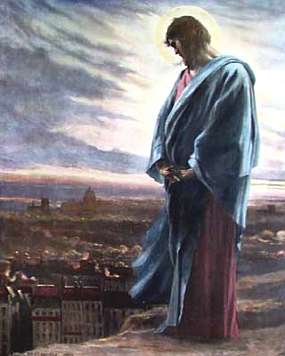 Folks, sad to say, that’s today’s Church. God gave us His Holy Spirit to work through us, but we continue to resist doing the work. We keep going back to the Father and telling Him He needs to do the work Himself. Even though He empowered us to do it by His Spirit, we’re sitting this one out. Or we’re picking and choosing when He can work through us and when He can’t, asking Him to bypass us to do the work when it seems too tough.
I’ve said this more times on this blog than I care to think, but if the Church doesn’t do the work, why do we think God’s going to step in and bypass us to get it done? When the widows and orphans of the Book of Acts needed to be fed, did God do it by raining down manna from heaven? No! He used the Church to feed them because God tasked the Church with that job and empowered them to do it.
Take a look at one man the Lord chose to do that work:
Now in these days when the disciples were increasing in number, a complaint by the Hellenists arose against the Hebrews because their widows were being neglected in the daily distribution. And the twelve summoned the full number of the disciples and said, “It is not right that we should give up preaching the word of God to serve tables. Therefore, brothers, pick out from among you seven men of good repute, full of the Spirit and of wisdom, whom we will appoint to this duty. But we will devote ourselves to prayer and to the ministry of the word.” And what they said pleased the whole gathering, and they chose Stephen, a man full of faith and of the Holy Spirit, and Philip, and Prochorus, and Nicanor, and Timon, and Parmenas, and Nicolaus, a proselyte of Antioch.
—Acts 6:1-5
And Stephen, full of grace and power, was doing great wonders and signs among the people. Then some of those who belonged to the synagogue of the Freedmen (as it was called), and of the Cyrenians, and of the Alexandrians, and of those from Cilicia and Asia, rose up and disputed with Stephen. But they could not withstand the wisdom and the Spirit with which he was speaking.
—Acts 6:8-10
God chose a man full of the Holy Spirit, an ambassador of His Kingdom, to wait tables filled with the lowest of the low, the widows and orphans of Palestine. Why? Because He trusts that kind of man to do the work.
Folks, God equips us for a reason: to do the work. We can’t sit back and act as if He’ll bypass us to do it if we sit this one out. Nor can we tell Him we don’t want Him to use us in impossible or supernatural ways. If that’s the way we think, then we should pack up the Church and go home.
The Scriptures exist so we can do the work:
All Scripture is breathed out by God and profitable for teaching, for reproof, for correction, and for training in righteousness, that the man of God may be competent, equipped for every good work.
—2 Timothy 3:16-17
Faith exists so we can do the work:
What good is it, my brothers, if someone says he has faith but does not have works? Can that faith save him? If a brother or sister is poorly clothed and lacking in daily food, and one of you says to them, “Go in peace, be warmed and filled,” without giving them the things needed for the body, what good is that? So also faith by itself, if it does not have works, is dead. But someone will say, “You have faith and I have works.” Show me your faith apart from your works, and I will show you my faith by my works.
—James 2:14-18
The Church God uses understands this. It understands it’s empowered by God to do the work. It knows that apart from God we can do nothing, but it also knows we do not stand apart from God! He lives in us by His Spirit, and He is perpetually rewarding those who do the work with a larger container to hold His poured-out Spirit. And from that growing container, greater works will be done so that even the mountain cannot remain if told to be cast into the sea.
The priest and Levite who passed by the robbery victim lying near death on the side of the road were of Israel, but they didn’t do the work of their God. Instead, they passed the work back to God and insisted that He do it. But the Samaritan, filled with the kind of love that only the Holy Spirit can instill, saw the need and did the work. He didn’t pray to know what to do. He saw the need, understood the love of God within him, and did the work. He didn’t need to ask if he should do the work, because the Lord had already said yes. And the Lord always says yes to doing the work.
Every day, God brings others in desperate straits into our lives. They might not know Christ. They might be destitute. They might be facing disease or discouragement. God gave us His Spirit to do the work. His Spirit does not change, nor does He flinch in the face of the work. He empowers to do the work today exactly as He did 2000 years ago because the work has not changed and neither has He. We have to trust the Spirit.
If we want to be the Church God uses, we have to do the work. If we want to be the Church God uses, we must see the need and meet the need. If we want to be the Church God uses, we must not toss the work back to Him to do apart from us, but understand that He will work through us because He lives in us. That’s our reason to exist. That’s our worship.
If we want to be the Church God uses, if we truly want to be with all our hearts, we will be.
Are we ready?
 We pick many of them by hand and dump them into a jar of soapy water. The soap plugs their breathing holes and that’s that. It’s a lot of work, but weirdly satisfying, too.
 My favorite Dr. Seuss book is