

No Shield Big Enough

Standard

We can't always shelter, can we?Though we serve a big God, no shield is large enough to keep out the world.

Tuesday literally burst with life. We had a day that epitomized gorgeous here (mid-70s, dry, slight breeze, and sunny with cotton candy clouds), so I bagged work. My son and I went geocaching instead. We hunted caches down by the Ohio River in Kentucky, the shoreline scenery adding to the picturesque day.

But before we got to our destination, I had to deal with the radio.

I don’t listen to kid-friendly radio. In other words, my listenership of Christian radio borders on the non-existent. I stopped listening when they refused to play a single one of the artists I listen to on a regular basis. You know, artists who talk about Jesus, sin, and repentance.

Instead, I tend to listen to classical music, which is primarily on Public Radio. Same for my news. And as I flipped to the news station, it just so happened to be discussing gay marriage as we drifted down the highway on that stunning June afternoon.

Where’s the force field when you need it?

My son was largely oblivious because he doesn’t know that gay means anything other than happy. You know, the way I understood it as a kid, too. Sadly, it just doesn’t mean that alone anymore.

My parents didn’t talk to me about “The Love That Dare Not Speak Its Name.” When I was in college in the early 1980s, a few men tried to hit on me. Clueless, I just thought they were overtly friendly in an odd sort of way. I didn’t know that there were men out there having sex with other men. I was in my mid-20s before I finally understood what homosexuality was. Even then, it made no sense to me. How was such a thing even possible?

My son won’t get that same shielding. None of our children will.

So I had to talk about homosexuality with my son. In the end, his reaction was much the same as mine: “I wish we could get the word gay back, Dad. It’s a good word.”

I wish we could get a lot of things back.

When I was a kid, things were different:

  • You could leave your house unlocked.
  • Adults were trustworthy, not potential molesters.
  • People looked out for each other and their neighborhoods.
  • The rules everyone knew actually worked and most people weren’t fighting to change them.
  • A boy might take a gun to school and the principal would admire it, not declare a lockdown.
  • Civic pride meant something.
  • You got the sense that people lived for some aspiration or belief greater than themselves.
  • People didn’t go out of their way to avoid someone in need or in trouble.
  • Social groups that hold our society together saw increases in membership, not precipitous declines.
  • A collective trust existed that each of us knew we were a part of a great nation, the best that had ever been.

All those good things (and more) seem to have vanished. Our children will never personally experience how it was for us to grow up in that environment. Instead, they’ll have to deal with the fallout of the jihad we declared on our own values.

In geocaching, you search for little treasure containers scattered all over the planet. I think that in many ways, our society has gone searching for similar containers, each a box with Pandora’s name carved on the front. And when we find one, we fail to ask whether it should be opened. Instead, we forge ahead, unable to contain our glee over what we might find inside.

There’s nothing I would like more than for “The Love That Dare Not Speak Its Name” to shut the heck up already. I’d love for us to close a few of those Pandora’s boxes and know that what Pandora could not repair, we could. But I know better.

The second law of thermodynamics applies beyond the laws of physics, doesn’t it?
The Commodore Decker Conundrum

Standard

When I was the age my son is now, the original Star Trek was still on first-run TV. I actually remember my father watching the show. However, when I asked to join him, he told me that Star Trek was “too scary for seven-year-old boys.” That, of course, only pushed me more to want to watch it. In a way, that show became the ultimate forbidden fruit of my childhood.

Not only is Star Trek a scary show at times (a fact I learned in later years when it hit syndication), but it mirrors well the overall frightening aspects of day to day living on this simple planet. No episode of the classic series reflects this better than “The Doomsday Machine.”

Written by the well-known science fiction author Norman Spinrad, “The Doomsday Machine” pits the crew of Enterprise against a mindless device of staggering power, The picture of doing it right but getting it wrongan alien weapon hellbent on destroying everything it encounters as it drifts through space, even entire planets. (Star Trek apologists claim the invincible weapon was designed specifically to combat the Borg.)

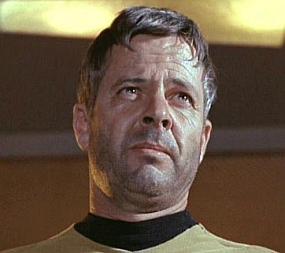
Enterprise discovers its sister ship Constellation battered and adrift in space. The lone occupant of the crippled craft is Commodore Matt Decker  (played with scene-chewing, Shatner-like intensity by William Windom). When an away team beams aboard Constellation, Captain Kirk and Commodore Decker, whose sanity is fraying at the seams, carry on this exchange concerning Constellation‘s encounter with the space-borne WMD:

Decker: “We tried to contact Starfleet… no one heard—no one! W-we couldn’t run!”

Kirk: “Matt, what happened to your crew?”

“Oh, well, I had to beam them down. I mean, we were dead—no power, our phasers useless. I stayed behind. The Captain… last man aboard the ship; that’s what you’re supposed to do isn’t it? And then it hit again, and the transporter went out. They were down there; I’m up here…”

“What hit? What attacked you?”

“They say there’s no devil, Jim… but there is—right out of hell, I saw it!”

“Matt, where’s your crew?”

“On the third planet.”

“There is no third planet.”

Decker, now sobbing: “Don’t you think I know that? There was, but not anymore! They called me, they begged me for help—four hundred of them! I couldn’t… I-I couldn’t….”

When Decker mouths those final lines, I find them some of the most chilling in all of television.

Decker’s “Don’t you think I know that?” stands as the frantic wail of a man who did everything by the book, drew on every command principle he’d been taught, stuck to the rules passed down from leader to leader, and yet none of that wisdom was good enough in the end. Events conspired against him and wound up destroying his crew—and ultimately the Commodore himself.

One clear decision goes awry, morphing into a nightmare that can never be undone.

Recently, I read the bestsellers The Black Swan and Fooled by Randomness by Nassim Nicholas Taleb. In them, Taleb forges a convincing argument that none of today’s leaders got to their positions of leadership through any other factor than chance. The difference between the corporate mailroom clerk and the CEO may have come down to nothing more than getting stuck in a traffic jam in the wrong place at the wrong time. Yet the CEO goes on to write a bestselling book telling how his “wisdom” won him the corner office, while the mailroom clerk labors forgotten, his aspirations forever on hold.

I know too many mailroom clerks, though. Too many good people who fell prey to the Commodore Decker Conundrum. They did everything they were supposed to do, but it wasn’t good enough. They were undone by the greatest doomsday machine of all: rotten luck.

And that’s a troubling reality to me that I’ve never quite been able to reconcile either in my own life or in the lives of others. The Bible speaks to this conundrum in what I find to be one of the most inscrutable verses in the Bible:

Again I saw that under the sun the race is not to the swift, nor the battle to the strong, nor bread to the wise, nor riches to the intelligent, nor favor to those with knowledge, but time and chance happen to them all.
—Ecclesiastes 9:11

In other words, you may do it all right and  yet still fail for reasons outside of your control. Just like Commodore Decker. You may try to recover, but chance so dashed your jigsaw puzzle and trashed its pieces that the final image is irretrievably lost.

Chance is quite a difficult concept to grasp in the Kingdom of God. Some Christians would say that chance doesn’t exist as God is control of our every action. Others argue for chance’s reality; how else to explain why some godly endeavors fail?

A friend of mine once told the story of a teen who lived in his hometown who felt the call of God to work as a missionary in Africa. That young woman spent several summers raising money to preach the Gospel to lost Africans. Hers was a burning desire, and everyone who knew her understood her cause was smiled upon by the Lord. One day, she boarded that plane and found herself in Africa, the fulfillment of all that hard work and desire.

That young, bright star of a missionary died later that week from some virulent disease she picked up while traveling.

I’m not sure I understand what happened to that young woman. Was she a victim of chance? Did she simply sit next to the wrong fellow passenger, one who harbored the disease that would ultimately take her life before she had the opportunity to share Christ with even one African?

Certainly God knew that she would die, her mission unfulfilled. Still, the why of it haunts the survivors.

I don’t know the answer to the Commodore Decker Conundrum. I’m not sure I know what to say to those Christians who do it all right by the Book, but then everything seems to go wrong. While none of us can see what is happening behind the curtain, I know that I don’t like to think that chance enters into the equation at all. Yet Ecclesiastes 9:11 says otherwise.

I look around and I see too many Deckers out there, solid people who did all the right things and yet were crushed by happenstance. More than anything, I want to know what to say to them. I never find the right words, though. Romans 8:28 stands as the counter to Ecclesiastes 9:11, but smarter Christians must know how to reconcile the two. When I hear the stories of men and women who made decisions they still pay for every day of their lives, decisions that seemed in keeping with the prevailing Christian wisdom yet have put them in desperate positions, I’m at a total loss—as if staring into the unrelenting maw of a doomsday machine.

Tozer on Discernment

Standard

Recently, I reviewed Lyle Dorsett’s biography of Tozer, A Passion for God: The Spiritual Journey of A. W. Tozer. I’ve read Tozer for years, but knew little of the man, so Dorsett’s biography helped fill in many blanks.

Of all the quotes that Dorsett pulled for the book, one struck home for me. It’s a scary wise kind of word that carries so much gravitas as to hit like a nuclear bomb. It’s the weighty word that helps you better understand those strong, silent men burdened with grave faces.

To his associate pastor and friend, Raymond McAfee, Tozer once said:

If you want to be happy, never ask for the gift of discernment.

I think that’s a word worthy of discussion. Please leave your thoughts in the comments section. I will be monitoring this discussion, so I’ll definitely respond.