Not So Wild About Harry

Standard

I’ve ignored writing on all things Harry Potter over the years, but this weekend forced me to change my mind. With my wife’s sister’s family down for the weekend, we were looking for things to do. Unfortunately for us, the city we live near was in the grip of Pottermania and half the activities in town were geared to the release of the latest book.

I’ve written a few posts about the world of fiction in the last couple weeks, but this isn’t going to be a diatribe about J.K. Rowling’s billions or the quality of her writing. The problem is not one of literary aspirations. To me, Harry Potter is a symptom of the much larger problem.

When I was a kid I watched Bewitched, I Dream of Jeannie, and any host of shows that featured magic. Some Christians would say that I was leaving myself open to all sorts of negative spiritual forces for doing so, but what no one could claim then is that they knew real witches. I certainly didn’t at that time. There weren’t any girls in my school that fancied themselves to be a witch (or even sympathetic to the witch’s cause.) The worst thing you could say about some young woman was that she had the lousy ’70s and ’80s fashion sense to dress just a little too much like Stevie Nicks. But witches? Nah. In fact, it was more likely that guys could be accused of witchcraft because Dungeons & Dragons was insanely popular by the time I graduated from high school. At Carnegie Mellon University in the early 80s I knew guys who skipped all their classes just to play D&D, sitting around getting high and drawing arcane symbols on the walls of their dorm rooms.

While some of the signs for a groundswell were in place even when I was a child, it can be argued that the later syndication of those TV shows I mentioned above lowered the defenses for witchcraft for the generation that came after mine when added to later societal changes. Today, everywhere you look, you can’t seem to get away from all things Wiccan or pagan. In fact, I have to believe that the fastest growing religion in the United States is not Islam, but the same one that has captured so much of the British population in recent years, Neo-paganism. Sorcery, vampire cults, an affinity for the goth lifestyle, even postmodernism—all of it has roots in paganism. Couple this with a societal outlook that is rational but growing more irrational by the day, and Neo-paganism looks ready to explode in the West.

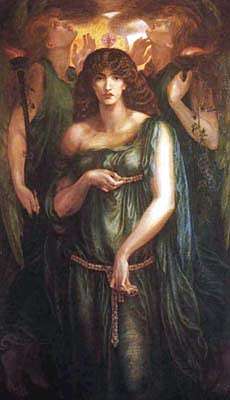
Why? Nature abhors a vacuum. Especially human nature. With Christianity on the down side in the Western world, people who are searching for answers, particularly those answers that cater to humanity’s fallen need to have power and control, are finding what they want in paganism.'Astarte Syriaca' by Dante Rossetti Earth religions are picking up adherents left over from the New Age movement, the children of the Haight-Ashbury crowd, and the rise of “organic culture.” (My wife and I are trying to get an organic farm going and it is shocking how much the “religion” of some organic farmers is rooted in goddess worship and fertility cult thinking.)
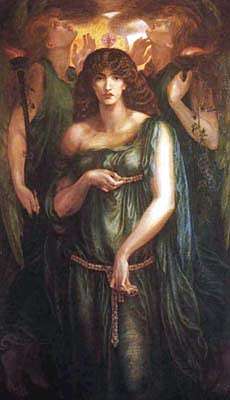
Earth religions have been around nearly as long as there has been a planet with that name. The Bible contains numerous commands of God to keep trees and natural distractions away from His altars lest they be construed to have anything to do with the worship of nature (Deut. 16:21 is an example.) The entire religion of Astarte/Ashera/Ishtar that bedeviled the prophets and kings of the Old Testament is the same earth goddess worship we see today (much of it penetrating Christianity in the form of the Roman Catholic Church’s Marian cult.) There truly is nothing new under the sun.

With the desire to worship the creation rather than the Creator comes the desire to control the creation; this leads us to witchery and the rise of Wicca as a religion to be reckoned with in the United States. While the number of self-identified witches, pagans, and Wiccans is wildly variable (anywhere from 100,000 to over three million adherents in the United States), the one truth is that their numbers are growing rapidly.

But nowhere has there been greater capitulation to Neo-paganism than in the UK. With studies showing that less than 3% of the population of Great Britain attends church on the weekends, Neo-paganism has filled the void left behind by the abandonment of Christianity. Even some high-ranking church officials in that country have been linked to the ancient Druid religion, and druid gatherings have been picking up in number, with more and more people flocking to see druidic ceremonies performed.

So it comes as no surprise that Britain gave Harry Potter to the world. Say what you will about the books, they are certainly a phenomenon we’ve never seen before. The problem here lies in the fact that Harry Potter could very well be the poster child for Neo-paganism. As a recruiting tool par excellence, nothing will break down the walls to the further acceptance of Neo-paganism than a boy sorcerer intent on saving his friends, his school, and the confused, non-“gifted” Muggles from evil machinations that threaten the world.

The problem then of Harry Potter that separates him from other books featuring magic is not only the craze that has developed around the books, but that reality is being blurred. When I was watching Bewitched I knew that witches weren’t real. People didn’t go around saying that they were witches. It put a kibosh on anyone thinking that being a witch was a likely choice of religion. But not so today. In my county alone there are several recognized covens. Elsewhere I had mentioned that a young couple came into the Christian bookstore I worked in many years ago and told us they had just left a coven that was actively attacking the bookstore via prayers and incantations. Needless to say, I was naive to this modern reality.

We cannot afford to be naive. If Harry Potter had hit the scene in the 1940s, I believe his impact would have been negligible compared with today. But given that the environment into which he’s flown is primed for his brand of Neo-paganism, I believe the influence of Rowling’s books is far more dangerous. While some might claim that I’m cutting my own throat as a writer of speculative fiction, I can’t keep silent while a generation’s defense against Neo-pagan thought is being systematically disabled by what many Christians consider a harmless story. Fantasy novels of all kinds are some of the bestselling books in bookstores and it is safe to say that the most rabid fans are the ones who are most likely to self-identify not as Christians, but something more akin to Neo-paganism.

Although this may seem like a broad brush, the fact remains that the Harry Potter generation will be the backbone of Neo-paganism in the next dozen years. They’ve been groomed with what on the surface was a mere gripping read, but which planted a seed that will grow into a noxious fruit that we Christians of 2020 will have to confront. We must fight it now and work to deprogram kids before they grow up as enemies of the Lord.
The Desperate Need for Heroes

Standard

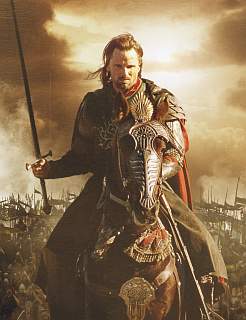
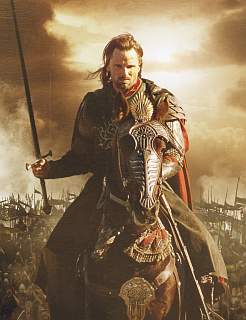
Aragorn from The Lord of the Rings trilogyThe annual Christian Booksellers Association convention (now with the utterly ghastly new name “International Christian Retail Show”—boy, that’s a blog entry in itself!) is running this week and it’s started off with a bang due to a speech given by Andy Crouch (who?) that called Christian fiction writers to abandon writing escapist novels and start addressing “reality.” His assertion comes from watching airline travelers; he observes that they have traded their books for playing solitaire on a notebook computer or cell phone. From this he posits that too many of us have traded gritty life for virtual reality:

It’s worth pausing and asking ourselves whether what we are looking for when we read, what our readers are looking for, is not escape and seclusion. This is a constant Christian temptation. We are prone to create our Christian virtual reality. I’m sure that right here at the International Christian Retail Show you’ll be able to meet good-hearted folks creating Christian video games. Isn’t that appealing? A world, suitably tweaked and put at your disposal for your entertainment, where Christianity actually works! Just obey the Christian rules and you win the game. A world where prayers are always answered! A world where sin doesn’t weave itself so tightly around even our best efforts! It is so tempting to strategically simplify, to create a fictional reality in which things just seem to work better than they do in this world.

But to do that is to deny the Incarnation, to deny that God became real in this world, in this very world where God does not seem real to many people much of the time. To create Christian virtual reality is to choose escape and seclusion and thus become entirely irrelevant to the heart of the gospel, which is God entering into this very world in order to liberate it from its captivity to itself.

So I plead with you, as a reader, as a fellow follower of the Incarnate One, as someone who daily wonders how this gospel to which I am giving my life can possibly be true, I plead with you not to tell me stories which improve on the world. Instead, tell me stories about the world as it is, strange and real and full of grace.

Like so many Christian commentators today, Crouch understands a problem exists. However, I believe his analysis and solution are profoundly wrong. It is not that people have abandoned books and movies (box office numbers continue their free-fall, too) because they are escapist, but because they aren’t escapist enough!

I’ve given up on most mainstream fiction because I can no longer stomach anti-heroes. Every character in every novel I have read lately is an amalgam of relativistic “ideals” that amounts to nothing more than a shell inhabited by moralistic flotsam and jetsam. You can’t tell the good guys from the bad guys because the bad guy has his subversively “noble” cause, while the “good guy” has more moral failings than the denizens of Sodom.

Now we might live in a postmodern age that attempts to call black “white” or even “chartreuse,” but I can tell you straight up that people are bored stiff with fictional characters that have few admirable traits, no transcendence over the rest of skulking humanity, no divine fire in their bellies that compels them to rise up and let the world know that they are different.

I’m shifting to film here because it provides a more concentrated and widely-known pool of examples to choose from, but why do people love the Star Wars movies and flock to them even when Episodes 1-3 were acknowledged by everyone as having awful dialog, wooden acting, and ham-handed direction? After watching a great musical like Singing in the Rain or The Sound of Music, why do so many people let their first comment be, “Why don’t they make movies like that anymore?” Why did the first Matrix movie inspire devotion, the second ambivalence, and the last one contempt?

It’s all about heroes. People are dying for heroes. People long for happy endings in which the clearly drawn hero with a heart of gold vanquishes the bad guy—a bad guy so bad he’d even eat his own mother for breakfast. The average guy in the average house in the average suburban tract has had his fill of anti-heroes. He doesn’t want someone who looks like him, struggles like him, and in the end is no better for any of his trials. He wants to see someone grow and learn and kick the bad guy’s ass in the last scene. If Yoda had a penchant for picking up little green call girls and knocking back the Tatooine hooch whenever he had the chance, no one would be cheering, and no one would be standing in line to see another Star Wars film. The Wachowski brothers forgot that the reason people liked The Matrix was more than just the cunning special effects, it was the fact that the good guys were good and believed in something greater than themselves. When in The Matrix Reloaded Morpheus’ altruism was demeaned as being little more than religious fanaticism, you could feel the collective audience sigh of “Well, there goes the series!”

What some label as mere escapism, the majority of people consider to be their one chance to see the good triumph over evil. When our TV news programs depict one hopeless scene of brutality, disease, and loathsomeness after another, why would we want to subject ourselves to reading the same in our fiction or watching it on our screens? People don’t want to see any conflict in a character like Aragorn from The Lord of the Rings other than Do I kill that orc with my broadsword or with my dagger? We don’t want all his moral failings paraded before us; we want him to grow into his kingship. Because if he can, maybe we can, too.

Has anyone asked the solitaire player on Crouch’s flight why he plays solitaire instead of reading the latest novel? Could it be that the solitaire player prefers an electronic card game because it contains the promise that the game could be won? Virtual reality at least allows the one immersed in it to possibly come out on top, to vanquish some imagined foe, to live out the heroism that is so lacking in our daily lives.

This is no endorsement for John Eldredge’s fatally flawed Wild at Heart, but the reason that book resonated with so many disaffected men is that it put out a call to heroism, a call lacking in much of our culture because we have for too long ceded our imaginations to anti-heroes and protagonists of questionable morality. Our culture screams, “There are no heroes!” We are told by the media elite that happy endings are for simpletons. Yet, who reading this today would want to come to the end of his/her life and NOT want it to end happily?

I find Crouch’s appeal to Christian writers to write more fiction that is rooted in the funk of this world and to avoid obvious happy endings to be a capitulation to the spirit of the age. It is to take our injunction to think on what is noble, pure, and right and turn it into just another dark day in the gutter. You can claim that it’s all about mystery and grace, but if that amazing grace doesn’t lead us to a heavenly home where we’ll be for a lot longer than ten thousand years, then Christian writers will be offering their readers the same bankrupt worldview that the world is offering. Our identity as Christians will be lost amid the many secular and religious voices that take a look at the vagaries of our existence and can only shrug and say, “Man, life is tough, isn’t it?”

The incarnation that Crouch uses as his proof text does not end with the dead Christ hanging on His cross. Paul himself said that if that is the whole of it, we are people to be most pitied. No! That dead Christ—our very archetypal hero—overcame Death itself! The stone is rolled away from the tomb! Jesus was the victor then and will be the victor to come when He and His righteous legions destroy all the powers of Darkness!

If our creative writing doesn’t regularly reflect this final triumph of good over evil, then all we have handed our readers is another maudlin dose of despair. I for one am not willing to write books that fail to offer this triumph; I know that you are not wanting to read them, either.

{Image: Aragorn of The Lord of the Rings trilogy from New Line Cinema}

Isolationism, Materialism, and the Evils of Our Age

Standard

Just a monkey in a cageIt doesn’t take a genius to see that something is drastically wrong at the very heart of our daily living. After reading Brad over at The Broken Messenger blogging about the American Dream and how it is destroying us through our materialism and outright stinginess toward tithing, I have to wonder if the cure we Christians are offering is just a Band-Aid pasted over something gangrenous.

Though I want to charge ahead in this post, let’s first consider Brad’s lament:

We blend the definitions between “need” and “desire” such that they are indistinguishable so that we can justify not giving to the Body of Christ our time and or money; yet somehow we find the means to set aside regular portions of our wages and time in our lives for our dreams – all with the expectation that once the allotted time has passed, we will reap the rewards for our patience and self sacrifices. But in the same manner that we pursue our earthly dreams, Jesus has asks us to abandon them along with everything else. He asks that we sacrifice all for a little while, for inconceivable and imperishable riches later.

With all respect to Brad, there is a far deeper problem here. Not only do we suffer from the very things Brad so rightly accuses, but we cannot NOT suffer from them because of the way we’ve setup our societal structures.

I’ve blogged about this many times before, most recently in part in my business series, but it bears repeating. I own a large farm tractor. I bought it when we moved to our property with the idea of having a small farm. All my neighbors own farm tractors, too, in various sizes, capabilities, and vintages. There are five families that live on about sixty acres of land. We all have need for a tractor, but do each of us have to have one that is strictly ours?

With our island mentality of existence, each man must have his own self-sufficient world supplied with things that keep him isolated. A man must have his own tractor because he rarely interacts with his neighbor at all, so it makes borrowing an issue.

It goes beyond sharing commonly used items, too. If fifty acres of wheat need harvesting, he, his wife, and his 2.1 children can’t do it by themselves if they try to do it by inexpensive hand labor—they need the machinery that will enable them to work alone. The machinery costs money—a lot of money. Now they’ve got to work even harder to make more money to afford the expensive machines, the fuel to power them, and their upkeep. Maybe the wife takes an outside job now. And the kids wind up latchkey kids because he’s moonlighting at night and there’s that overlap when both he and his wife are gone. It’s all too common and the reason is that there is no community left that will come to his side to eliminate his need for the expensive equipment in the first place.

What if instead of going bankrupt trying to buy a $75,000 combine, all his neighbors came over and helped harvest the wheat using little more than a horse-drawn scythe or two? Inexpensive and communal, too. The labor is divided. Repeat that pattern over a number of families and many hands make for easier work.

Sure, that may work for organic farm communities, hardcore Amish-types, and the like, but what about the VP of Operations at the soap making company? Well, what about him? What are we Christians failing to work through when it comes to problems like this?

Brad’s issue over the American Dream and how it afflicts us Christians will NEVER go away no matter how hard we try unless we jettison our self-sufficiency. If you aren’t part of a community that strategically works to see that no one gets left behind in the grinding wheel of modern life, then each one of us has to have a complete set of stuff to be self-sufficient enough to live. Even Saint Francis could not have been Saint Francis unless some person out there included him in the life of a community. Yes, a few people can drop out altogether and live like hermits, but all of us can’t do that. The only answer is for Christians to start abandoning the pie-in-the-sky idea that we will somehow stop with the self-sufficiency and the requisite materialism that naturally attends it without covering each other’s backs!

Initially we put our parents into nursing homes when they were aged not because we have hard hearts, but because no one would be there to support us in our support of them. Pull the right stick out of the Kerplunk game and all the marbles will fall. Name a problem in our society and I bet you can trace it back to our misguided belief in self-sufficiency.

Ever wonder why there are a hundred different types of breakfast cereal in the grocery store? Self-sufficiency breeds self-centeredness. Self-centeredness naturally evolves into the concept that I am the master of my own kingdom. As a king, I need something that sets me apart from the commoner. They may eat cornflakes, but I need the organic muesli with non-GMO, freeze-dried ollaliberries added. The common becomes despised because I require something better. Whining for “better” promotes greed. Need I say more?

Folks, being more holy won’t fix this. We’ve tried that route and failed miserably. Nor will attempting to live a simpler life get us out from under the burden that reinforces the very complexity we try to avoid. The brick wall awaits and we’re going ninety even with the brakes on. The system is broken at a fundamental level: We lack real, connected community and our need to overcome that lack results in our becoming self-sufficient. If I don’t need you, I need everything that is not you that might replace you. And soon enough, the thing that replaces you is viewed as more essential than you are. Is it any surprise then that we live in such an angry society? If I don’t need you, then all you are doing is competing against me. There’s that Darwinian ethic again—seems to crop up everywhere.

Our self-imposed isolation is destroying us on the inside and driving us to lengths that dishonor God. But a Christian community founded upon the ideals that no one is ignored and that your problem is my problem will not succumb to isolation, self-sufficiency, and materialism. It will naturally avoid living out a disconnected, stingy, ungrateful life before God.

Trying to undo entrenched societal structures that diminish our potential for the Lord takes brave men and women. Any of them still out there?