
The Christian, Rage, and Powerlessness

Standard

It started with a lack of bacon.

Too many people at Wendy’s ordered items with bacon, so the crew had to cook more. The bacon lovers in line were told it would be six minutes, so we gathered calmly off to one side and began to chat. EnragedOne man steered the conversation to politics. In minutes, I wondered if a riot would break out.

While people were willing to wait patiently for food items filled with bacony goodness, patience is in small supply when it comes to waiting till November to “throw the bums outta Capitol Hill.” People aren’t just mad at the condition of America 2010, they’re downright enraged.

People are livid at overreaching government, at seeing their tax dollars given to scoundrels, at watching themselves move down the class ranks, at losing their jobs, at losing their homes, at losing out on every dream they once had.

They seethe because the gulf fills with oil while the people responsible for the disaster lie about its severity.  Companies that created the economic mess ask for more aid and then give it as bonuses to leaders responsible for the mess. The country has lost control of its borders. Nuts and flakes in Iran build the Bomb. Corporations lay off hardworking people and reward sloth because the slothful know where the skeletons are buried. Health insurers begin terminating policies, arguing that Obamacare will take care of everyone—some day—leaving the average Joe buried in debt as he pays either outrageous costs for replacement insurance or nightmarish costs for  health care, living in dread that he may one day get sick and need medical attenti0n that will  cost him all his savings, his kids’ college funds, and even his home.

The inability to stop this downward spiral breeds fear. Like a tapeworm, powerlessness eats at people’s guts. They can’t stop the insanity; they can only be carried along with it. And that spawns this stark rage that many feel.

I have known Christians who seem to escape these trials. I have known Christians who have been buried by a relentless series of landslide-like events. Both groups have been faithful, yet one seems to attract trouble like a bare bulb at night brings in the summertime moths.

And it goes much deeper than just calamity or human failings. I was talking with a friend on Monday about the way we live our lives, and it seems to both of us that trying to fall back to a more sane position only creates chaos in the poorly thought-out systems we’ve created for ourselves. Eating locally grown food sounds like a wise idea, but what instabilities are created by a large-scale move away from food trucked in from long distances, instabilities whose ripple effects can’t be predicted easily?

It is one thing to pray that God will deal with the wicked people who knowingly hurt others in the pursuit of cold, hard cash. But what of the janitor who cleans the wicked people’s buildings? Is he in collusion with evil? And is he us?

And how does one pray about entrenched systems that are not so much empowered by evil principalities but by mistaken notions that were innocent five decades ago but which have now bred dependencies from which we cannot escape readily? Are all wrongs rightable? And was that wrong truly wrong at the time of its conception? What do we do when black and white have dulled over time to gray?

If others are like me, then I suspect more and more people wake up feeling inadequate to the task. In simpler days, choices seemed to come easily. Now, though, it feels as if every decision that life presents is like a bucket of murky water with something awful lurking at the bottom out of sight. We have made everything in life so complex that any simple act of deciding is fraught with danger, consisting, in many cases, of wondering whether the potential sea snake hiding in one bucket is more lethal than the possible blue-ringed octopus in the other.

What this means for modern Christians is hard to fathom. Are we immune to bad outcomes? If not, how then do we navigate the complexity of modern life? How does one break out of the system when one is a product of that system? Would Jesus even have us attempt to break out? Or does conformity and relenting not matter in the wider scheme of things? Is powerlessness good or bad? And is numb consent to the downright infuriating aspects of life a sin?

We in America are definitely control freaks; we want everything just so. That’s not of faith. But then the counter to that is to wonder whether simply allowing ourselves to be swept along powerlessly is not of faith either. And if it isn’t, where is the happy medium?

As a Christian, my tendency is to immediately answer by saying that faith,  prayer, abiding in Christ, and Bible reading are the answers. Certainly, faith brings us through all trials. Yet what is the faithful answer to a nuclear Iran that will certainly attack Israel? How do we meet the health care needs of people without bankrupting our country? Does every issue have a solution, or are some problems destined always to diminish us?

And most of all, how should you and I, such small people, live in the face of these issues?

I feel for angry people. I truly do. Jesus has an answer for them. My deficiency is that I don’t always know what that answer might be or how to bring it about. And I believe that if we were honest with ourselves, many of us will realize that more and more issues are harder to resolve than we might think—that is, if we are thinking at all.
Indoctrinating for Heaven or Hell

Standard

I once read about a pastor who was criticized for telling people he was baptizing that when they came up from the water not to be surprised if they were speaking in tongues—which was the case for many. Critics would argue that this set a false expectation.

But in thinking about this, I have to come down in favor of the pastor.

You see, each of us is receiving indoctrination. Just being alive means that a perpetual stream of thought patterns assaults us 24/7/365. Some of that stream is obvious; some is not.

Three responses to indoctrination exist: We can embrace an idea, ignore it, or counter it.

When we look at the American Church today, we have to ask just what kind of indoctrination we are receiving. By and large, the message coming out of our churches sounds like this:

Jesus loves you, even though you sometimes sin. You can rest in His grace and not be worried about doing things for Him except to read your Bible and pray. Show up on Sundays and to the occasional church event. If you are young, go to a good college and get a degree that ensures a solid job working for a reputable company. Find a good-looking Christian mate from among the right kind of people, buy a house, and have 2.2 kids. Make sure those kids are loaded with activities and skills so they can get into an even better, more expensive college. Live in the right neighborhood with the right kind of people who can help you advance in life and build your career. Go on vacations and enjoy yourself. Give some money every once in a while to worthy causes. And most of all, be happy with your Christian experience, even if you sometimes wonder whether it’s really all it’s cut out to be.

Seriously, isn’t that the indoctrination most of us Christians receive from childhood until the day we die?

In stark contrast, here is the Bible’s true indoctrination:

You have been crucified with Christ. Any pretense you had to living like worldly people is dead. Jesus Christ, the Lord of All, dwells inside you. Greater is He that is in you than he that is in the world. You are being changed from one degree of glory to another, moving from sinner to saint. You are seated in the heavenlies with Christ and are empowered by His Spirit. Therefore, nothing is impossible for you. The Christian life is filled with miracles; they should be expected. You overcome the world because Christ did. Take dominion. Make disciples of all nations and tear down strongholds. Worship Christ with your entire being, even if that puts you at odds with the establishment. Pray at all times and in all places, and expect those prayers to come to great fruition.

You will be hated for Jesus’ sake. Because you have counted all things lost for the sake of knowing Christ, you will live a countercultural life that will be misunderstood by most people. For this reason, many of you will be martyred for the Gospel because Christ is in you, is transforming you, and compels you to speak about Him.

Your love will be for all men, no matter race, creed, or color. You will care for the downtrodden and weak. You will repay good for evil and will love and pray for those who persecute you. Your life is now hidden with Christ, therefore, you are not your own. You only do what the Father is doing, not what you want. Your life is expendable for the cause of Christ. Therefore, you should not think too highly of yourself, but in humility you should value others as much as yourself and your family, if God in his graciousness gives you a family. Your primary family is the family of God, and building up the community of faith through the supernatural gifts God has implanted in you is one of your primary reasons for existence. Meet with the community of faith as much as possible and ensure that no one among you lacks for anything needful, even if that means you personally do without the trappings of worldly class and culture. And no matter what kind of life you end up living, you should give thanks to God at all times.

Most of all, never stop laying ahold of Christ and abiding in Him.

We don’t set that kind of expectation in our churches, though, do we?

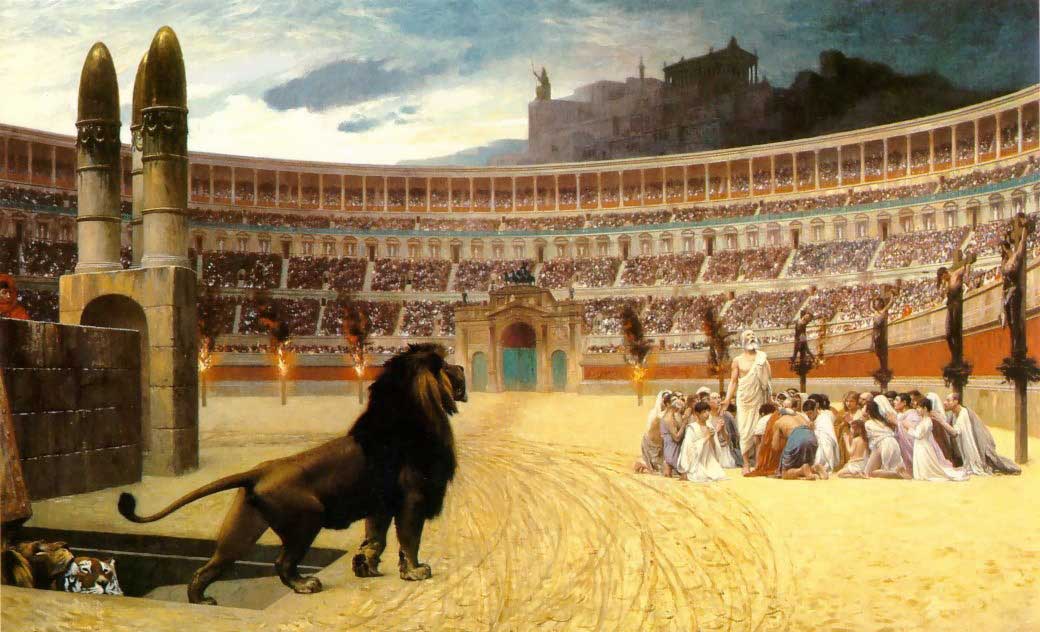
The Church in America bears little to no resemblance to the Church of the 1st century because our indoctrination is lukewarm or nonexistent. Period. 'The Christian Martyrs' Last Prayer' by Jean-Léon GérômeSome may argue that they do try to indoctrinate people into that more Biblical model. But the fact is that we hear it rarely, and surely not enough to compete with the nonstop message the world gives. And a worldly message abhors a vacuum, too.

As a Church, we have got to get serious about speaking truth to each other. We have got to stop watering down our indoctrination. If we don’t, the world is all set to step in and give us its own deviant set of expectations.

In closing, imagine what the next generation of Christians would be like if we set just the one expectation that they would be martyred for Christ because they love Jesus so much. Too strong? I don’t think so. For too long we’ve been preaching a watered down message that asks nothing. Why then should we be surprised at the powerless outcome?

Faith, the Opposite of Control

Standard

If you were to ask me what one lesson stands out in my life in this last decade, I would point to control.

Fact is, you and I don’t have any. Control is an illusion created by our culture. We in America idolize the self-made bootstrapper, yet if we can’t control whether or not we take our next breath, then ultimately, we are not in control of our lives.

Most people in America, most Christians even, have their minds fogged by the illusion of control. And the illusion is easy to believe because we surround ourselves with gadgets and services that perpetuate it. We read books, especially self-help tomes, that reinforce that we can be masters of our personal kingdoms. We are told that getting ahead is all about our own efforts. Our society holds out a roadmap that shows that if we just work hard enough, we can walk from the mall entrance to Neiman Marcus.

But if you’ve lived long enough, you begin to see what we have been fed about controlling our lives is a lie. Sometimes, no matter how hard we work toward a goal, it never arrives. Sickness intrudes. Randomness strikes. A butterfly in China flaps its wings and a tornado destroys a palatial estate accrued through decades of sweat. In the great mall of life, we end up in Spencer Gifts staring at black light posters instead of negotiating down the price of a Botero at Neiman.

The Great Recession, as this economic downturn has been called, is proving to be a factor in waking some Americans out of the control delusion. People who did everything right, who followed the mall map to a T, still saw their shopping trip of life go awry. Now they sit in the food court sucking down an Orange Julius and not the complimentary Roederer Cristal handed out by the luxury retailers.

I suspect that the next couple years will be an enormous wake-up call to Americans, for many will find themselves progressively sliding down the class ranks. And the resulting anguish will be like nothing our generation has ever seen.

But then, basing our lives on our own ability to control them can have no other outcomes except grief. The expectations run too high.

A few years ago, I read The Black Swan, a fascinating book by Nassim Nicholas Taleb. The author posits that too few people account for the unexpected and that most success is illusory, the product of chance happenings that are all that separate the board room from the mail room. Taleb states that those business celebrities who write books about how they achieved their success might as well have saved all their scribblings and just written, Hey, I got here by dumb luck. When even the secular crowd wakes up to the lack of control we have over our destinies, maybe hope for positive change within our country remains.

What the Bible says:

Again I saw that under the sun the race is not to the swift, nor the battle to the strong, nor bread to the wise, nor riches to the intelligent, nor favor to those with knowledge, but time and chance happen to them all. For man does not know his time. Like fish that are taken in an evil net, and like birds that are caught in a snare, so the children of man are snared at an evil time, when it suddenly falls upon them.
—Ecclesiastes 9:11-12

I have known too many cases where hard work failed to win the day. I have known too many people who did everything right, but they still got steamrolled by events they could not foresee. I know people who made decisions praised as wise by the wisest of the wise, but who still saw that wise choice end in bitter fruit.

We are not in control of our lives. We deceive ourselves when we insist we are.

For the Christian, the answer to the delusion of control is here:

You are not your own, for you were bought with a price.
—1 Corinthians 6:19b-20a

Set your minds on things that are above, not on things that are on earth. For you have died, and your life is hidden with Christ in God.
—Colossians 3:2-3

For this light momentary affliction is preparing for us an eternal weight of glory beyond all comparison, as we look not to the things that are seen but to the things that are unseen. For the things that are seen are transient, but the things that are unseen are eternal.
—2 Corinthians 4:17-18

As I look at the American Church of 2010, I see people struggling to maintain control. We consider ourselves to be our own, masters of imagined destinies that line up more with the American Dream than with having a mind set on the eternal unseen. To such people, the following verse is the strangest in the Bible and is prayed with the least conviction:

Give us this day our daily bread….
—Matthew 6:11

When we have surrendered control of our lives entirely to Jesus, we can pray Matthew 6:11 with joy.

But for too many people, praying such a prayer becomes an issue of abandoning too much control. It asks too much. It asks us to rely on something foreign to us: faith.

You see, faith is the opposite of control. Faith says, “I do not know what tomorrow will hold. I cannot even control today. Instead, I will live by the Spirit. Jesus leadsI will live with the uncertainty of the world and instead exercise the muscle of faith that I have let atrophy for too long. Christ is in me; therefore, I have hope.”

The times we live in now will tax many people. All the old refuges will fail. The Church must revise the way it thinks about life, putting Christ first and its own finaglings last. We will have to experience what it means to depend on Jesus alone for physical healing because we can no longer control our health care because we can no longer afford doctors and hospitals. It will mean praying for food and expecting to receive it, even when the grocery store shelves are bare. It will mean learning to be thankful for even the smallest blessing we receive in faith from God. It will finally mean learning to move beyond just talking about faith and actually living it.