Jesus said to [Martha], “I am the resurrection and the life. Whoever believes in me, though he die, yet shall he live, and everyone who lives and believes in me shall never die. Do you believe this?”
—John 11:25-26
As a younger man, my favorite book was The Journals of Jim Elliot, the personal writings of the famed missionary/martyr. Elliot was always a hero of mine. He and four others were speared to death by aboriginals in Ecuador, people they were trying to reach with the Gospel.
Only recently, 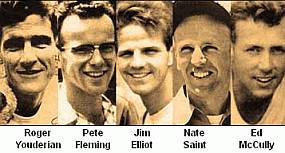 though, did I read an interesting fact: Elliot and his companions carried guns, yet they chose not to fire them in self-defense. Instead, they took the spears and died.
The simple question: why?
Many believe that Elliot and his friends chose to die rather than kill others who, not knowing Christ, would be doomed to hell. They gave up their perceived right to life to keep others from eternal death. They loved strangers more than they loved their own lives.
When I look around the American Church, I don’t find that mentality. If anything, we are Americans, first and foremost, and our right to life, liberty, and the pursuit of happiness trumps any idea of forgoing that right to save another from the lake of fire. Our enemies deserve to burn in hell; they’re our enemies, aren’t they?
Yet the Kingdom of God has different rights than the kingdoms of this earth. For instance, here’s one of the realities of the Kingdom of God:
As it is written, “For your sake we are being killed all the day long; we are regarded as sheep to be slaughtered.”
—Romans 8:36
Paul then notes that this reality makes us more than conquerers.
But we don’t think that way. Our view is that retaliation against our enemies and those who intend to harm us is our right as Americans. Yet Paul says it is for God’s sake that we lay down our lives.
An eye for an eye was most definitely the Old Testament way, as was the sword. But I struggle to find any evidence that the New Testament incorporates that same thinking:
Then Jesus said to him, “Put your sword back into its place. For all who take the sword will perish by the sword.”
—Matthew 26:52
When the inclination is to pick up the sword rather than the cross, then we live by the sword. And we in America most definitely live by the sword because we see it as our right to wield it.
“Blessed are you when others revile you and persecute you and utter all kinds of evil against you falsely on my account. Rejoice and be glad, for your reward is great in heaven, for so they persecuted the prophets who were before you.”
—Matthew 5:11-12
Persecuted didn’t just mean opposed, unless Isaiah’s being sawn in two can be considered mere dissent on the part of those who “persecuted” him.
“You have heard that it was said, ‘An eye for an eye and a tooth for a tooth.’ But I say to you, Do not resist the one who is evil. But if anyone slaps you on the right cheek, turn to him the other also.”
—Matthew 5:38-39
What part of “Do not resist the one who is evil” do we not understand?
“But I say to you, Love your enemies and pray for those who persecute you, so that you may be sons of your Father who is in heaven.”
—Matthew 5:44
Isn’t “Hate your enemies and counterattack those who persecute you” more the way we live? Don’t most of us think a chromed Dan Wesson .45 with a walnut grip a better response to one’s enemies than prayer? Don’t we all smirk when someone offers that we should “kill ’em all and let God sort ’em out”? Well?
“A disciple is not above his teacher, but everyone when he is fully trained will be like his teacher.”
—Luke 6:40
And how were Christ’s disciples like their teacher? Nearly all died deaths at the hands of those who reviled them. What’s more, the Bible hints that they welcomed such a death. (“My desire is to depart and be with Christ, for that is far better.”—Philippians 1:23 / “And they have conquered him by the blood of the Lamb and by the word of their testimony, for they loved not their lives even unto death.”—Revelation 12:11)
“And when they bring you to trial and deliver you over, do not be anxious beforehand what you are to say, but say whatever is given you in that hour, for it is not you who speak, but the Holy Spirit. And brother will deliver brother over to death, and the father his child, and children will rise against parents and have them put to death. And you will be hated by all for my name’s sake. But the one who endures to the end will be saved.”
—Mark 13:11-13
Was Jesus ignorant of how those trials would end? What retaliatory plans did He offer His followers in the wake of their sentencing?
Here’s a good example of one such trial:
Now when they heard these things they were enraged, and they ground their teeth at [Stephen]. But he, full of the Holy Spirit, gazed into heaven and saw the glory of God, and Jesus standing at the right hand of God. And he said, “Behold, I see the heavens opened, and the Son of Man standing at the right hand of God.” But they cried out with a loud voice and stopped their ears and rushed together at him. Then they cast him out of the city and stoned him. And the witnesses laid down their garments at the feet of a young man named Saul. And as they were stoning Stephen, he called out, “Lord Jesus, receive my spirit.” And falling to his knees he cried out with a loud voice, “Lord, do not hold this sin against them.” And when he had said this, he fell asleep.
—Acts 7:54-60
I believe some would have preferred that Stephen, doing his best Chuck Norris, pull out a couple of AK-47s and dust every last person holding a rock. Yeah, man!
Instead, Stephen died praying for his enemies because he knew that vengeance belongs to the Lord alone.
Paul wrote this:
For to me to live is Christ, and to die is gain.
—Philippians 1:21
In that spirit, I offer this scenario (not for the fainthearted):
One day, your enemies come for you and your Christian family. Instead of reaching for your shotgun, you attempt to share the love of Christ with them. Their response? They force you to watch as they rape your daughter, then slit her throat. Then they put a couple slugs into your wife’s face and do the same to you. For a finale, they set your house to flame to ensure that your young son, who is hiding somewhere inside, doesn’t make it out alive.
A few months later, one of those enemies, having heard the life-filled testimonies and seen the holy martyr deaths of enough Christians, gives his life to Jesus.
I believe that one of the reasons that such a response on our parts seems so inconceivable is because we don’t really live as if a mansion in glory awaits us. The question of Jesus to Martha that opens this post receives an answer of yes in our heads, but no in our hearts. We love this life too much because it’s the only thing that seems real to us. We can’t see the value in giving that up willingly. Only fools, weaklings, and cowards would do such a thing. Better that we go down with a pistol in hand than be thought impotent against our enemies’ attacks.
Yet Jim Elliot’s holstered gun speaks long after its owner took his last breath.
As an American, all this is foreign to me. It’s not the way I have ever thought or even think now. I encounter an Elliot or a Dirk Willems and such people exist outside my own worldview box. No, I would prefer to think that Corrie and Betsy Ten Boom pulled out a couple Walther P38s and sent a dozen Nazis to hell before they and their family and their boarders were hauled off to the concentration camps. That the Apostle Paul yanked out a secreted knife and gutted his executioner before the Romans managed to strap him down and remove his head.
But when the room is quiet and it’s just the Lord and me, I realize I think that way because my mind is not as Christlike as I would believe.
So I ask, when they finally come for you and me, will we go down fighting like men who don’t believe in the world to come? Or will we kneel in prayer and die like Christians?

 These were not lobbed question, either, but stuff like What is the nature of Man? and How does Man relate to His Creator? (Today, you’d be hard pressed to find a kid in your youth group who could thoughtfully answer those questions.)