
Live from the Battlefield

Standard

Imagine you’re a soldier on Omaha Beach, Normandy, France on June 6, 1944. It’s D-Day.

Eight hours into the fighting, you wiped the brains of your best Army buddy off your sleeve after a shell removed the top half of his head. Your thigh aches and oozes blood from the small fragments of a mortar round. When that happened, you have no clue. It’s all adrenaline all the time. Memento mori lurks around every corner. No time to think, just survive.

The stench of sulfur, sweat, and blood assaults your nose. The wails of the dying and injured never cease their howling. And you just walked past a kid—at least he looked like kid, even in his fatigues—Robert Capa's Omaha Beachwho had half his body torn away by machine gun fire, but there he was, still chattering. At least for now. You don’t come come back from an injury like that. You just don’t.
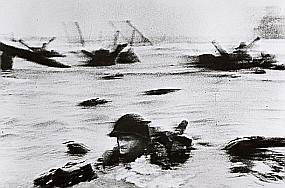
It’s kill or be killed. And too many of your side fell into the latter.

You regroup when the paratroopers drop in later that evening, and as you gaze out over the carnage, you wonder if your side won. Because nothing here resembles victory. Hell couldn’t look this bad. In the end, perhaps everyone lost.

Here and now…

When tribulation comes, it’ll make D-Day feel like a hangnail.

I say that because we are not ready for tribulation. Most of us wouldn’t last through two days of genuine tribulation. The closest we’ve been to tribulation is at family reunions when grandpa talks about the Depression. Oh, and pass the corn on the cob slathered in butter.

I don’t know if we’re headed into tribulation or not. It sure seems like it. Only God knows.

But here’s what I’m certain of: For Christians alive during that tribulation, it’s going to feel like defeat. I don’t say that blithely. We may look around and see nothing but utter chaos, even within our families.

Consider this passage from Daniel 10. The prophet saw a vision and prayed for an interpretation, but one failed to materialize. Finally, many days later, an angel arrives and speaks:

Then he said to me, “Fear not, Daniel, for from the first day that you set your heart to understand and humbled yourself before your God, your words have been heard, and I have come because of your words. The prince of the kingdom of Persia withstood me twenty-one days, but Michael, one of the chief princes, came to help me, for I was left there with the kings of Persia, and came to make you understand what is to happen to your people in the latter days. For the vision is for days yet to come.
—Daniel 10:12-14

This awesome angelic being was thwarted by demonic powers. Only after receiving assistance from an archangel did he manage to break through the line of chthonic assault.

And that was during the good times. Tribulation will see far worse.

For Christians, it will feel as if God has abandoned us because all the benefits we’ve known as believers will be bitterly, and perhaps even successfully, opposed. Life and faith won’t work like they normally do. The foundation won’t feel secure. Madness may strike someone you love. Cruel people might take your children away from you. When the forces of hell fight that last battle, they will not go down without taking out as many of us as they can.

It will look like defeat, folks. It will smell, taste, sound, and feel like it, too.

You’ll hear pollyanna Christians talking about how it will all be better. But it won’t be. And those pollyannas will one by one reject the faith because they built their hope on rainbows and fluffy bunnies instead of the Rock. People you know, even people who pledged allegiance to Christ, will turn on you to save themselves. Your best friend may sell you for a loaf of bread.

Torture. Pestilence. Horror.

Like that soldier on D-Day, you may look out over the day’s savagery and weep, wondering who won. And the answer will be just as elusive.

This is what I’m here to tell you: Don’t give up. Don’t ever give up.

Because you’ll be tempted in a million ways to do so. People you love will succumb. People you love may even beg you to give up too.

Don’t do it.

We don’t know what to means to endure here in America 2008. We have no idea. Yet soon enough endurance may be our bread and butter.

He who endures till the end will be saved. We know those words well enough. But have they been burned into our hearts? Remember, the only time when we can truly say that Christ is all we need is when Christ is all we have.

And those days may be upon us very soon.

No Shield Big Enough

Standard

We can't always shelter, can we?Though we serve a big God, no shield is large enough to keep out the world.

Tuesday literally burst with life. We had a day that epitomized gorgeous here (mid-70s, dry, slight breeze, and sunny with cotton candy clouds), so I bagged work. My son and I went geocaching instead. We hunted caches down by the Ohio River in Kentucky, the shoreline scenery adding to the picturesque day.

But before we got to our destination, I had to deal with the radio.

I don’t listen to kid-friendly radio. In other words, my listenership of Christian radio borders on the non-existent. I stopped listening when they refused to play a single one of the artists I listen to on a regular basis. You know, artists who talk about Jesus, sin, and repentance.

Instead, I tend to listen to classical music, which is primarily on Public Radio. Same for my news. And as I flipped to the news station, it just so happened to be discussing gay marriage as we drifted down the highway on that stunning June afternoon.

Where’s the force field when you need it?

My son was largely oblivious because he doesn’t know that gay means anything other than happy. You know, the way I understood it as a kid, too. Sadly, it just doesn’t mean that alone anymore.

My parents didn’t talk to me about “The Love That Dare Not Speak Its Name.” When I was in college in the early 1980s, a few men tried to hit on me. Clueless, I just thought they were overtly friendly in an odd sort of way. I didn’t know that there were men out there having sex with other men. I was in my mid-20s before I finally understood what homosexuality was. Even then, it made no sense to me. How was such a thing even possible?

My son won’t get that same shielding. None of our children will.

So I had to talk about homosexuality with my son. In the end, his reaction was much the same as mine: “I wish we could get the word gay back, Dad. It’s a good word.”

I wish we could get a lot of things back.

When I was a kid, things were different:

  • You could leave your house unlocked.
  • Adults were trustworthy, not potential molesters.
  • People looked out for each other and their neighborhoods.
  • The rules everyone knew actually worked and most people weren’t fighting to change them.
  • A boy might take a gun to school and the principal would admire it, not declare a lockdown.
  • Civic pride meant something.
  • You got the sense that people lived for some aspiration or belief greater than themselves.
  • People didn’t go out of their way to avoid someone in need or in trouble.
  • Social groups that hold our society together saw increases in membership, not precipitous declines.
  • A collective trust existed that each of us knew we were a part of a great nation, the best that had ever been.

All those good things (and more) seem to have vanished. Our children will never personally experience how it was for us to grow up in that environment. Instead, they’ll have to deal with the fallout of the jihad we declared on our own values.

In geocaching, you search for little treasure containers scattered all over the planet. I think that in many ways, our society has gone searching for similar containers, each a box with Pandora’s name carved on the front. And when we find one, we fail to ask whether it should be opened. Instead, we forge ahead, unable to contain our glee over what we might find inside.

There’s nothing I would like more than for “The Love That Dare Not Speak Its Name” to shut the heck up already. I’d love for us to close a few of those Pandora’s boxes and know that what Pandora could not repair, we could. But I know better.

The second law of thermodynamics applies beyond the laws of physics, doesn’t it?

The Rescue of Moonbase Asimov – The Real Story

Standard

If you didn’t read yesterday’s post, the story of Christian ethicist and professor Tom Killian and his presidential meeting to decide the fate of Moonbase Asimov, read it first and then come back to this post.

So, what did Tom Killian tell the president’s advisory committee? As a Christian, his worldview gave him a good reply. You may have your own ideas, but I’ll tell you what I think his reply would have been.

Clearly, the economics involved in maintaining the moonbase made for problems, the biggest of which was that the moonbase could not sustain itself without a series of expensive transports routinely bringing in food. The price spike in food that resulted led to rioting at the moonbase that had to be quelled through military intervention.

From a strictly rational viewpoint, sustainability is the 800-lb. gorilla in the room. In truth, sustainability is ALWAYS a primary consideration for any human endeavor. Want to climb Mount Everest? You can’t do it dressed for the beach, with only a handful of granola bars in your pocket. Want to have a moonbase that houses multiple thousands of people? Then you must find a way to address the very simple requirements of food and water. If you can’t, then you either watch the denizens of the moonbase die or you keep shoveling good money after bad to support an enterprise that has no future.

Many spiritually sensitive people would employ the tactic of Dahlia Winters, the leader of the Phos cult. While it is a laudable idea to minister to the needs of the people at the moonbase, adding more people only decreases sustainability further. Such thinking runs counter to common sense, only accelerating the moonbase’s problems.

Sending counselors to the moonbase is especially ill advised when other options exist. Evacuating large portions of the moonbase’s population until it reaches some level of sustainability makes the most sense. If at that point a religious group should desire to minister to the remnant, then fine. The religious group would have just as many options to minister to the evacuees, too. Better to meet their needs in a sustainable environment than in a nonviable one.

Does this make sense? It should. Yet many Christian leaders aren’t tracking with that kind of sense.

Moonbase Asimov is not that far-fetched actually. In many ways, we on planet Earth have our own unsustainable “moonbases.” We call them cities. And some well-known Christian leaders are telling us we can’t be good Christians unless we consider the plight of the city.

In truth, they are absolutely correct. We must consider the plight of our cities. And we should have a Christian response to that plight. Unfortunately, the most Christian response bears little resemblance to the one being advocated by those Christian leaders.

Our cities today are like Moonbase Asimov because they cannot sustain themselves. They are bastions of consumption that fail to produce the most basic element necessary for human survival: food. Is it any surprise then that major cities across the world are seeing riots over the unavailability of food? You can’t bring millions of people into an area and eliminate all its food-producing acreage then expect people to have access to food. That’s insanity. Yet that is what we have done in large cities around the globe.

Our entire world is changing. No longer will people be able to afford food trucked into a region from vast distances. Prices of food are skyrocketing. Much of that skyrocketing comes from our dependence on factory farms displaced into regions far outside population centers. Those industrialized farms rely on massive amounts of costly energy to raise their crops and even more to ship them to distant cities.

While some would claim this to have been a successful model for years (though I would argue against that notion), we cannot sustain that model. The model of the modern city is failing and its failure will be epic.

To send Christians into the heart of an unsustainable model is akin to asking them to board a sinking ship, comfort the occupants, and then go down with the ship. Only a madman would endorse such a plan.

The wiser plan of action would see the Christians board the foundering vessel and get as many people off that ship as possible before it sinks beneath the waves. During the rescue and its aftermath, they can still provide succor, but the end goal is different because it is sustainable. Thousands of survivors beats thousand of people serving as chum for sharks.

One reality we must all face is that our food must be locally grown. In an age of skyrocketing energy costs, we can no longer afford to truck in our food. It must come from nearby sources. Unfortunately, the modern city has all but destroyed farming within or near its borders.

In Bible times and for long afterwards, civilization’s answer was to build walled cities for protection while ensuring the area immediately outside the wall stayed farmland. That made sieges hell as you were cut off from your food supply, but in normal times the food was right outside the wall. A farmer might live inside the city during the perilous nighttimes when robbers and raiders were about, but he could still walk outside the gate of the city and step onto his pasture land. While that kind of city was not perfect, it could still function.

However, today’s cities have no nearby ring of farmland and none inside its incorporation zones. Productive acreage has largely been relegated to far-off outposts hundreds or thousands of miles away from the cities. You simply can’t walk to the gate of the city and step outside it into farmland. And that’s a serious problem. A Moonbase Asimov kind of problem.

I firmly believe the answer to the unsustainability of the modern city is for us to rethink the small family farm. I also think that rather than sending Christians into the city to live, Christians should be helping city-dwellers get out of our unsustainable cities. It only makes for further stress on the system if Christians add to the unsustainability of the city model by moving into it rather than living elsewhere and helping others get out of the cities.

Helping people transition out of our cities rather than moving Christians into them has no negative effect on our ability as Christians to minister to those people’s souls and to share the Gospel with them. If anything, it helps: We show the foresight and desire to “rescue those being led away to death” by offering a radical response to a very real and quite terrifying problem. As many people ministering to those in the city know, city-dwellers are facing enormous pressure on their incomes when it comes to food. Again, riots are breaking out in major cities all over the globe due to this issue. And the problem of food prices and availability will get far worse before it gets better (and that’s IF it gets better).

I believe it is possible to find ways to improve the sustainability of cities, but the entire concept of the city and how it is laid-out for food production will have to be rethought. And that will take decades, time many in the city may not have if the course of our world continues as it is. Sadly, wise urban planners of the past who attempted to build-in food production greenspace were often shouted-down. In this case, though, no one wins when those insightful planners are vindicated.

One famous Christian leader (who shares his initials with Tom Killian) has repeatedly bashed those who believe that a return to agrarianism is our best solution. I would contend that it’s not only our best solution, it may be our only solution in short order. In fact, it’s the only solution that epitomizes the Gospel’s desire to lift people up out of their dilemma into a life of abundance.

Because it’s very hard to be spiritually-minded when you don’t know where your next meal is coming from.