Humility, Unity, and the Overly Opinionated Christian

Standard

If Americans are known for one thing globally, it’s that we’re a bunch of opinionated cusses. And if anything, social media and the Internet have not only made us more so, they have made us militant about ensuring we express those opinions in public spaces.

Take the recently concluded legal case of George Zimmerman, accused of shooting black teenager Trayvon Martin. My Facebook Wall had a number of people commenting on this case. In addition, the Internet practically swelled with opinions on the verdict.

Here’s the breakdown:

Whites = Justice was done. Now let’s move on.

Blacks = Justice was stymied. The verdict needs to be thrown out.

I happen to know the religious affiliation of many of those with an opinion, and here is what I noted:

White Christians = Justice was done. Now let’s move on.

Black Christians = Justice was stymied. The verdict needs to be thrown out.

If I were not a Christian, the only conclusion I could draw from that outcome is Christianity makes no difference in the way people think. Their upbringing, race, viewpoints—whatever—are untouched by their faith. Being “born again” doesn’t really change anything.

What a terrible witness!

The problem as I see it is that we Christians too often let our opinions overwhelm our Christianity. The average unsaved person sees this happen so often that they immediately form “antibodies” against the truth of the Bible and, ultimately, against Jesus. That’s not the fault of the Lord, but it is the fault of us who bear His name.

There’s a second problem. In the case of the Zimmerman trial, neither you nor I were privy to all the details of that trial, yet we are commenting on it like we are experts. We offer an opinion based on incomplete facts, and then we spout that ill-informed opinion to the world and draw our line in the sand for everyone to see.

And that’s a sin.

What the Bible says:

Let what you say be simply ‘Yes’ or ‘No’; anything more than this comes from evil.
—Matthew 5:37 ESV

But avoid foolish controversies, genealogies, dissensions, and quarrels about the law, for they are unprofitable and worthless. As for a person who stirs up division, after warning him once and then twice, have nothing more to do with him, knowing that such a person is warped and sinful; he is self-condemned.
—Titus 3:9-11 ESV

Put on then, as God’s chosen ones, holy and beloved, compassionate hearts, kindness, humility, meekness, and patience, bearing with one another and, if one has a complaint against another, forgiving each other; as the Lord has forgiven you, so you also must forgive. And above all these put on love, which binds everything together in perfect harmony. And let the peace of Christ rule in your hearts, to which indeed you were called in one body. And be thankful.
—Colossians 3:12-15 ESV

There is something in the American Collective Experience that makes it a crime not to have an opinion about this topic or that. Christians cannot fall for that lie. If we are to be salt and light to a dying world, our response must always be 180 degrees from the prevailing wisdom of the world. Always.

If we are to truly let our yes be yes and our no no, then there are times when our only response to situations in which we lack all the facts is to say:

“I don’t have all the facts, so I’m going to refrain from speculating rather than potentially dishonoring the Lord by offering my unenlightened opinion.”

Blasting our opinionWhat if each of us who claims to be a Christian started responding that way?

Feels a little humbling, doesn’t it? Suddenly, we’re not a subject matter expert on every little topic that comes down the pike. In addition to humility, not having an opinion all the time may actually cut down on the dissension that is ripping apart our society and even our churches. Did you spot that word in the list of things Paul said Titus should avoid? Well, are we avoiding dissension or not? Or is letting others know our opinion more important than unity?

This is not to say that we cannot speak truth when it needs to be spoken. However, much of what we pass off as truth is just our fact-deficient opinion about something we probably know less about than we think we do.

And I, when I came to you, brothers, did not come proclaiming to you the testimony of God with lofty speech or wisdom. For I decided to know nothing among you except Jesus Christ and him crucified. And I was with you in weakness and in fear and much trembling, and my speech and my message were not in plausible words of wisdom, but in demonstration of the Spirit and of power, so that your faith might not rest in the wisdom of men but in the power of God. Yet among the mature we do impart wisdom, although it is not a wisdom of this age or of the rulers of this age, who are doomed to pass away.
—1 Corinthians 2:1-6 ESV

Therefore, if anyone is in Christ, he is a new creation. The old has passed away; behold, the new has come. All this is from God, who through Christ reconciled us to himself and gave us the ministry of reconciliation; that is, in Christ God was reconciling the world to himself, not counting their trespasses against them, and entrusting to us the message of reconciliation. Therefore, we are ambassadors for Christ, God making his appeal through us. We implore you on behalf of Christ, be reconciled to God.
—2 Corinthians 5:17-20 ESV

Christians are to know Christ alone and Him crucified. Our charge is to be ambassadors for Christ. Our message is to be one of reconciliation.

Which is more important then, our opinion about some topic about which we most probably lack many of the facts, or reconciling people to Jesus?

Are we driving away people from Jesus because we feel compelled to comment on some political happening? Is our identity in Christ that weak that we must ensure people know where we stand on issues we actually know little about? Are we that arrogant that we think our input is the deciding factor? Are we drawing lines in the sand over some opinion based on grains within that sand rather than the truth of God?

I’m going to start defaulting to this more often:

“I don’t have all the facts, so I’m going to refrain from speculating rather than potentially dishonoring the Lord by offering my unenlightened opinion.”

How about you?
When the Church Gets All OT on You

Standard

Can’t stop thinking about this…

Whenever Church leaders talk about how great it is to be a follower of Jesus, does it ever bother you that they always go back to the Old Testament for props for their teachings and sermons?

In the Old Testament, the reward in this life for faithfulness included the following:

Health

Material prosperity

Freedom from want

Large families

Respect from the community

Long life

But then in the New Testament, something else enters that idyllic picture and seems to replace it. The reward in this life for faithfulness in the New Testament:

Persecution

Separation from family

More persecution

Martyrdom

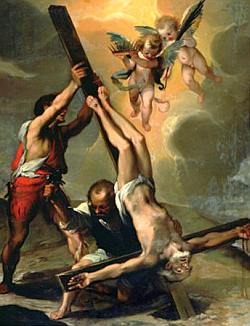
"The Crucifixion of St. Peter" by Ventura SalimbeniAmid all those sermons on all the great stuff you’ll now get from claiming OT promises, no one seems to talk about the hallmarks of NT faithfulness and what its rewards now look like.

My son and I are reading through the entire NT together, and that thread of persecution for following Jesus is simply unmistakable. Not only this, but Jesus Himself states that much of what was thought to be the hallmark of Old Testament faithfulness and reward would look different in the Kingdom of God that Jesus was instituing and that expectations should change. Something larger was now here, and it eclipsed what was thought to be the be all and end all of faithfulness and reward.

We don’t talk about that though.

What if instead of thinking about the OT reward of long life and material prosperity we instead thought of the blessing of having our head lopped off at age 30 by people who hated us and our Christ?

What does that do to “counting the cost”? Can any of us who have bought into the OT reward mentality truly accept the NT reward reality? Or do we keep retreating to a place that lessens the likelihood that we should ever receive a genuine NT reward—the only kind that truly matters.

Because, hey, someone once called me a bad name on my Christian blog, and I felt all persecuted.  🙁

Knowing Jesus and the Death of Self-Help

Standard

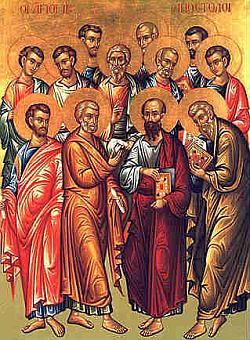
12 ApostlesIt was turning out to be the worst meeting Matthias had attended.

Yes, the worship had been exemplary, as usual. No doubt the Lord was present in their midst. But then, so it seemed was a spirit of bureaucracy—and Matthias hated bureaucracy. Hadn’t he been chosen by a casting of lots? How much easier could it have been?

And why DID the Gentiles have to receive the Gospel? Why couldn’t it have stayed among the Jews only? What a bureaucratic nightmare.

So there he sat, hoping against hope that Peter was not going to chime in again.

Oh, heavens no. Here we go.

Peter stood up.

“Brothers,” the apostle announced in his bass voice that shook the flimsy meeting room furniture, “having weighed this question in my soul after much placement before the Lord, I conclude that there are actually only seven steps to a God-honoring sex life.”

“We weren’t talking about sex, Peter,” Silas said. “Were you asleep—again?”

“The question was the title of Levi’s preaching series,” Barnabas reminded, “The 10 Principles of Financial Success.”

He had a gift for reading lips, and Matthias swore that James mouthed,  It’s a baker’s dozen, not 10. That James’s little brother then punched him in the arm meant the youngest attendee at the meeting had heard him too.

A man with a pained expression on his face stood and asked, “How are the Gentiles going to live a life of fullness in our Lord if we who are appointed their leaders can’t decide these simple issues?”

Matthias shook his head. Thomas again. Always stirring the pot.

“Everything depends on our hammering down what is necessary for the Gentiles to live,” Peter agreed.

“You remember that our Lord said I was an Israelite without deceit—” Nathanael started.

Matthias rolled his eyes. Always the same prelude from Nathanael.

“—and I think that we never settled on the take-away points of my series, Raising Godly Children in an Ungodly World.”

“Hey, Mr. Honesty,” someone yelled from across the dimly lit room, “why not be truthful with the Gentiles and tell them you don’t have any children?”

Matthias thought that was worth a good chuckle. He wasn’t alone.

“Now listen here—” Nathanael began, before he was cut off again.

Five Biblical Ways to Reach Your Neighbors for Christ,” Philip said. “I mean, c’mon, guys. Isn’t that what we’re all about? I used those five when I spoke to that eunuch, and you all know how effective that was. Shouldn’t the Gentiles know them? Just five simple ways?”

Andrew leaned over to Matthias and said, “I tuned out after they kicked out Martha. I kind of liked her Beat Busyness the Bible Way.” He then turned pensive and asked, “Do you remember how many steps her method had?”

“I think it was five,” Matthias answered.

Andrew glowered. “No, I think you’re thinking about Philip’s five ways.”

“Maybe I am,” Matthias said. “Maybe I am.”

***

That meeting in Jerusalem among the leaders of the young Church actually happened. It just didn’t happen that way. The question of how to live a godly life wasn’t found in principles or spiritual To-Do lists. Here’s that meeting’s conclusion:

After they finished speaking, James replied, “Brothers, listen to me. Simeon has related how God first visited the Gentiles, to take from them a people for his name. And with this the words of the prophets agree, just as it is written, “‘After this I will return, and I will rebuild the tent of David that has fallen; I will rebuild its ruins,  and I will restore it, that the remnant of mankind may seek the Lord, and all the Gentiles who are called by my name,  says the Lord, who makes these things known from of old.’ Therefore my judgment is that we should not trouble those of the Gentiles who turn to God, but should write to them to abstain from the things polluted by idols, and from sexual immorality, and from what has been strangled, and from blood.”
—Acts 15:13-21 ESV

In short, don’t load up the Gentiles with stuff to do. Stuff wasn’t the point of the Gospel.

Here’s how Paul saw living the Christian life:

For I decided to know nothing among you except Jesus Christ and him crucified.
—1 Corinthians 2:2 ESV

Jesus summed it up nicely:

And this is eternal life, that they know you the only true God, and Jesus Christ whom you have sent.
—John 17:3 ESV

How is it then that we sit still on Sunday and have someone tell us all these things we should be doing so as to be good Christians? How is it that we say we embrace grace, yet we load ourselves up with lists of necessities and principles and ways and means of living like Christians, when it all begins and ends with knowing Christ?

What if we just knew Christ and knew Him a little more each day? Can’t anyone tell us how to know Christ more?

Or do we not believe this Scripture?

And I am sure of this, that he who began a good work in you will bring it to completion at the day of Jesus Christ.
—Philippians 1:6 ESV

If we know Christ more deeply, isn’t it the work of the Father to make us perfect in His Son? Why then do we trouble ourselves with endless self-help sermons?

Now if the ministry of death, carved in letters on stone, came with such glory that the Israelites could not gaze at Moses’ face because of its glory, which was being brought to an end, will not the ministry of the Spirit have even more glory? For if there was glory in the ministry of condemnation, the ministry of righteousness must far exceed it in glory. Indeed, in this case, what once had glory has come to have no glory at all, because of the glory that surpasses it. For if what was being brought to an end came with glory, much more will what is permanent have glory. Since we have such a hope, we are very bold, not like Moses, who would put a veil over his face so that the Israelites might not gaze at the outcome of what was being brought to an end. But their minds were hardened. For to this day, when they read the old covenant, that same veil remains unlifted, because only through Christ is it taken away. Yes, to this day whenever Moses is read a veil lies over their hearts. But when one turns to the Lord, the veil is removed. Now the Lord is the Spirit, and where the Spirit of the Lord is, there is freedom. And we all, with unveiled face, beholding the glory of the Lord, are being transformed into the same image from one degree of glory to another. For this comes from the Lord who is the Spirit.
—2 Corinthians 3:7-18 ESV