
The Evils of Community?

Standard

Tuesday, I wrote on the need for us Christians to understand that community and relationship with others is at the core of who we are as Christians, especially as it relates to the Great Commission and meeting the needs of others. You simply can’t have a ministry without people.

Wednesday, The Wall Street Journal ran a sidebar column that absolutely blew my mind. It shows exactly what we Christians are up against when it comes to fighting for depth in community. I almost never reproduce an entire article, but this one (“What’s Hurting America? Widespread Homeownership“) contains mind-boggling assertions in nearly every sentence:

Widespread homeownership has proven benefits for the nation but the Atlantic‘s Clive Crook says it brings some serious economic drawbacks with it. Citing research from Warwick University economist Andrew Oswald, Mr. Crook says the main problem with homeowners is that they are less mobile than renters. Less willing to leave their homes for greener pastures when the local economy falters, homeowners slow the nation’s economic growth and exacerbate unemployment issues by staying put. Communities of homeowners also often suppress new development by calling for new zoning rules.

On the plus side, homeowners are more invested in their communities, more likely to vote and work harder to improve their neighborhoods, but the overall societal good in homeownership isn’t clear-cut, Mr. Crook says. To that end, he questions the wisdom of the mortgage-interest tax deduction, a subsidy set up to ostensibly encourage widespread homeownership.

Mr. Crook said the deduction often promotes over-borrowing and higher spending, thus artificially increasing home values and placing borrowers in greater financial risk during downturns, such as the current housing market crunch. On a broader level, higher investments in housing †“ fueled by the tax deduction — come at the expense of investments in areas that expand the economy, such as commercial building and spending on business equipment, he says. — Troy McCullough

This is what we Christians are up against. If we fight tooth and nail to preserve our communities, we’re labeled “malcontents” for doing so. Bad! Bad house!We “exacerbate unemployment issues by staying put” and cause untold hardship fighting for zoning laws that restrict sprawl and consumerism.

Unbelievable.

Want to hurt the Church in this country even more? Increasingly force congregants to move every few years to chase jobs.

Want to bring most ministerial works within a church to a standstill? Keep changing the mix of people in the church so the wheel must constantly be reinvented.

At least nomadic tribesmen stay together as a tribe, but the kind of thinking listed in that article pretty much ensures alienation and disconnection.

Americans are already some of the most mobile people in the world. Studies show most families stay in one spot for less than seven years. Multiply that by a hundred families in a church and it’s no wonder little gets accomplished for the Kingdom. Everyone’s constantly on the move. People don’t get extended years ministering Christ to each other or to their communities.

This constant nomadic existence chasing fleeting jobs from one part of the country to another is why the Church in America MUST start speaking to issues of work and the revitalization of local and regional economies. The world is telling us that we can’t be good citizens if we want to put down roots and minister for years in the same community.

I’m not saying that we petrify in one spot. Even Jesus said that those of us who leave houses and lands for the sake of the Gospel will be blessed. Still, I suspect that most people in my town aren’t born again, so what is my obligation?

If my living situation is so transitory that I never truly get involved to any depth in the lives of those around me, then I’m less effective as a messenger of the Gospel. Just the disorientation of having to adjust to a new place means people who move are preoccupied with everything BUT ministry. The amount of bureaucracy and paperwork alone that accompanies moving within the same city is a nightmare, much less chasing jobs from city to city. That constant disequilibrium is the world’s way of distracting us from what truly matters.

We Christians have got to get serious about creating our own alternative/underground economy. We’ve got to be better networked so that people in our congregations don’t have to leave town to find work. We’ve got to start thinking of innovative ways to bring in income, even if it means exploring communal living arrangements that eliminate our need to duplicate goods to survive . If we can be freed of the need for the kind of jobs that force us to move from town to town looking for work, then let’s start working toward that goal.

I keep hoping and praying that someone on the national Christian stage will start speaking up about these issues. They play into the busyness that is crippling our effectiveness as the ambassadors of Christ in a dying world. If we’re constantly having to plan what city we’re going to move to next so we can follow the jobs willy-nilly, we’ll be distracted and ineffective our entire lives.

And that’s just what the Enemy wants.

(In similar news, it looks like we’ve been lied to for years about the lack of engineers and scientists in this country. If anything, there’s a glut. This hasn’t stopped Congress from continuing to demand H-1B visas to bring in more foreign workers to displace American engineers and scientists. I’ve been saying for years that the shortage of tech workers is a lie. Now the lie comes out. I think our government owes us former tech workers an enormous apology. If I had a Benjamin for every tech worker I’ve met who was forced into a nomadic existence to find work, or who bailed from tech altogether, I could’ve retired by now.)

What the Other Guys Taught Me

Standard

I talk a lot about intrachurch community here at Cerulean Sanctum, but not as much about the kind of community that spans denominations. Today’s post rectifies that lack.

Leonard Ravenhill, the great British revivalist (and one of the patron saints of this blog) was fond of wordplay. One of his favorite tricks follows:

“…that’s not the kind of message you’ll hear today in our religious abominations…er, denominations.”

As much as I love Ravenhill for his wit and spiritual depth, I’m not to the point of calling our denominations abominations. Fact is, I’ve learned a considerable amount from the denominations I’ve interacted with since coming to Christ.

  • From the Lutherans, I learned about Jesus (for the first time), grace, and the priesthood of all believers.
  • From the Assemblies of God, I learned about the power of the Holy Spirit for service.
  • From the Presbyterians, I learned about the authority of the Scriptures.
  • From the Disciples of Christ, I learned about holiness.
  • From the Methodists, I learned about fellowship.
  • From the Evangelical Free Church, I learned about the necessity of a Christian worldview.
  • From the Vineyard, I learned about evangelism through service and how to listen to the Holy Spirit.
  • From the Pentecostals, I am learning the depth and breadth of what Christ did for me through the cross and what that means for how I view myself and others.

If this makes me a “mongrel in the Faith,” then I’m a mongrel. In defense of mongrels, I’ll say this much: we aren’t prone to genetic diseases that afflict the purebreds, and we’re certainly not inbred to the point of weakness.

I learned all those different aspects of the faith from those different denominations largely because each denomination has found a handful of specific truths in the Scriptures that they latched onto and defended with tooth and nail. Even a black sheep gives woolSuch is the specialist aspect of Christianity today, but still. Someone defended truth and held it up as an example, even if it was just a small piece of a larger whole.
In truth, how can we not fall into these little groups? I’m not sure that such a division was inevitable when the Christian Church sprang to life, but I suppose the über-sovereigntist would argue that God planned it that way all along. We wouldn’t agree. I can see Ravenhill’s point. A fractured Body is a fractured Body.

Still, considering the tribal nature of human beings, I’m not surprised that we continue to fall into tribes of people who believe, look, and act like each other. That this also marks our churches should come as no surprise. We feel most comfortable in a community that looks like us. As for me, I’m thankful that I’ve been a part of enough Christian groups that don’t look exactly like me that I’m comfortable with a wide-variety of Christian experience. Even then, I’ll say that not every one is my exact cup of tea.

We need the proper perspective: heaven isn’t going to be tribal. I highly suspect that it won’t reflect our own idiosyncratic groups, but reflect the entirety of every tongue and every nation. The divisions won’t mean anything anymore.

All this brings me back to the great philosopher Rodney King who once said:

“People, I just want to say, you know, can we all get along?”

Well, can we?

As someone coming from a charismatic perspective, it always hurts to see fellow believers absolutely foam at the mouth and lash out with every verbal weapon they possess when it comes to the whole issue of the charismata working today. The worst part of that is the anger and accusations get leveled at people as opposed to ideas.

In any theological battle royale, people lurk behind every idea. So even if an idea is wrong, there’s still a person who holds it. For us Christians, that should matter more than it seems to.

When I discuss things with people who have ideas different than mine, I do keep up a mental fence to screen out ideas that violate Scripture. The difference is I still try to listen. Too many Christians out there stick their fingers in their ears and start screaming, “Nah, nah, nah, I’m not listening.” And that’s a darned shame.

So the Nazarene guy and I are not going to agree on the charismata. It doesn’t mean I treat him like crap. It also means he may have insights into a portion of theology and the practice of the Faith that I lack. But if we start gouging out each other’s eyes because our theology doesn’t align perfectly in every minute detail, then we’ve lost the real battle and let Satan win. And Satan gets too many wins nowadays.

I can’t imagine what my faith would be like today if I never experienced those other denominations. I wish true Christianity wasn’t as fractured as we’ve made it, but what it is, it is this side of heaven. I don’t see a reversal of that trend until the Lord returns.

This isn’t a call to ecumenism. I don’t support the current incarnation of the ecumenical movement because it gives away the farm in order to get the cow. That’s not wisdom and right fellowship. Some things about our Faith are givens (like the divinity of Christ and His salvific uniqueness), but I’m willing to listen on some of the smaller points.

Most of all, I’m willing to love my neighbor. Love overcomes a great deal, even mistaken ideals.

The “other guys” in that Christian church across the street have something to teach us. Are we listening?

Radical Thoughts, Real Community

Standard

Sunday night, my church shared a Thanksgiving feast together. And while some may believe Lutherans have cornered the market on potluck dinners, my Pentecostal church did a fine job.

So I went off my diet for a day. Sometimes you have to savor the moment with friends.

When I think about one area of our lives as Christians where our walk doesn’t match our talk, it’s in building real community. The word community lingers on the lips of so many  Christians today, but when I look around I don’t see much community. At least not real community that bursts ungodly societal constraints.

In talking with a friend from church, Don, we both commented on how dependent we have become on technology in our lives. Don mentioned that one finely placed electromagnetic pulse over the United States, crippling most of our electronics, would have a destabilizing effect on our society. In many ways, we have made ourselves so dependent on our cell phones, computers, cable TV, and even the simple electronics that run a stoplight, that to lose them for an extended length of time would wreak utter chaos.

I believe Don is correct. When I lived out in California, an intersection lost a stoplight for a few minutes and someone who didn’t like the snarl that occurred got out a gun and started shooting. With people wound so tightly by our modern society, should we be surprised?

Even if society should fail to collapse without our tech gadgets, those electronics have changed us in profound ways. Call me a neo-Luddite, but I believe that many of those devices have already had a destabilizing effect on our society, especially when it comes to experiencing genuine community.

The items we buy, especially advanced machinery and electronics, may make our lives simpler, but they also make us self-sufficient to the exclusion of others. We live in an age dominated by the idea that we do not need each other. Our machines have made it possible for us to exist apart from other people. Many would consider this a positive, but when it comes down to how God made us, it’s clear that the very foundations of community are specters of their former selves.

The result? We have become a disconnected and depressed people.

One of the radical truths of the Gospel we can’t escape is that Jesus is NOT so much a personal Savior as He is a a Savior of a people, a people He is drawing to Himself. The Marriage Supper of the Lamb will not be you alone in a room with Jesus, but with the whole host of believers from all time. If we are being fitted to heaven by our time on this blue orb, then that fitting must be thought of in terms of community.

Yet we do little this side of eternity to live in community.

Our problem stems from our inability–to use a much overused phrase–to think outside the box. I remember many years ago how my old neighborhood experienced a power outage that blackened TVs, silenced video games (Atari 2600s back then), and stilled the bits and bytes of computers (Commodore 64 and Apple IIe).  Right after supper, the electronics stilled, the soft voice of that beautiful summer night  called to people. The next thing I knew neighbors were chatting in each other’s yards, kids were playing impromptu games of Kick the Can and softball, and the neighborhood came alive. But when the power kicked on an hour or so later, the neighborhood took on the feel of a tomb. People had trudged back to their electronic distractions, each homeowner shutting on the door on his or her personal fortress.

We’re still locked up today. Perhaps more so.

But the Bible is a story of God and the community He is creating. The Gospel exists for people and is meant to be shared between people, to be celebrated in community. Christ’s clarion call in the Great Commission is Christ’s call bids us, his people, to go out and bring in more people to the Church. We exclude no one. The widow, orphan, and immigrant are to be welcomed in our midst. Jew and Gentile, all are welcome. What Christ is building has no limits and no boundaries, save for our own unwillingness to participate in the work.

This is why we Christians MUST rethink how we view the Gospel and the Kingdom. Every effort we make, the very way we live, must be oriented toward outreach. Even when we play, we don’t play alone, but with others. It’s our mandate.

Do we see how this is at complete odds with our societal constructs? We talk about relevancy in the Church, but the truth is that most of how we are to live cannot be shoehorned into society and culture. Instead, they must conform to the ideals of Christ. This means we Christians must learn to think like Christians and not like the world.

Well, no duh, right? We all know this.

Do we?

Think about a common activity we enjoy today: listening to music on our iPods. We Christians should ask ourselves how this solitary activity connects us in community to other people. Truth is, it accomplishes quite the opposite effect. Worse, it disempowers the listener, forcing him or her into a consumer mode. The music is disconnected from the hearer and from the community. Something is ultimately lost in the process.

So what is the truly Christian response, the one that works toward community and sharing among people?

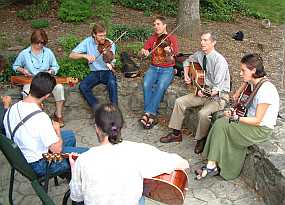
What would happen if instead of reaching for the iPod, we make music ourselves? And what if we make it in community, getting together with others to play and sing? Just hanging out together and jammingSuch a move makes us less dependent on consuming and more dependent on each other. Not only this, but we encourage others to use their gifts. We provide an example to the young and to each other. The musical talents we share uplift the community that forms around our music.

When we keep community in mind, we form relationships that build networks of dependency that shatter our self-reliance and return us to God’s ideal interaction. He walked with Adam in the garden because He is a relational God. How then do we approach all of life with this mindset?

Why do our families eat alone? What if the rarity was to eat just by ourselves? Should we not have others eating in our homes on a regular basis? Wasn’t this one of the unusual hallmarks of the early Church? I believe we Christians must start opening our homes on a regular basis so that few of our meals are eaten just with our own nuclear family. What better way to talk with others about what God is doing in our lives than in this kind of atmosphere?

How would this kind of thinking change our culture?

What if Christians were at the forefront of the slow food movement, taking time to prepare good food made without extreme processing, and always share that food with a group? What if we set aside our evenings for being with other people around a table of homemade food? How would that transform our understanding of community?

Even if we were to go out to eat at a restaurant, why not pay the way of some people we don’t know well so they might join us and begin to share in our community?

What would it mean for the Christian community to live in such a way that we share what we have rather than buying redundant copies of everything we believe we need? Would we be able to work fewer hours and devote more time to the Gospel and to others?

Consider what might happen if we begin to forgo purchasing more junk for ourselves so that we might consider the needs of others. Watch this video to see how one church thought better of building a new building and decided to put that money to a more Christ-centered use. Then consider how saying no to extravagance might change the lives of others. What if we lived that way every day?

Think about what might happen to us and those around us if we turned off the TV. What would we do with that free time that would place us in the lives of other people?

What might come about if truly esteemed others better than ourselves?

If we begin to ask how we might be more others-centered, I suspect that we’ll eventually change how we live and, ultimately, change the world for Christ. It doesn’t take much more than making a few decisions differently each day. If we do that long enough, our lives are transformed. Hospitality doesn’t become so frightening to us anymore. People aren’t left on the vine to wither. The Gospel goes out into new venues. Others see that Christians really care, rather than just talking about caring.

Radical thoughts lead to real community.

Readers, what are some of your suggestions for taking the worldly way of looking at a situation and turning it into a godly means by which we encourage interaction with others and build community?