21st Century American Evangelicalism: The Ne Plus Ultra of Christianity?

Standard

Out of Ur posed an intriguing question a few weeks ago. I intended on writing about it, but time got away from me. Since then, that post, "Have We Become Crypto-Christians?," has taken on a life of its own in the Godblogosphere. I've encountered it at a dozen or more sites.

The setup of the post follows the rise of Christianity in 16th century Japan and its subsequent brutal extermination by warlords. To survive, the handful of Christians who remained hid their faith and practice within Japanese culture so well that when Japan re-opened to the West in the late 19th century, that tiny remnant still remained. However, the centuries of dalliance with the culture had so metamorphosed the faith of those Japanese Christians that missionaries barely recognized it for what it was. This Crypto-Christianity, as it was called, bore little resemblance to orthodox Christianity.

It's a good story. Makes for an obvious warning, too.

But there's a problem.

Any scientist worth his PhD will tell you that an experiment is only as good as its control. Without a control in place, results can't be measured accurately.

For centuries, the idea that life sprang from non-living matter (spontaneous generation) ruled science. Put a piece of bread in a container and miraculously fungi would arise from within it. Where did the fungi come from? They spontaneously generated from the bread.

Obviously, any science devoted to studying biological systems would be hampered by this erroneous notion. That it took until the middle of the 19th century to finally lay it to rest showed the intractability of disproving it. Only through a well-conceived experiment (by a young Louis Pasteur) and a proper control could valid conclusions be drawn. Heat a flask with an ingenious S-shaped trap in its neck (to let in air, but trap external airborne microbes) and compare it against a flask without the trap. The first remained sterile, while the other allowed airborne microbes to settle, giving rise to life.

The problem with the Crypto-Christianity post and its troubling question of altered Christianity is the same that bedeviled scientists searching to disprove spontaneous generation: no proper control existed.

When missionaries returned to Japan in the late 19th century, were they the control? Was their Christianity the pure unadulterated form practiced by the first century Church?

Hardly. 

While this does not mean they had no ability to say that Crypto-Christians of Japan practiced an aberrant form of Christianity, their ability to judge was severely limited by their own conceit that they alone were practicing the pure Faith.

We Americans suffer from this delusion that we are the pinnacle of any particular cultural expression seen as worthwhile. Elliot Erwitt's "Felix, Gladys, and Rover" - 1974It's the very backbone of the concept of "The Ugly American." And we show few signs of abandoning this delusion.

Because the Church in America is made up of Americans steeped in this mentality, Christians here act is if we're the control for all of Christianity worldwide. Nowhere is this conceit more grounded than in Evangelicalism. For Evangelicals go to great lengths to assert their superiority over the rest of the American Christendom, creating a king-of-the-hill bravado. Needless to say, this not only bothers other Christian sects worldwide, but even other Evangelicals outside of America.

So we consider ourselves the control portion of the experiment. Any results we gain from any experiment in the Faith must be measured against us.

Does that bother anyone else? I'm livid over it, frankly, because it's so inherently self-centered. Not only this, but the tendency is to denigrate the Christians who came before us, as if they were practicing a kind of Preschool of the Faith. They were the devolved Australopithecines and us the fully realized Homo Sapiens. As such, they have nothing to teach us.

Oversimplification? Stay with me.

Let's consider Protestantism, especially those sects within it that trace their founding to the Reformation. When we encounter doctrinal discussions within those sects, it's as if a vast amnesia occurred between the time the Apostle John drew his last breath and Martin Luther pounded his 95 Theses to the cathedral door. Sure, a few councils dealt with Pelagianism and Sebellianism and a few other -isms, but for the most part, the Roman Catholic Church ruled for a thousand years, and we all know NOTHING of any theological worth happened in that millennium.

Mark Lauterbach recently posted excellent insights into this theological blindness. He decided to break the artificial barrier of the Reformation by reading many of the earlier Church fathers. In particular, he notes that Athanasius teaches using metanarrative and avoids the individualism we inherently lay over the Gospel message. Mark ends his post with a warning from C.S. Lewis to avoid reading these great men of God through any of our contemporary lenses lest we warp their teaching to fit our own.

Which is what we do all too easily.

In the end, the battle here resembles the one between the Chihuahua and the Great Dane over who is the real Canis lupus familiaris. When seen from the outside, neither looks much like the original dog they descended from.

Yet we American Evangelicals have these blinders on prevent us from considering that perhaps we are not the ne plus ultra of Christian expression. If we actually encountered a real first century Church practicing within our midst, I would say that many of us would consider it deviant. Not so? Look how easily some of us attack other Evangelicals who contend they're trying to get back to that first century ideal.

Have we become Crypto-Christians? I'd say that long slide toward some level of cryptic faith started just a few years after  Pentecost. The question of what is normative is a difficult one because culture intrudes so easily, especially in practice. Just witness the extremes of practice within orthodox Christianity today and ask why they deviate so wildly.

In the end, the question is a red herring. We American Evangelicals already are and probably have been Crypto-Christians for a very long time. Yet somehow, we continue to think of ourselves as the standard by which all Christianity is measured, both past and future.

Is that a Chihuahua I hear yapping?

{Image: Elliott Erwitt's classic Felix, Gladys, and Rover, 1974

The F-World

Standard

As a musician (I'm a drummer and guitarist), I've got an ear for challenging or snappy music. As a writer, I've got an appreciation for witty or deep lyrics. It should be no surprise then that most contemporary music bores me to tears. It lacks charm, and most of it suffers from a dearth of both musicality and lyrical excellence. Doesn't matter what the genre is.

If I have any musical weakness, I'm overly fond of jangly, "sunshine" pop with monster hooks that'll have you singing along all day.  That Rickenbacker 12-string sound brings a smile to my face. Think bands like The Association, The Zombies, The Byrds, and—of course—The Monkees. Think AM radio's golden age. That style of music largely passed into lore. No one writes music like that anymore. Worse, no recent band has the cleverness to pull it off consistently.

I don't buy a whole lot of music like I once did. The last CD I purchased was Derek Webb's She Must and Shall Go Free, which has a sort of folk and roots rock feel. Good music, stunning lyrics.

The other day, I followed a link looking for some trivial fact and it led to a site that played a random selection of "baroque pop," contemporary sunshine pop music that has the feel of the real thing. The song was by Belle & Sebastian, a band I'd not heard before. Not only was the song "Another Sunny Day" absolutely right on sound-wise, but the lyrics abounded in perfect touches.

So I did something I've rarely done: I downloaded the song from iTunes. Played it over and over at full volume. For about a half hour I was immensely pleased by the find.

Only one problem…

When you get to be my age, lyrics run past you and you don't get them with the same precision you did as a teenager. I caught that first stanza, but a couple jumbled ones followed. The British accents didn't help. So being the kind of person who cannot gain full satisfaction from something without knowing every trivial detail about it, I summoned the lyrics from one of a bazillion lyrics sites.

Awesome lyrics, clever and witty. And I'm reading and…oh.

The effenheimer. The F-bomb. Right there. Third stanza. And not in any grammatical usage that I've ever encountered before.

Ugh.

How I'd missed it the first hundred times I played the song, I can't say. After seeing it there in the lyrics, it was if the singer now shouted the word right in my ears, helped along by the background chorus who repeats it with the same emphasis.

Dang. The Monkees wouldn't have talked like that. And where was the "Explicit Lyrics" tag at iTunes? Nowhere to be found. I guess in the bizarre context used in the song, someone deemed it "Non-explicit."

That's what Apple gets for cozying up to Bono. What's an F-word between friends, right?

Because I write for a living, I'm attuned to the issue of censorship. I think I can also make a case that the F-word has legitimate uses. Kevin Carter's Pulitzer-Prize-winning photoI just don't want to hear it in my sunshine pop.
In fact, I don't want to live in a fallen world. I don't want to hear the "old familiar suggestion" coming out of the mouth of a twelve-year old girl. I don't want to hear about fathers decapitating their toddlers. I want to close my ears and scream at the top of my lungs to drown out the news telling me that the sex slave trade is alive and well  in the world, mostly populated by teenagers and tweens.

But we live in a fallen world—the F-World, for want of a more clever ID. Everything around us reeks of sin, as if some quark-sized evil implanted itself in every atom in existence.

Yet consider how easily we Christians believe two lies:

  1. We can play with that evil and not have it consume us from within.
  2. We can keep that evil at bay and never have to confront it. 

I see far too many Christians making excuses for the sins they justify in their own lives. We might even come up with clever renderings of particular Scriptures to cover our shame, but in the end, it's only amplified.

Or we'll scoff at some contemporary leader we don't like who goes down in flames, while we pat our man on the back. Then we're shocked—SHOCKED—when our man's feet prove to be clay.

So many of us navigate the F-World poorly. We mindlessly jump from church to church, forever running from whatever it is that we despise in its operation, unable to come to grips with the truth that the Church must live in the F-World until Christ returns. Or we do the opposite and embrace every piece of garbage the F-World throws at us as if its manna from heaven. Both are foolish. Both come to ruination.

I hear Christians talking all the time about the F-World. Why then do we seem to be more at the mercy of the F-World than at the mercy seat of Christ? For all our theology on a fallen world, we lurch from extreme to extreme in the ways we deal with it. One day we're burning all our hard rock albums because they're evil, and the next day we're buying them all back off eBay because to the pure all things are pure. 

It's bad enough that our incoherent message on how to deal with the F-World confuses the lost, but it confuses Christians even more. I've been a Christian for thirty years and I can honestly say that I don't think I've met another Christian who understands the tension of living in the F-World to the point that he or she deals with it as Christ did. Finding that narrow path must be far more difficult than we believe.

Bunkers or Excess. In the F-World, neither one makes sense. 

{Image: Kevin Carter's Pulitzer-Prize-winning photo of a vulture stalking a starving Sudanese child. Shortly after winning the prize, Carter committed suicide.

Busting Myths About Christianity: Assessing Myths 9-10

Standard

Entering the homestretch of this series on myths believed about the American Church by those outside it, it's hard to avoid the cruel fact that several of these myths aren't myths. At one point, they may not have had one shred of truth to them at all, but something's happened to the Western Church—a very bad something. Sadly for us, those people who hold no pretenses to following Christ have noticed, yet we haven't. 

The myths: 

  1. Christians are more judgmental than non-Christians.
  2. Christians are stingier than non-Christians.
  3. Christians are more intolerant of other people than non-Christians.
  4. Christians are more short-sighted than non-Christians. 
  5. Christians don't know how to have fun. 
  6. Christians despise intellectuals more than non-Christians do.
  7. Christians prefer kitsch over important art.
  8. Christian subculture mimics the world rather than creating anything lasting.
  9. Companies run by Christians are as unethical as secular companies, and perhaps more so.
  10. Christianity causes more problems in the world than any other religion.

Today, we'll look at the final two.

9. Companies run by Christians are as unethical as secular companies, and perhaps more so

One of the most damning newspaper articles I've read in my life arrived in The Wall Street Journal shortly after the Enron and Worldcom scandals rocked the business world. In that article, the author took an in-depth look at the religious backgrounds of all the principal players in all the scandals. In nearly every case, those leaders were Evangelicals deeply involved in their churches as elders, teachers, deacons, and more.

I read that article about five times, attempting to find some way to reject what I was reading, but the truth shouted from the page.

My own personal odyssey dealing with Christian businesspeople is about as bad. When I look back on all the times I hired self-professed Christian professionals to help me resolve a problem, the number of times I got stiffed—and grossly, too, I might add—far, far, far outweighed the number of times the same happened with folks who made no pretenses to being Christians. Like 10:1.

So when I need an electrician to wire my house correctly so that the resulting "fix" doesn't burn it down, an ICHTHUS plastered on a Yellow Pages ad is my sign to hire someone else.

I hate saying that. As a Christian businessman myself, I would go sleepless for months if I knew I didn't turn in my best work. I'm a representative of Jesus Christ. My word and my work mean something deeper than putting food on the table. Doing outstanding work on every job I take is more than just the norm; it's my worship!

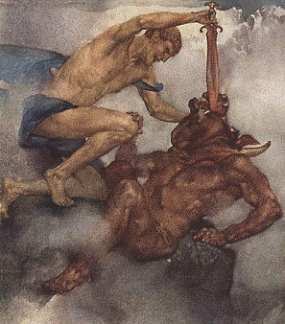
Why, then, do so many Christian businesspeople do such shoddy work—and under the guise of Christianity, too? Don't they know that's an anti-witness? Perseus slaying the MinotaurThat kind of carelessness may be the foot that stomps out the Holy Spirit, not only in the life of the businessperson, but in his or her client's life, as well.

Why does this happen? I think it may have something to do with a hyperinflated and mind-bogglingly poor notion of what grace entails. Some Christians must cover their atrocious work ethic with such a thick lacquer of "grace" that they convince themselves it will hide all the flaws. Or they're nothing more than cultural Christians, reflecting no true inner conversion, bereft of the Holy Spirit who would never let them rest for doing such poor work in the name of Christ. I have no other explanation.

At one time in history, Christians could be counted on to provide the best of every service and manufactured product available. I can't muster the historical proof to say that we're far worse now than then, but doesn't it seem like it? Sure, a real mythbuster would have the proof, but all I have is a lopsided series of encounters with Christian businesses that weighs heavily in favor of a negative assessment. That doesn't mean that millions of good Christians who would never lie, cheat, or steal from a client don't exist. But whatever the case, the scoundrels are making it tough on all of us.

So while Hebrew National Hot Dogs claims to answer to "a higher Authority," we Messiah-worshipers better do more than just answer.

Assessment: Plausible, and very likely Confirmed.

*** 

10. Christianity causes more problems in the world than any other religion

Let me make this simple: Bull.

If anything, the heritage of the Christian Church since its founding proves a history of God using believers to fashion every good we enjoy today. Anyone who believes that Christianity is more a problem than a solution long ago turned off the brain cells.

If no Church of Jesus Christ graced this planet, we would kiss goodbye…

…the majority of the world's greatest art, music, and literature.

…large portions of philosophy, science, and invention.

…nearly all charitable organizations that reach out to the least of these.

…virtually all hospitals and medical centers in the world.

…every concept of personal freedom in government.

…the hope of rescue of oppressed people everywhere.

In fact, I would guess that a world with no Church would be so hopelessly grim by now that a traveler through such an alternate Earth, if not already a Christian, would convert on the spot after returning to his Church-filled reality. And that's true of no other religion or thought system. 

For this reason, it's imperative that we Christians assess where we are today and ask if we're still making that kind of difference. If we're not on the forefront in every fruitful endeavor that Mankind enjoys, then we've failed to live as the Lord's fully redeemed people.

Our ancestors understood what Christ bought them by His blood, and they ran with that opportunity. They understood what it meant to live like wise Daniel did among the worldly, that it was more than just being pious. It meant learning! It meant expanding the horizons of what is known and what can be. Those wise men from the East called by God to visit the infant Jesus were the direct result of a godly man like Daniel who saw that serving God wasn't just a set of religious rituals separated from the whole of life.

Those Christians before us got it. Their devotion spawned countless benefits to us in every part of our lives. We can't drop the baton. To those who have been given much, much has been required.

Assessment: Couldn't be more Busted!

*** 

In the end, every single Christian in America should be a mythbuster. Too many of the myths held by unbelievers about Christianity today are shockingly closer to the truth than we care to admit. We can't continue to reinforce those myths.

If our passion for Christ is outweighed by our longing for entertainment, then we shouldn't call ourselves Christians. I'm afraid that in too many cases we're more concerned with our Tivo programming than reversing the mindset of unbelievers about the Church, and Jesus Christ, in particular. By living such worldly, meaningless lives, we only drive the lost away from their only hope.

Those Christians who gave their best to give us the science and arts we enjoy today took risks and God rewarded them. Many sinned boldly, yet loved God more boldly still. That kind of baldfaced living under grace seems foreign to us today. The modern American Church shies away from wrestling with angels. While some small-minded Christians point with pride to the fact they're not limping, it's also why so few of them go on to have their names listed among the heroes and patriarchs of the Faith. And it's why there's so little greatness in the American Church of the 21st century.

Christian, live in such a way that no myth hatched by the world applies to you.

Have a great weekend.

Entries in this series:

{Image: Perseus slaying the Minotaur